Richard Anuszkiewicz
Richard Anuszkiewicz: The Master of Living Color
Artist Spotlight · The Collection Editorial
“My work is in the tradition of Albers, but I have tried to go beyond him into a more complex use of color.”
Richard Anuszkiewicz
Stand in front of a Richard Anuszkiewicz painting long enough and something almost physiological begins to happen. The concentric squares pulse. The lines seem to breathe. Colors you would swear are different hues turn out, upon closer inspection, to be identical pigments transformed entirely by their neighbors.
Richard Anuszkiewicz
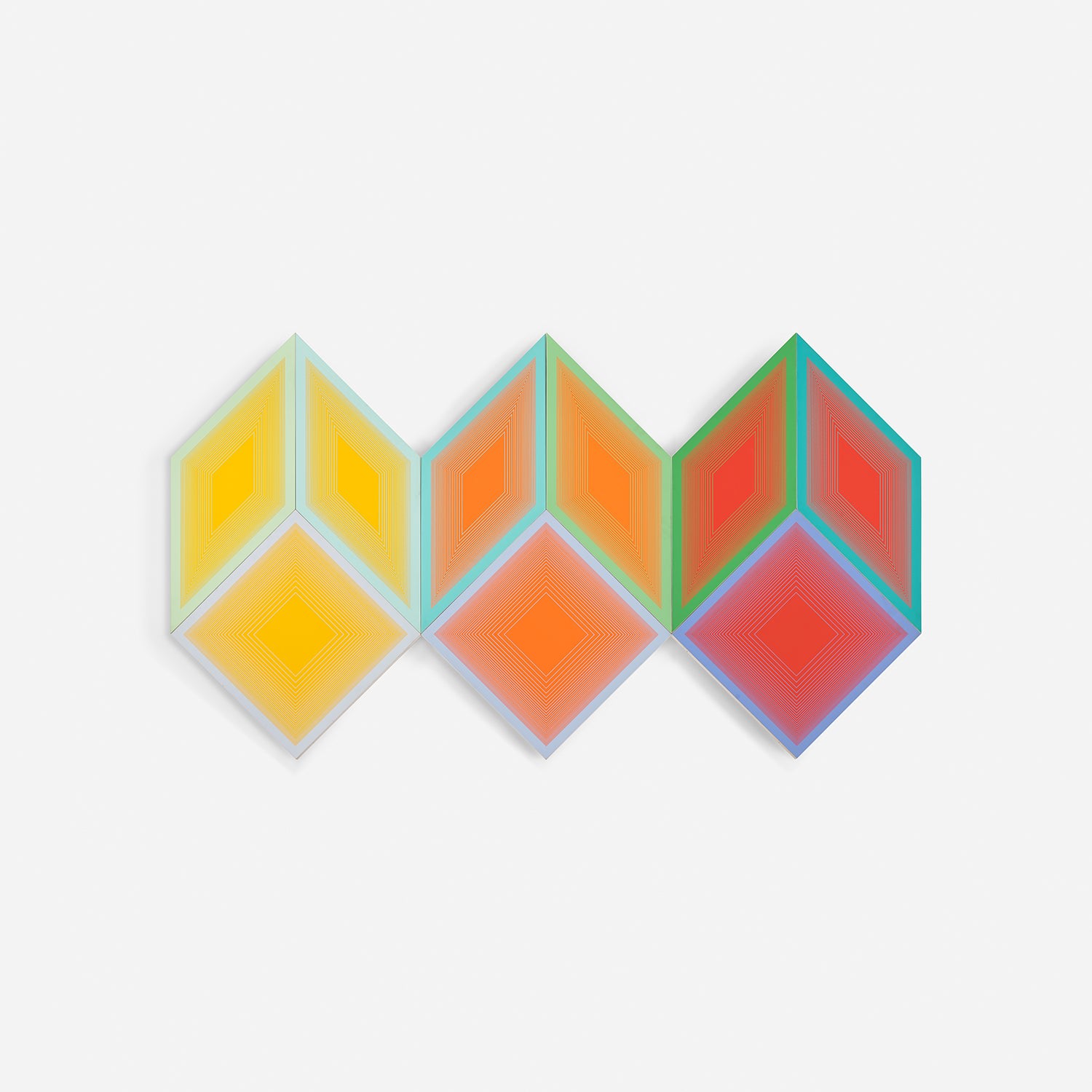
Volumes: A Variable Multiple
It is a phenomenon that no reproduction can fully capture, and it is precisely why, more than four years after his passing in 2020, Anuszkiewicz continues to command devoted attention from collectors, curators, and anyone who has ever stood before one of his canvases and felt their vision reorganize itself in real time. Richard Anuszkiewicz was born in Erie, Pennsylvania in 1930, the son of Polish immigrants who brought with them a deep sense of craft and an appreciation for precision. He studied at the Cleveland Institute of Art before making the pivotal move that would define his trajectory: enrolling at Yale University's School of Art and Architecture, where he studied under Josef Albers. That encounter was transformative.
Albers, already developing the ideas that would become his landmark series Homage to the Square, recognized in his young student a rare perceptual sensitivity, and the two developed a genuine intellectual kinship. Anuszkiewicz absorbed Albers's systematic investigation of color interaction and then, characteristically, pushed it somewhere entirely his own. After graduating from Yale in 1953, Anuszkiewicz continued his education at Kent State University and later at the New School for Social Research in New York. He arrived in New York at a moment of enormous ferment, when Abstract Expressionism still dominated the conversation but younger artists were beginning to look for alternatives rooted in structure, perception, and optical experience.
Richard Anuszkiewicz
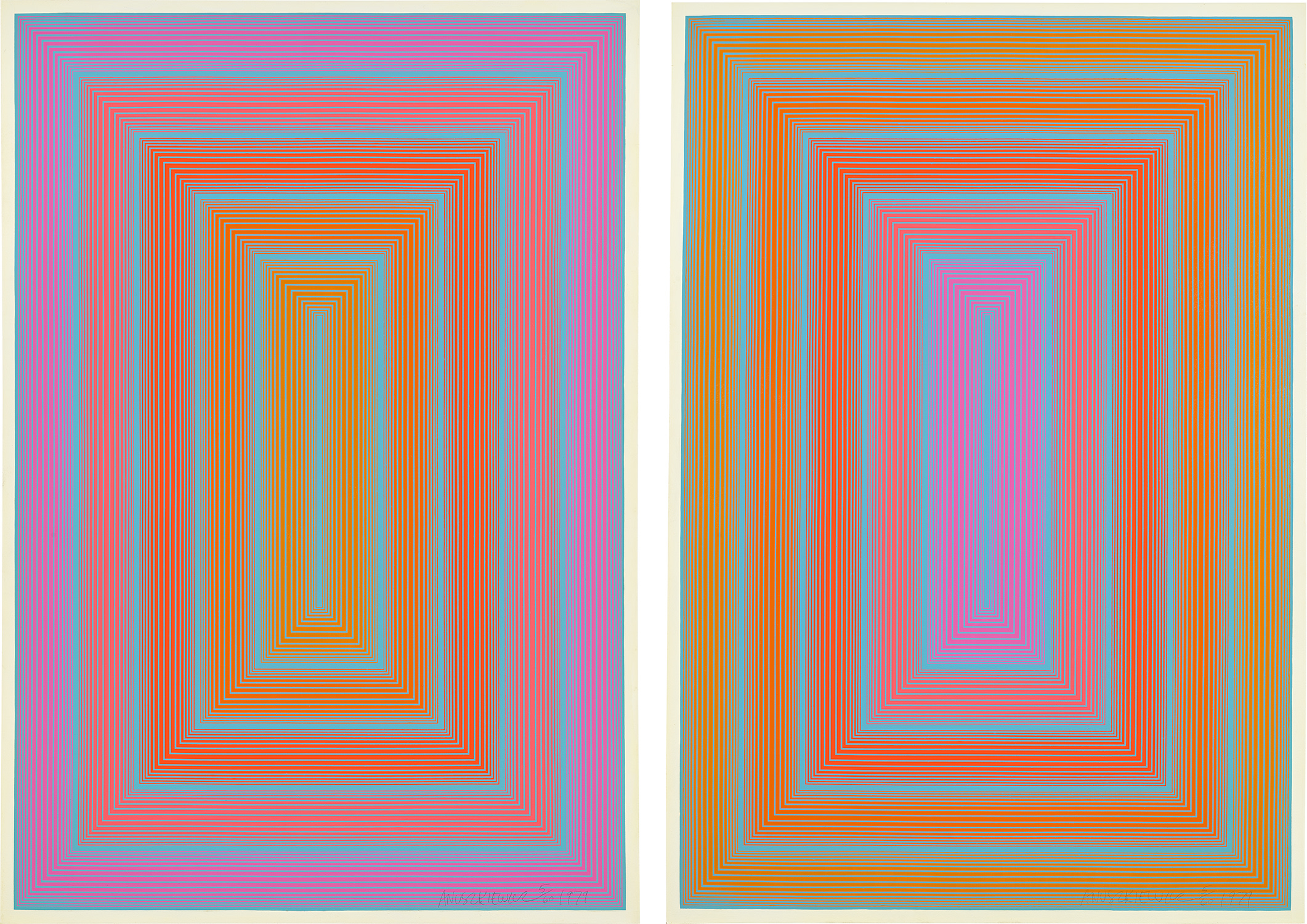
Reflections I-Blue Line With Ochre Center; and Reflections I-Blue Line With Mauve Center
Anuszkiewicz found his people. By the early 1960s he was exhibiting alongside artists who shared his fascination with the mechanics of seeing, and in 1965 the Museum of Modern Art included him in the landmark exhibition The Responsive Eye, organized by curator William Seitz. That show introduced Op Art to a mass audience and placed Anuszkiewicz firmly at the movement's American center. His artistic development across the following decades showed a restlessness that belied the apparent orderliness of his compositions.
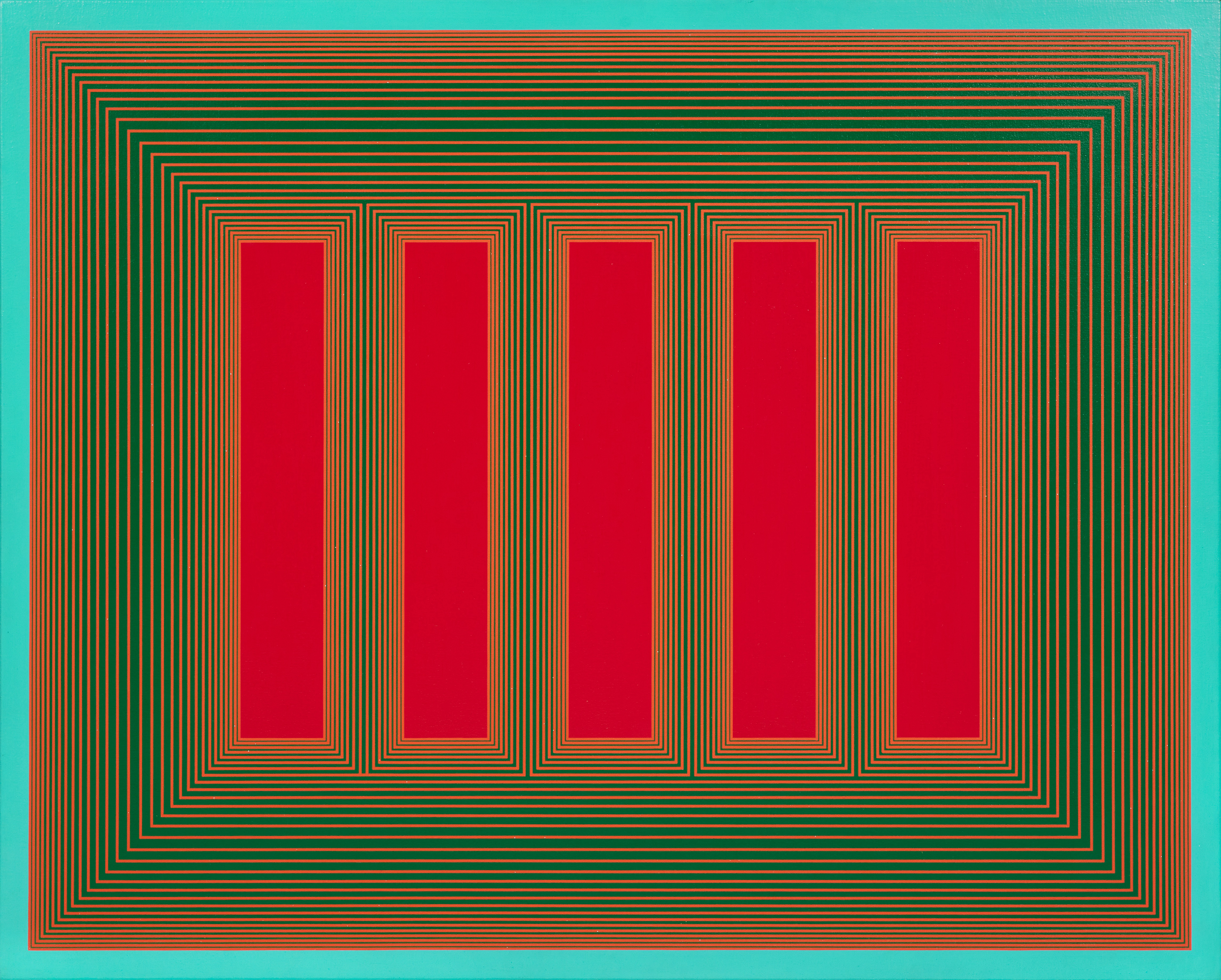
The tight grids and radiating lines of his early work gave way to more architecturally conceived formats, most notably his celebrated Temple series, which emerged in the 1970s and continued to evolve through the 1980s and beyond. Works such as Temple of Deep Red with Turquoise from 1983 and Temple of Summer Red With Green demonstrate the series at full maturity. Here the geometry becomes almost monumental, evoking ancient sacred spaces through pure chromatic relationship rather than any literal representation. The effect is meditative, even devotional, and it speaks to an ambition that goes well beyond optical novelty into something approaching spiritual experience.
Richard Anuszkiewicz
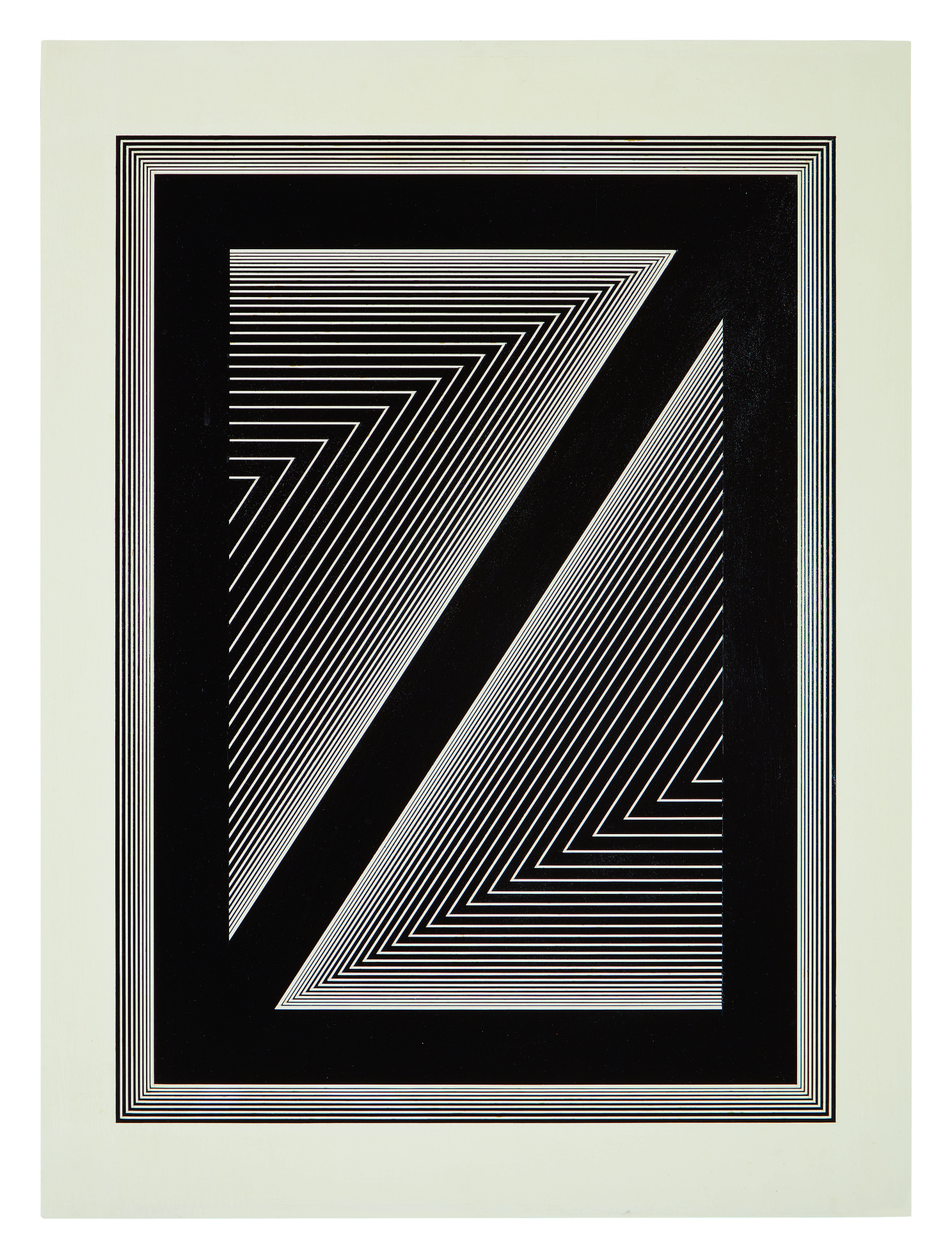
Black Diagonal
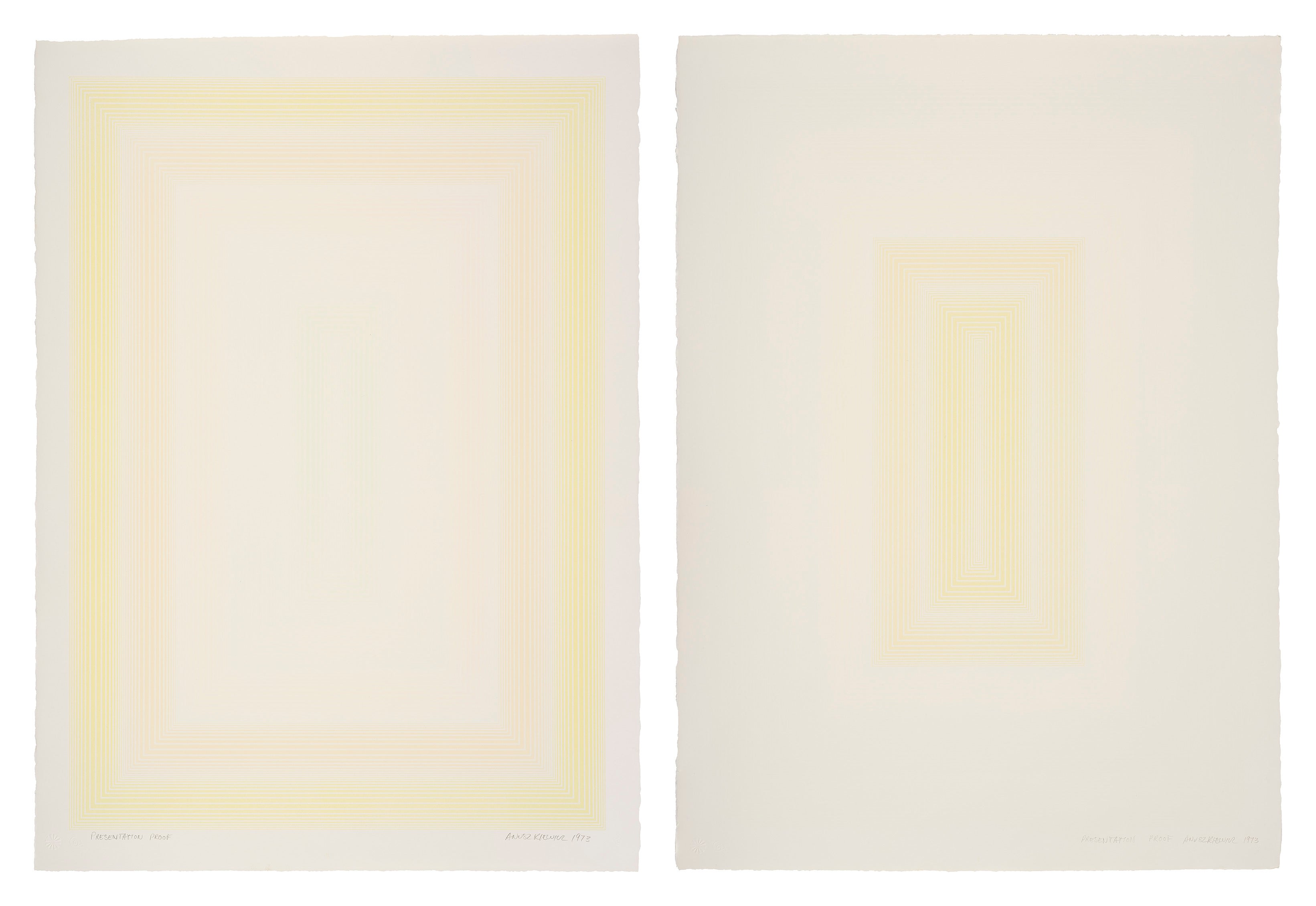
Alongside the canvases, Anuszkiewicz pursued an equally rigorous printmaking practice. His collaborations with Graphicstudio at the University of South Florida in Tampa produced works such as Tampa Summer and Tampa Winter in 1973, editions that show how completely his vision translated into the printed medium. His work with Contemporary Collections Inc. on the variable multiple Volumes, produced by the Stuttgart atelier Domberger KG, and his Reflections series published by Editions Lassiter Meisel in New York, further cemented his standing as a printmaker of exceptional ambition and craft.
For collectors, Anuszkiewicz offers something genuinely rare: a body of work that is both intellectually rigorous and immediately, viscerally pleasurable. There is no requirement to decode a theoretical program before the work delivers its rewards. The paintings and prints operate on the nervous system directly, and yet the more one understands about his methodology, the richer the experience becomes. Works on paper and prints represent a particularly accessible entry point.
Richard Anuszkiewicz
Temple of Deep Red with Turquoise, 1983
Editions such as Rosafied and Veridified, published by Licht Editions in New York, or the Sun Coast lithograph triptych printed on Arches Buff paper, demonstrate the full range of his chromatic thinking in formats that have found enthusiastic homes in both private collections and institutional holdings. His acrylic paintings on panel and canvas, including Black Diagonal and the Study series, reveal a sustained engagement with pictorial architecture that rewards extended looking and grows more compelling over time. Auction appearances have consistently confirmed collector confidence in the work, with strong results across both paintings and multiples in major sales at Christie's, Sotheby's, and Swann Galleries. To fully appreciate Anuszkiewicz, it helps to place him within the constellation of artists who were asking similar questions about perception and structure during the same period.
His debt to Albers is acknowledged and genuine, but he belongs equally to a broader international conversation that included Bridget Riley in Britain, Victor Vasarely in France, and his American contemporaries Frank Stella and Ellsworth Kelly. Where Kelly pursued reduction and Riley embraced dynamic instability, Anuszkiewicz occupied a particularly warm corner of this territory, one where color temperature and simultaneous contrast were marshaled not toward coolness or anxiety but toward something luminous and generous. His palettes carry the heat of the American Southwest, the shimmer of a summer afternoon, the particular quality of light that seems to come from within rather than from without. The legacy of Richard Anuszkiewicz is still being fully reckoned with.
For decades, Op Art was treated as a historical curiosity, a period style associated with the mid 1960s and little else, but that reductive view has given way to a far more nuanced understanding. Contemporary artists working with digital tools and immersive environments have found in Anuszkiewicz a genuine forerunner, someone who understood intuitively that perception is not passive, that looking is an active, embodied, and deeply personal act. Museums including the Smithsonian American Art Museum and the Newark Museum of Art have held his work in their permanent collections for many years, a quiet but meaningful form of institutional recognition. For anyone who has yet to spend serious time with his paintings and prints, the invitation is open and the reward is considerable.
Color, in the hands of Richard Anuszkiewicz, is not decoration. It is the subject, the structure, and the experience itself.
Explore books about Richard Anuszkiewicz
Richard Anuszkiewicz
Lucy R. Lippard
Richard Anuszkiewicz: A Retrospective Exhibition
Whitney Museum of American Art
Anuszkiewicz
Larry Aldrich
Richard Anuszkiewicz: Prints 1963-1983
Smithsonian Institution