René Portocarrero
René Portocarrero: Cuba's Master of Radiant Color
Artist Spotlight · The Collection Editorial
When the Museo Nacional de Bellas Artes in Havana dedicated a permanent room to the work of René Portocarrero, it was not merely an institutional gesture toward one of Cuba's most beloved sons. It was an acknowledgment that his paintings had become inseparable from the Cuban imagination itself. His canvases, dense with color and ornamentation, humming with the spiritual energy of Santería and the sensory riot of Havana's streets, occupy a rare place in twentieth century Latin American art: they are simultaneously intensely local and universally felt. To stand before one of his great cathedral paintings is to understand something profound about the relationship between place, faith, and artistic vision.
René Portocarrero
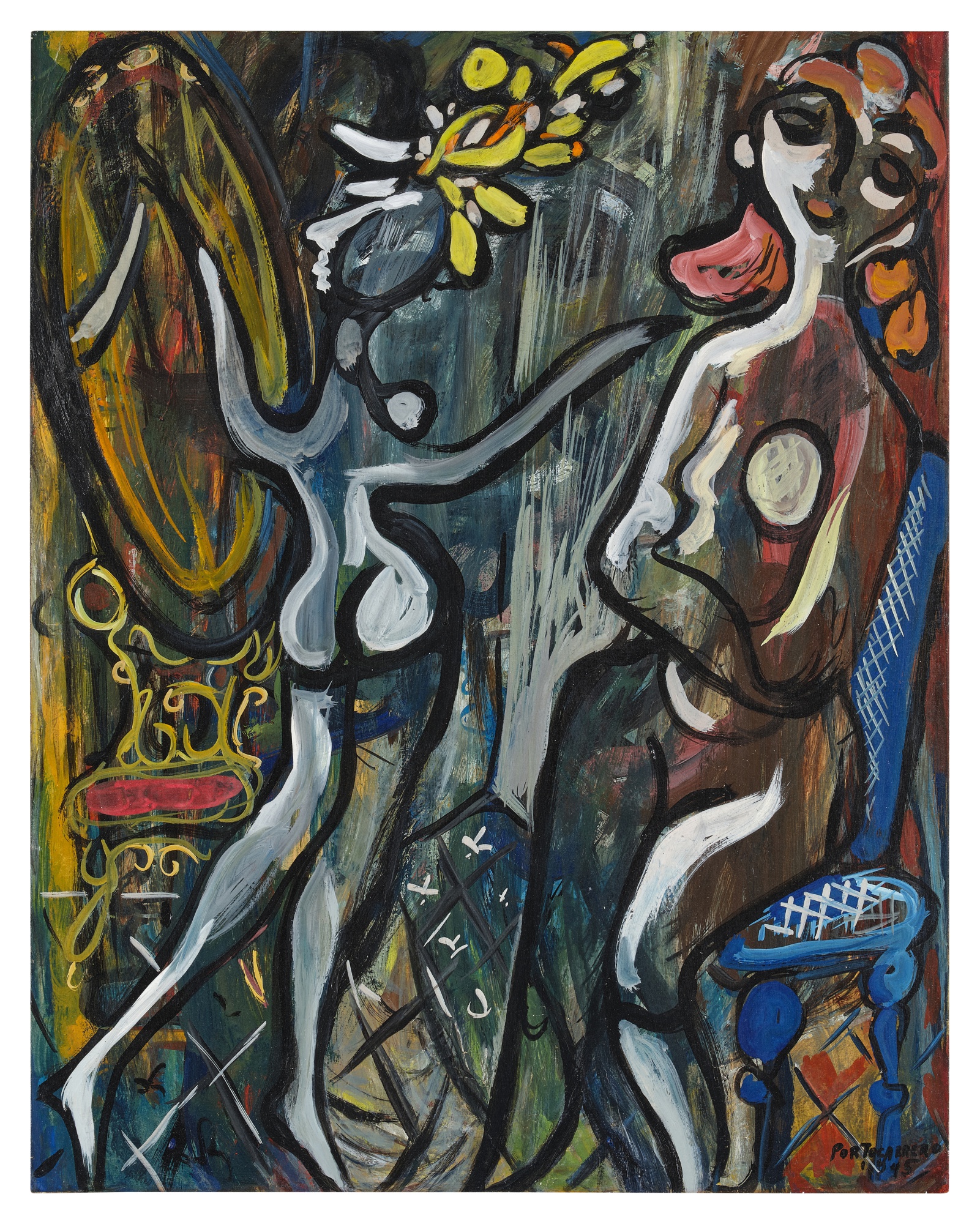
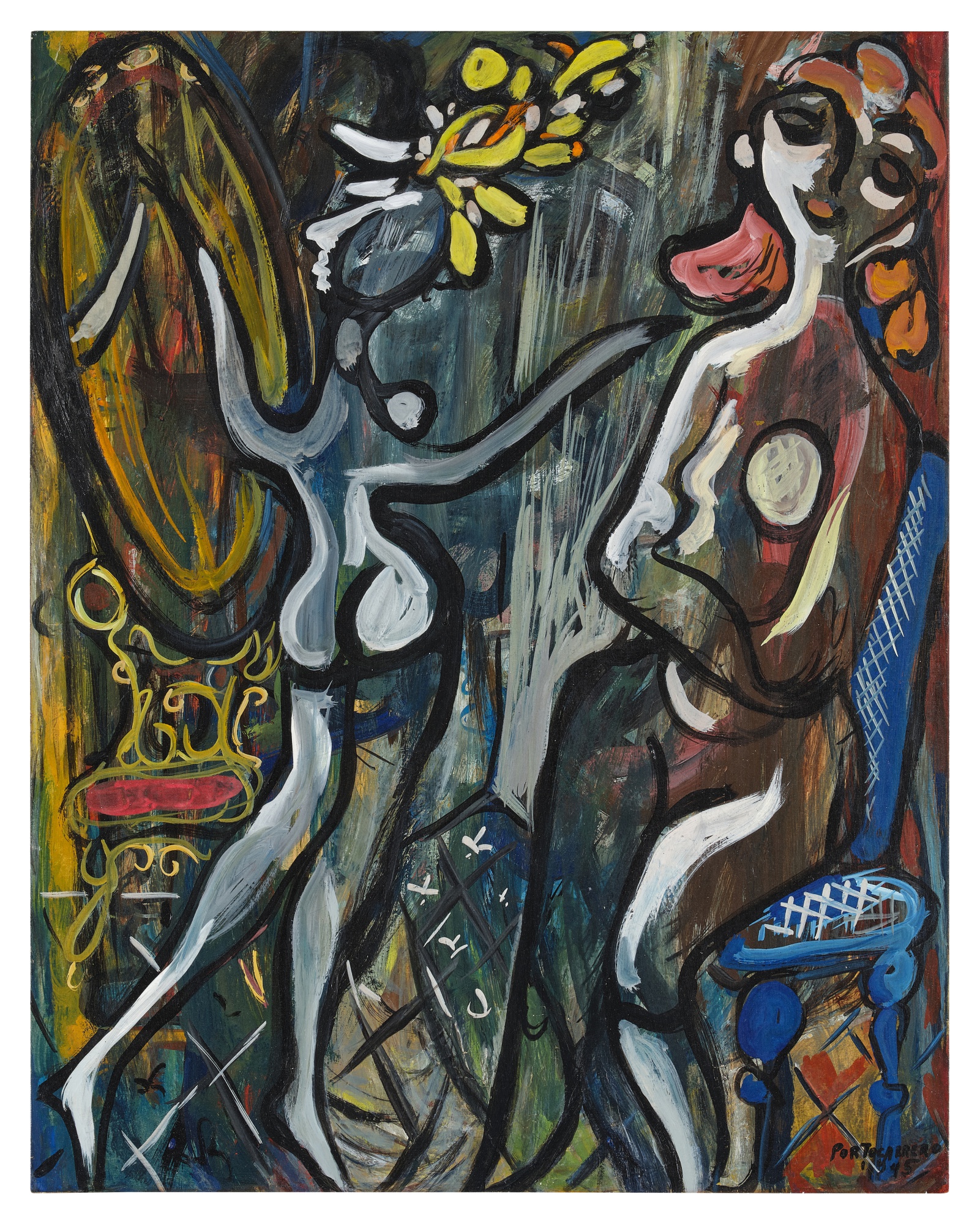
Espejo y desnudos en azul y rosa, 1945
René Portocarrero was born in Cerro, a neighborhood on the southwestern edge of Havana, in 1912. Cerro in those years was a district of crumbling colonial grandeur, its streets lined with ornate facades and its domestic interiors filled with the layered iconography of Cuban religious life, both Catholic and Afro Cuban. That visual environment proved formative in ways that never left him. He studied at the Escuela de Artes y Oficios and later at the Academia de San Alejandro, the preeminent art school in Cuba, where he encountered the modernist currents being absorbed and reinterpreted by a generation of Cuban artists determined to forge a distinctly national artistic identity.
Unlike painters who pursued their formation in Europe, Portocarrero remained rooted in Cuba, drawing his deepest inspiration not from Paris but from the baroque churches, carnival processions, and religious ceremonies that surrounded him. His artistic development in the 1940s placed him squarely within the circle of Cuban modernists who sought to reconcile international influences with indigenous and Afro Cuban cultural material. He was a contemporary and collaborator of Wifredo Lam and Amelia Peláez, two figures whose own practices similarly wrestled with questions of Cuban identity, African heritage, and European modernism. While Lam absorbed the Surrealist vocabulary he encountered through Pablo Picasso and André Breton and redirected it toward a mythologically charged imagery of the Cuban jungle, and while Peláez wove the decorative ironwork and stained glass of Havana's colonial architecture into her own form of tropical cubism, Portocarrero found his singular voice in a kind of ornamental expressionism rooted in the sensory world of Havana's streets, altars, and festivals.
René Portocarrero
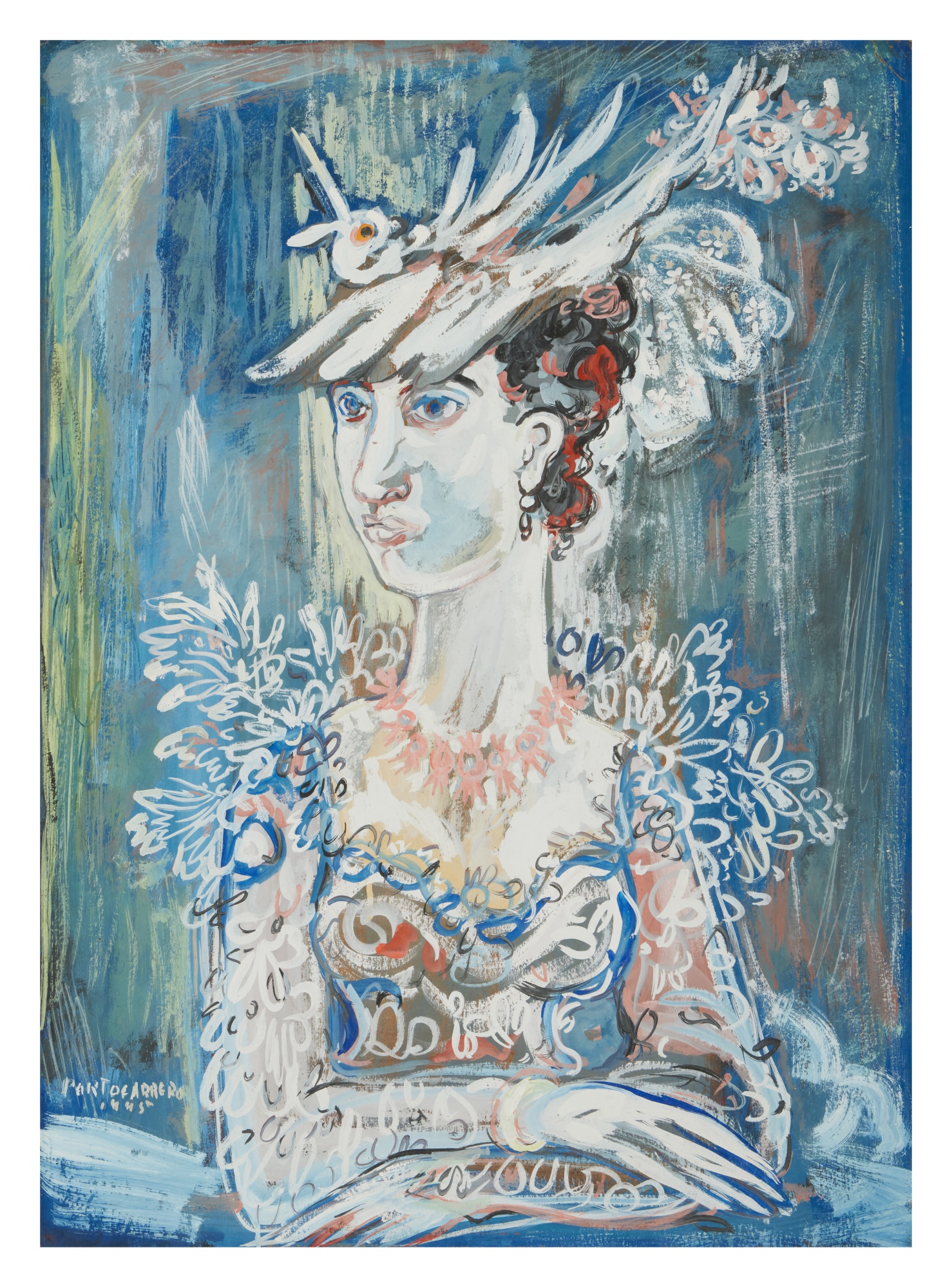
Retrato de dama, 1945
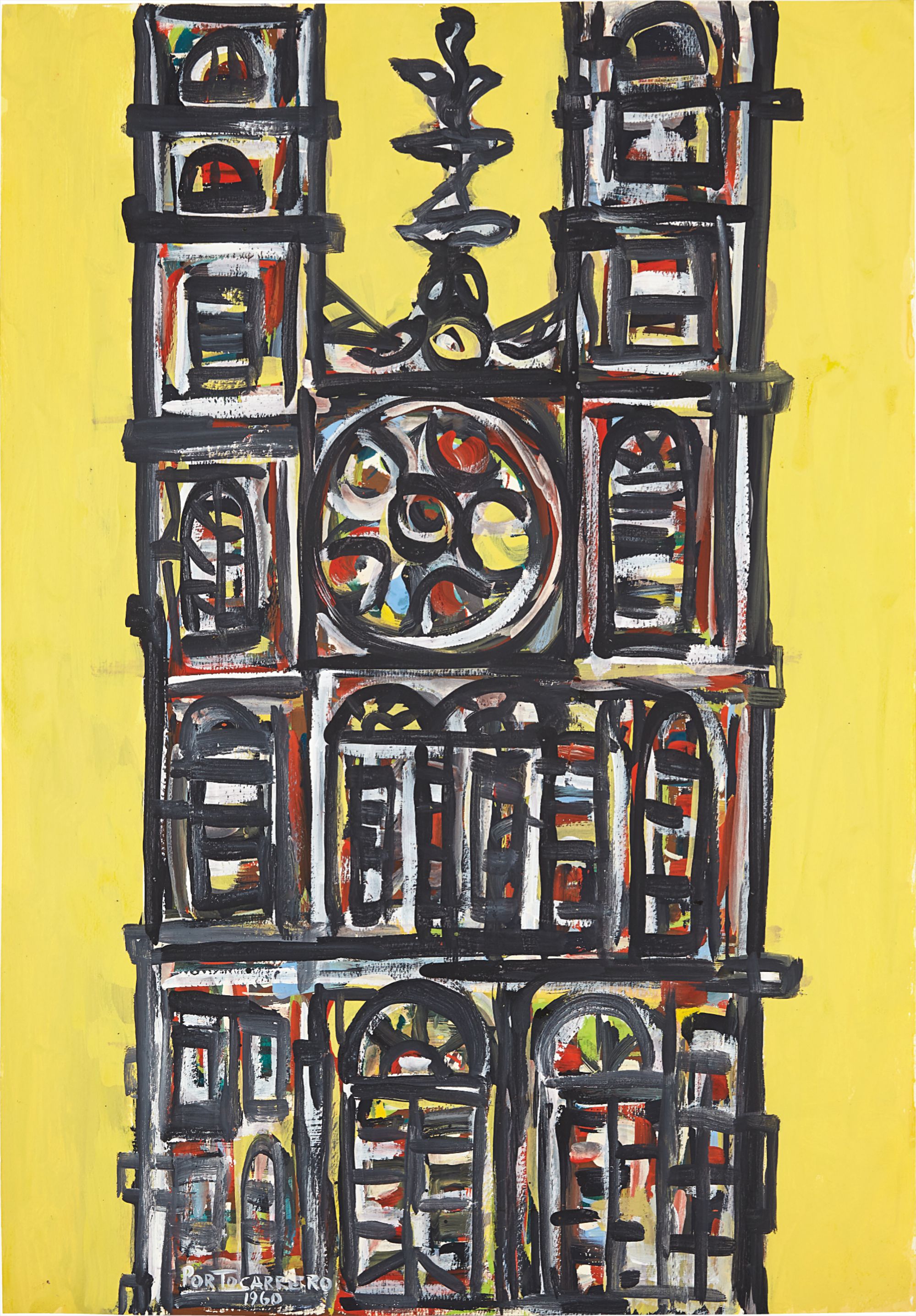
By the late 1940s, his style had crystallized into something entirely his own: an almost frenzied accumulation of decorative detail, rich impasto textures, and colors of extraordinary jewel like intensity. The works from the 1940s and early 1960s that now appear most frequently in prestigious collections reveal the full range of his concerns. His cathedral paintings, including the luminous "Catedral en amarillo" and the oil on paper "Catedral" of 1963, are among the most celebrated images in Cuban modernism. These are not architectural studies in any conventional sense.
The cathedrals dissolve into cascading patterns of color and light, their facades becoming almost textile like in their intricacy, suggesting the way a building can become a living thing when seen through eyes saturated with religious feeling and artistic fervor. His figurative works are no less remarkable. "Espejo y desnudos en azul y rosa" from 1945, a gouache on paper, demonstrates his early mastery of chromatic harmony and his ability to suffuse even intimate domestic subjects with a sense of mythological weight. "Retrato de dama," also from 1945, rendered in tempera on board, captures the decorative intensity that would define his mature practice, the figure emerging from and merging with a field of ornamental detail in a manner that recalls Byzantine icon painting as much as it does Cuban folk tradition.
René Portocarrero
Catedral en amarillo
His flower paintings, including the radiant "Flores con fondo azul" of 1961, show him at his most joyfully exuberant, color piled upon color with a generosity that feels almost musical. For collectors, Portocarrero presents a compelling proposition that operates on multiple levels. On a purely aesthetic level, his paintings reward sustained looking. The more time one spends with a Portocarrero canvas, the more one discovers: hidden figures within decorative fields, layers of spiritual symbolism drawn from Santería practice, passages of extraordinary painterly sensitivity buried within what initially appears to be pure ornamental surface.
On an art historical level, he occupies a position of genuine significance within the story of Latin American modernism, a story whose importance international institutions have increasingly come to recognize. Works by Portocarrero have appeared at major auction houses including Christie's and Sotheby's, where his paintings have attracted serious bidding from collectors across Latin America, Europe, and the United States. His versatility across media, from oil on canvas to gouache, tempera, casein, and works combining ink and pastel, means that collectors at a range of price points can access his vision. Works on paper, such as the "Ciudad" of 1963 in brush and ink and pastel on canvasboard, offer an entry into his practice that can be no less thrilling than his larger canvases.
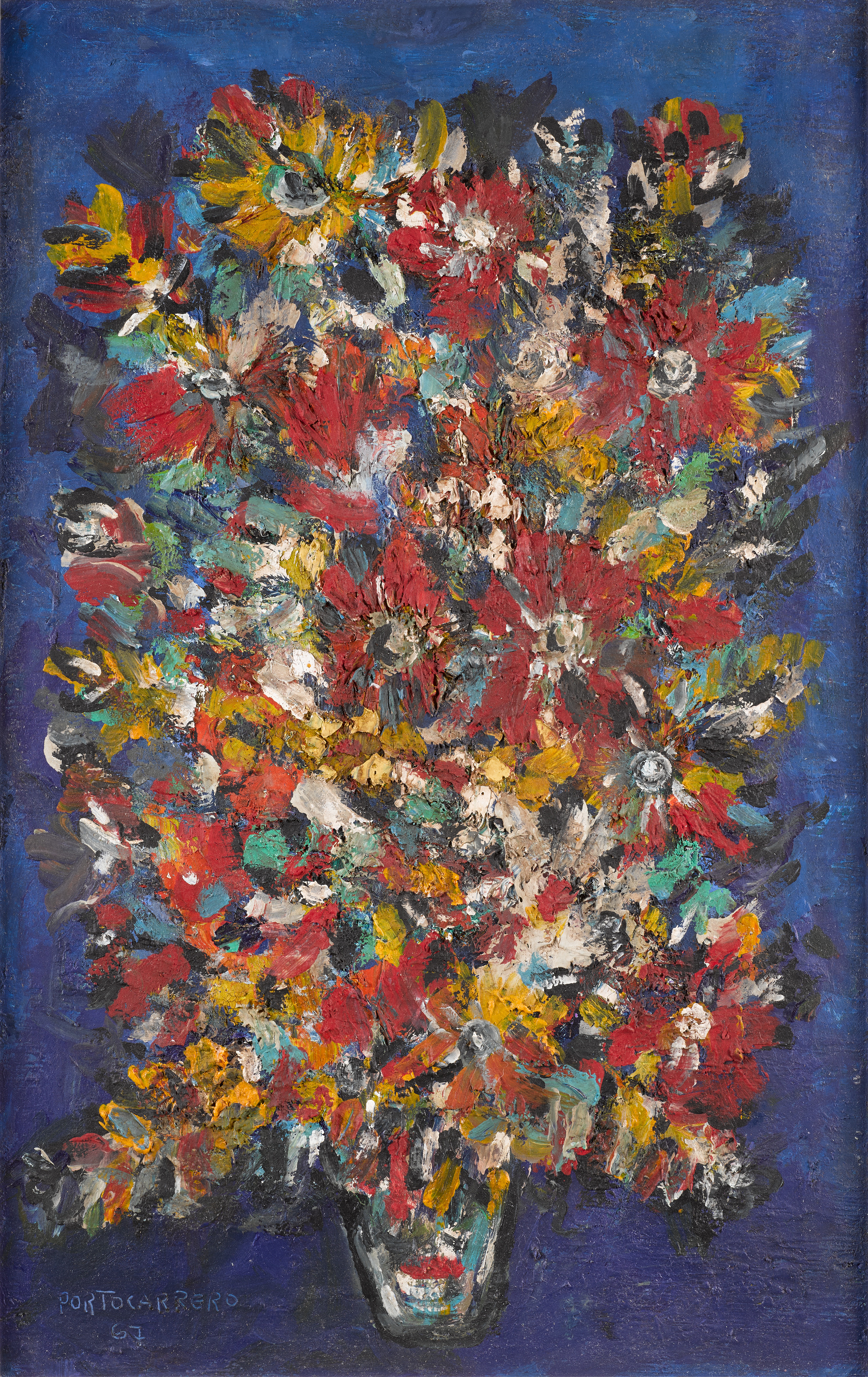
René Portocarrero
Flores con fondo azul, 1961
To understand Portocarrero fully, it helps to situate him within the broader constellation of mid century Latin American modernism. His closest affinities lie with artists who similarly drew on non European spiritual and decorative traditions to create a modernism that was neither derivative of European models nor simply folkloric. Wifredo Lam remains the most internationally celebrated of his Cuban contemporaries, but Portocarrero's contribution is distinct and no less significant. His work also resonates with that of the Mexican muralists in its commitment to cultural rootedness, though his practice remained emphatically personal and easel scaled rather than public and monumental.
He can be productively compared to artists such as Fernando de Szyszlo in Peru and Alejandro Obregón in Colombia, figures who similarly forged individual modernist vocabularies from a deep engagement with their own cultural landscapes. Portocarrero died in Havana in 1985, leaving behind a body of work that has only grown in critical and market stature in the decades since. The renewed global interest in Latin American modernism, driven in part by major institutional surveys at venues including the Museum of Modern Art in New York and Tate Modern in London, has brought a new generation of collectors and scholars to his paintings. His work speaks to our present moment with particular urgency because it insists on the value of cultural specificity, on the idea that a painter rooted in the streets of Cerro and the ritual spaces of Havana can produce art of universal resonance and beauty.
For collectors building serious collections of twentieth century art from the Americas, Portocarrero is not a peripheral figure to be discovered after the obvious names have been acquired. He is one of the essential ones, an artist whose joyful, spiritually alive paintings remind us why looking at art matters in the first place.