Rembrandt Bugatti
Rembrandt Bugatti: Bronze, Breath, and Brilliance
Artist Spotlight · The Collection Editorial
Picture the Antwerp Zoo in the early years of the twentieth century, morning light falling across the animal enclosures, and a slight young man standing before a rhinoceros with his thumbs working furiously into a mound of clay. No sketches, no preparatory studies, no academic scaffolding. Just eyes, hands, and an almost preternatural attunement to the living creature before him. This was Rembrandt Bugatti's method, and it produced some of the most electrically alive sculptures ever made.
Rembrandt Bugatti
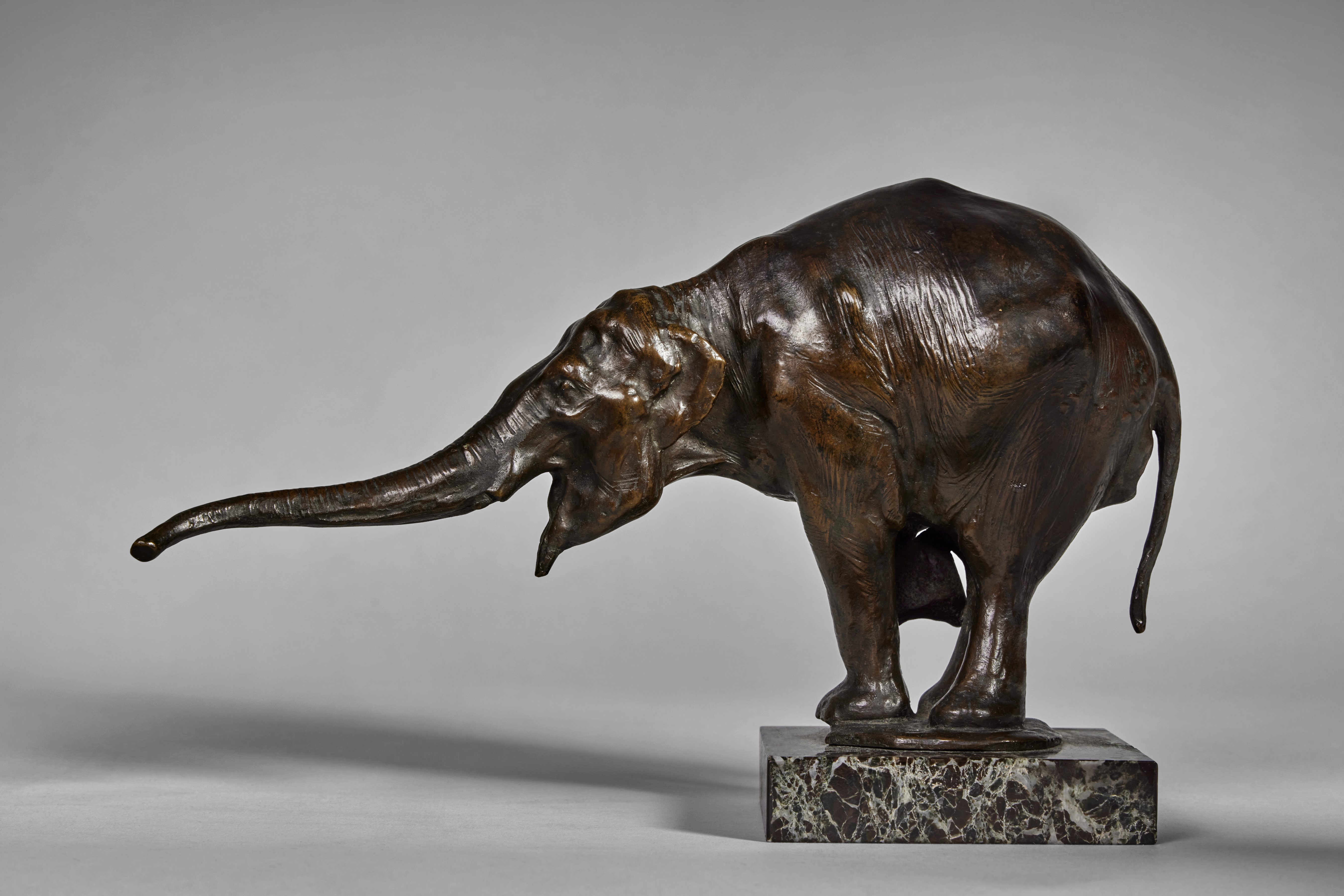
Éléphant Blanc Mendiant
A century after his death, museums and auction houses across Europe and North America continue to recognise him as a singular force in the history of animalier sculpture, and the sustained appetite among collectors for his bronzes shows no sign of cooling. Rembrandt Bugatti was born in Milan in 1884 into a family that seemed almost genetically disposed toward creative genius. His father, Carlo Bugatti, was an influential designer of furniture and decorative objects whose work bridged symbolism and art nouveau with considerable flair. His older brother, Ettore, would go on to found the legendary automobile marque that still carries the family name.
Growing up in this environment, Rembrandt was surrounded by conversations about form, function, beauty, and craftsmanship from his earliest years. He showed a prodigious talent for sculpture as a child and received early encouragement from the sculptor Prince Paul Troubetzkoy, whose loose, impressionistic approach to modelling left a lasting impression on the young artist. By his late teens he had relocated to Paris, the undisputed capital of the sculptural world, where he quickly attracted the attention of the renowned foundry and publisher Adrien Hébrard, who would become his dealer and the caster of nearly all his mature work. The relationship with Hébrard was transformative.
Rembrandt Bugatti
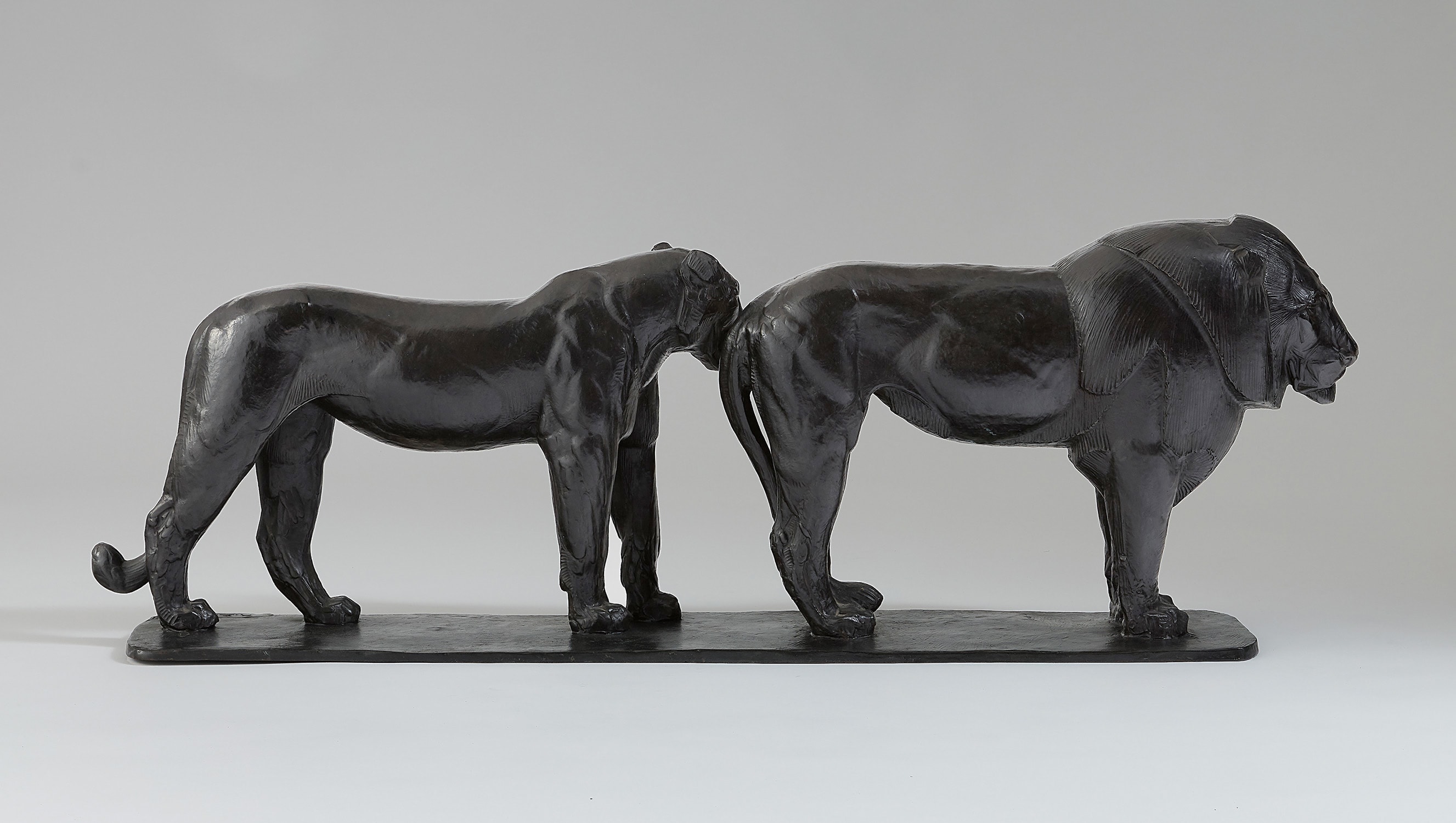
Lion et lionne de Nubie, 1909
It gave Bugatti not only commercial stability but also access to some of the finest bronze casting expertise in the world, and the lost wax process used by Hébrard preserved every nuance of Bugatti's rapid, gestural modelling in the finished metal. Bugatti divided his working life between Paris and Antwerp, spending long hours at both cities' zoological gardens studying animals with an intensity that bordered on obsession. He preferred to model directly from life, capturing animals in motion or at rest, and he worked with extraordinary speed to seize a posture or expression before the creature shifted. The Antwerp Zoo in particular granted him rare access and proximity to its animals, and the relationship between the sculptor and the institution became genuinely collaborative.
Those hours among the elephants, leopards, giraffes, and exotic birds produced a body of work that remains unmatched in its sense of immediate, breathing presence. Bugatti's technique was rooted in an impressionistic sensibility applied to three dimensions. Where academic animal sculptors of the nineteenth century sought anatomical correctness above all else, Bugatti sought vitality. His surfaces are deliberately worked and textured, the thumbprints and tool marks left visible as evidence of the making process, and the effect in the finished bronze is of something caught in the act of existing rather than posed for posterity.
Rembrandt Bugatti
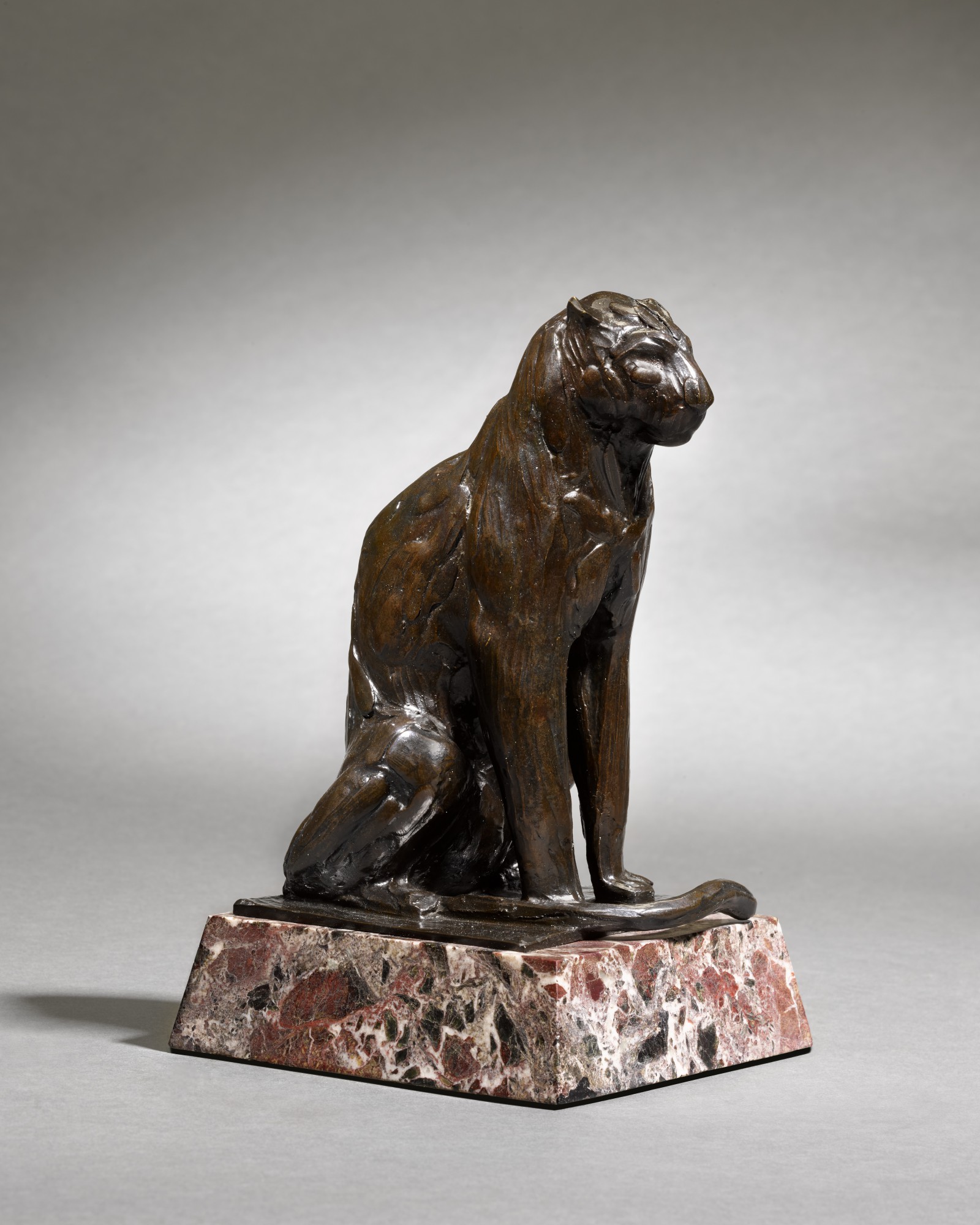
Petit Léopard assis, la queue placée en avant, 1912
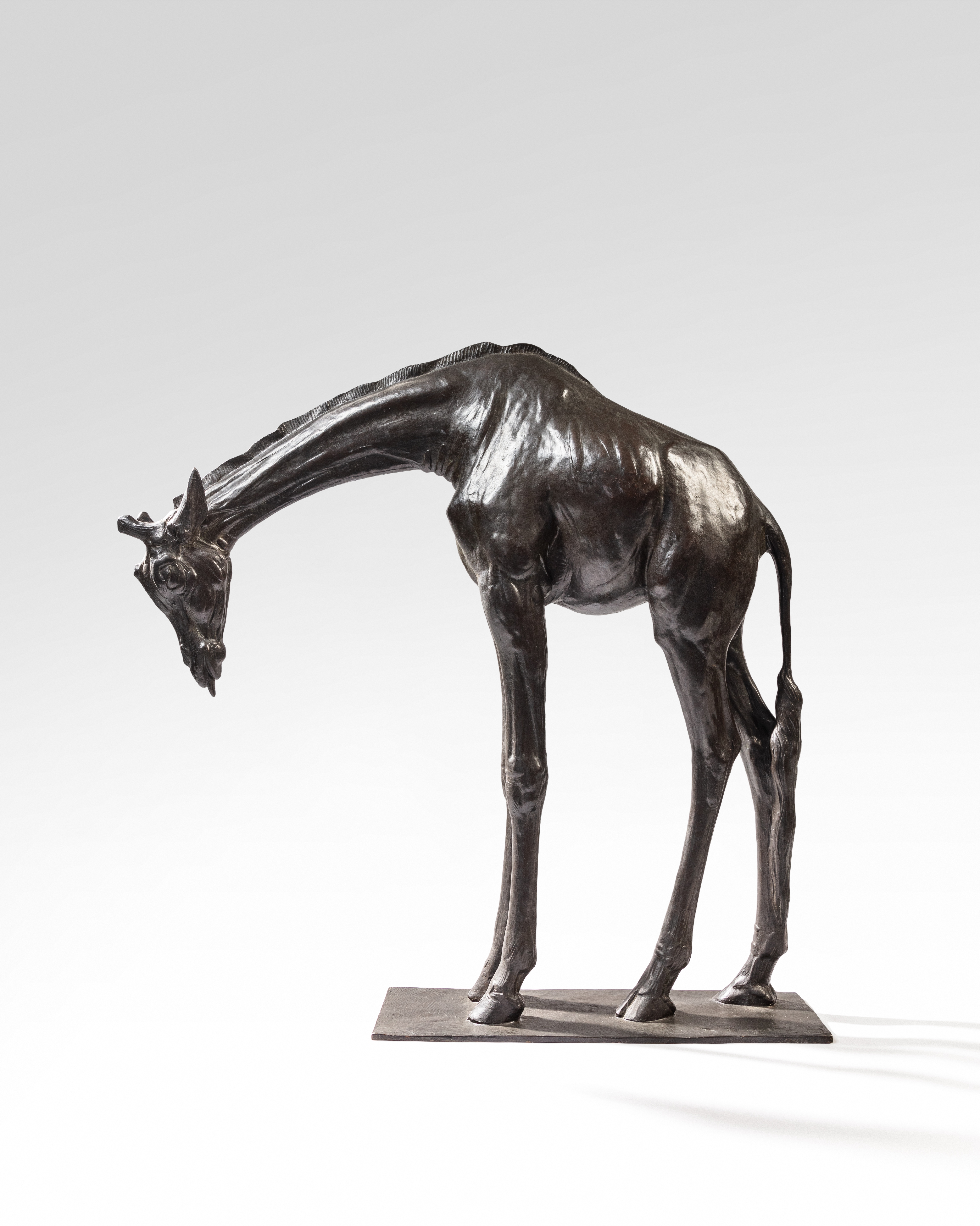
Works such as Grande Girafe tête basse demonstrate his ability to distil an entire animal's character into a single arrested gesture: the long curved neck lowered, the body gathered, the whole composition radiating a quality of absorbed, animal concentration. His elephants are among the most beloved subjects in his catalogue. Éléphant Blanc Mendiant and Éléphant d'Asie (mendiant) both portray Asian elephants in the characteristic begging pose, raised trunk and lifted foreleg, and there is a tenderness in these works that goes far beyond technical accomplishment. Similarly, his big cats, including Petit Léopard assis, la queue placée en avant and the commanding Deux grands léopards, capture a watchful, coiled energy that lesser sculptors spent entire careers attempting to achieve.
From a collecting perspective, Bugatti's bronzes occupy a position of genuine rarity and consistent desirability. Hébrard editions were cast in carefully controlled, relatively small numbers, and because Bugatti died at thirty one, the total output of his career is finite. That scarcity, combined with the universally acknowledged quality of the work, means that exceptional examples regularly appear at the top international auction houses and attract serious competition. Patina is a key consideration for collectors approaching Bugatti's bronzes: the artist and Hébrard worked with a range of patination, from deep black to warm medium brown with gold undertones, and the condition and integrity of the original surface is a significant factor in both attribution and valuation.
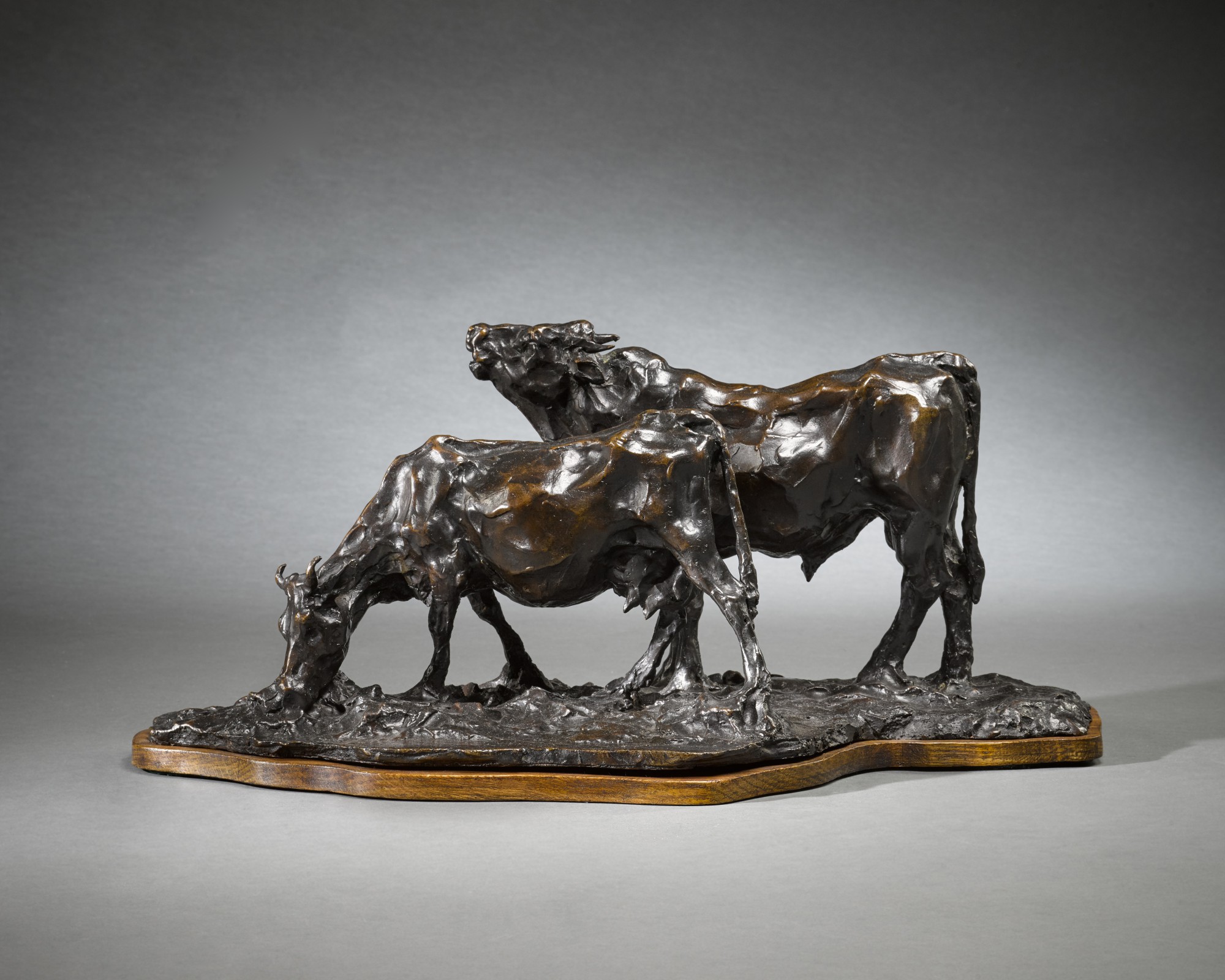
Rembrandt Bugatti
Vache broutant et Taureau meuglant
Works retaining their original marble bases, as with the Éléphant Blanc Mendiant, are especially prized. Collectors are also attentive to the distinction between lifetime casts and posthumous editions, and provenance research is correspondingly important. The market rewards patience and knowledge in equal measure, and a well documented Bugatti with a distinguished collection history is among the most satisfying acquisitions available in the field of early twentieth century sculpture. Bugatti belongs to the tradition of the great animalier sculptors, a lineage that stretches back through Antoine Louis Barye, whose ferocious, romantic animal bronzes defined the genre in the nineteenth century, and includes the refined elegance of Georges Gardet and the bold stylisation of later figures such as François Pompon, whose simplified, monumental animal forms represent a different but equally powerful response to the same challenge.
What distinguishes Bugatti from both his predecessors and his contemporaries is the combination of intimacy and immediacy in his work. Barye was heroic; Pompon was architectural. Bugatti was something else entirely, an observer of extraordinary sensitivity who communicated not just the appearance but the inner life of his subjects. His work also resonates with the broader impressionist impulse in European art of his era, sharing with Rodin, whom he admired, a belief that the trace of the artist's hand is not a flaw to be smoothed away but the very source of a work's vitality.
The legacy of Rembrandt Bugatti is secure, and in recent years it has only deepened. Major museum collections including the Musée d'Orsay in Paris hold significant examples of his work, and scholarly attention to his practice has grown substantially since the early 2000s. There is something about Bugatti that speaks with particular force to the present moment: an artist who worked in close, attentive proximity to animals, who was driven by empathy as much as by craft, and who produced objects of enduring beauty from a practice rooted entirely in direct observation. For collectors, his bronzes offer the rare combination of art historical significance, aesthetic pleasure, and genuine emotional resonance.
To live with a Bugatti is to live with something that has never fully stopped moving.
Explore books about Rembrandt Bugatti
Rembrandt Bugatti: His Life and Work
Ghislain Aubry
Rembrandt Bugatti: The Last of the Medalists
Philippe Dagen
L'Œuvre de Rembrandt Bugatti: Catalogue Raisonné
Ghislain Aubry and Anne Pingeot
Rembrandt Bugatti: Sculptor of the Animal
Anne Pingeot
The Bugatti Family: A Dynasty of Innovation
Stefano Pasini