Reginald Marsh
Reginald Marsh, Poet of the Pavement
Artist Spotlight · The Collection Editorial
“I want to paint people in their natural environment, not posing, but living.”
Reginald Marsh
Picture Coney Island on a blazing August afternoon in 1946. The boardwalk heaves with bodies, the rides blur against a salt bright sky, and somewhere in the thick of it all stands Reginald Marsh, sketchbook in hand, absolutely alive to the spectacle. This was his natural habitat, not the quiet of a country estate or the hushed corridors of an academy, but the roaring, sweating, laughing press of ordinary American life. Decades after his death in 1954, his work continues to surface at major institutions and auction houses with a vitality that refuses to recede, and for collectors who have discovered him, the pull is immediate and permanent.
Reginald Marsh
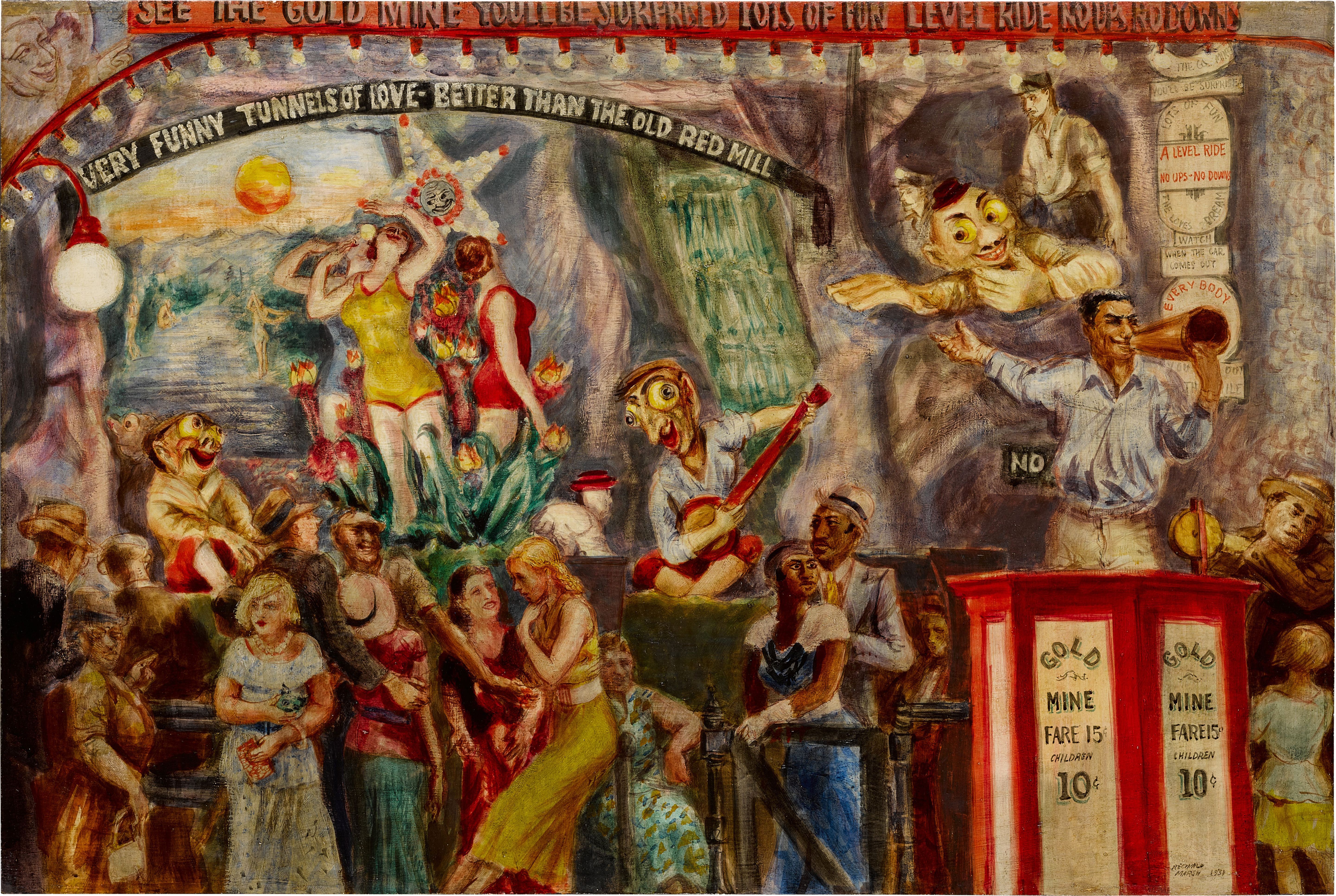
The Gold Mine Ride (Tunnels of Love), 1931
Marsh was born in Paris in 1898 to American parents who were both artists, a fact that shaped his sensibility in ways both obvious and subtle. The family returned to the United States when he was still a child, and he grew up in New Jersey before making his way to Yale, graduating in 1920. New York City claimed him almost instantly. He joined the staff of The Daily News as an illustrator and contributed to The New Yorker in its earliest years, work that sharpened his eye for the telling gesture, the comic dignity of a face caught in an unguarded moment.
These were not sideline activities; they were a genuine training ground for one of the most acute visual journalists American art has ever produced. His formal artistic education came through the Art Students League in New York, where he studied under John Sloan and Kenneth Hayes Miller, two figures whose influence on the so called Fourteenth Street School planted the seeds of his mature vision. Miller in particular urged Marsh toward the Old Masters, and Marsh responded with an almost obsessive devotion to Rubens, Michelangelo, and Titian, copying their works during extended trips to Europe and reading deeply in the technical literature of Renaissance painting. This combination, classical anatomy married to subway crowds and burlesque halls, sounds unlikely on paper and looks absolutely inevitable on canvas.
Reginald Marsh
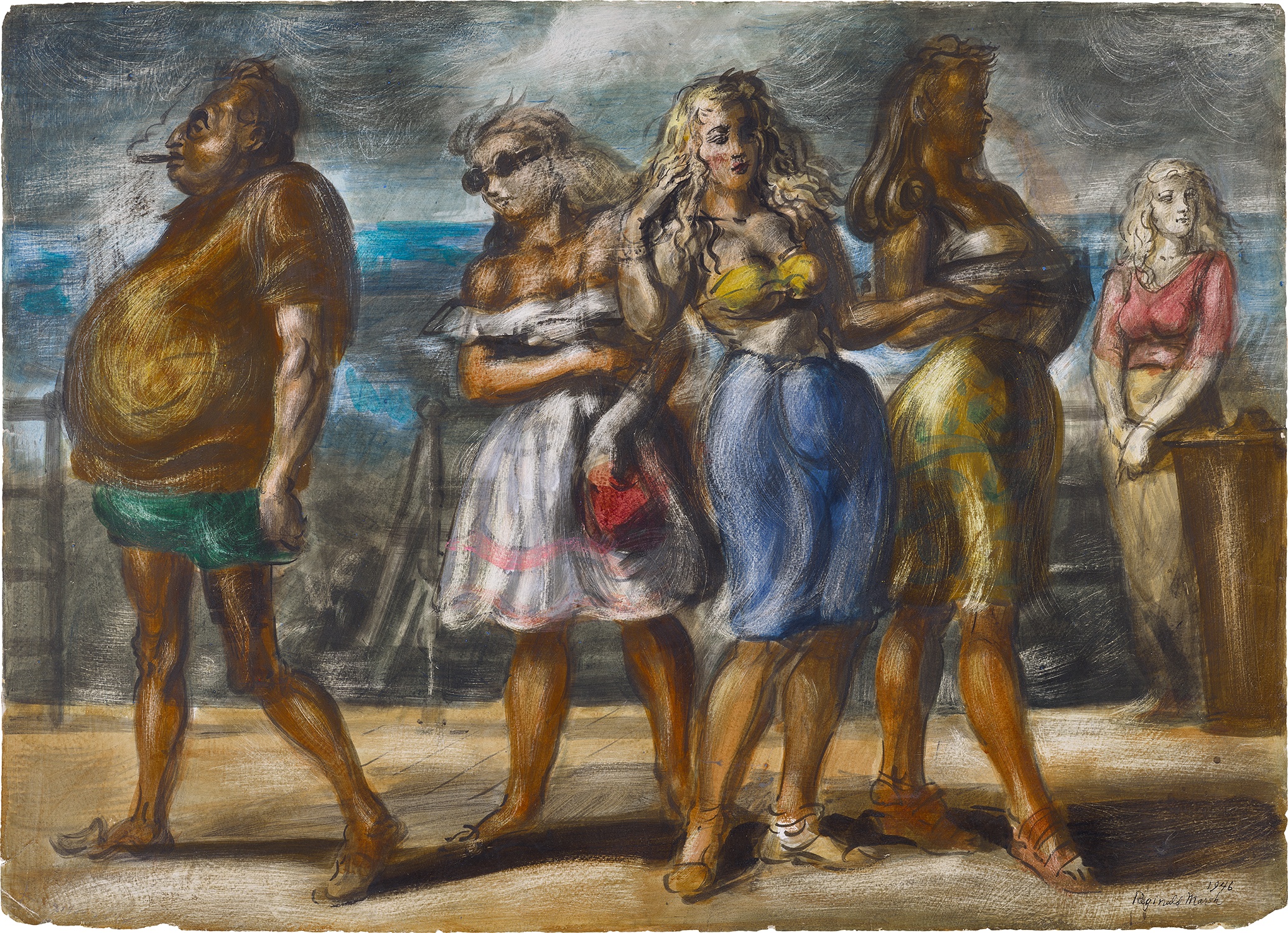
Coney Island, 1946
He mastered egg tempera at a time when almost no American painters were working in the medium, drawn to its luminosity and its direct connection to the methods of the masters he revered. The 1930s represent the full flowering of his powers, and the decade produced some of the most electrically charged images of urban America ever committed to paint. Marsh moved through the city the way a great novelist moves through a neighborhood, nothing was beneath his attention, and everything was charged with meaning. His Coney Island paintings, including the magnificent mixed media work from 1946 held on The Collection, show crowds rendered with a compositional grandeur that owes as much to the Sistine Chapel as to the F train.
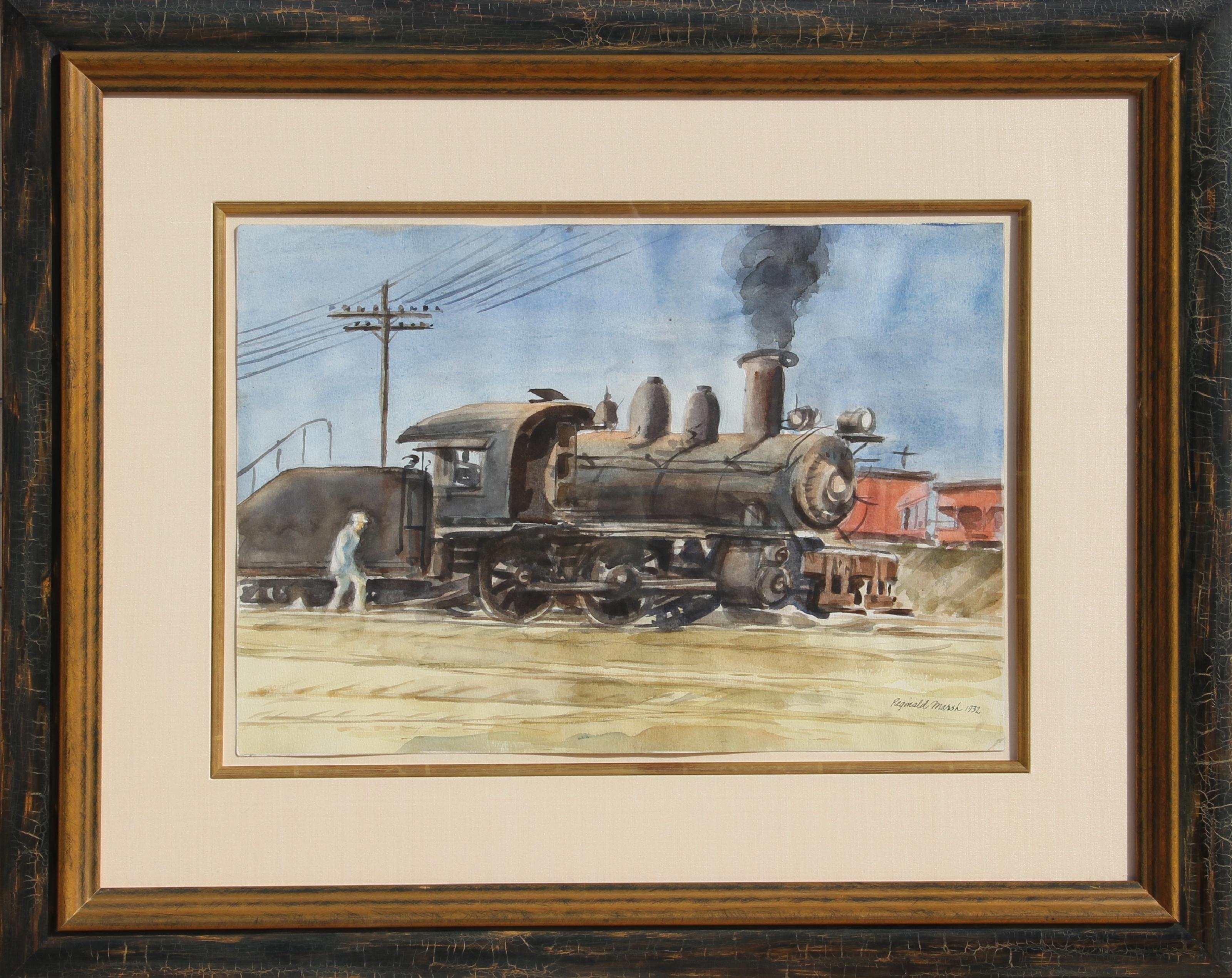
The figures tumble and press against one another in a way that is simultaneously formal and utterly spontaneous. The 1931 tempera on panel "The Gold Mine Ride (Tunnels of Love)," also available on The Collection, captures the carnivalesque energy of that world with a warmth and a slightly knowing wit that remains completely fresh. His locomotive watercolors demonstrate the same instinct for mass and motion translated into the industrial sublime. As a printmaker, Marsh achieved a parallel distinction.
Reginald Marsh
Locomotive
His etchings of the 1920s and 1930s, depicting the elevated railways, the Bowery, and the theatres of lower Manhattan, are prized by print collectors and museum curators alike. The Whitney Museum of American Art, which holds an important collection of his work, has featured him in numerous surveys of American realism, and his paintings appear in the permanent collections of the Metropolitan Museum of Art, the Smithsonian American Art Museum, and the Art Institute of Chicago, among others. These institutional homes speak to his canonical standing, yet his accessibility to private collectors remains one of his most appealing qualities. Works on paper and smaller panels can still be found at price points that reward close looking and early commitment.
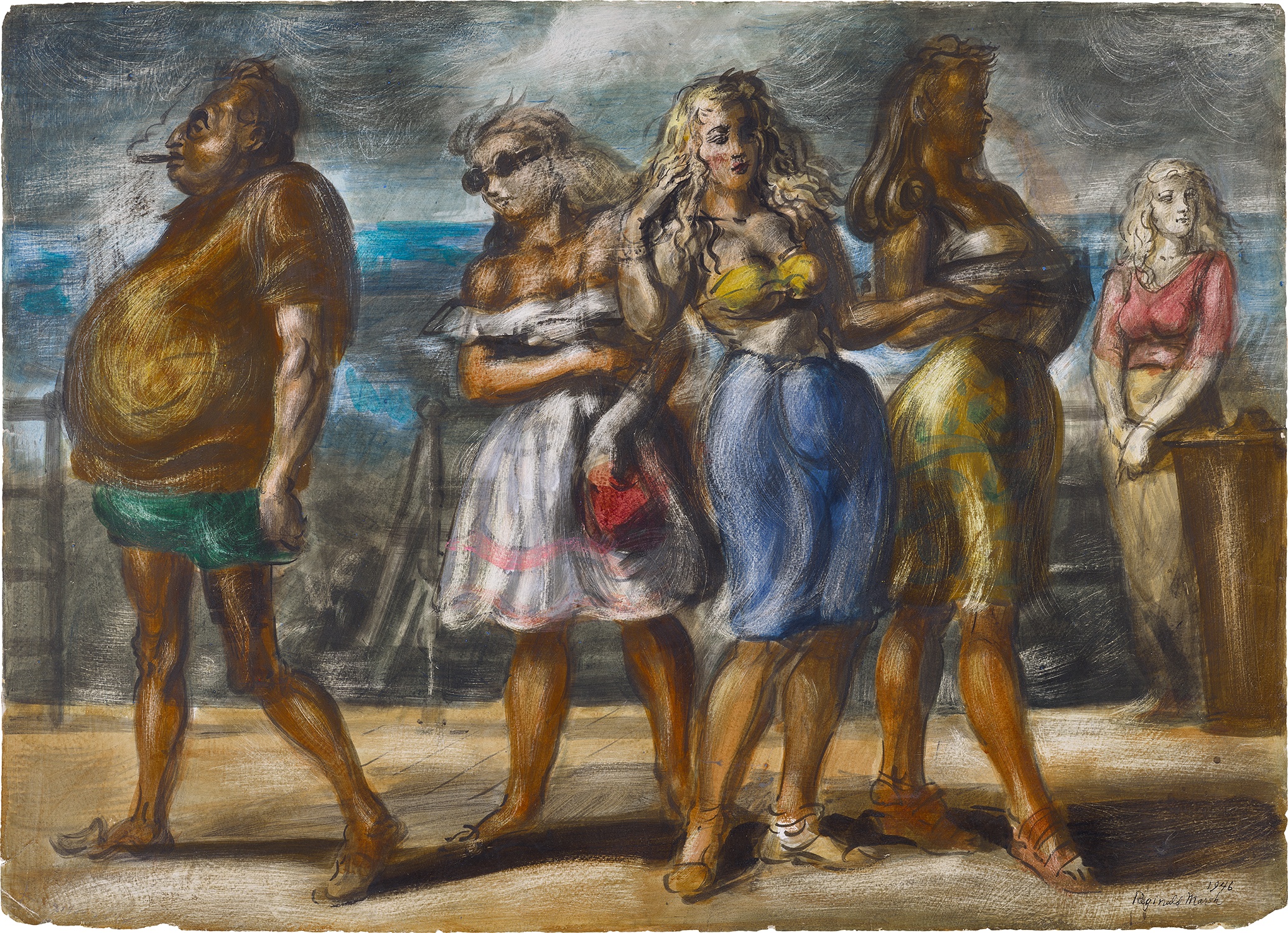
For collectors, Marsh offers something increasingly rare in the market: a fully realized artistic vision that has never depended on fashionable critical frameworks to sustain its value. His work speaks directly, without requiring translation. Auction results at Christie's and Sotheby's have demonstrated consistent demand for his Coney Island subjects and his figure studies, with strong works on paper commanding prices that reflect genuine institutional and private appetite. The double sided works are particularly compelling objects, revealing his restless practice and the speed with which he worked, turning a sheet over rather than reaching for a fresh one.
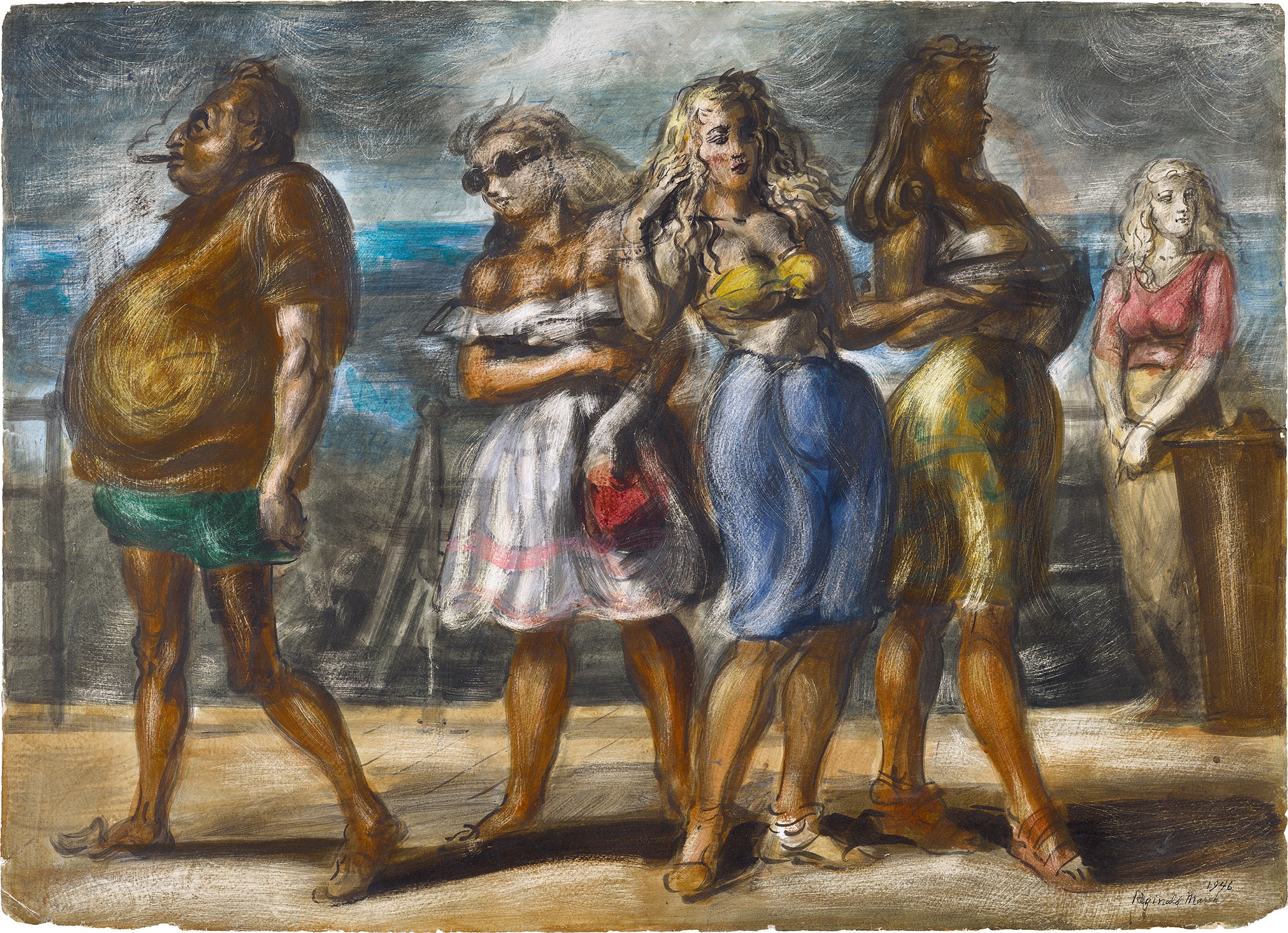
Reginald Marsh
Coney Island (double-sided), 1946
These works carry an intimacy that larger finished canvases cannot always provide. Placed in the broader context of American art history, Marsh belongs to a distinguished lineage that runs from the Ashcan School through to the social realists of the Depression era. His contemporaries and fellow travelers include Isabel Bishop, whose tender observations of working women shared his Fourteenth Street address; Edward Hopper, whose quieter and more solitary vision of the American city provides an instructive contrast; and Raphael Soyer, whose compassion for the urban dispossessed runs parallel to Marsh's more exuberant celebration of the crowd. Together these painters constitute a school of looking that insists on the dignity and the drama of everyday American experience, a tradition that feels urgently relevant whenever the city reasserts itself as the great subject of the national imagination.
Reginald Marsh died of a heart attack in 1954 at the age of fifty six, leaving behind a body of work whose energy shows no sign of diminishing with time. If anything, the distance of seven decades has clarified what he achieved: a synthesis of European classical technique and American vernacular subject matter so complete and so confident that it produced an entirely original art. He saw the masses not as a problem to be solved or a spectacle to be pitied but as a great human pageant deserving the same careful attention Rubens gave to mythological processions. That generosity of spirit, combined with the sheer quality of his draftsmanship and his painterly intelligence, is why collectors who encounter his work tend to return to it again and again.
To own a Marsh is to own a window onto a city that no longer exists in quite that form, rendered by someone who loved it completely.
Explore books about Reginald Marsh
Reginald Marsh: A Retrospective Exhibition
Whitney Museum of American Art
Reginald Marsh: 1898-1954
Lloyd Goodrich
Reginald Marsh: America in the 1930s
Marianne Doezema
Reginald Marsh's New York: Paintings and Drawings Celebrating the City
Bowdoin College Museum of Art
Reginald Marsh: The Hirshhorn Museum and Sculpture Garden Collection
Smithsonian Institution