Red Grooms

Red Grooms, America's Most Joyful Visionary
Artist Spotlight · The Collection Editorial
“I want my work to have the energy of a street corner.”
Red Grooms
Walk into any room where a Red Grooms construction lives and something shifts in the air. The colors press forward. The figures lean and lunge. The whole chaotic, glorious pageant of American life seems to have been compressed, tilted, and set spinning at a frequency only Grooms can tune.

Red Grooms
Clean and Press, 1989
It is no accident that major institutions from the Smithsonian American Art Museum to the Metropolitan Museum of Art have long championed his work, and that 2024 saw renewed critical attention to his legacy as museums across the country revisited the artists who defined postwar American art on their own irreverent terms. Charles Rogers Grooms was born in Nashville, Tennessee, in 1937, and from early on he was drawn not to the quiet studio but to the theatrical and the communal. He studied briefly at the New School for Social Research in New York, the School of the Art Institute of Chicago, and the Hans Hofmann School in Provincetown, Massachusetts, where he absorbed the lessons of Abstract Expressionism without ever fully surrendering to its solemnity. Hofmann's teachings about the push and pull of pictorial space would leave a permanent mark on Grooms, but the young artist was already looking elsewhere, toward the carnival, the movie house, the crowded street corner, and the animated Saturday morning screen.
Grooms arrived in New York City in the late 1950s and threw himself into the emerging downtown scene with a performer's instinct and a cartoonist's eye. He became an early and enthusiastic participant in Happenings, the theatrical art events that blurred the line between audience and performer, object and action. His own Happenings, staged in the late 1950s and early 1960s in downtown lofts and storefronts, were raucous and handmade, full of painted backdrops and costumed figures, more circus than ceremony. These experiences gave Grooms something many painters of his generation never quite found: a working understanding of how art could exist in three dimensions of space and in real time.
Red Grooms
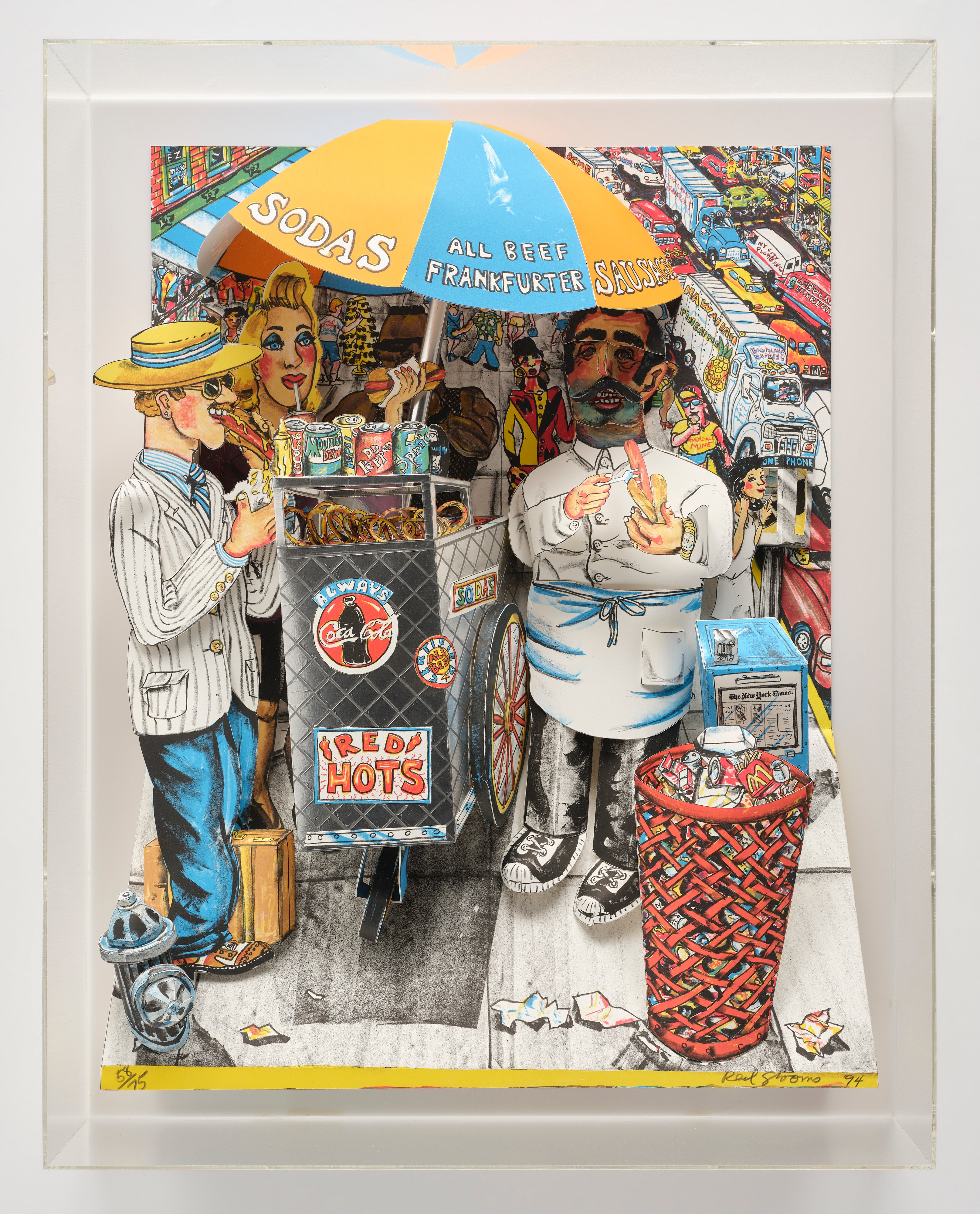
Hot Dog Vendor (K. 142)
The breakthrough that would define his career came in 1975 with the monumental installation "Ruckus Manhattan," conceived and built with his collaborative studio group. Filling a downtown gallery, the work was a room sized, walkable, zany reconstruction of New York City, complete with a tilting Brooklyn Bridge, subway cars packed with caricatured straphangers, and a Times Square teeming with vendors and tourists. Visitors could walk through it, peer around corners, and recognize themselves in the lovingly exaggerated crowd. "Ruckus Manhattan" established the term that would follow Grooms ever after: the sculpto pictorama, a word he coined to describe environments that are simultaneously paintings, sculptures, and theatrical sets.
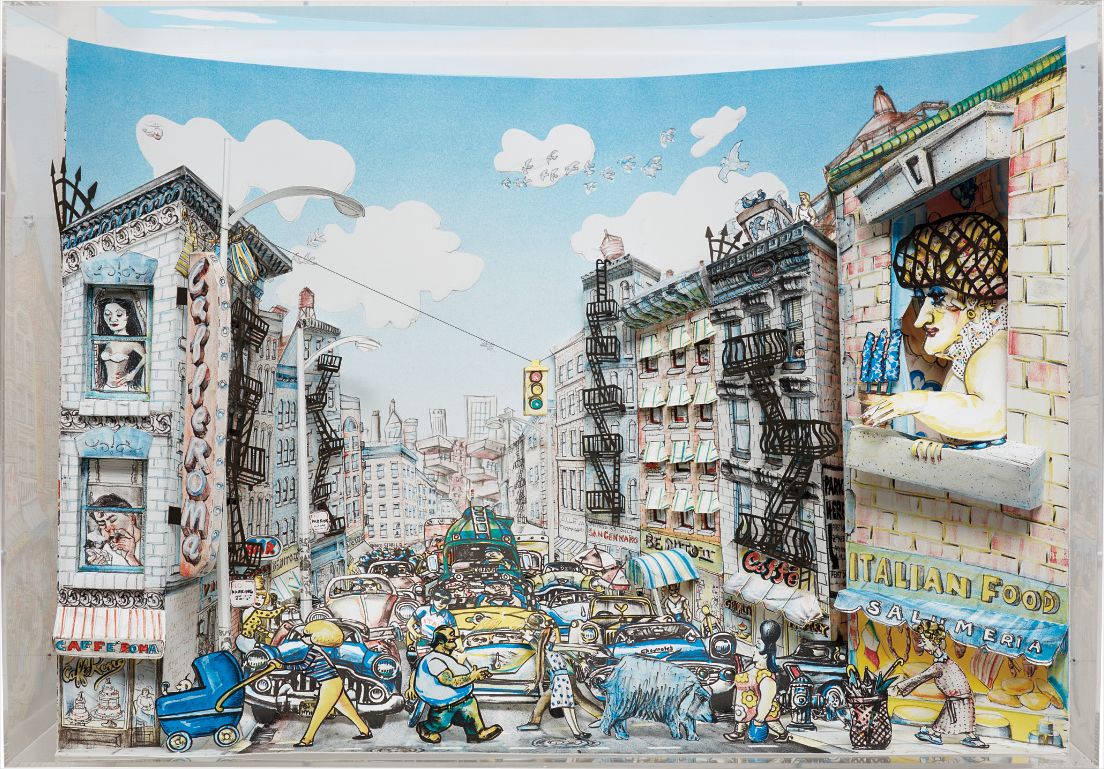
The work toured nationally and cemented his reputation as an artist of singular ambition and infectious generosity of spirit. Grooms's prints and three dimensional works on paper represent one of the most rewarding areas of his output for collectors today. Works such as "Hot Dog Vendor" demonstrate his mastery of complex printmaking techniques, combining lithography, linocut, aluminum foil, and Chine collé elements that are then cut, assembled, and mounted in custom Plexiglas cases so that the figures seem to step off the wall and into the room. "Little Italy" achieves a similar feat, layering die cut elements into a bustling street scene of almost novelistic depth.
Red Grooms
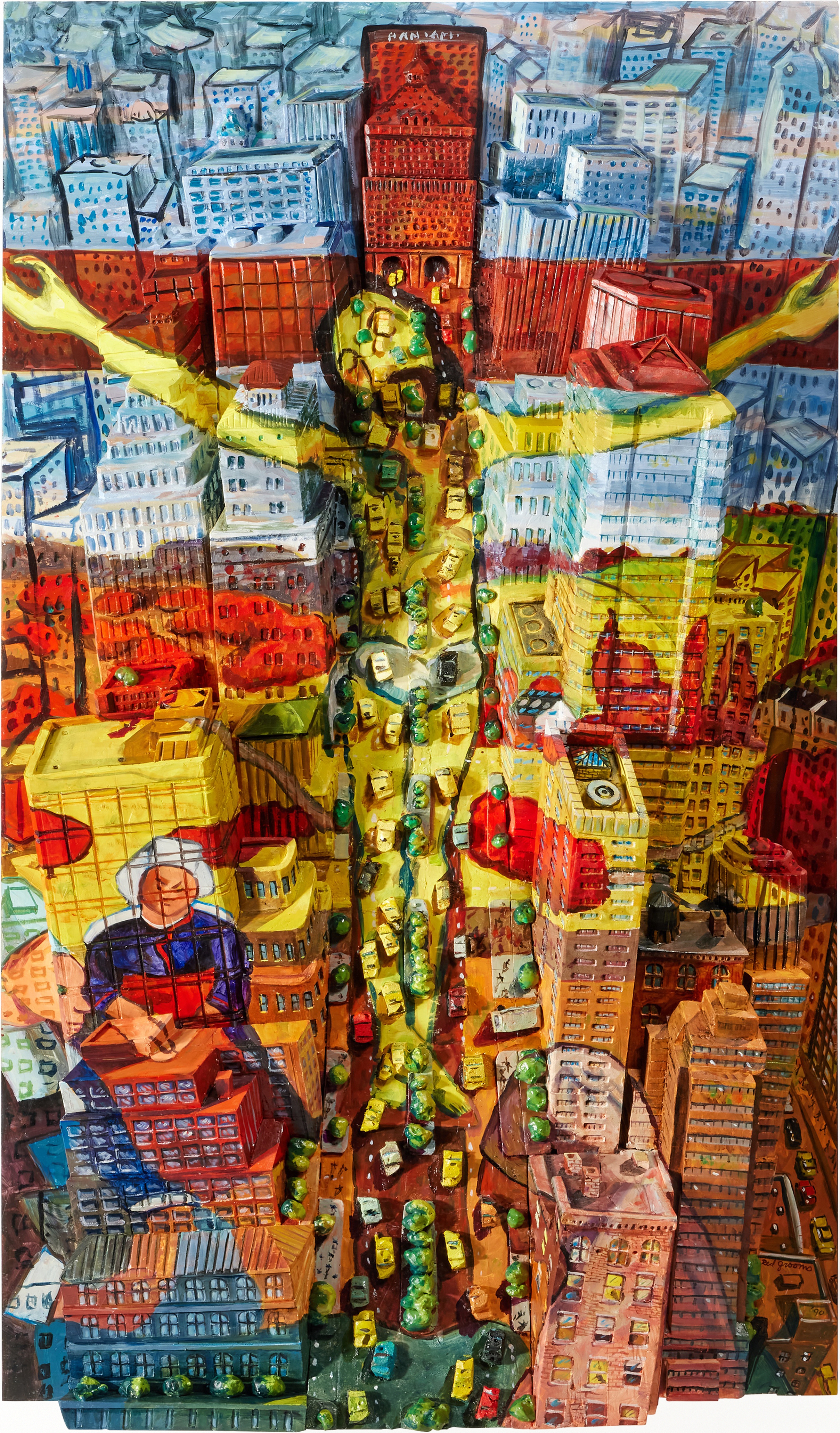
Yellow Christ on Park Avenue, 1990
"Dali Salad II" extends the logic further still, incorporating ping pong balls and vinyl cutouts beneath a Plexiglas dome to create something closer to a cabinet of curiosities than a conventional print. These works reveal a printmaker who treats the medium not as a means of reproduction but as a stage. In painted bronze and mixed media constructions, Grooms shows an equally inventive hand. "Clean and Press" from 1989 and "Yellow Christ on Park Avenue" from 1990 exemplify the way he can take an everyday urban encounter or a loaded art historical reference and render it both funny and strangely moving.
"Yellow Christ on Park Avenue" in particular shows his willingness to set the sacred inside the secular without diminishing either, placing a devotional image within the visual language of the New York streetscape with an ease that only an artist of genuine cultural confidence can manage. His portraits of fellow artists, including "The Existentialist," a woodcut homage to Alberto Giacometti, show that his wit is matched by a deep literacy in art history. For collectors, the appeal of Grooms's work rests on several convergent qualities. His prints, particularly the three dimensional editions issued through major print publishers, combine technical complexity with genuine accessibility of subject matter and a warmth that rewards daily living with the work.
Red Grooms
Little Italy
Auction results for his three dimensional prints have remained consistently strong, with Plexiglas mounted editions in fine condition commanding particular attention at major houses. His painted bronzes, rarer and more sculptural in character, represent a more significant collecting commitment and appear less frequently at auction, making their acquisition through private channels especially meaningful. Collectors drawn to American Pop, to the New York School, and to the legacy of artists who treated humor as a serious aesthetic strategy tend to find Grooms a natural and rewarding addition to a collection. Grooms sits in a fascinating position within art history, adjacent to but never quite absorbed by the movements that surrounded him.
His connection to the Happenings scene places him near figures like Claes Oldenburg and Jim Dine, while his love of popular imagery and commercial vernacular draws obvious comparisons to the Pop artists. Yet where Roy Lichtenstein cooled his sources into ironic distance and Andy Warhol drained affect through repetition, Grooms runs hot. His closest spiritual relatives may be the urban caricaturists of the nineteenth century, Honoré Daumier in particular, and the American regionalists who saw dignity and comedy as inseparable. William Gropper, Reginald Marsh, and the tradition of narrative illustration all flow through his work, filtered through a thoroughly postwar sensibility.
The lasting significance of Red Grooms lies in his refusal to separate pleasure from ambition. At a moment when the art world continues to wrestle with questions of accessibility and elitism, Grooms has always offered a body of work that welcomes the viewer entirely, asking nothing but attention and rewarding it with an overflow of invention. His cities are everyone's cities. His crowds are everyone's crowds.
The artist who built "Ruckus Manhattan" nearly half a century ago is still building, still finding in the chaotic, beautiful, absurd texture of American life an inexhaustible subject. For collectors who want their walls to feel alive, who want art that opens a room rather than closes it, there may be no more reliable or more genuinely joyful choice.
Explore books about Red Grooms
Red Grooms
John Gruen
Red Grooms: A Retrospective
Various curators
Red Grooms: Ruckus Manhattan and Other Works
Museum curators
Red Grooms: The Artist and His Work
Barbara Rose
Ruckus Manhattan
Red Grooms