Ralph Goings
Ralph Goings and the Glory of the Everyday
Artist Spotlight · The Collection Editorial
There is a moment, standing before a Ralph Goings painting, when the eye refuses to believe what the mind already knows. The chrome edge of a napkin dispenser catches the light with impossible precision. A ketchup bottle glows like a lantern. A vinyl seat reflects the pale wash of a diner window.
Ralph Goings
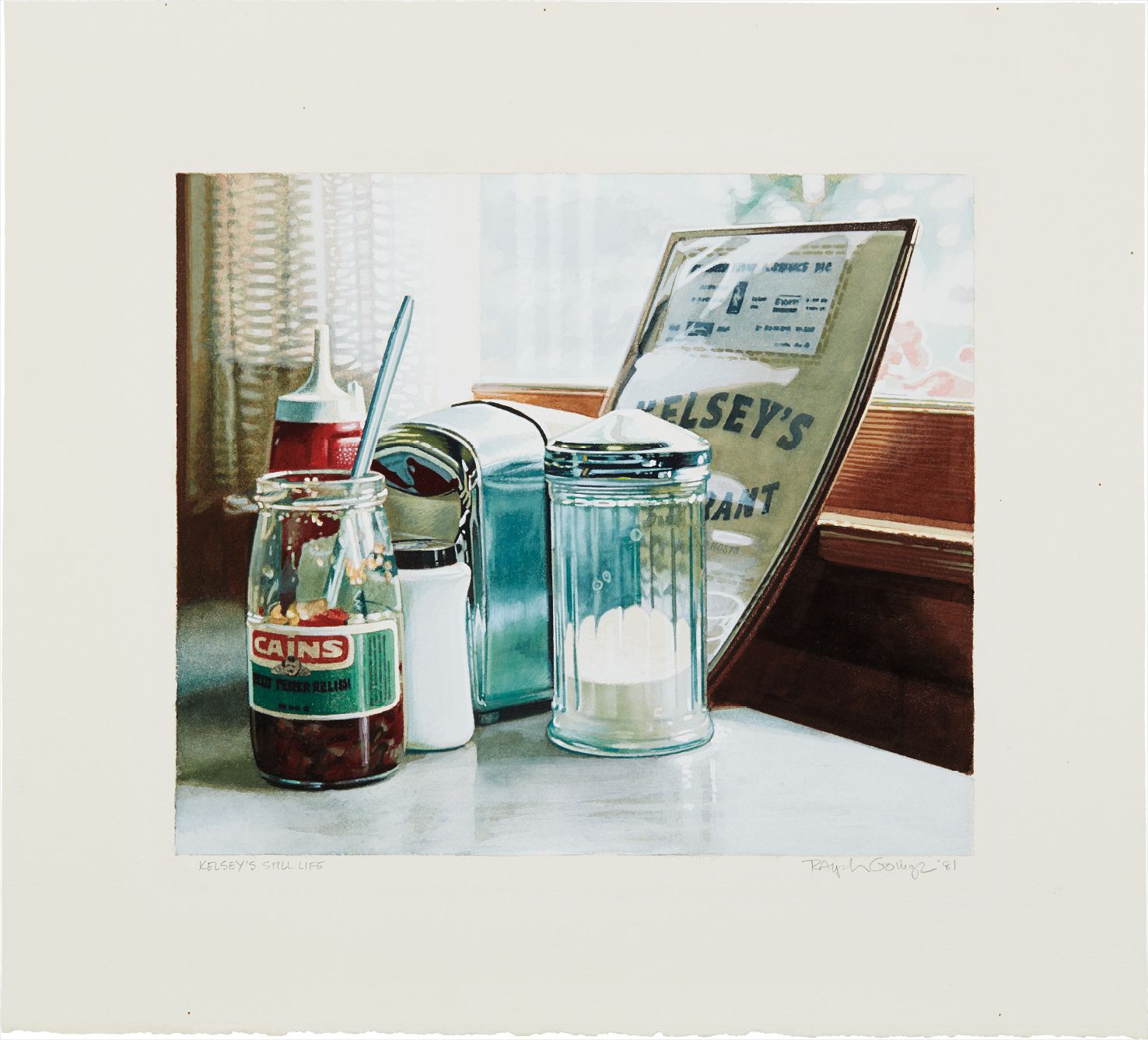
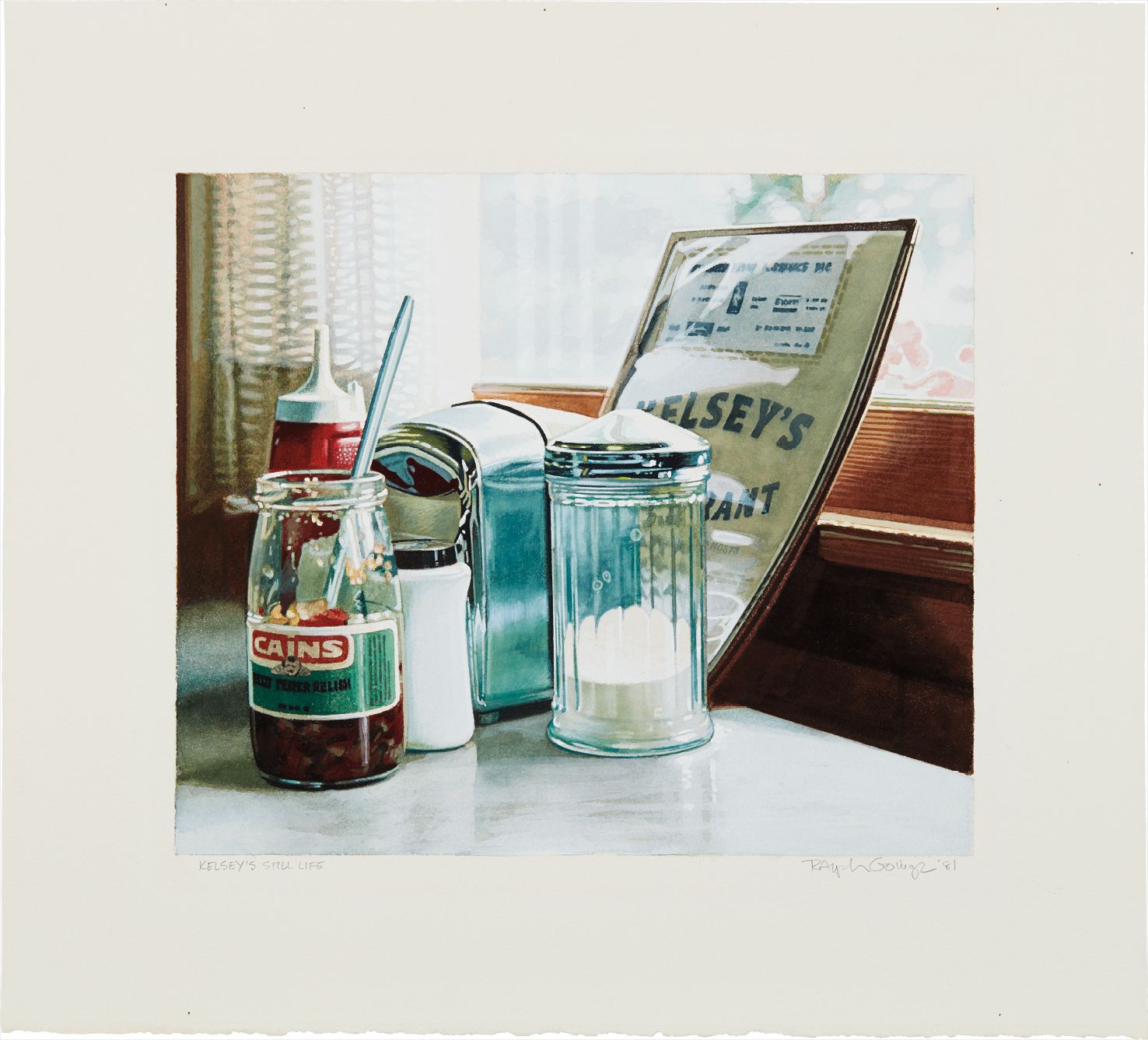
Kelsey's Still Life, 1981
These are not photographs. They are paintings made with such devotion to the ordinary that they become, quietly and insistently, extraordinary. Goings spent the better part of five decades asking America to look more carefully at itself, and the answer he offered back was always warmer, more generous, and more luminous than anyone expected. Ralph Goings was born in 1928 in Corning, California, a small town in the northern Sacramento Valley far removed from the cultural centers that would eventually celebrate his work.
He studied at the California College of Arts and Crafts in Oakland, graduating in 1953, before earning his master's degree from Sacramento State College. For years he taught art in Sacramento area schools while developing his own practice on the side, a circumstance that kept him grounded in the practical and the everyday long before those values became the philosophical engine of his mature work. The distance from New York, often seen as a disadvantage, gave Goings a perspective unclouded by the dominant anxieties of the Abstract Expressionist moment. He was looking at truck stops and drive ins while the art world was looking inward.
Ralph Goings
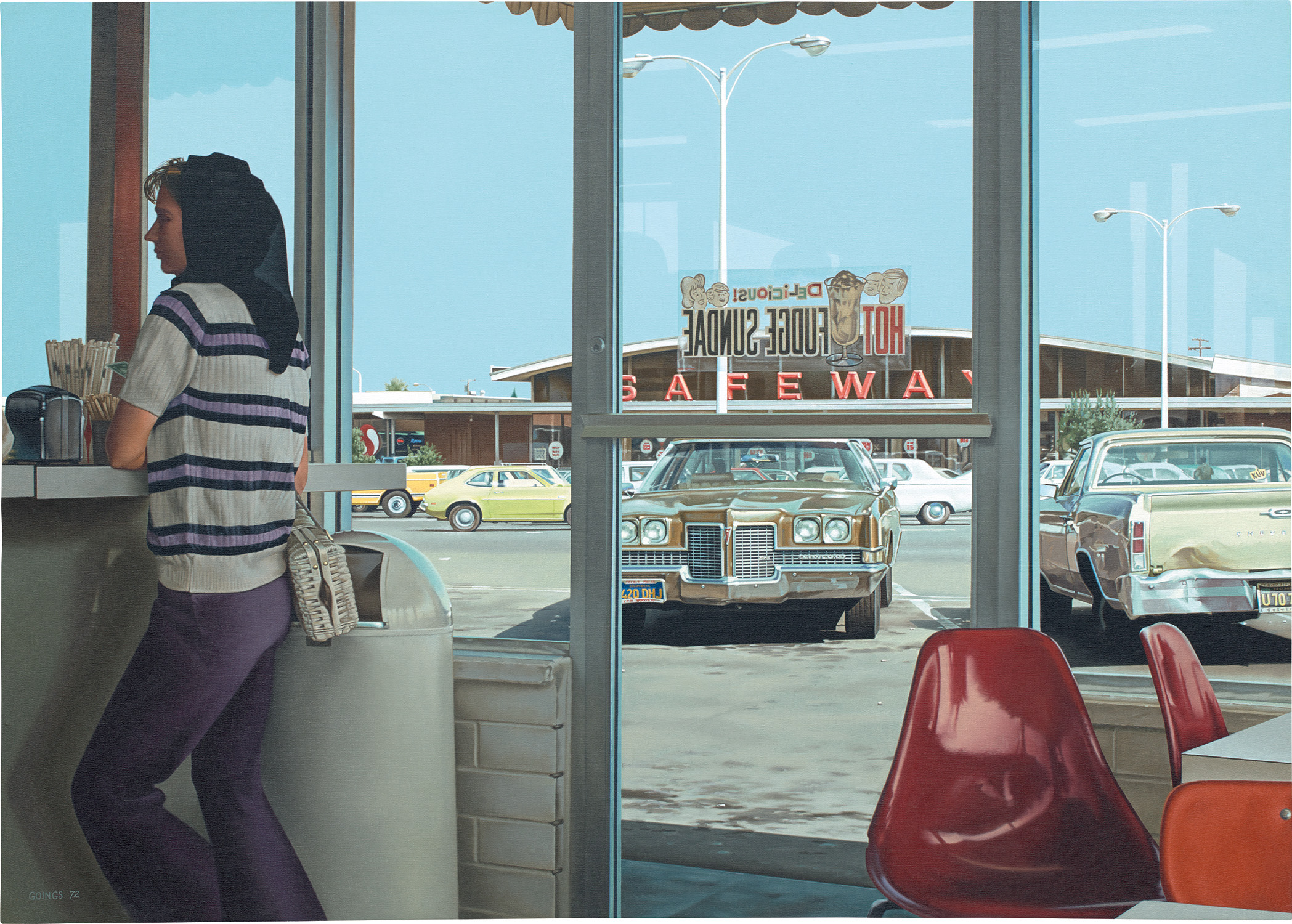
Hot Fudge Sundae, 1972
By the mid 1960s, Goings had begun working with photographs as the basis for his paintings, a method that aligned him with a cohort of American artists who would soon be grouped under the banner of Photorealism. He was among the first to use a photographic slide projected directly onto canvas as a compositional guide, a process that demanded extraordinary technical discipline while simultaneously liberating the artist from conventional notions of what painting was supposed to look like. His early works from this period, including canvases depicting pickup trucks parked outside fast food restaurants and California storefronts, announced a completely original sensibility. The subject matter was aggressively unheroic.
The execution was breathtaking. The Photorealism movement gained institutional visibility in 1972 when the landmark exhibition Documenta 5 in Kassel, Germany, brought together artists including Goings alongside Chuck Close, Richard Estes, Audrey Flack, and Robert Bechtle under curatorial scrutiny for the first time on a major international stage. That same year, Louis K. Meisel Gallery in New York began championing Goings and his peers with a consistency and conviction that helped define the movement's identity for decades.
Ralph Goings
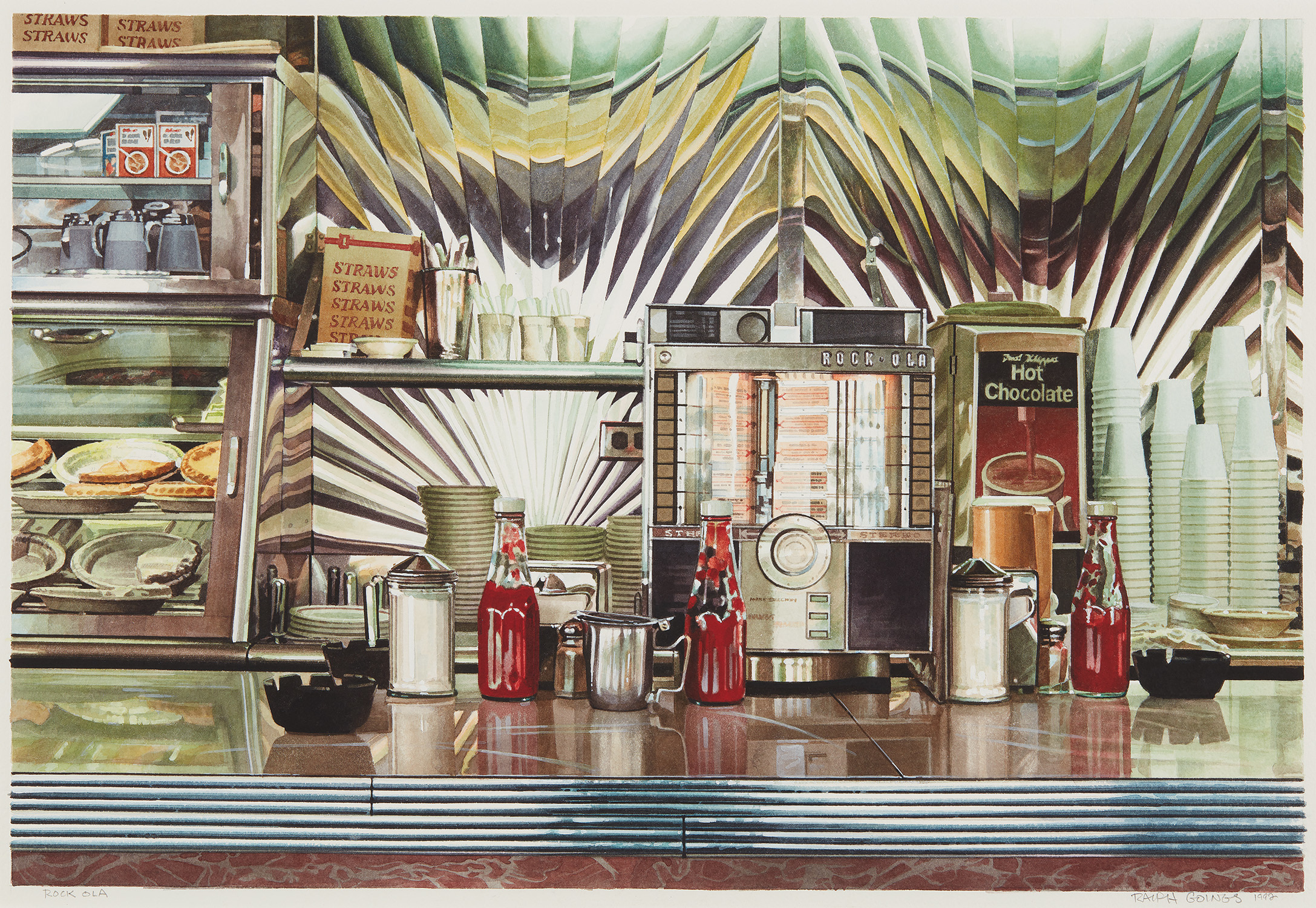
Rock Ola, 1992
Meisel would go on to publish the foundational critical surveys of Photorealism, and Goings was consistently positioned as one of its central figures. The critical conversation around Photorealism was not always warm in those early years, with debates about whether the work was merely mechanical or critically engaged, but Goings answered those questions through the unmistakable emotional presence of his canvases. Among his most celebrated works, Hot Fudge Sundae from 1972 stands as a kind of manifesto. Rendered in oil on canvas with meticulous attention to every reflective surface and pooled shadow, the painting transforms a humble dessert into an object of near sacred attention.
The work captures everything Goings believed about looking: that close attention is itself a form of respect, that the ignored corners of American commercial life are as worthy of sustained gaze as any classical subject. Kelsey's Still Life from 1981, executed in watercolor and gouache on paper, reveals the parallel strand of his practice devoted to tabletop arrangements of diner condiments and vessels. Salt Shaker from 1988, rendered in watercolor on foamcore, is a masterwork of concentrated seeing, the kind of object that rewards a collector willing to sit with it for years. Rock Ola from 1992 demonstrates his sustained affection for the vernacular beauty of mid century American design, finding in a jukebox the same cathedral light he might find anywhere.
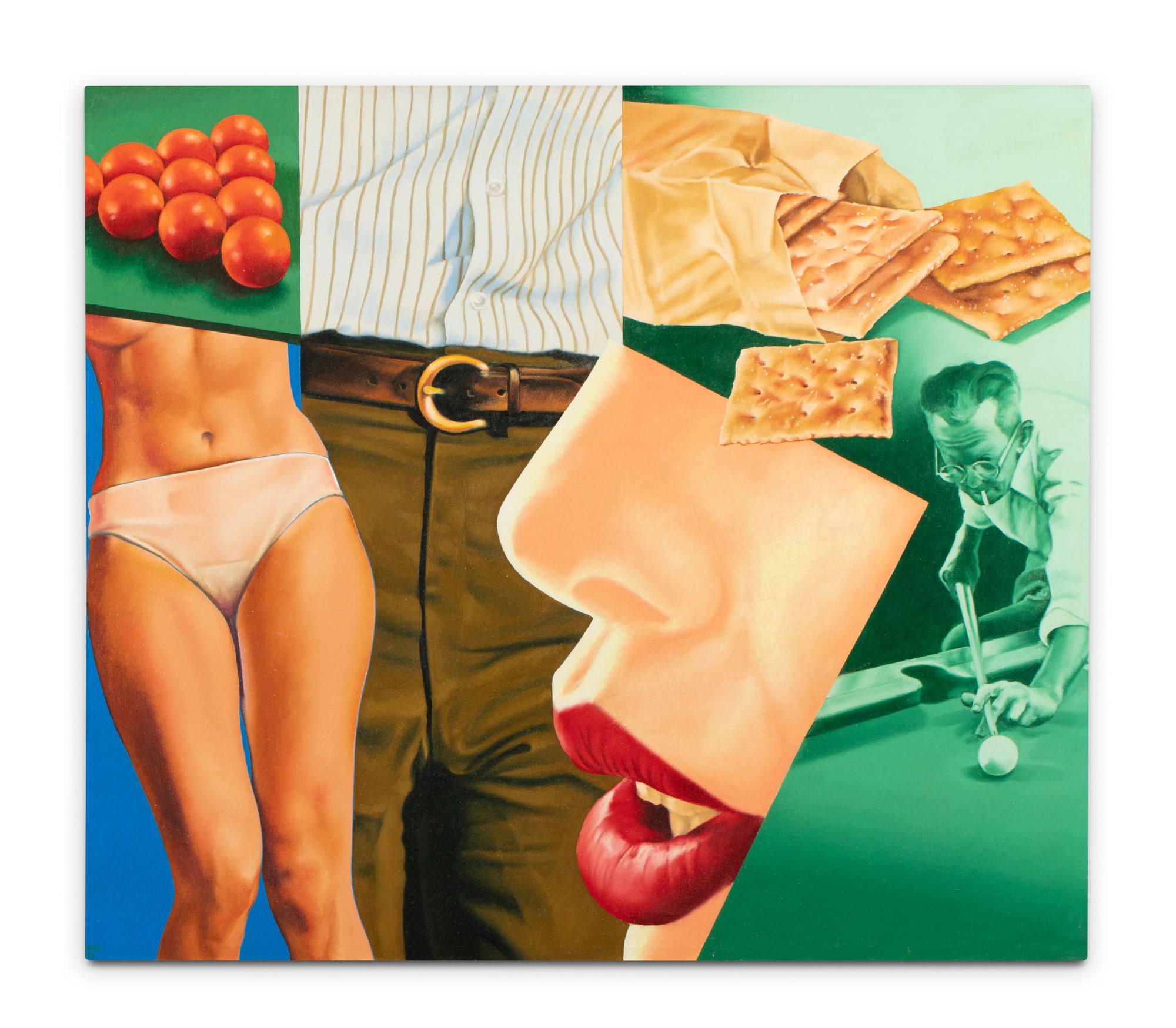
Ralph Goings
Pool crackers, 1966
For collectors, the work of Ralph Goings presents a compelling proposition precisely because of its range of media and scale. His oil paintings on canvas represent the full technical ambition of his photorealist practice and appear with some regularity at major auction houses including Christie's and Sotheby's, where strong examples have attracted serious institutional and private interest. His works on paper, including the watercolors and gouaches for which he had particular affection in his later decades, offer an entry point that is both more intimate and no less rigorous. What collectors consistently respond to is the paradox at the heart of the work: that paintings so devoted to surface should feel so emotionally resonant, that pictures of salt shakers and sundaes should produce something very close to tenderness.
Works from the early 1970s, when the photorealist vocabulary was freshest and most radical, are especially prized. Goings belongs to a tradition that includes not only his Photorealist contemporaries but also reaches back to the American Scene painters and the precisionist tradition of Charles Sheeler, who found in industrial and commercial America a landscape worthy of formal rigour. His affinities with Edward Hopper are often noted, not for stylistic reasons but for the quality of attention both artists brought to the overlooked spaces of American life, the diners, the roadside stops, the places where ordinary people pause between one thing and the next. Among his closer contemporaries, Robert Bechtle shares his California roots and his appetite for the suburban vernacular, while Richard Estes pursues a cooler, more urban version of the same photorealist impulse.
Together they form a constellation of American painters who insisted, against considerable critical resistance, that the world immediately in front of us was worth painting. Ralph Goings died in 2016, leaving behind a body of work that has only grown in cultural resonance as the America he depicted recedes further into memory. The diners he painted with such love are closing. The truck stops are changing.
The particular quality of afternoon light falling through a plate glass window onto a formica counter belongs now to a world that is becoming historical even as we watch. That is precisely why his paintings matter with such urgency today. They are acts of preservation and acts of celebration simultaneously, documents of a democratic beauty that was always there for anyone willing to look. To live with a Goings is to be reminded, daily, that attention is a form of love.
Explore books about Ralph Goings