Rafa Macarrón
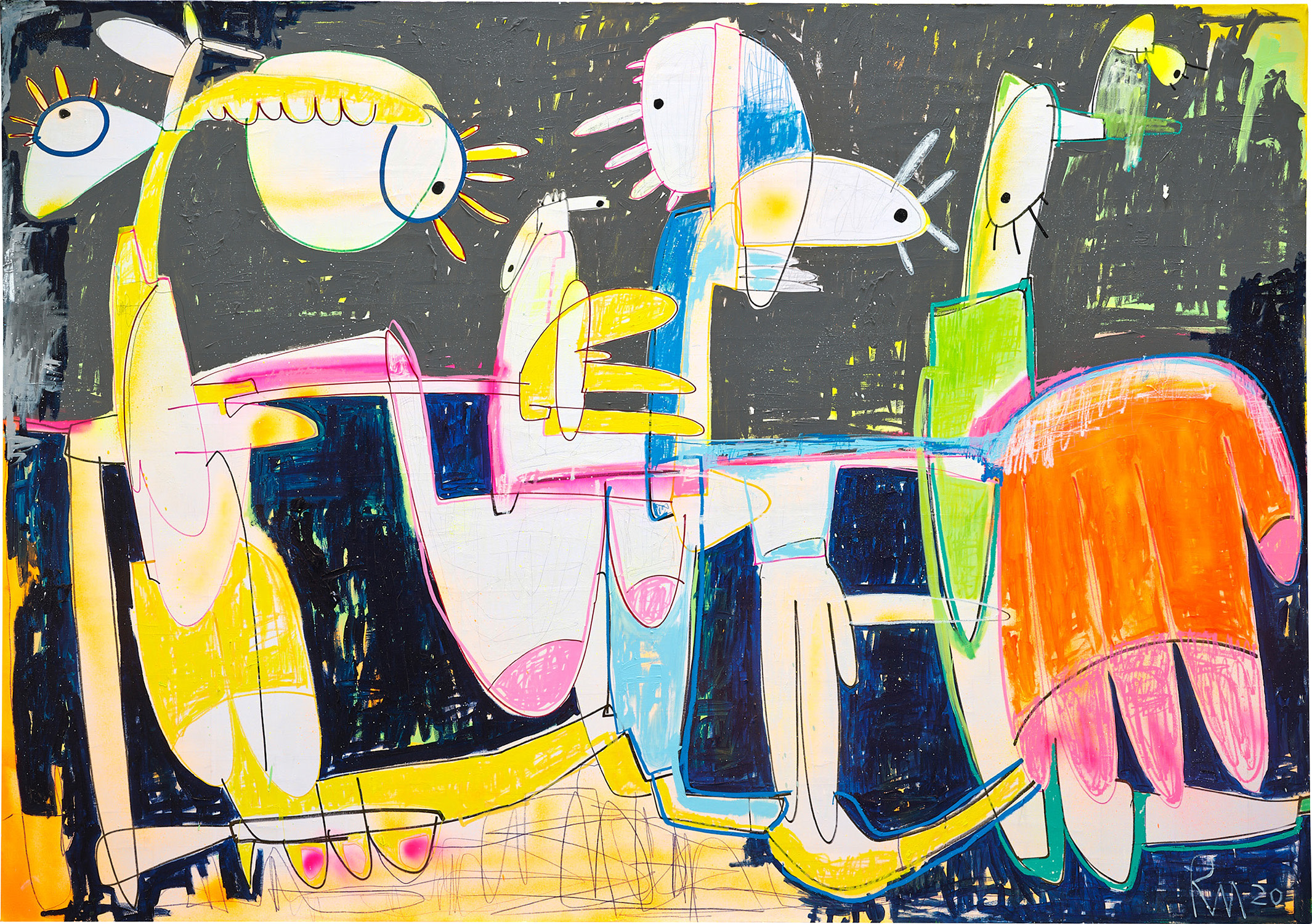
Rafa Macarrón: Life Caught in Brilliant Motion
Artist Spotlight · The Collection Editorial
Something remarkable has been unfolding in the contemporary figurative painting world, and those who follow it closely have known Rafa Macarrón's name for some time now. His works have passed through the rooms of major international auction houses, drawn sustained attention from discerning private collectors across Europe and Asia, and appeared in galleries from London to beyond with a consistency that speaks not to trend but to genuine artistic conviction. That his titles arrive in both Spanish and Chinese, that his canvases carry a warmth legible across languages and cultures, feels entirely intentional from an artist who has made human connection the very substance of his practice. Macarrón was born in Spain in 1974, arriving of age during a period of vivid cultural reopening in his home country, when Spanish art and cinema were surging with a new appetite for emotional honesty and expressive freedom.
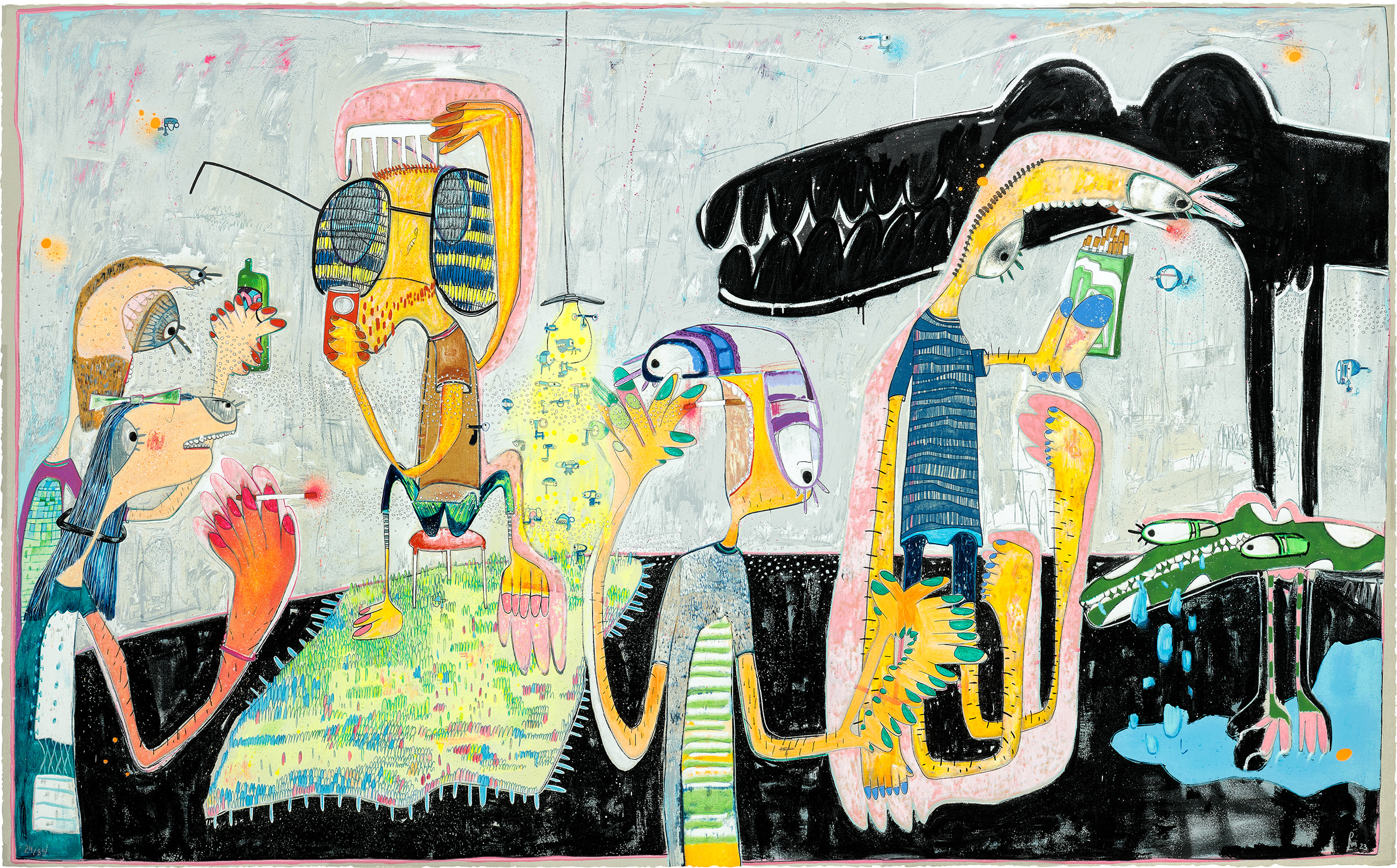
Rafa Macarrón
Rafa Macarrón
That national sensibility, rooted in the richly gestural traditions of Spanish painting and the visceral humanism running from Goya through to the postwar generation, appears to have settled into Macarrón's visual instincts early. He later made London his base, a move that positioned him at the intersection of European figurative tradition and the energetic, internationally minded contemporary art scene that the British capital sustained through the 2000s and 2010s. The city gave him proximity to a global collecting community while allowing him the distance to observe Spanish culture and identity with a traveler's fond clarity. His development as a painter shows a clear and confident arc.
Macarrón works primarily in mixed media on canvas, a choice that is never merely technical but fundamentally expressive. Paper collage, acrylic, oil pastel, pen, felt tip pen, resin, and spray paint all enter his practice as tools of layering and excavation, building surfaces that feel lived in rather than merely painted. The gestural looseness of his brushwork aligns him with the broader Neo Expressionist current that has reasserted itself in contemporary painting over the past two decades, yet Macarrón avoids the nihilistic edge that sometimes accompanies that tradition. His figures are warmly observed.
Rafa Macarrón
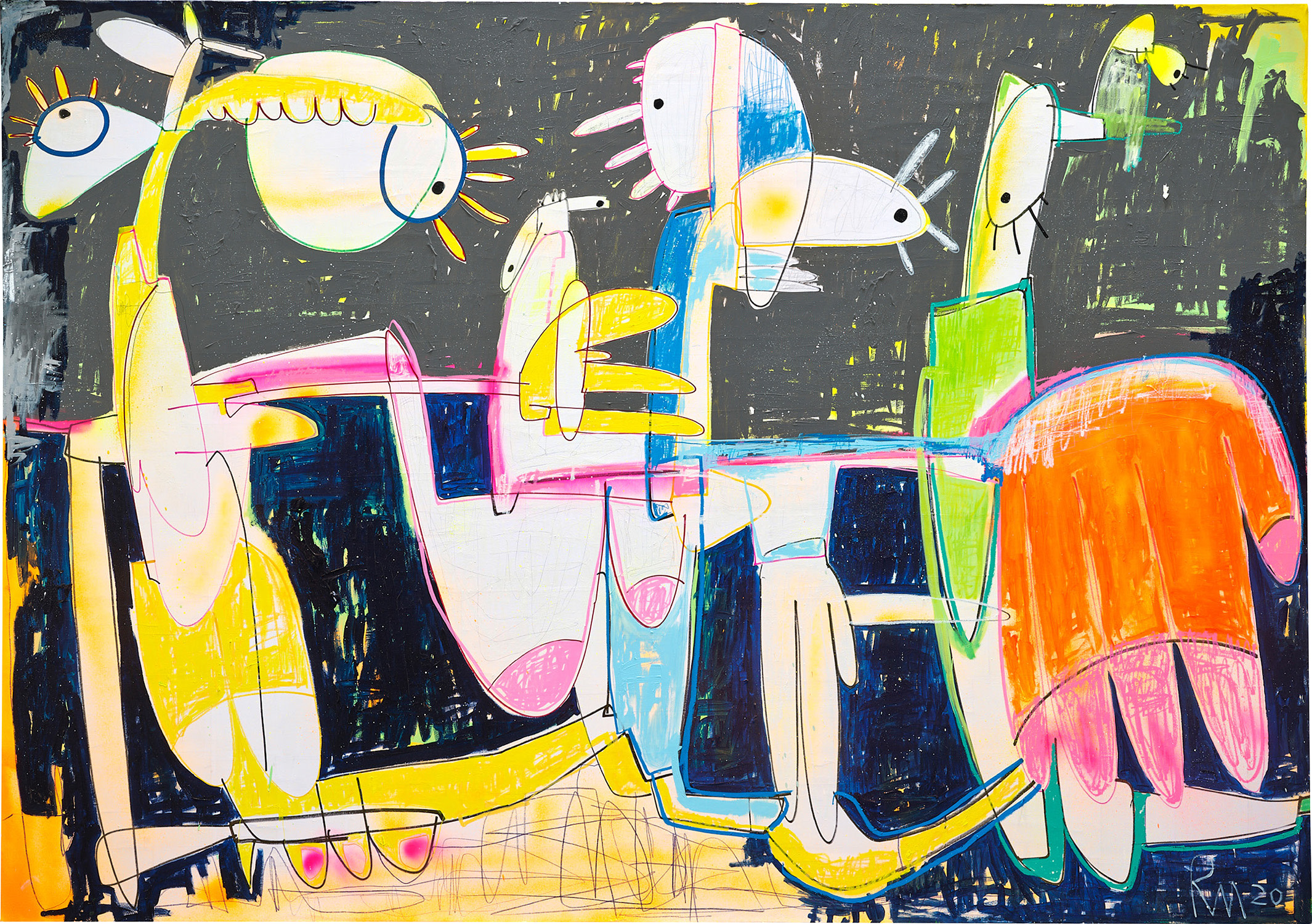
Viaje al Espacio, 2020
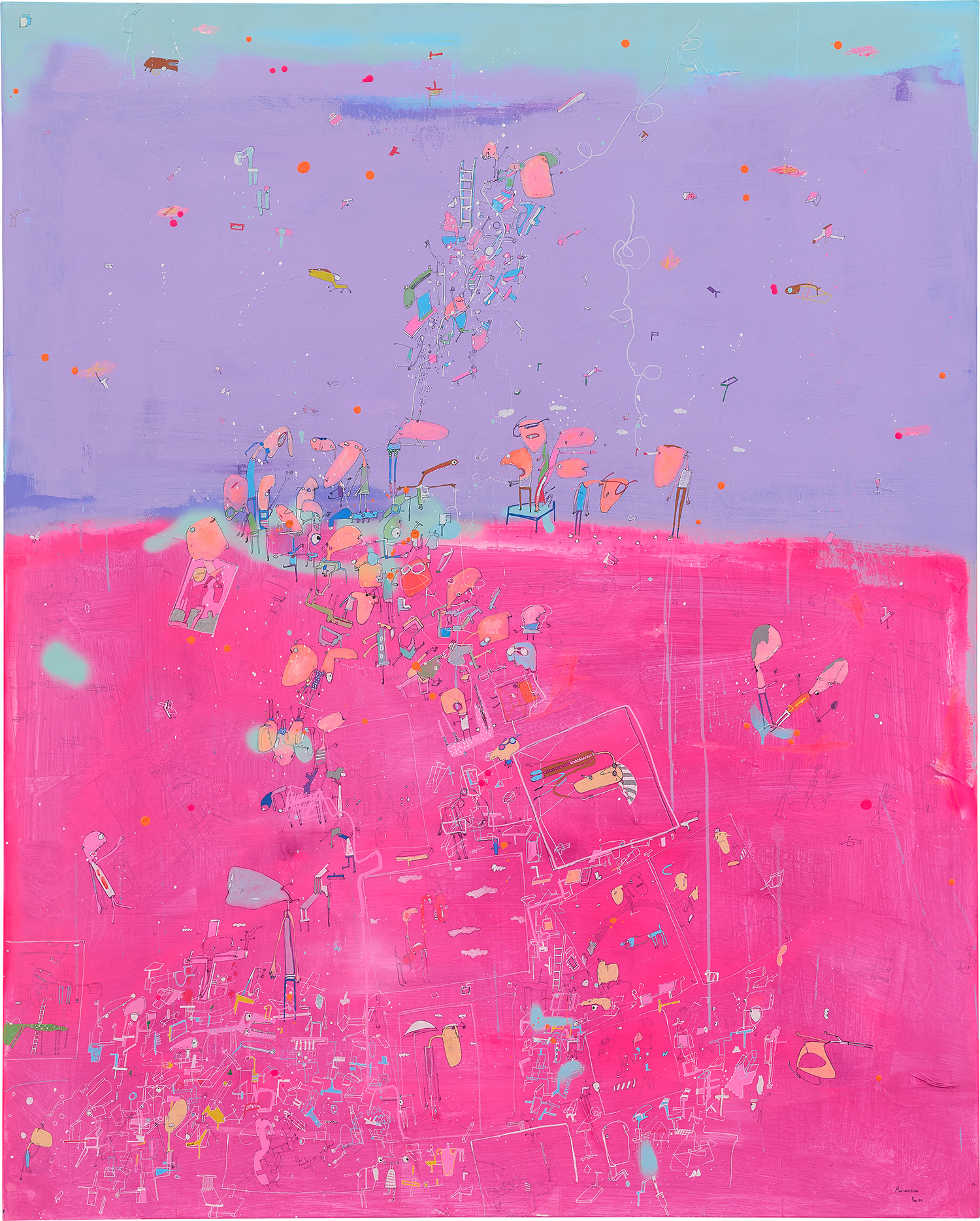
His scenes carry the texture of real afternoons, real fatigue, real tenderness. Among his most celebrated works, "Hormigas" from 2013 exemplifies the early confidence of his practice, its mixed media and paper collage construction presented in an artist's acrylic box that underscores the work's status as a considered object as much as a painting. "Los mentores," also from 2013, demonstrates his ability to invest a figurative composition with psychological weight through economy of means, while "Anocheciendo" from 2014 captures that particular quality of fading light that his Spanish title names with such precision. By 2016, "Angeles" had expanded his material vocabulary further still, incorporating plastic, oil pastel, acrylic, pen, felt tip pen, resin, and spray paint on paper collage laid on aluminium, a work that feels simultaneously intimate and formally adventurous.
His 2020 works, including "Viaje al Espacio" and the diptych "Historias Cotidianas," show an artist at full creative command, the titles' bilingual presentation in Spanish and Chinese pointing toward the genuinely international conversation his work has entered. "Afterwork," subtitled with its Chinese characters for the end of the working day, is perhaps the work that most efficiently communicates what Macarrón does best. The premise is entirely ordinary, the hour after labor ends, and yet the painting elevates it into something quietly luminous. This is where his practice finds its philosophical center: in the unremarkable rhythms of shared life, in the small ceremonies of connection that pass unnoticed and yet constitute everything.
Rafa Macarrón
Anocheciendo, 2014
"Matilda" and "Rutina Fluor" carry the same quality, each a study in how a day, a person, a mood can be held inside a canvas without being pinned down or explained away. The use of acrylic boxes and aluminium supports across several works also reflects a collector oriented sensibility, an awareness that these objects will be lived with, displayed, and treasured. From a collecting perspective, Macarrón represents a compelling proposition at a significant moment in his career. He sits in that productive territory that experienced advisors recognize well: established enough to have a coherent body of work and a track record at auction, yet still mid career in ways that suggest continued evolution and long term value.
His works have attracted collectors across multiple continents, and the bilingual titling of key works points to genuine traction in Asian markets as well as European ones. Collectors drawn to the gestural figurative painters who have defined the past decade of serious collecting will find in Macarrón a voice that stands apart through its warmth and its commitment to legible human experience rather than ironic distance. In situating Macarrón within a broader art historical conversation, one thinks naturally of the tradition that runs through the School of London painters, the emotional directness of Frank Auerbach and Leon Kossoff given a Mediterranean openness, or the figurative energy of contemporary Spanish painters who have carried their national tradition into global dialogue. There is also something of the intimate social observation found in Luc Tuymans and Peter Doig, though Macarrón's palette runs warmer and his figures invite rather than unsettle.
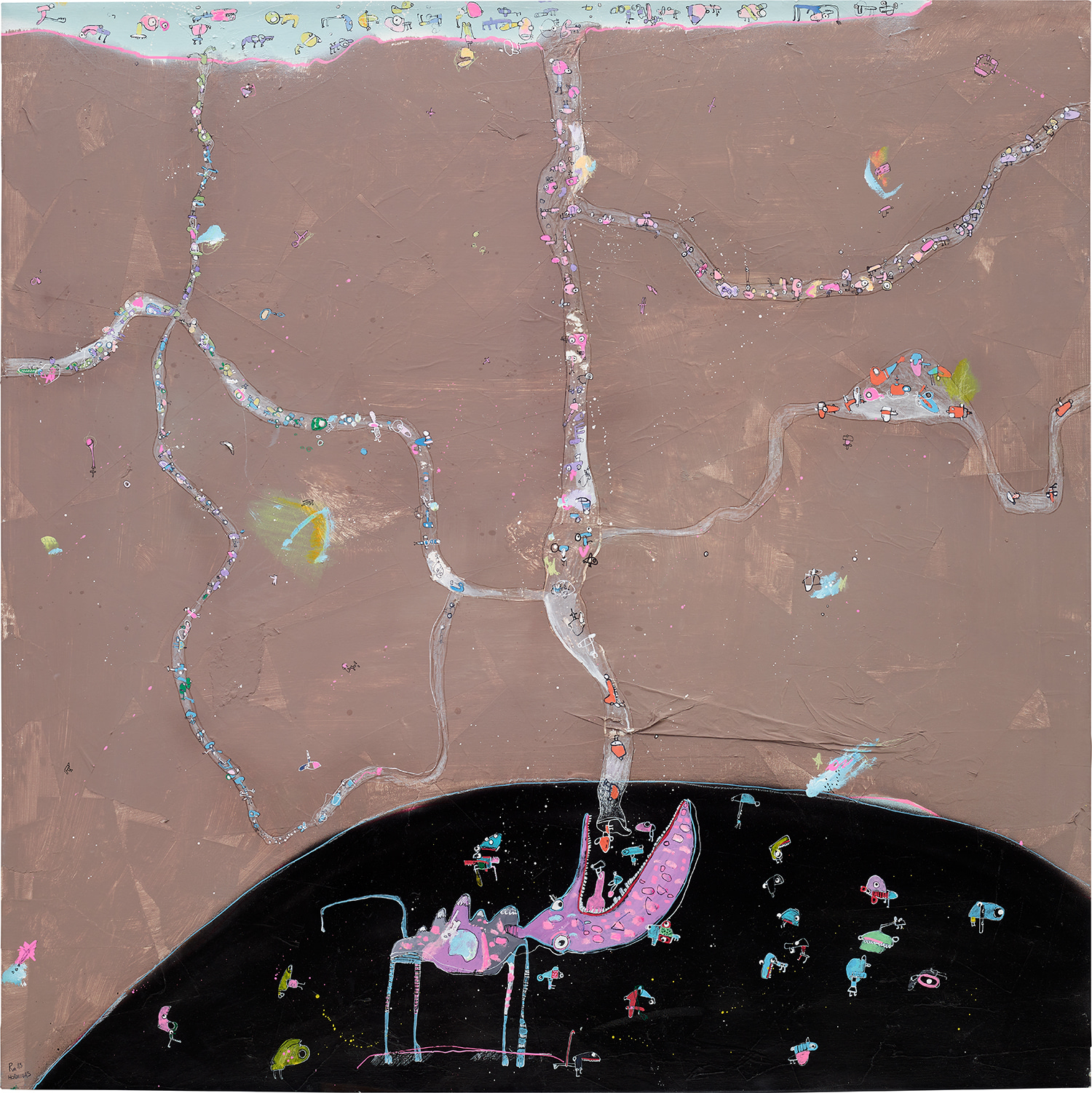
Rafa Macarrón
Hormigas, 2013
He belongs to a generation of painters who took the lessons of late twentieth century expressionism and redirected them toward affirmation rather than critique. What ultimately makes Rafa Macarrón matter, now and into whatever comes next, is a quality that resists easy critical language but that any attentive viewer feels immediately: he paints as though people are worth paying attention to. Not as symbols or archetypes or provocations, but as themselves, going about the tender and exhausting business of being alive. In a contemporary art world that often rewards conceptual remove, that is a genuine and generous act.
His canvases ask nothing of the viewer except presence, and in return they offer the particular satisfaction of feeling seen. For collectors who want work that rewards daily living with, that deepens rather than decorates, Macarrón is an artist whose moment is very much now.