R.B. Kitaj
Artist Spotlight · The Collection Editorial
```json { "headline": "R.B. Kitaj: A Mind Alive in Paint", "body": "There are painters who decorate the world and painters who argue with it. R.
R.B. Kitaj
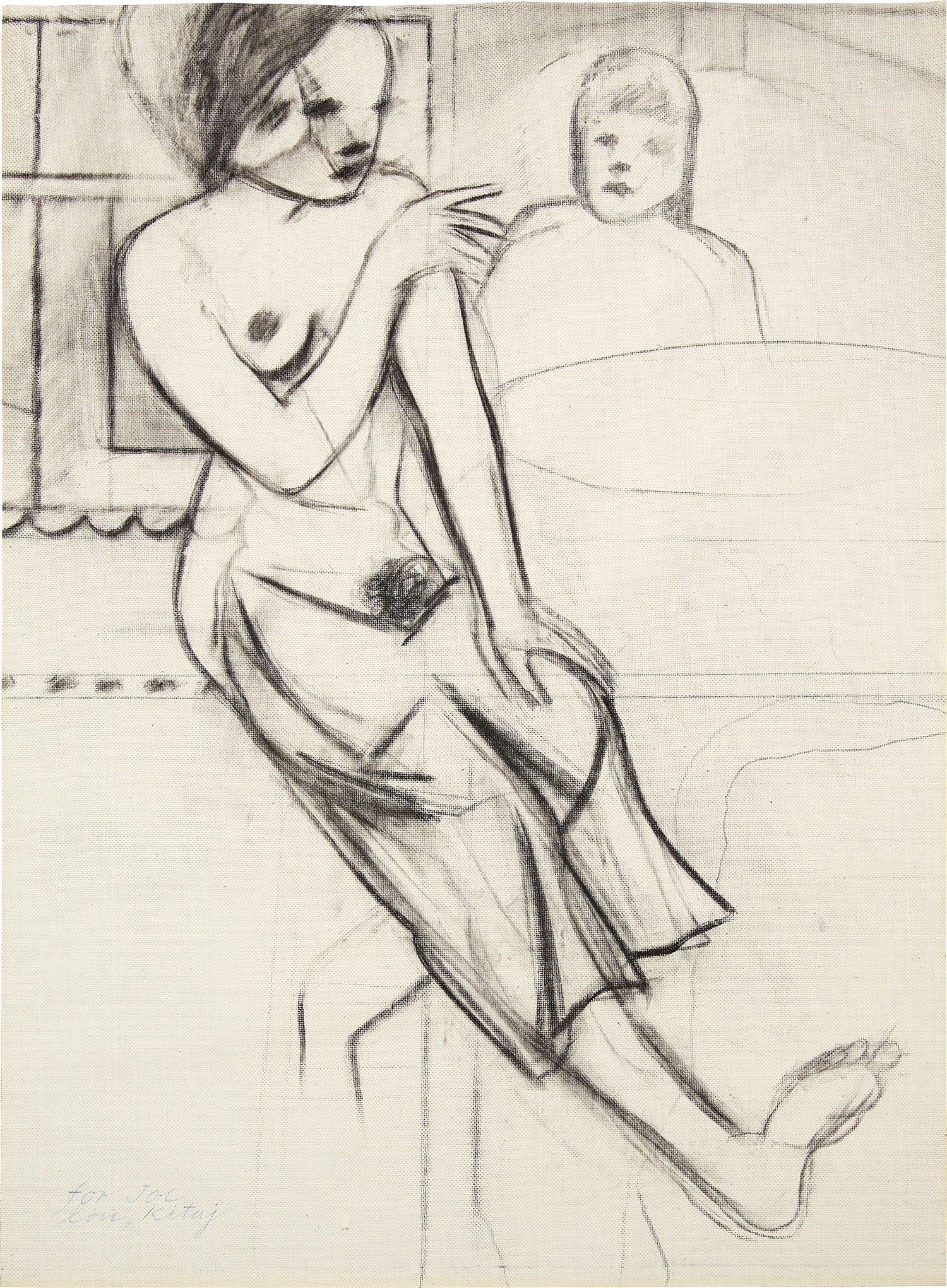
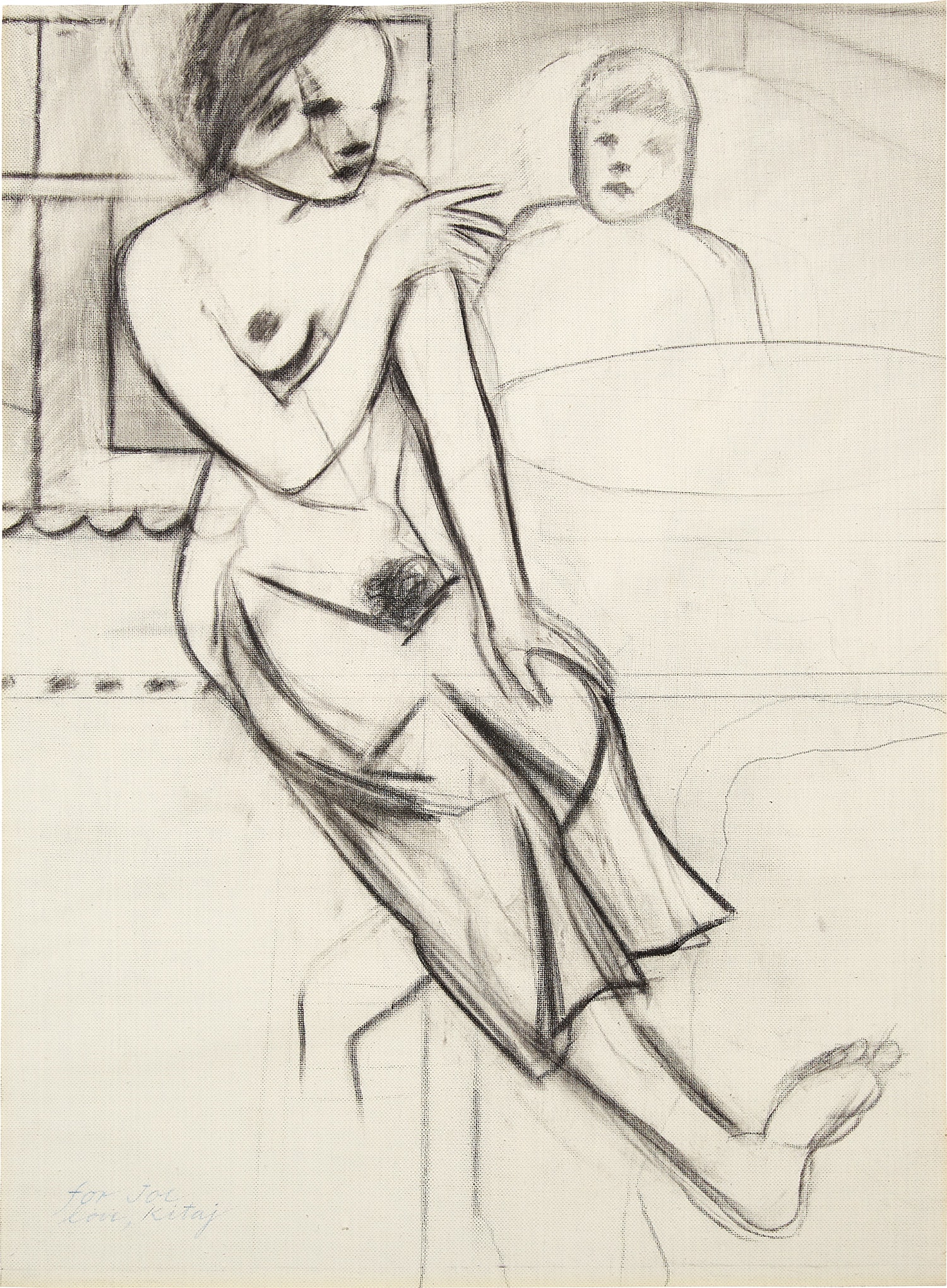
Female Nude
B. Kitaj belonged emphatically to the second company. When the Tate Gallery mounted its landmark retrospective of his work in 1994, the exhibition arrived with the weight of a major literary event as much as an artistic one, dense with footnotes, personal manifestos, and the kind of accumulated thought that most painters leave in sketchbooks. That show, controversial and galvanizing in equal measure, confirmed what his peers had long understood: Kitaj was one of the most intellectually serious figurative painters of the twentieth century, a restless American in London who turned the canvas into a theater of ideas.
", "Kitaj was born Ronald Brooks Kitaj in Chagrin Falls, Ohio, in 1932, into a Jewish family whose circumstances were modest and whose culture was rich. He took his stepfather's surname, Kitaj, and carried it into a life shaped by displacement and curiosity. Before he ever held a serious paintbrush in a European studio, he had already been a merchant seaman and a soldier, traveling through ports and continents that would feed his imagination for decades. The GI Bill eventually brought him to the Ruskin School of Drawing in Oxford and then to the Royal College of Art in London, where he arrived in 1959 and immediately changed the temperature of the room.
R.B. Kitaj
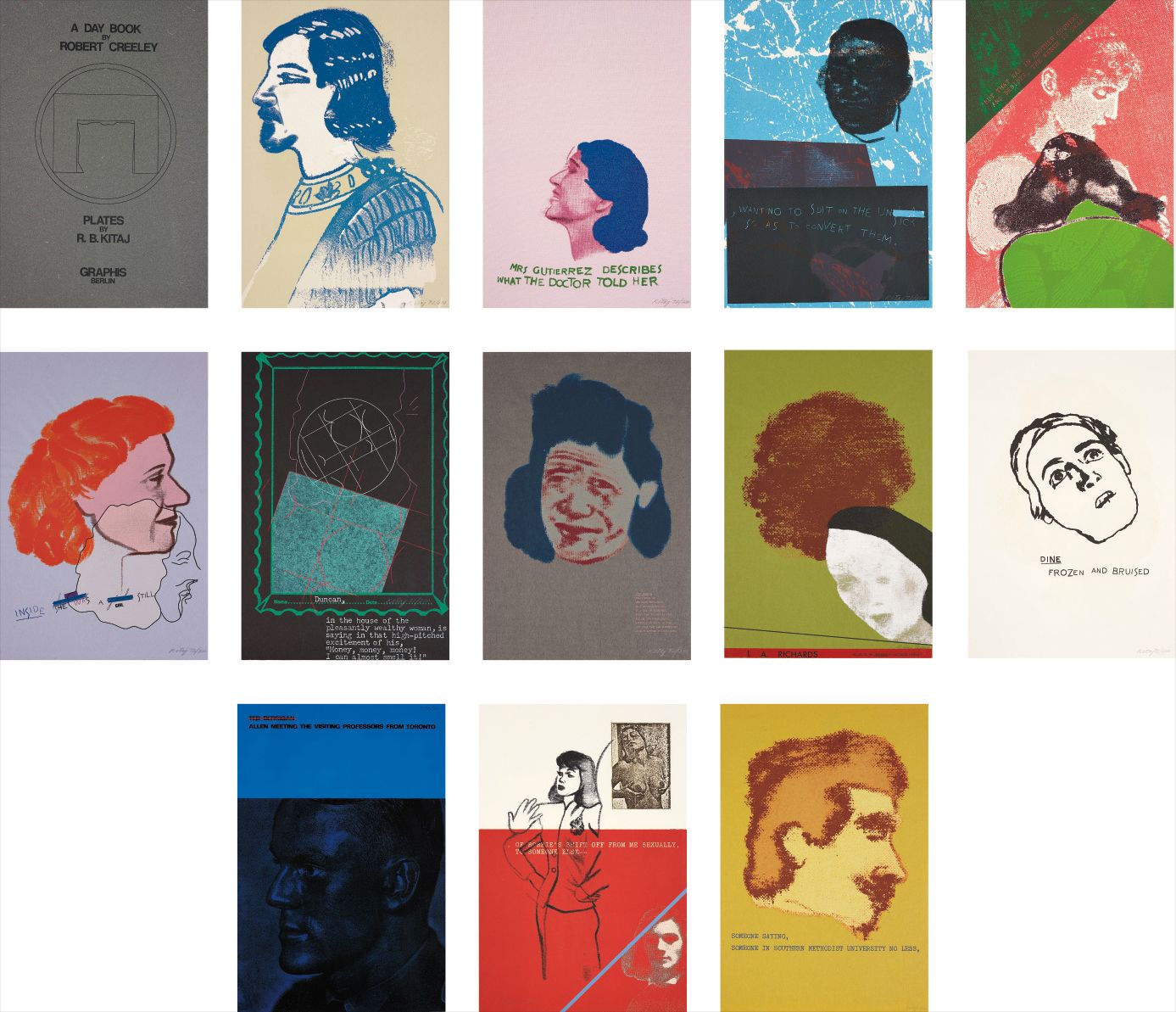
A Day Book by Robert Creeley; including two additional prints
", "At the Royal College, Kitaj was older than most of his peers and far more widely read. He became a catalyzing presence for a generation that included David Hockney, Allen Jones, and Patrick Caulfield, encouraging them to look beyond pure abstraction toward the possibilities of the figure, the narrative, and the page. His own practice drew from an extraordinary range of sources: the late bathers of Cézanne, the cool observation of Degas, the iconological method of the art historian Aby Warburg, and the poetry of Ezra Pound and T.S.
Eliot. These were not passing references but structural foundations, woven into compositions of deliberate complexity and genuine feeling.", "Through the 1960s and 1970s, Kitaj developed a signature visual language that felt unlike anything else being made in Britain at the time. His paintings and prints operated like layered texts, combining fragmented figures, snatched quotations, flat planes of color, and passages of almost classical draftsmanship.
R.B. Kitaj
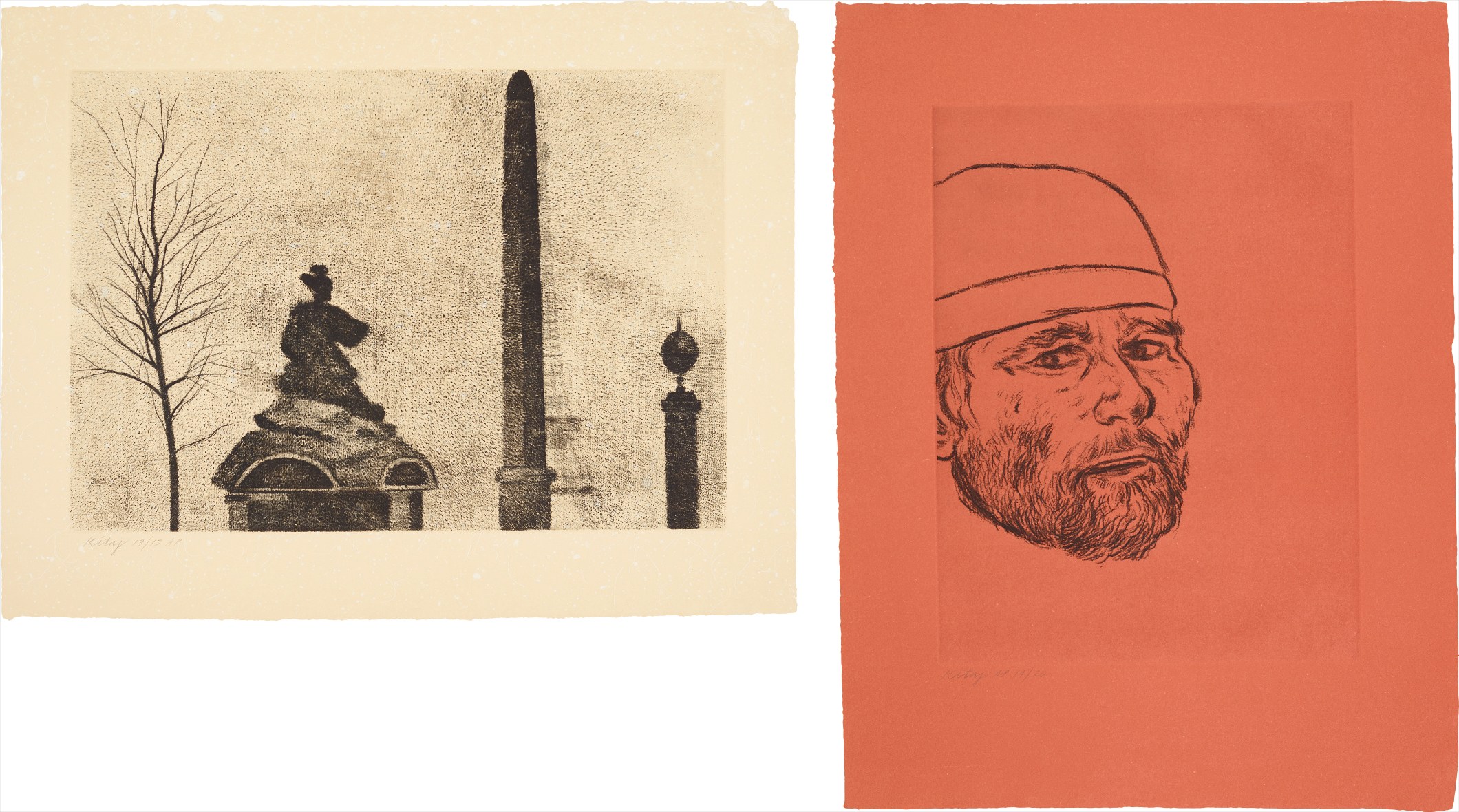
Place de la concorde; and Self portrait (After Matteo)
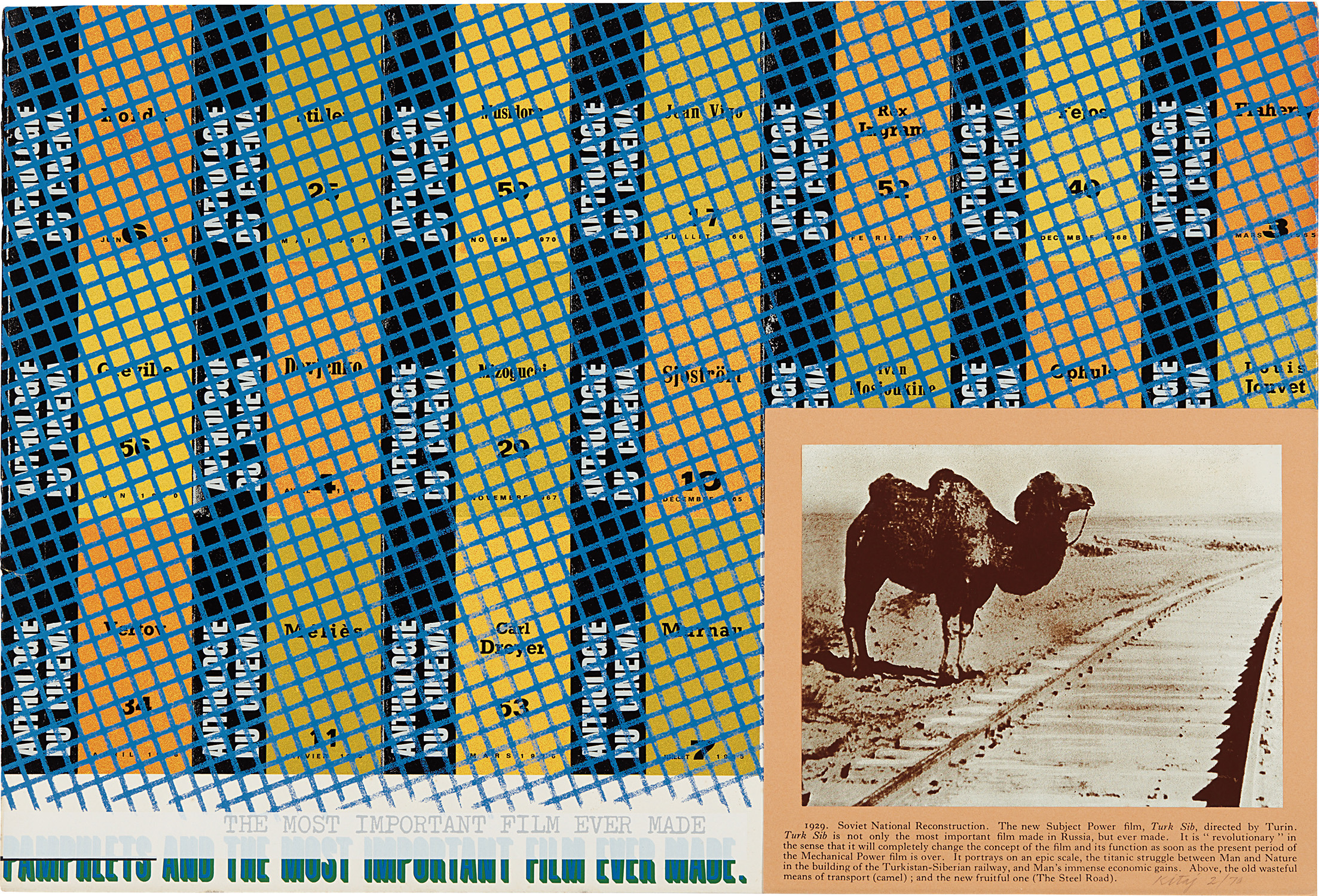
His print work from this period is particularly significant. The complete portfolio 'A Day Book' created in collaboration with the poet Robert Creeley stands as one of the great artist and poet collaborations of the postwar era, bringing together screenprints, etchings, and a lithograph across a range of papers and surfaces in a way that treated the printed page as a space for genuine dialogue between word and image. Works like 'The Most Important Film Ever Made' demonstrate his mastery of screenprint as a medium capable of conceptual weight and visual wit simultaneously.", "Kitaj was also one of the great draftsmen of his generation, and his works on paper reveal the foundation beneath the intellectual scaffolding.
His charcoal drawings, including the powerful 'Female Nude' and the intimate 'Female Head' in oil on canvas laid on panel, show an artist who could strip away the literary machinery and arrive at something urgent and immediate. The pastel 'Lauren' from 1983, a portrait almost burning with tenderness, is among his most direct and emotionally transparent works, a reminder that for all the erudition, Kitaj was fundamentally a painter of people, of faces, of the weight that individual human beings carry through the world.", "The 1970s saw Kitaj develop what he would eventually call the Diasporist dimension of his work, a sustained meditation on Jewish identity, exile, and belonging that deepened after the death of his beloved wife Sandra Fisher in 1994, a loss he connected publicly and painfully to the critical hostility that followed his Tate retrospective. His 'First Diasporist Manifesto,' published in 1989, laid out a philosophy of art making rooted in the condition of being perpetually between cultures, never entirely at home.
R.B. Kitaj
The Most Important Film Ever Made
It was a provocative document and a deeply personal one, and it gave collectors and scholars alike a new framework for understanding the restlessness that had always animated his canvases.", "In terms of the collecting landscape, Kitaj occupies a position of considerable and growing interest. His prints, particularly those made at Atelier Crommelynck in Paris alongside artists like David Hockney who also worked with that legendary studio, represent an accessible entry point into his practice without sacrificing any of the intellectual richness. Signed artist's proofs such as the pair 'Place de la Concorde' and 'Self Portrait (After Matteo),' both produced at Crommelynck and carrying the artist's hand in pencil, carry particular appeal for collectors who appreciate the intimacy of the proof state.
His oil paintings command serious attention at auction, with major works held in the collections of the Tate, the Hirshhorn Museum, and the Los Angeles County Museum of Art.", "Within the broader context of postwar British figurative painting, Kitaj belongs alongside Francis Bacon and Lucian Freud as a defining figure of what became known as the School of London. That grouping, which also included Frank Auerbach and Leon Kossoff, shared a commitment to the human figure at a moment when abstraction dominated critical conversation. What distinguished Kitaj within this company was his transatlantic sensibility, his refusal to separate painting from reading, and his insistence that a canvas could hold as much as a novel without becoming merely illustrational.
Collectors drawn to Freud's psychological intensity or Bacon's existential drama will find in Kitaj a complementary voice, one more optimistic in its humanism, more open in its range of references.", "Kitaj spent his final years in Los Angeles, having left London after the grief of losing Sandra Fisher and the bitterness of critical misunderstanding, and he died there in 2007. But the distance from London only clarified how central he had been to it. His legacy is one of genuine originality, of a painter who insisted that culture, history, and personal identity were not decorations for a picture but the very substance from which pictures are made.
For collectors today, his work offers not just beauty and craft but genuine intellectual companionship, the sense of being in conversation with one of the twentieth century's most alive and searching minds." , "quotes": [ { "quote": "I want to be a history painter. I want my pictures to be about the great themes.", "source": "R.
B. Kitaj, interview with Timothy Hyman, 1977" }, { "quote": "I am a Diasporist painter. My art is based on the Jewish condition as I have lived it.
Explore books about R.B. Kitaj
R.B. Kitaj: A Retrospective
Richard Morphet
R.B. Kitaj: The Informed Eye
Richard Morphet
R.B. Kitaj: Complete Paintings
Marco Livingstone
Kitaj: Pictures and Conversations
R.B. Kitaj and Richard Morphet
R.B. Kitaj: A Life
Andrew Lambirth
R.B. Kitaj: Art, History, Autobiography
Marco Livingstone
First Diasporist Manifesto
R.B. Kitaj