Popo Iskandar
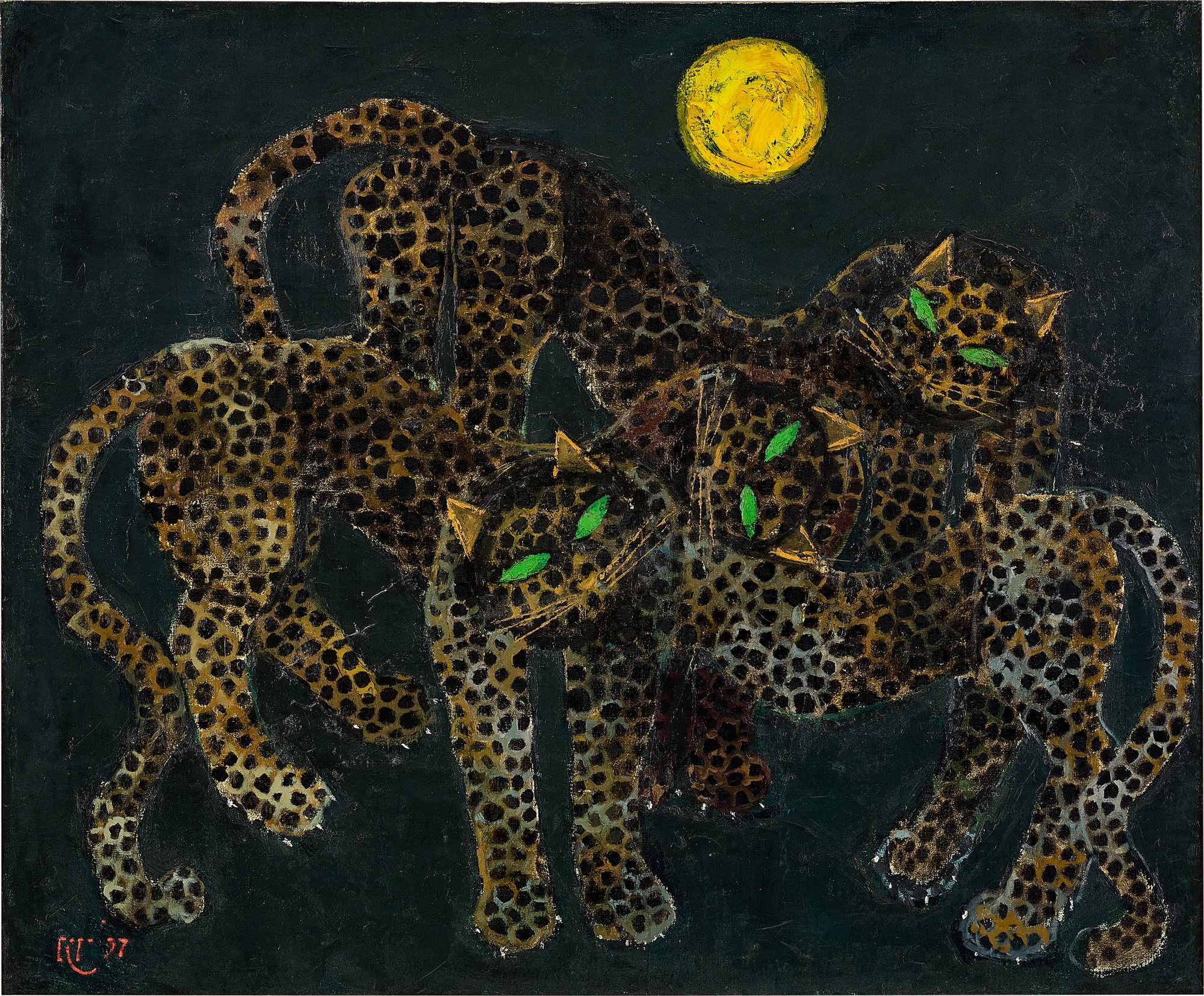
Popo Iskandar, Where Wild Things Glow
Artist Spotlight · The Collection Editorial
There is a particular stillness that falls over a room when one of Popo Iskandar's paintings is given proper light and proper space. It happened most memorably at the National Gallery Singapore during a landmark survey of Southeast Asian modernism, and it continues to happen whenever his canvases are brought out of storage and placed before fresh eyes. The leopards, those recurring, luminous presences that have come to define his legacy, seem to breathe. The moons above them seem to pull.
Popo Iskandar
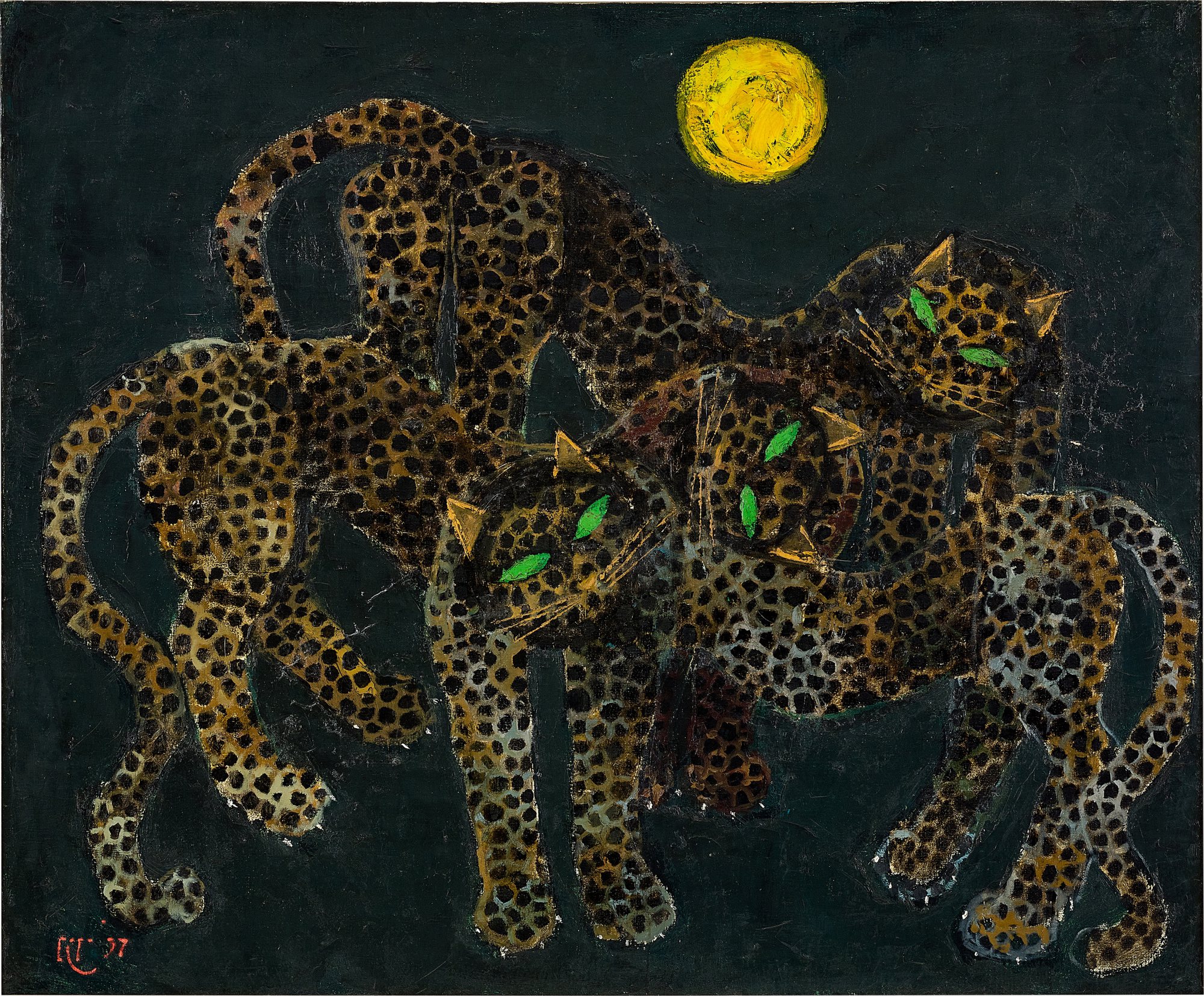
Three Leopards and the Moon 三豹和月亮, 1997
For a generation of collectors and curators rediscovering the postwar avant garde movements of Indonesia and the wider Southeast Asian region, Iskandar has emerged as one of the most emotionally direct and visually compelling voices of his era. Popo Iskandar was born in 1927 in Garut, West Java, a region of terraced rice fields, volcanic highlands, and deep Sundanese cultural tradition. He came of age during a period of extraordinary national turbulence, witnessing first the final years of Dutch colonial rule, then the Japanese occupation, and then the fire and promise of Indonesian independence in 1945. These formative experiences gave his worldview a hard won complexity.
Art, for Iskandar, was never purely decorative. It was a way of processing the enormous forces, historical, spiritual, and personal, that shape a human life. He trained at the Bandung Institute of Technology, now known as Institut Teknologi Bandung, where he would eventually spend decades as both student and educator. The Bandung school, as it came to be called, was a crucible of Indonesian modernism.
Popo Iskandar
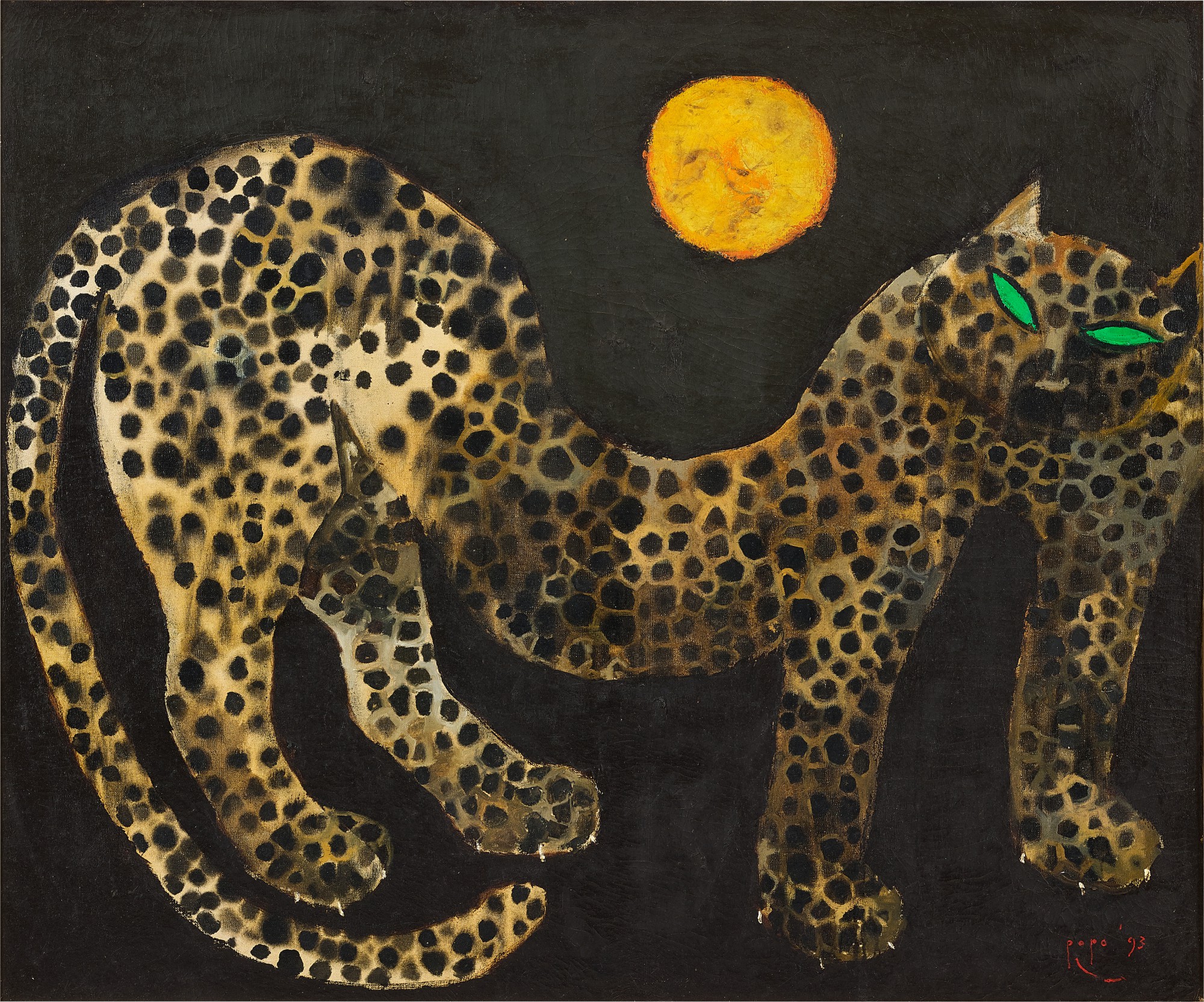
Macan dan Bulan (The Leopard and the Moon) 豹與月亮
Under the influence of Dutch painter Ries Mulder, the curriculum was deeply engaged with Western formalist traditions, particularly the structural lessons of Cézanne and the color theories circulating through postwar European painting. Iskandar absorbed these influences without being consumed by them. He understood that formalism was a tool, not a destination, and he spent the rest of his career bending that tool toward something altogether more personal and rooted. His artistic development unfolded across several distinct phases.
Early in his career, he worked through the kind of disciplined structural experimentation that the Bandung program demanded, building a rigorous understanding of composition and pictorial space. But it was in his mature work, beginning in the 1970s and reaching full power through the 1980s and 1990s, that his singular voice emerged. The subject matter narrowed and deepened simultaneously. Cats, roosters, figures glimpsed in half light, and above all, the great spotted cats of the Javan imagination began to dominate his canvases.
The paint itself grew more gestural, more alive, applied in strokes that carry the rhythm of a practiced hand working with total confidence. The works available through The Collection offer an ideal entry point into understanding what made Iskandar so enduring. "Three Leopards and the Moon" from 1997, rendered in oil on canvas, is a consummate example of his late style. Three feline forms are arranged with the kind of balanced asymmetry that recalls both Indonesian textile composition and the structural concerns of Western modernism.
The moon above them is not merely a light source but a presence, a counterweight to the animals' earthly power. There is something ceremonial about the image, something that speaks to older traditions of animist reverence without being reducible to folklore. It is a painting that belongs to no single culture and yet feels deeply, specifically Indonesian. "Macan dan Bulan," which translates as "The Leopard and the Moon," distills this vision further, concentrating the energy into a single feline and its celestial companion.
The reduction does not diminish the impact. If anything, it intensifies it. For collectors, Iskandar represents a particularly compelling proposition. His work sits at the intersection of several currents that the contemporary market is only beginning to fully value: Southeast Asian modernism, non Western abstraction, and the expressive figuration that has been reappraised so dramatically over the past two decades.
His paintings have appeared at major auction houses including Christie's and Sotheby's, with works achieving significant results in sales dedicated to Southeast Asian art. The leopard and moon compositions are among the most sought after, combining immediate visual impact with layers of cultural meaning that reward sustained attention. Condition and provenance matter enormously in this category, and works with clear exhibition histories are especially prized. To place Iskandar in broader art historical context, it is useful to think about the company he keeps.
Within the Indonesian tradition, he belongs alongside figures such as Affandi, whose expressionistic energy shares something of Iskandar's gestural urgency, and Ahmad Sadali, whose abstractionism emerged from the same Bandung crucible. On a global scale, his mature paintings invite comparison with artists working in expressive figuration across the postwar period, from the Neo Expressionists of Europe to the generation of painters, across Africa, Asia, and Latin America, who were synthesizing local tradition with international modernist language in ways that Western critics were slow to recognize. That recognition, long overdue, is now arriving with genuine force. Iskandar passed away in 2000, leaving behind a body of work that has only grown in stature in the years since.
His tenure at Institut Teknologi Bandung shaped generations of Indonesian artists, and his influence on the visual culture of West Java in particular is difficult to overstate. The leopard, in his hands, became something more than a subject. It became a symbol of independence, grace, and the wild intelligence that persists at the edges of the civilized world. In an art market and cultural conversation that is actively working to dismantle the old hierarchies that kept non Western modernists in the margins, Popo Iskandar stands as exactly the kind of artist whose time has come.
His canvases are not historical documents waiting to be filed away. They are living things, still watching, still glowing, still asking something of whoever stands before them.