Pieter Hugo
Pieter Hugo Sees the World Whole
Artist Spotlight · The Collection Editorial
“I am interested in how we look at the other, and how the other looks back at us.”
Pieter Hugo, interview with Time Magazine
In the years since his breakthrough series first circulated through the international art world, Pieter Hugo has become one of the most seriously collected and widely exhibited photographers working anywhere on the planet. His large format portraits, saturated with presence and unflinching in their gaze, have entered the permanent collections of the Victoria and Albert Museum in London, the Museum of Modern Art in New York, and the J. Paul Getty Museum in Los Angeles. That triumvirate alone signals where Hugo stands: not on the margins of contemporary photography, but at its very centre, recognized by institutions that shape the historical record.
Pieter Hugo
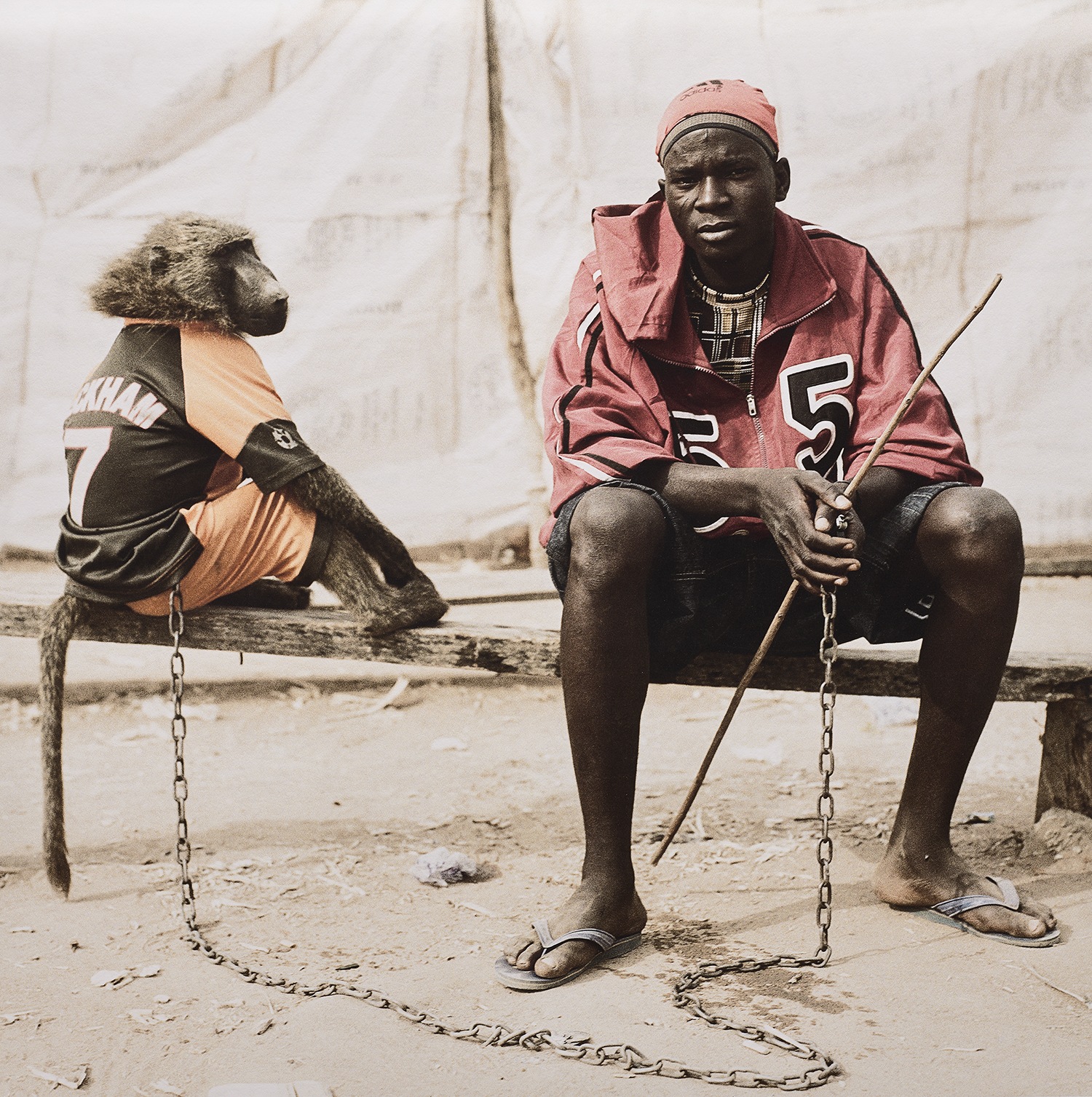
Abdulahi Galadima with the Monkey Amiloo, Nigeria from The Hyena and Other Men
His recent works have continued to find audiences at major international fairs and gallery presentations, and interest from collectors across Europe, the United States, and Asia shows no sign of slowing. Hugo was born in Cape Town in 1976, coming of age in a South Africa undergoing one of the most dramatic political transformations of the twentieth century. The end of apartheid and the turbulent, hopeful years of the new democracy formed the emotional and intellectual backdrop against which he first began to see the world through a camera. That context gave him something that cannot be taught: an acute sensitivity to the gap between how people are represented and how they actually live, between the images that travel out of Africa and the complex, layered human realities that stay behind.
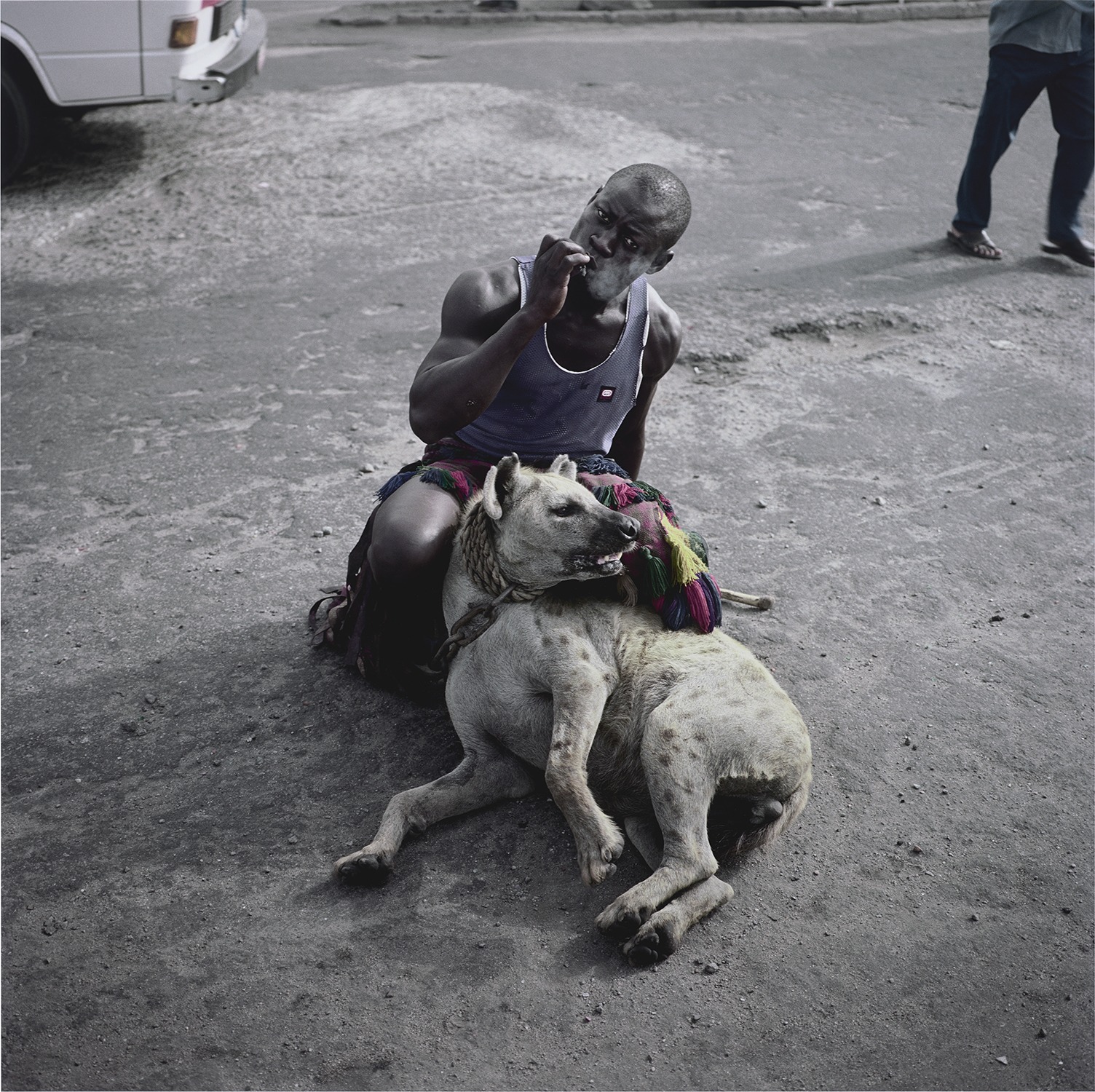
He began making photographs professionally in his twenties, initially working as a photojournalist before the constraints of that form pushed him toward something more considered and more personal. The decisive turn came in the early 2000s when Hugo encountered a photograph circulating on the internet: a group of men in northern Nigeria walking through a city with hyenas on chains. The image lodged itself in his imagination, and he eventually traveled to Nigeria to find and photograph these men himself. The resulting series, known both as Gadawan Kura and The Hyena and Other Men, announced a photographer of extraordinary gifts.
Pieter Hugo
Abdullahi Mohammed with Mainasara, Lagos, Nigeria from The Hyena & Other Men
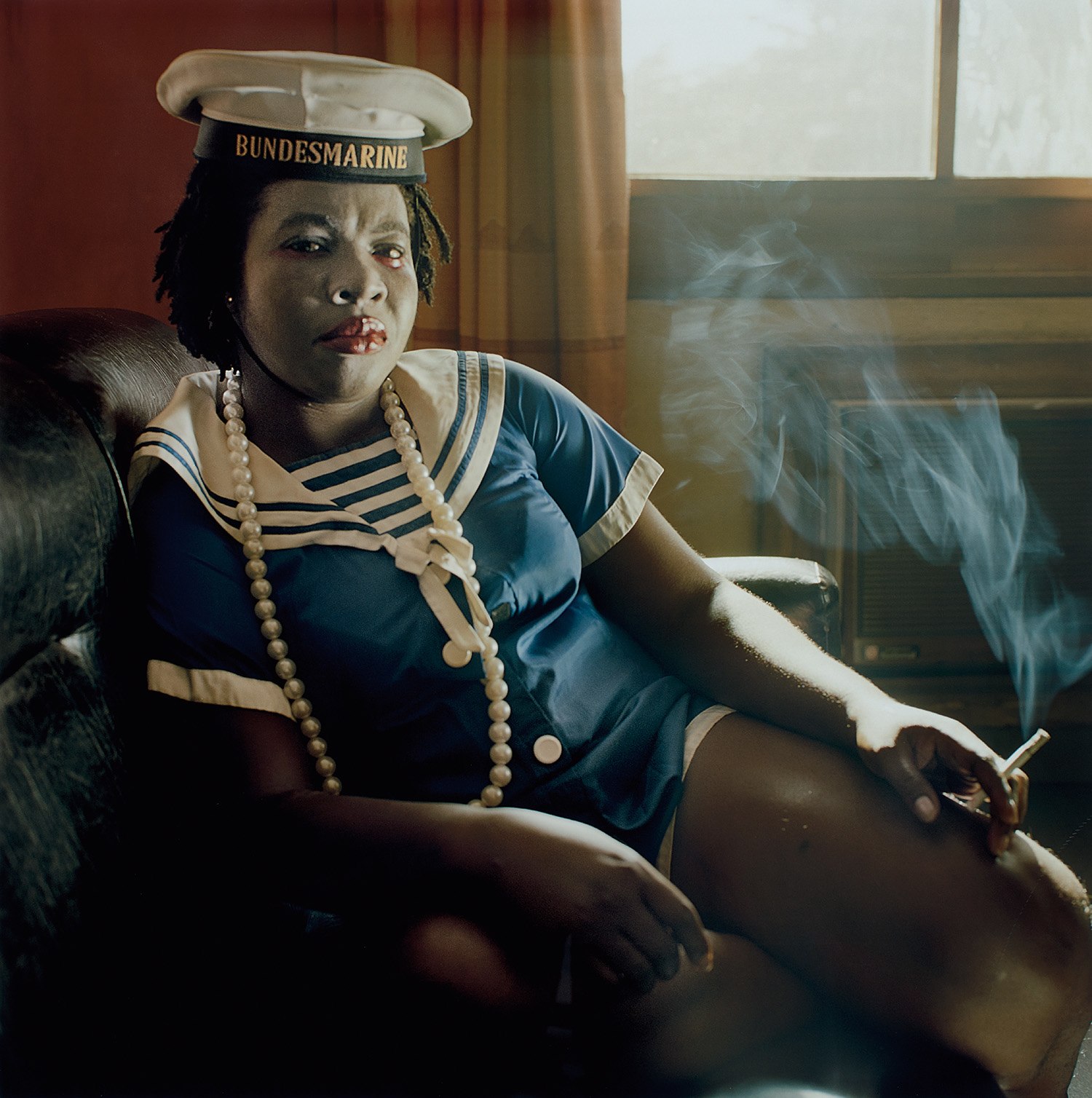
What made the work so startling was not the exotic spectacle many might have expected but precisely the opposite: Hugo's portraits insisted on the full humanity of his subjects, on their dignity, their complexity, and their irreducibility to any simple narrative. The men with their hyenas, baboons, and snakes stared back at the camera with a composure that turned the act of looking inside out. Hugo continued building a body of work defined by its willingness to go to places, both geographic and psychological, that most photographers avoid. His Nollywood series, made in and around Enugu and Lagos in Nigeria, explored the thriving popular film industry that produces more titles annually than Hollywood, examining how Nigerians construct and consume their own cinematic mythology.
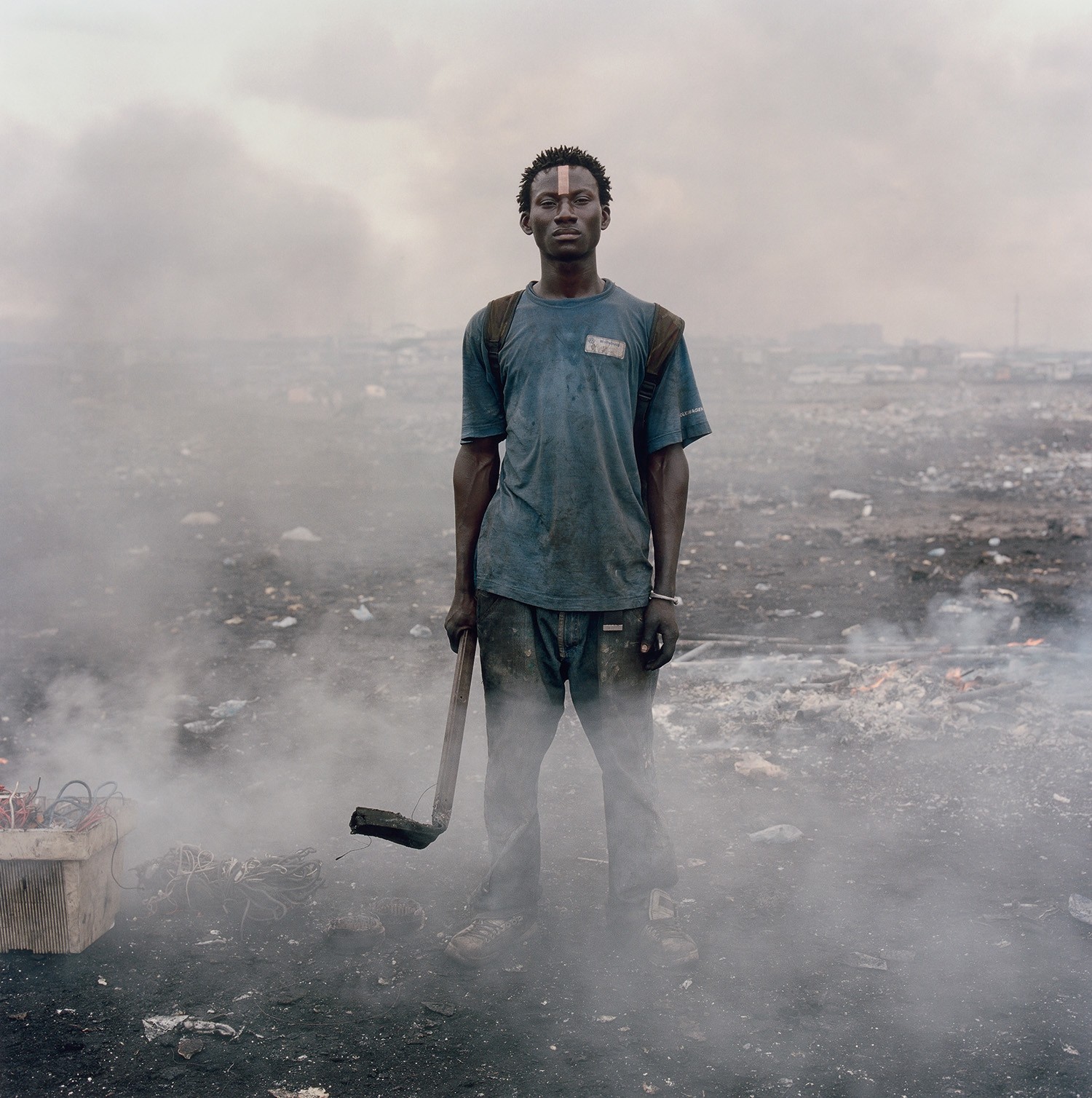
The portraits from that project, including the image of Obechukwu Nwoye in Enugu and the arresting figure of Escort Kama, capture performers in states between character and self, between performance and rest, in a way that opens onto deep questions about identity and image making. Then came Permanent Error, arguably the work that cemented his international reputation most decisively. Shot at the Agbogbloshie e waste market on the outskirts of Accra, Ghana, the series documented the landscape of discarded technology from the wealthy world, burned and broken by workers in conditions of extreme precariousness. The images of Aissah Salifu and Al Hasan Abukari at Agbogbloshie are among the most powerful photographs made this century: they combine the compositional rigor of formal portraiture with a political urgency that simply cannot be looked away from.
Pieter Hugo
Obechukwu Nwoye, Enugu, Nigeria from Nollywood
What draws collectors to Hugo's work is precisely this combination of beauty and gravity. His prints reward sustained looking in the way that great paintings do. The chromogenic prints and archival pigment prints he works in are technically immaculate, with a depth of tone and colour that reproduces the world at once faithfully and transformed. Many of his most significant works are produced in editions that are appropriately limited, and flush mounted presentations give the images a physical authority that commands any wall.
Collectors who have built serious holdings in contemporary photography have found that Hugo's work holds its position exceptionally well, both critically and in the market. His prints have appeared at major auction houses and in private sales, and works from the Hyena series and Permanent Error consistently attract competitive attention. For collectors entering the market now, works from the Nollywood series represent a particularly compelling entry point: they are somewhat less well known internationally than the signature projects, yet they demonstrate the full range of Hugo's gifts and are firmly embedded in museum collections that validate their long term significance. Hugo sits within a generation of photographers who redefined what documentary and portrait photography could be.
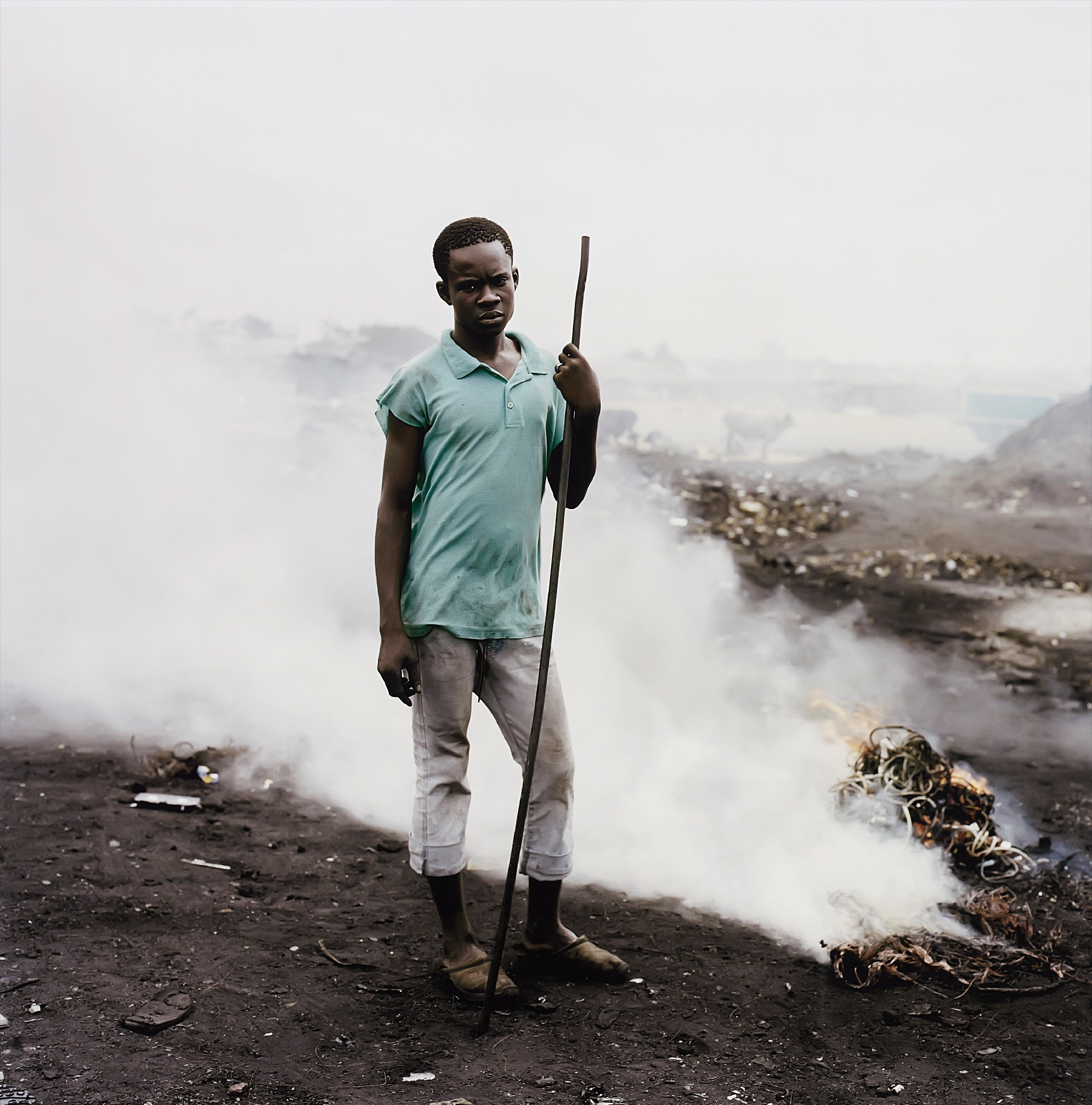
Pieter Hugo
Al Hasan Abukari, Agbogbloshie Market, Accra, Ghana from Permanent Error
His work is in conversation with that of Zwelethu Mthethwa, whose large format portraits of South African workers share Hugo's commitment to the dignity of the subject, and with the practice of Guy Tillim, whose surveys of post colonial urban Africa similarly resist easy categorization. Internationally, comparisons have been drawn with the work of Taryn Simon and Andres Serrano in terms of the deliberate, unflinching quality of the gaze, though Hugo's work is ultimately its own thing, rooted in a specifically African experience and a specifically South African sense of double consciousness about representation. His photographs acknowledge their own constructedness without retreating into irony, which is a difficult balance to strike and which he manages with a consistency that marks out a truly significant practice. The reason Pieter Hugo matters right now, and will matter for a long time to come, is that he is doing something that art at its best has always done: he is changing how we see.
He is asking audiences in galleries and museums and living rooms to sit with images that do not simplify the world, that do not offer the comfort of a single interpretation, and that treat the people they depict as full human beings deserving of full attention. In a visual culture saturated with images that flatten and reduce, his photographs expand. They make the world larger. For collectors and institutions building holdings that will define how this period of art history is understood, the work of Pieter Hugo is not optional.