Pierre Eugène Montézin
Light Made Flesh: Celebrating Pierre Montézin
Artist Spotlight · The Collection Editorial
There are painters who document the world and painters who transfigure it. Pierre Eugène Montézin belonged unmistakably to the second company. In the grand salons of Paris and along the quiet riverbanks of the Seine, his canvases arrived like windows thrown open on a summer afternoon, flooding the room with warmth, with the flutter of leaves, with water catching the last gold of a setting sun. Today, as collectors and institutions across Europe and North America rediscover the full richness of the French Post Impressionist tradition, Montézin stands out as one of its most purely pleasurable and technically accomplished voices, an artist whose reputation has only grown more luminous with time.
Pierre Eugène Montézin
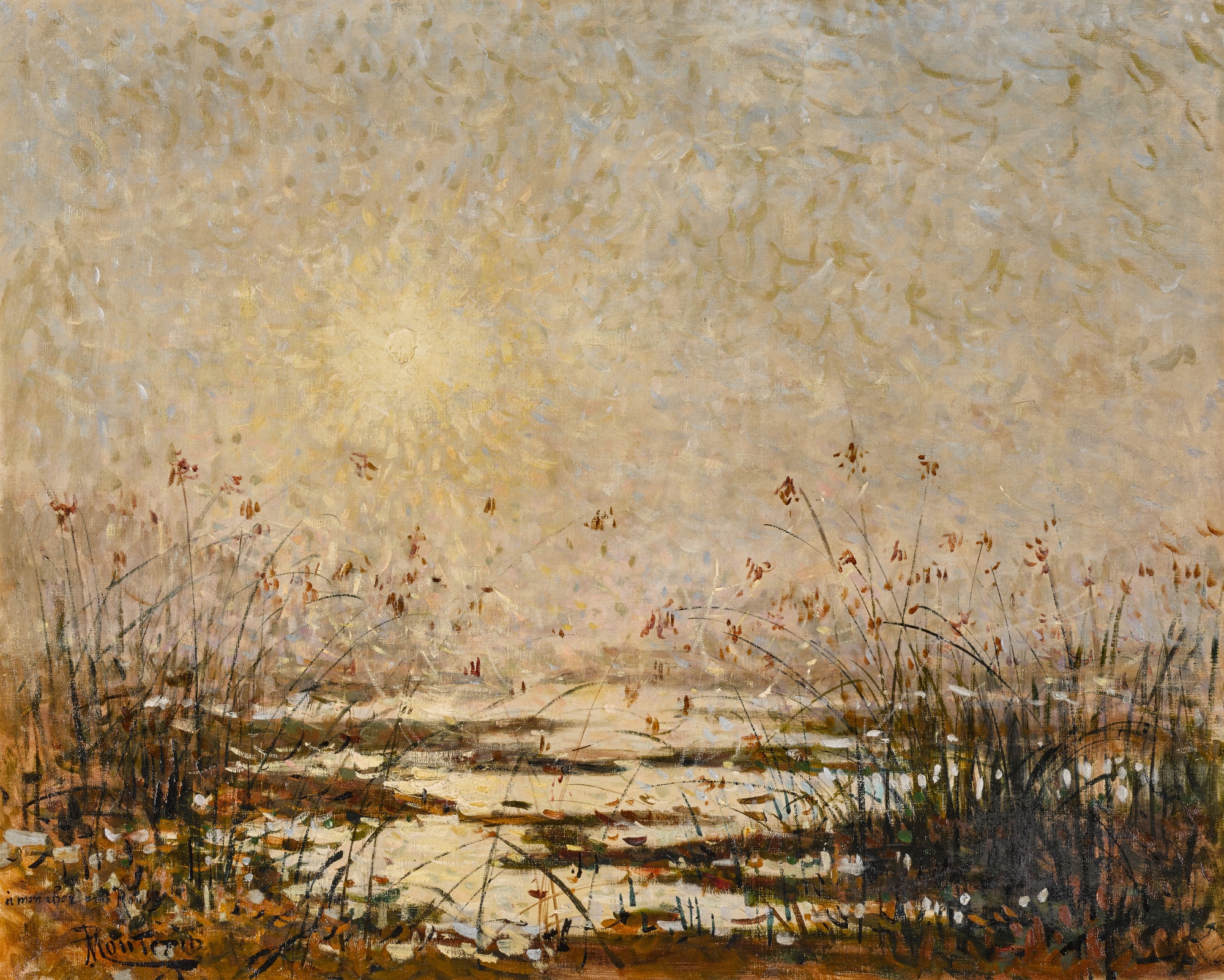
Coucher de soleil sur le marais fleur, 1905
Montézin was born in Paris in 1874, at a moment when the city itself was being remade and the art world was convulsing with new possibilities. The great Impressionists, Monet, Pissarro, Sisley, were already at work transforming how paint could capture fleeting sensation, though their recognition was still a contentious and uneven affair. Montézin came to painting not through the conventional gates of the École des Beaux Arts but through the humbler, hands on world of decorative painting and design. This formation was not a limitation.
It gave him a craftsman's intimacy with surface and material, a decorator's instinct for composition and color harmony, and a freedom from academic orthodoxy that would prove enormously generative throughout his career. His path to recognition was patient and determined rather than sudden. Working largely without formal instruction in the fine arts, Montézin built his practice through sustained looking and through direct, repeated engagement with landscape. The French countryside around the Seine valley, the marshlands and riverscapes of the Île de France, the gardens of the Paris suburbs: these became his primary subject matter and his laboratory.
Pierre Eugène Montézin
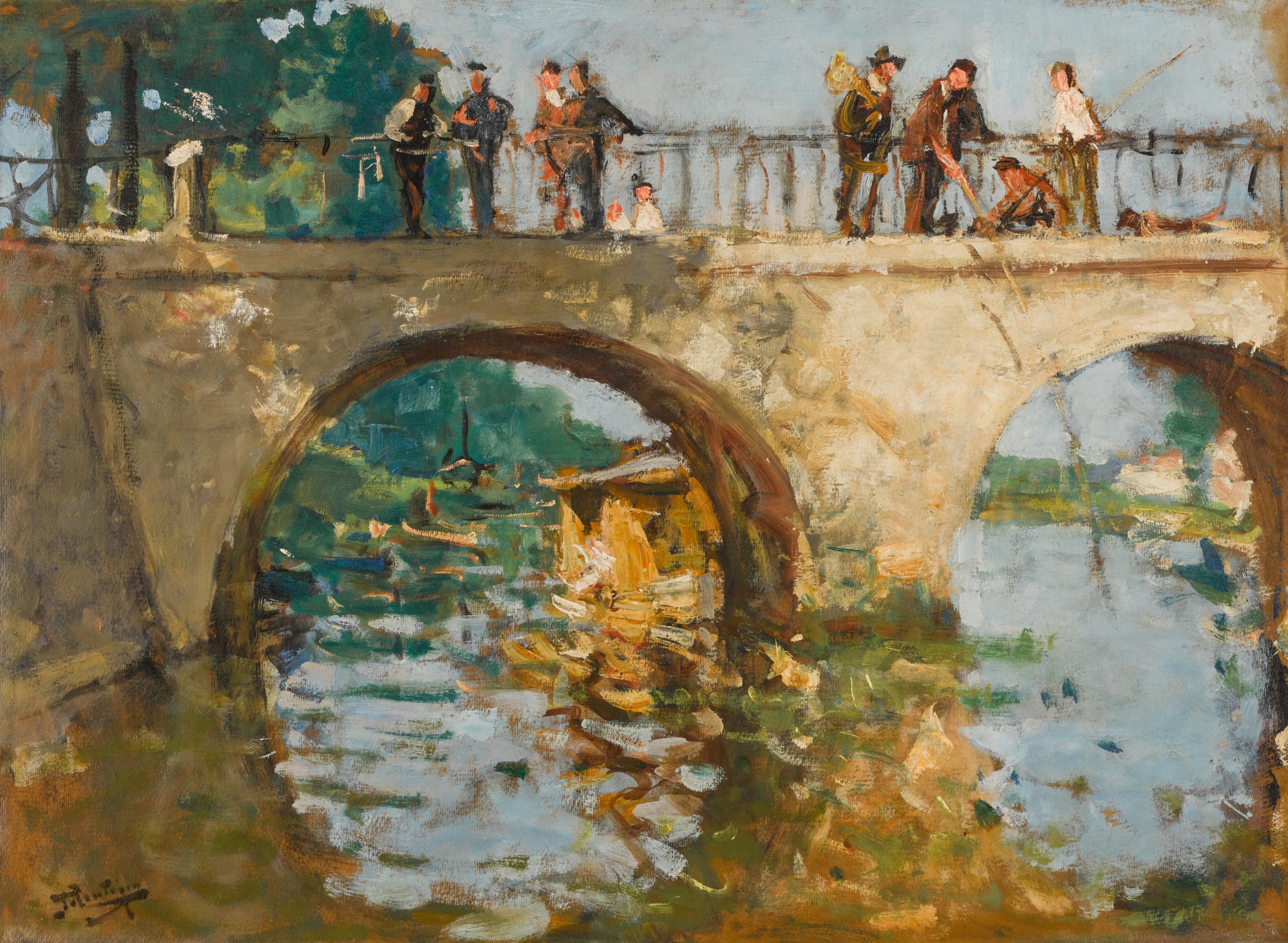
Les Pêcheurs sur le pont de Saint Mammés
He submitted regularly to the Salon, building a reputation through consistent quality and the particular emotional intelligence of his vision. His breakthrough came when he was awarded the Prix de Rome, an honor that confirmed his standing not merely as a self made enthusiast but as a painter of genuine and recognized accomplishment. The prize, associated historically with the most rigorous academic traditions in French art, was a striking validation for a man who had arrived at his art through entirely unconventional means. Where Montézin truly found his voice was in the treatment of light: specifically the broken, dappled, endlessly shifting light of the French outdoors at its most generous hours.
His brushwork loosened and quickened over the course of his career, moving toward a confidence and freedom that placed him in natural dialogue with the Impressionist masters he admired, while remaining distinctly his own. He was not an imitator of Monet or Sisley but a painter who had absorbed their fundamental discoveries about perception and sensation and then applied them to his own temperament and his own deeply loved geography. Color in his hands became almost musical, with warm oranges and yellows playing against cool blue greens, and passages of near white light interrupting foliage and water with something close to joy. Among the works that best represent his achievement, the oil on canvas "Coucher de soleil sur le marais fleur" from 1905 holds a special place.
Pierre Eugène Montézin
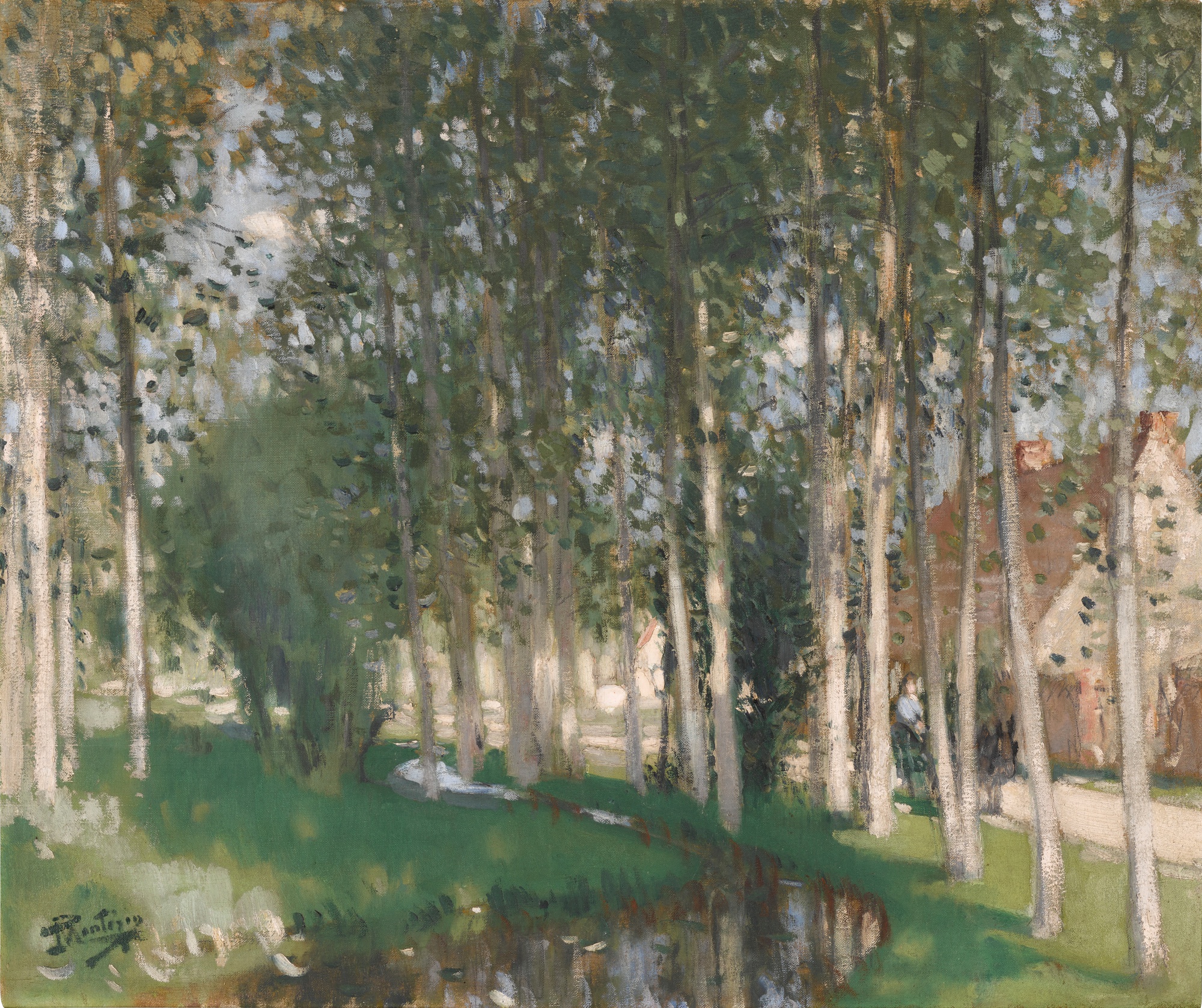
Les peupliers
Painted at a moment when Montézin was developing his mature handling, the work captures the particular stillness and incandescence of a marsh landscape at sunset, the sky and the water exchanging light in a way that dissolves the boundary between reflection and reality. "Les Pêcheurs sur le pont de Saint Mammés," executed in oil on card laid down on canvas, shows his affection for the working river life of the Seine corridor, a subject that connected him to a long tradition of French plein air painting while remaining grounded in observed, specific truth. "Les peupliers," with its vertical rhythms of poplar trees against sky, demonstrates his ability to find grandeur and lyricism in the most familiar elements of the French rural scene. Each of these works rewards sustained looking, revealing more the longer one stays with them: a shimmer here, a passage of surprising color there, a brushmark that captures the trembling of air itself.
For collectors, Montézin represents a compelling proposition on multiple levels. His work appears regularly at auction in France, the United Kingdom, and the United States, with strong results reflecting sustained demand from both European and international buyers. His paintings have appeared at major auction houses including Christie's, Sotheby's, and Drouot, where his riverscapes and garden scenes consistently attract competitive bidding. Collectors drawn to the French Impressionist and Post Impressionist tradition find in Montézin a painter of comparable quality to better known names but with a character and intimacy that is entirely his own.
When considering a purchase, the qualities to seek are consistent with his best work: the luminosity of the light, the confidence and freedom of the brushwork, the sense that the scene is alive and breathing rather than merely recorded. Works from the first two decades of the twentieth century, when his technique was most fully developed and his vision most assured, tend to represent the finest expression of his gifts. Montézin's place in art history is best understood in relation to the generation of painters who followed and extended the Impressionist revolution without simply repeating it. Artists such as Henri Lebasque, Gustave Loiseau, and Albert André occupied similar territory, sharing his commitment to the pleasures of light and landscape and his belief in the primacy of direct sensation.
Like them, he was deeply connected to the world of the official Salon while remaining sympathetic to the liberating energies of the avant garde. His eventual election as a member of the Académie des Beaux Arts represented the fullest possible institutional recognition, a sign that the Post Impressionist generation had not merely challenged the established order but had earned its place within it. Montézin died in 1946, having lived through two world wars and the radical transformations of twentieth century art, yet his commitment to his particular vision never wavered or seemed defensive. He understood what he was doing and why it mattered: that the beauty of the French countryside, of afternoon light on moving water, of gardens in their full summer abundance, was not a trivial subject but one of the most profound and enduring concerns a painter could have.
In an era of increasing noise and abstraction, his canvases offer something genuinely rare: the sense that looking carefully at the world is itself a form of gratitude. For collectors who believe that painting can and should move us, Montézin remains one of the most eloquent advocates of that faith.
Explore books about Pierre Eugène Montézin
Montézin
François Daulte
Pierre Eugène Montézin: Catalogue Raisonné de l'Œuvre Peint
François Daulte
Montézin: L'œuvre complet
Galerie Schmit
Pierre Eugène Montézin: Paysagiste Luminariste
Robert Schmit