Pierre Bonnard
Pierre Bonnard: A Feast for the Eyes
Artist Spotlight · The Collection Editorial
“Color does not add a pleasant quality to design. It reinforces it.”
Pierre Bonnard, notes and writings
There are painters who document the world, and there are painters who transfigure it. Pierre Bonnard belongs emphatically to the second category. When the Musée d'Orsay and the Royal Academy of Arts mounted major retrospectives of his work in the early 2000s, critics and collectors were reminded again of something that serious admirers had always known: Bonnard did not merely paint rooms, gardens, and bodies. He painted the sensation of being alive inside a moment, the shimmer of late afternoon light through a window, the warmth of a table set with fruit and wine, the impossible richness of a life lived in close attention to ordinary beauty.
Pierre Bonnard
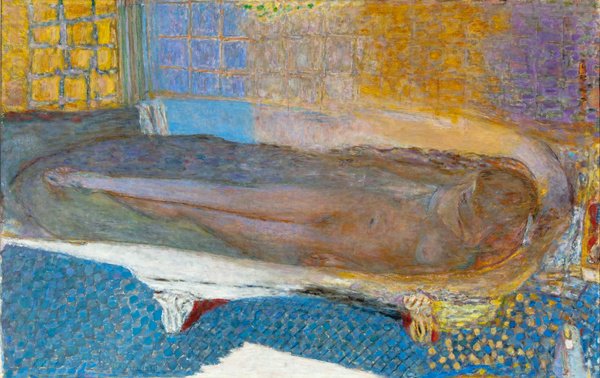
Nu dans le bain, 1936
His prices at auction have climbed steadily in the decades since, with major oils regularly achieving seven figures at Christie's and Sotheby's, and his works are among the most warmly contested in the post Impressionist canon. Pierre Bonnard was born on October 3, 1867, in Fontenay aux Roses, just south of Paris, the son of a senior official at the French Ministry of War. His upbringing was comfortable and bourgeois, shaped by the rhythms of Parisian intellectual life and long summers at the family property at Le Grand Lemps in the Dauphiné region. That rural retreat, with its enclosed gardens, dappled terraces, and sense of life conducted at a gentle remove from the city, would echo through his work for the rest of his life.
He studied law to satisfy his father before enrolling at the École des Beaux Arts and then the Académie Julian, where his real education began. It was there, in the late 1880s, that he fell in with a group of young painters who would change the course of French art. The circle that gathered around the charismatic Paul Sérusier at the Académie Julian called themselves the Nabis, from the Hebrew word for prophets. The group included Édouard Vuillard, Maurice Denis, Paul Ranson, and Ker Xavier Roussel, and they were united by a shared devotion to the lessons of Paul Gauguin, whose insistence on the expressive autonomy of color and form had opened a new world.
Pierre Bonnard
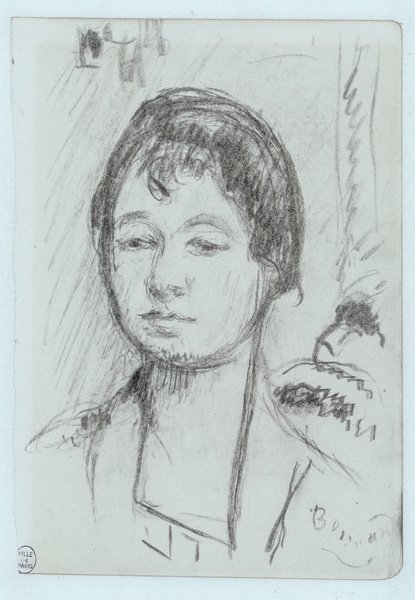
Buste de femme, 1900
Bonnard absorbed these ideas with particular intensity. In his early career he produced graphic work of genuine brilliance, including posters and illustrations that showed the influence of Japanese woodblock prints, a passion he shared with many of his contemporaries. His 1891 poster for France Champagne announced a talent of the first order and brought him to the attention of the Parisian art world almost overnight. He was briefly and affectionately nicknamed the Japanese Nabi by his friends.
“The painter must not paint what he sees, but what will be seen.”
Pierre Bonnard
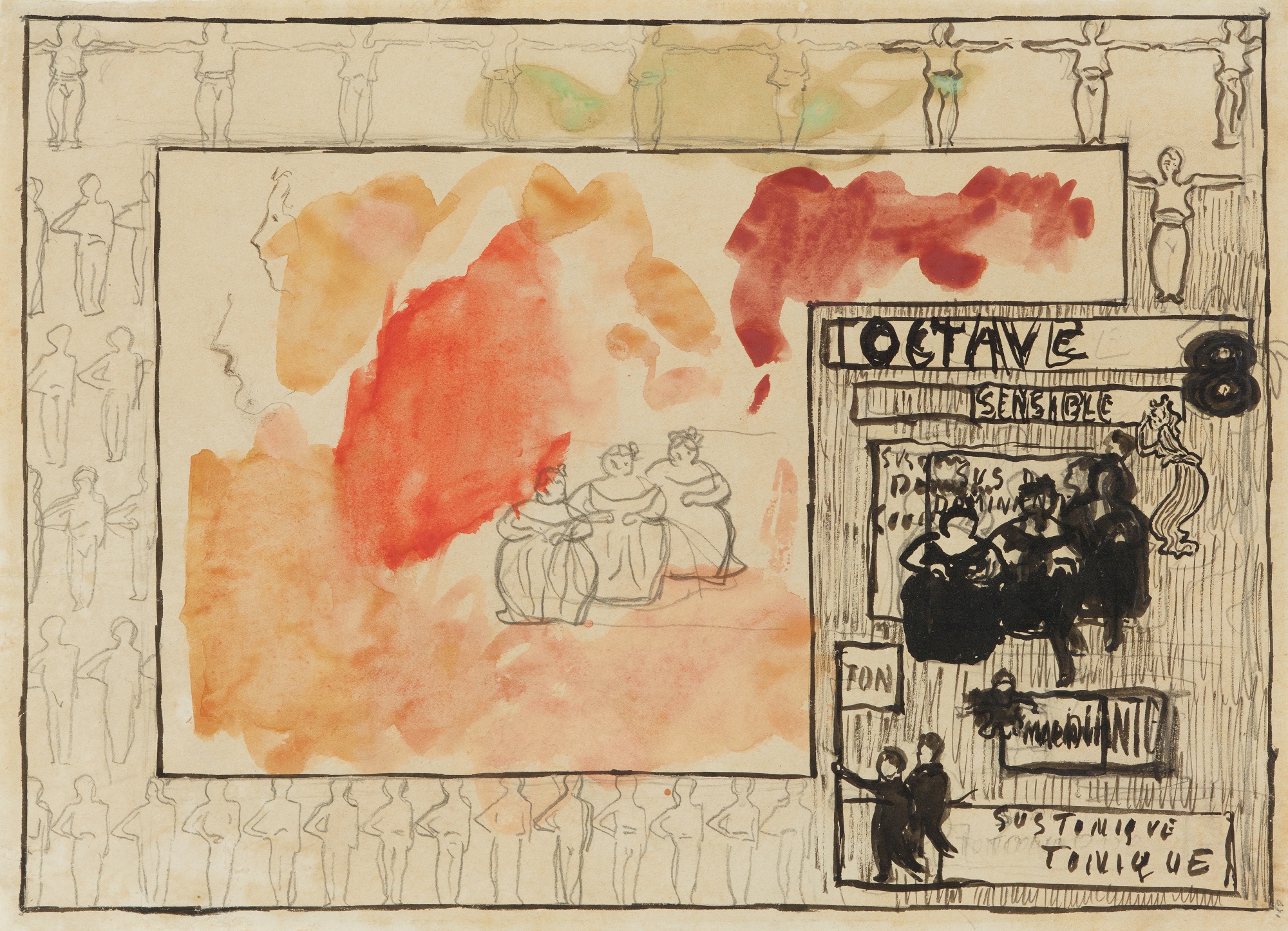
Bonnard spent the 1890s moving fluently between painting, printmaking, illustration, and decorative work, and the fluency of that movement shaped everything he would later do. He illustrated books, designed theater programs, and contributed to the journals and cultural projects that defined the avant garde in fin de siècle Paris. He was close to the poet and critic Octave Mirbeau, and his work was shown at the Galerie Durand Ruel, the great house of Impressionism, where he appeared alongside artists who were still reshaping the idea of what a painting could be. Through all of this activity, a signature approach was beginning to crystallize: a devotion to domestic and intimate subjects rendered in color relationships of extraordinary tension and vibrancy, forms compressed and tilted, space flattened and reimagined, the everyday world made strange and radiant.
Pierre Bonnard
Assiette de fruits, 1917
The great subject and the great presence in Bonnard's life and work was Marthe de Méligny, born Maria Boursin, whom he met in 1893 and who became his companion for decades before they married in 1925, remaining together until her death in 1942. Marthe was famously private, reclusive, and consumed by a near ritual devotion to bathing, a habit rooted in anxiety about her health. For Bonnard, this became the occasion for one of the most sustained and searching investigations of the human body in twentieth century painting. Works such as Nu dans le bain, completed in 1936 and among the most celebrated paintings in the entire Bonnard canon, show Marthe submerged in a bathtub of almost visionary chromatic intensity.
The body is present but dissolved into light and pattern, the bathroom tiles surrounding her a cascade of blue and gold, the water a luminous skin. These are not portraits in any conventional sense. They are meditations on presence, on intimacy, on the way that love transforms perception. Bonnard's mature work, produced in the long years he spent in the south of France at his house Le Bosquet in Le Cannet, near Cannes, is distinguished by a relationship to color that has no real parallel in modern painting.
Pierre Bonnard
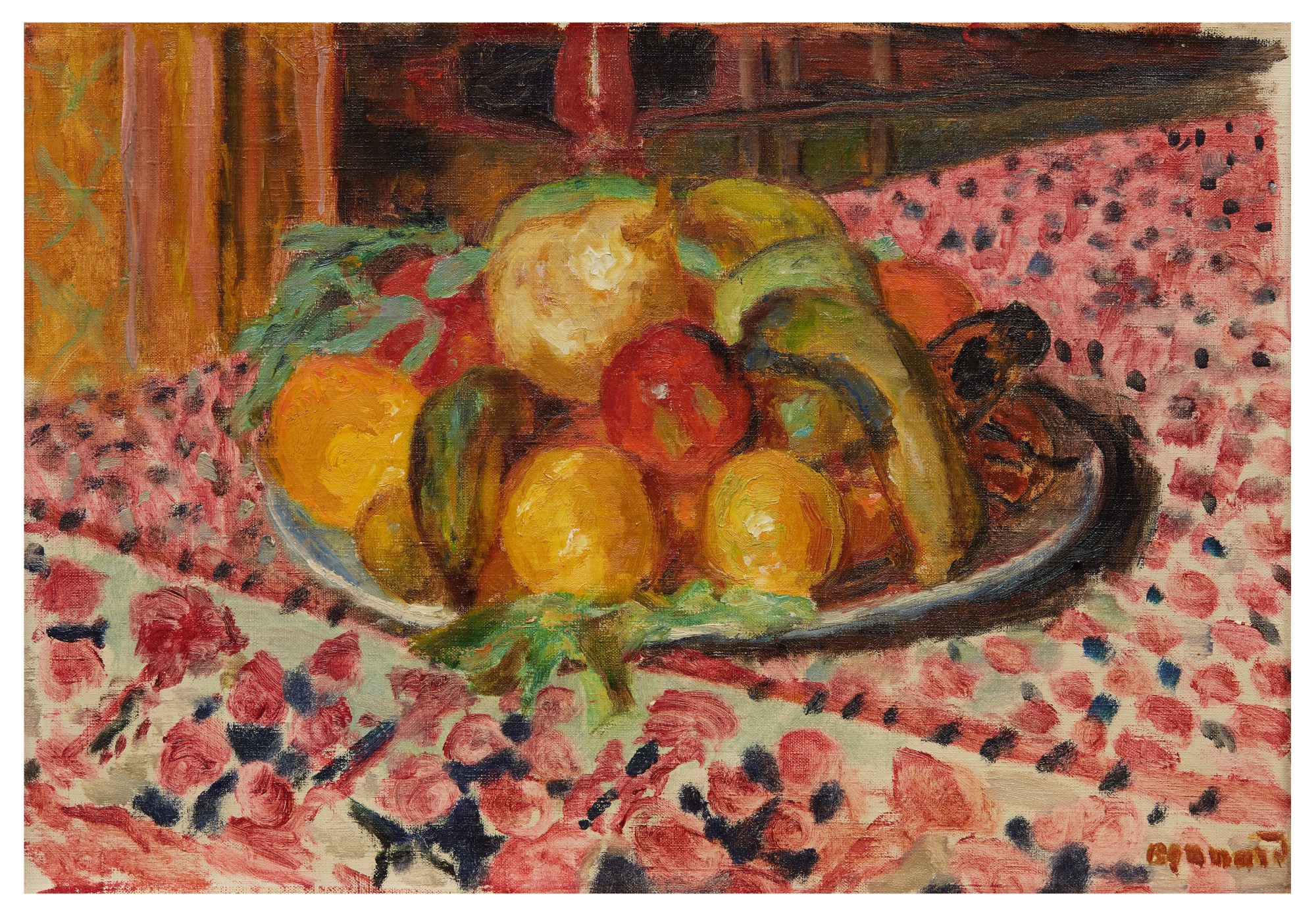
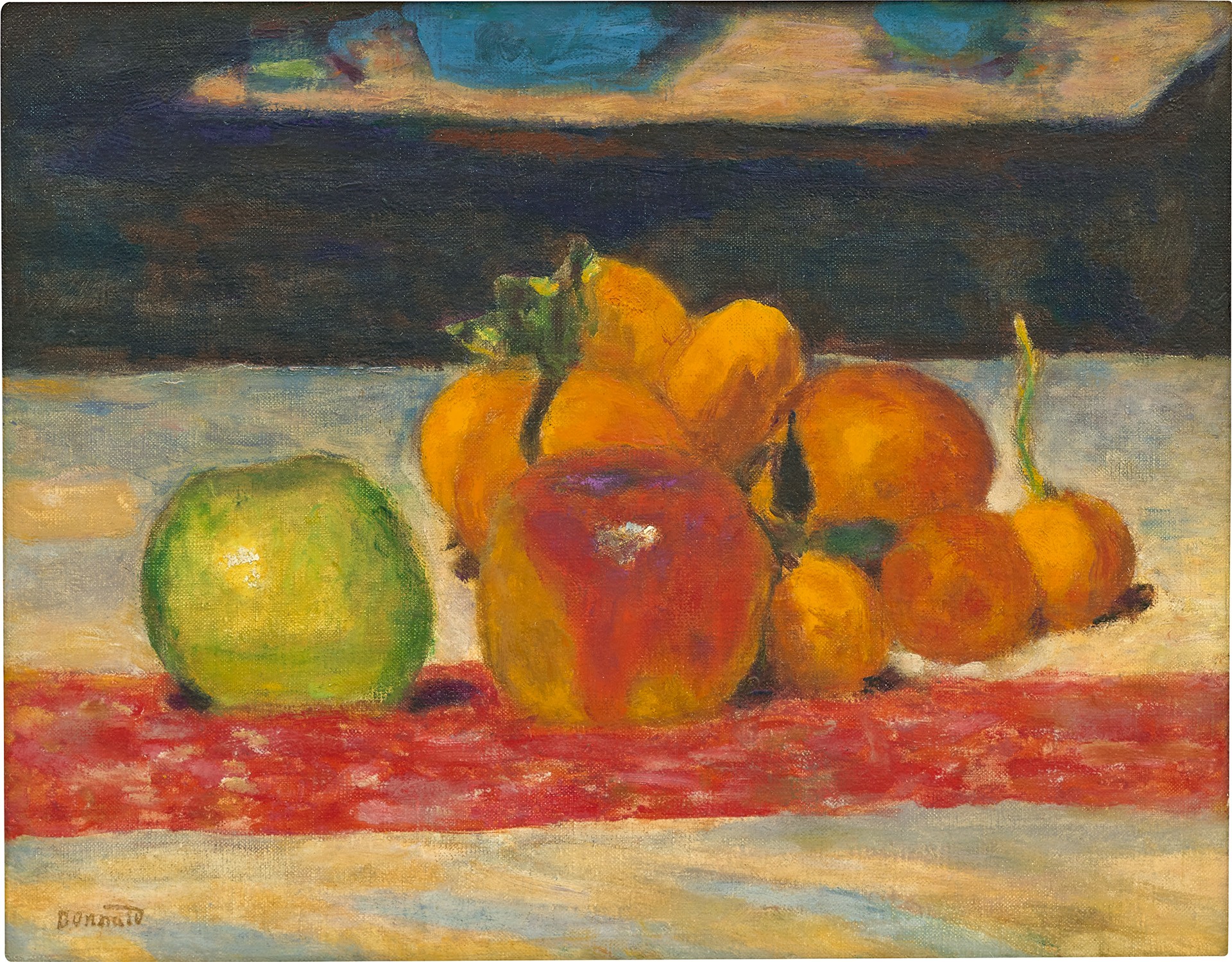
Nature morte, fruits (Still Life with Fruits), 1942
He worked from memory rather than direct observation, keeping small sketches and notes and then building his canvases in the studio from accumulated sensation. The result is color that feels emotionally true rather than optically accurate, yellows that vibrate against purples, pinks that push into orange, greens that carry within them the memory of every garden he had ever loved. His still lifes, including the radiant Nature morte, fruits of 1942, show fruit and vessels arranged on tables that seem to glow from within, the simple materials of domestic life elevated to something approaching the sacred. His garden paintings, such as Jardin au bord de la Seine, record a particular quality of French light that no photographer has ever quite captured.
For collectors, Bonnard represents one of the most compelling propositions in the post Impressionist market. His range is genuinely broad: from the graphic brilliance of his early prints and preparatory drawings, which offer an accessible and historically rich entry point, to the grand domestic oils and the late bathtub paintings that sit among the masterpieces of European modernism. Works on paper and preparatory studies, including his beautiful preparatory drawings for book illustrations and cover designs, carry the full weight of his vision in a more intimate register. Collectors drawn to Vuillard, Denis, or the late Cézanne will find in Bonnard a natural companion, while those who love the color field painters of the American mid century, particularly Mark Rothko, who openly acknowledged Bonnard as an influence, will recognize in him a sensibility that reaches across the decades.
The question of Bonnard's place in art history has been argued over with real passion since his death in Le Cannet on January 23, 1947. For a period in the postwar years, when Clement Greenberg's formalist orthodoxy dominated critical thinking, Bonnard was sometimes dismissed as too decorative, too devoted to pleasure, insufficiently rigorous. That argument has not aged well. What we see in his work now is not a retreat from difficulty but a radical commitment to the full complexity of subjective experience, the way light changes everything, the way intimacy reshapes vision, the way the domestic world contains within it the full range of human feeling.
He painted joy without sentimentality, beauty without superficiality, and love without ideology. In a century that often seemed to distrust all three, that achievement looks not smaller but larger with every passing year.
Explore books about Pierre Bonnard
Bonnard
Jean Leymarie
Pierre Bonnard: A Life
Elizabeth Easton and Suzanne G. Lindsay
Bonnard: The Complete Paintings
Guy-Patrice and Michel Dauberville
Pierre Bonnard, 1867-1947
Antoine Terrasse
Bonnard and His Environment
Sophie Bowness
The Intimate Interiors of Pierre Bonnard
Andrew Forge

Bonnard: Colour and Light
Jean Clair
Pierre Bonnard: Drawings
Sasha M. Newman