Pierre Alechinsky
Pierre Alechinsky, Where Ink Meets Infinite Freedom
Artist Spotlight · The Collection Editorial
“I paint with my back to the world.”
Pierre Alechinsky
In the spring of 2024, the Musée d'Art Moderne de Paris reaffirmed what a devoted circle of collectors and curators has long understood: Pierre Alechinsky remains one of the most vitally alive figures to have emerged from postwar European painting. His work has been the subject of renewed institutional attention across France and Belgium, and at auction his canvases and works on paper continue to attract serious competition, particularly among collectors who prize the rare combination of gestural urgency and deeply literate sensibility. At nearly one hundred years of age, Alechinsky endures not as a monument to a finished era but as an ongoing argument for the irreplaceable power of the mark made by hand. Pierre Alechinsky was born in Brussels in 1927, into a household shaped by medicine and music, two disciplines that reward both precision and improvisation.
Pierre Alechinsky
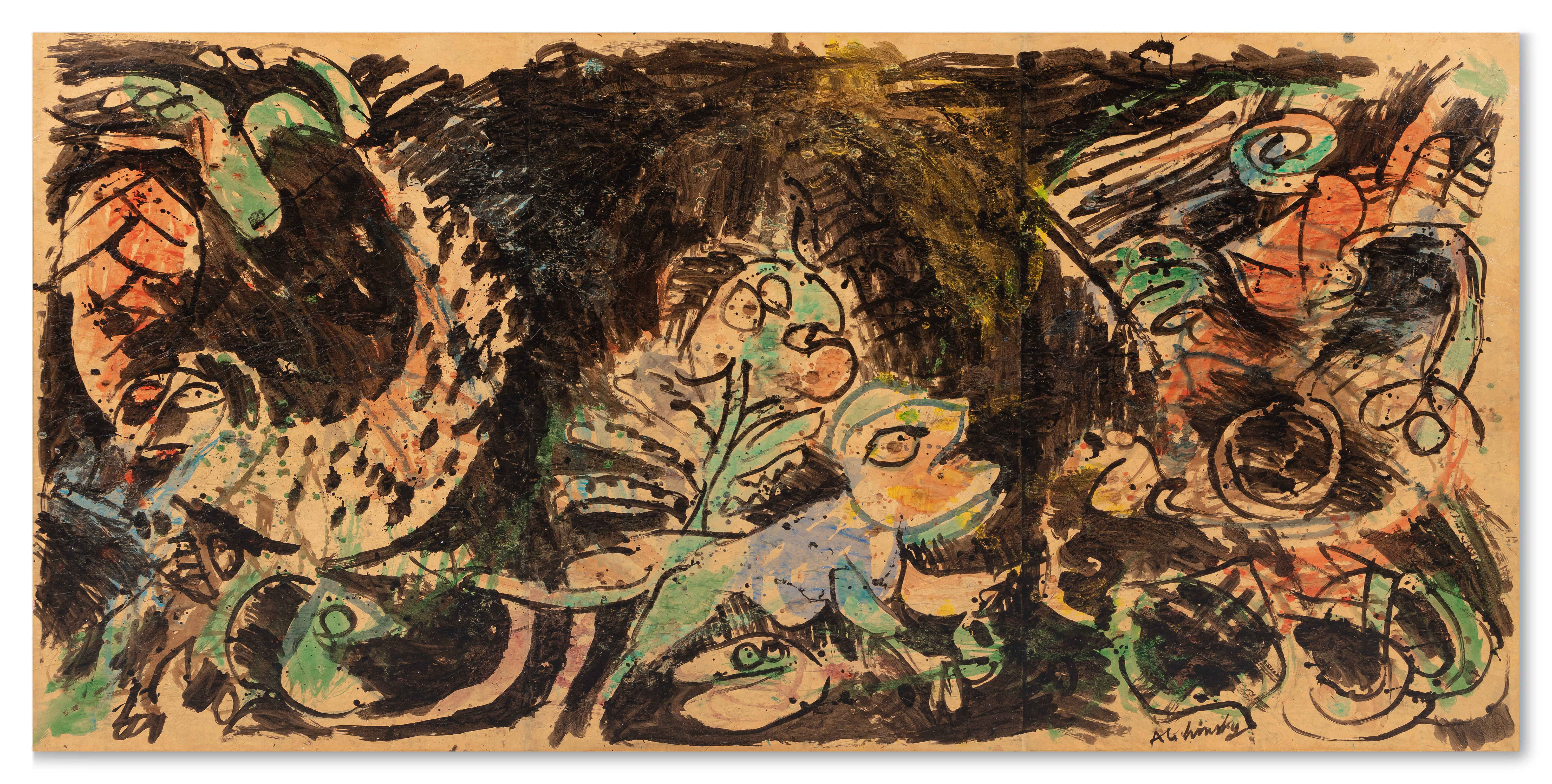
Contre courant, 1965
He studied illustration and typography at the École Nationale Supérieure des Arts Visuels de la Cambre in Brussels during the 1940s, where his formation was technical as well as artistic. That grounding in typography and the printed word would never leave him. Throughout his career, text and image would coexist in his work not as opposites but as kindred energies, two streams of human expression flowing from the same source. In 1949, Alechinsky became one of the founding members of CoBrA, the radical international movement whose name compressed the cities of Copenhagen, Brussels, and Amsterdam into a single battle cry.
CoBrA was a declaration of war against the constraints of academic painting and the cold geometries of constructivism, and it drew together artists including Asger Jorn, Karel Appel, and Constant in a shared pursuit of raw, mythic, childlike expression. The movement lasted only three years before dissolving in 1951, but its influence on Alechinsky was permanent. CoBrA gave him permission to be ferocious, instinctive, and generous on the canvas all at once. After CoBrA disbanded, Alechinsky moved to Paris, which became his adoptive home and the city most associated with his mature career.
Pierre Alechinsky
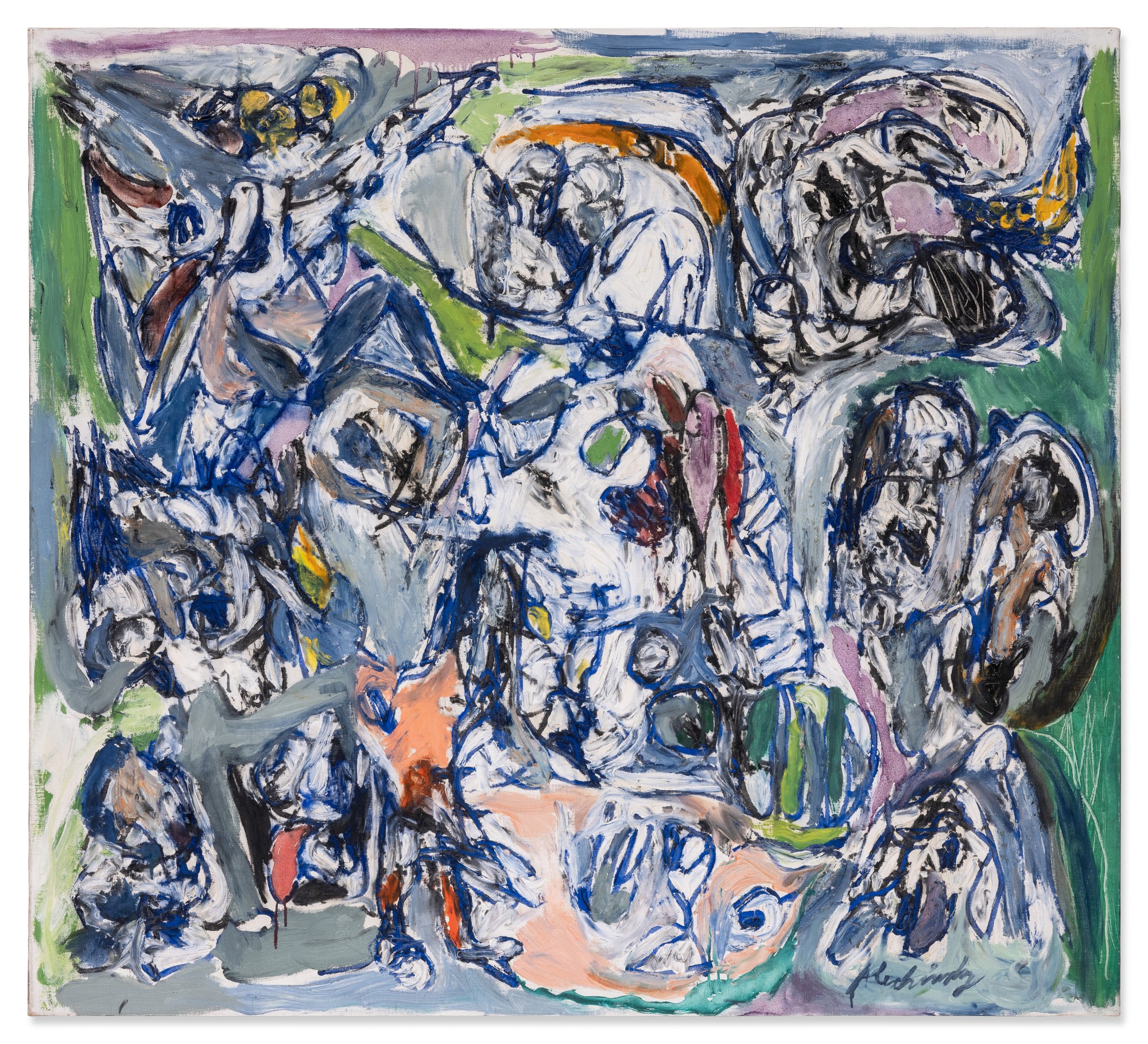
Connaisseurs de gouffres, 1962
He studied printmaking under Stanley William Hayter at the legendary Atelier 17, deepening his mastery of etching and engraving. In 1955 he traveled to Japan, where he filmed calligraphers at work and absorbed the philosophy of Zen brushwork, an encounter that would profoundly shape his understanding of line as gesture and gesture as thought. This influence is visible throughout the decades that followed, in the way his ink lines breathe and hesitate and accelerate, as if transcribing something urgent from the interior world. The works from the late 1950s and early 1960s represent one of the great sustained achievements in postwar European painting.
“Calligraphy taught me that the line is a living thing, not a boundary.”
Pierre Alechinsky, on his 1955 journey to Japan
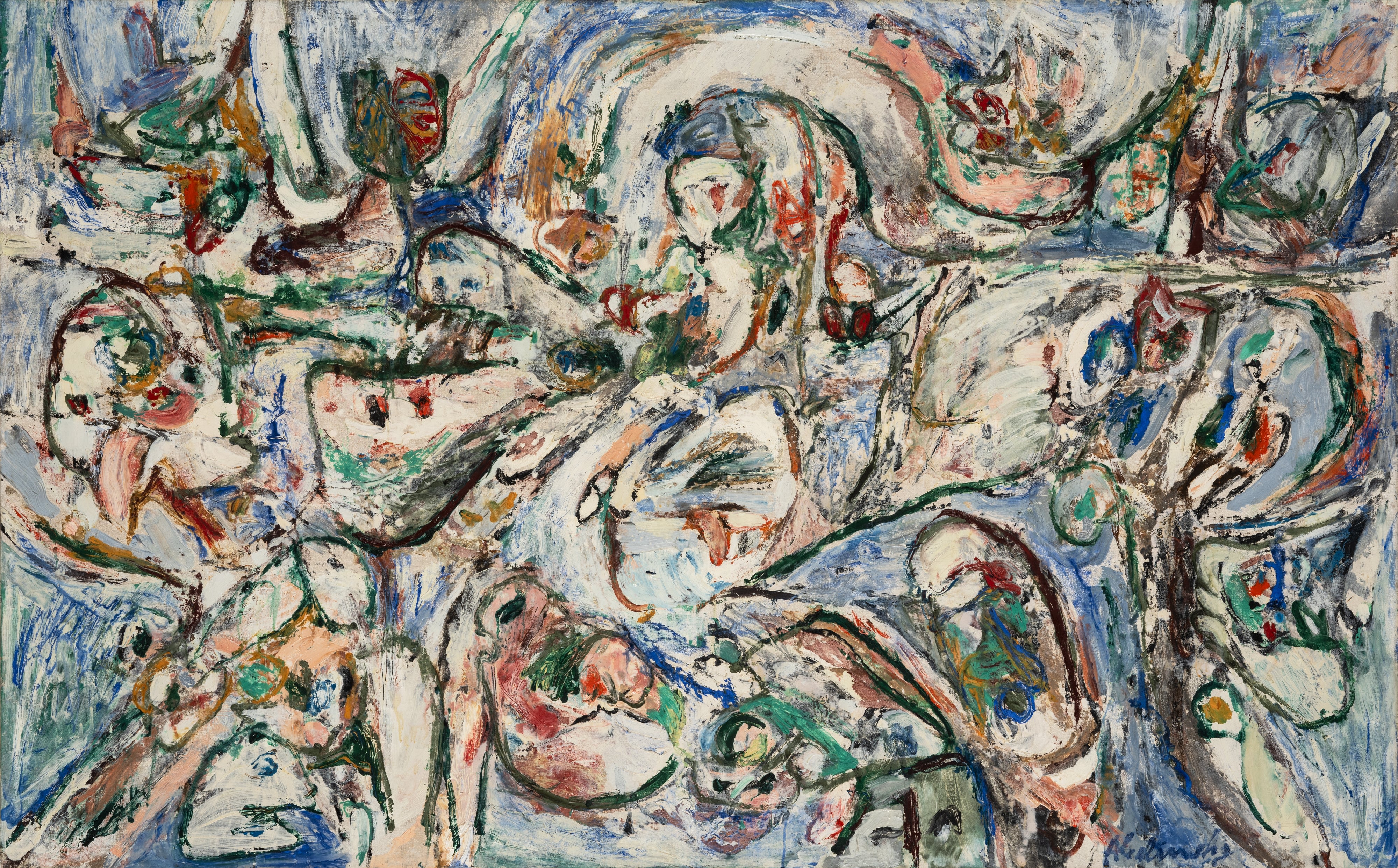
"Les Polyglottes" from 1959 is an extraordinary example of this period, a large oil on canvas in which fantastical creatures and writhing forms populate a pictorial field that feels simultaneously ancient and fully invented. "Connaisseurs de gouffres" from 1962 and "Encore une petite chanson" from 1961 share this quality of visionary density, each canvas a world teeming with presences that seem to have erupted from dreams, folklore, and some private mythology all at once. The borders of many of Alechinsky's paintings from this era contain smaller marginal images, a device borrowed from medieval manuscripts and comic strips alike, creating a visual counterpoint to the central composition and giving the work a narrative restlessness that keeps the eye in perpetual motion. The medium of ink on paper is where Alechinsky's hand feels most freely itself, and works such as "Contre courant" from 1965 and "Bouquet Persique" from 1983 demonstrate the full range of what he can achieve within it.
Pierre Alechinsky
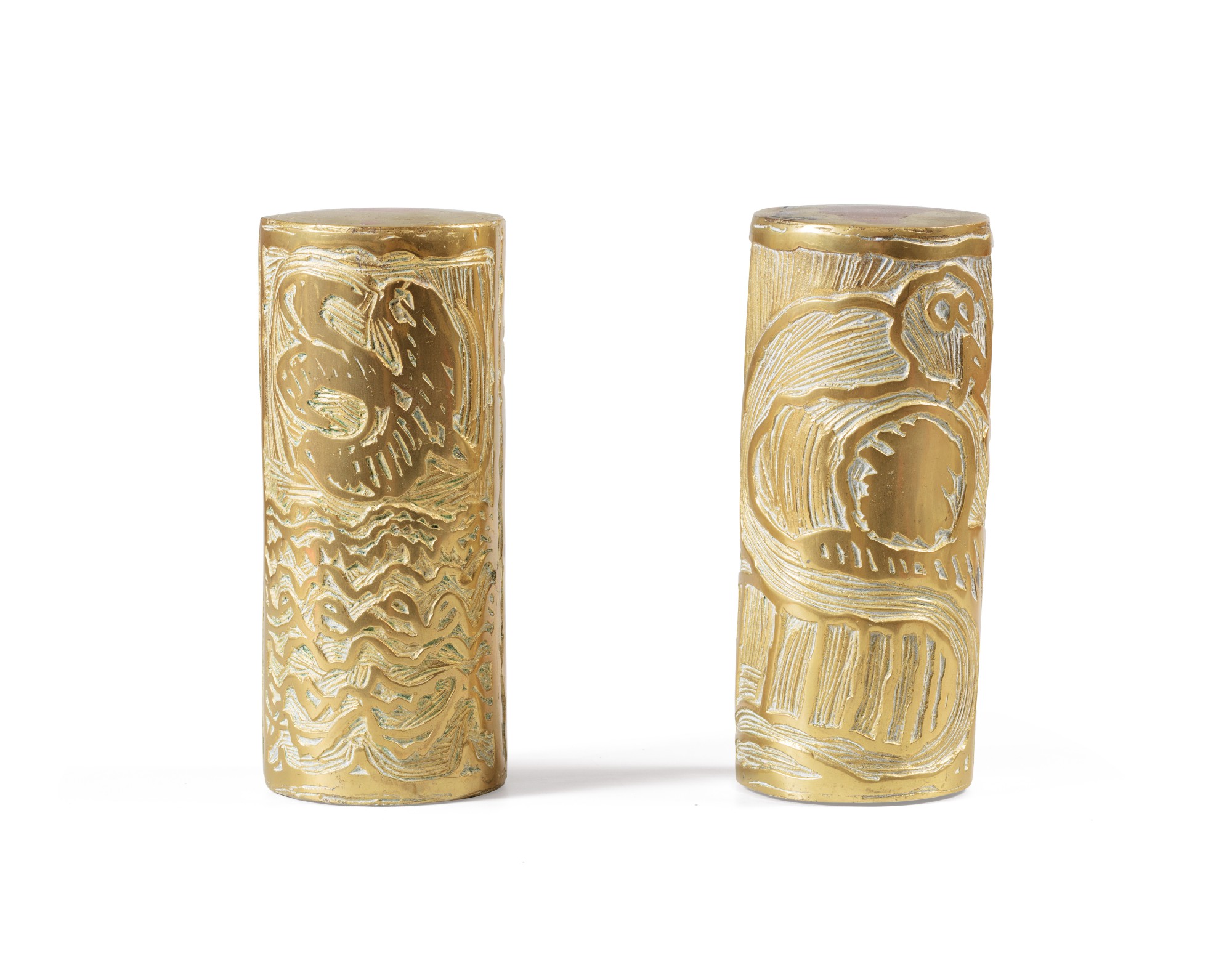
Rouleau d'écriture "Oiseau de mer" and "Visage et serpent", 1973
Ink demands commitment: there is no painting over, no revision in the conventional sense, and Alechinsky embraced this irreversibility as a creative condition rather than a constraint. His collaborations with poets, writers, and publishers extended this commitment across disciplines. The complete set of etchings "Le bleu des fonds," produced with a book by the Surrealist poet Joyce Mansour and cast in a transparent polyester cylinder attached to a cork cover with rope, is among the most inventive artist's books of the twentieth century, an object that exists somewhere between sculpture, literature, and print. For collectors, Alechinsky offers something increasingly rare in the market: a body of work that is both historically significant and visually rewarding to live with.
His paintings and works on paper do not demand that you solve them. They invite sustained looking, and they reward it over years and decades. Works on paper, particularly ink and watercolour pieces from the 1960s and 1970s, represent a compelling entry point for collectors who wish to engage with his practice at a high level. His prints and artist's books, such as the etchings produced with Mansour, occupy an important space between printmaking and object making and remain underrecognized relative to their quality.
Pierre Alechinsky
Les Polyglottes, 1959
Collectors drawn to the CoBrA circle, to artists such as Asger Jorn, Karel Appel, and Jean Dubuffet, or to the broader tradition of expressive figurative painting from Chaim Soutine onward, will find in Alechinsky a natural and deeply rewarding companion. Within the larger arc of art history, Alechinsky occupies a position of genuine originality. He absorbed the lessons of Surrealism without becoming a Surrealist, engaged with Abstract Expressionism without abandoning the figure, and drew from Asian calligraphy without exoticizing it. His work belongs to a specifically European humanism, one rooted in the body, the dream, the written word, and the long memory of Western and non Western image making alike.
The bronze works such as "Rouleau d'écriture" from 1973, with its paired images of seabird and serpent, demonstrate that this vision extended beyond two dimensions into sculptural form, further evidence of a creative intelligence that refused to be confined. What makes Alechinsky matter today is precisely what has always made him matter: the conviction that painting and drawing are among the most direct forms of human testimony available to us, and that freedom on the picture surface is not chaos but a different, harder kind of order. At a moment when so much art is mediated through concept, screen, and institutional frame, his work arrives with the force of something immediate and unmediated. To encounter a major Alechinsky is to feel the presence of another mind in full flight, and that feeling does not age.
Explore books about Pierre Alechinsky
Pierre Alechinsky
François Marquet
Alechinsky
Michel Tapié
Pierre Alechinsky: Catalogue Raisonné
Françoise de Loye
Alechinsky: Prints and Multiples
Pierre Alechinsky and Françoise de Loye
Pierre Alechinsky: Oeuvre Gravée
Françoise de Loye