Petra Cortright
Petra Cortright Paints the Internet Luminous
Artist Spotlight · The Collection Editorial
When Petra Cortright's digital paintings on anodized aluminum were shown alongside traditional canvases at major international art fairs in recent years, something quietly revelatory happened: collectors who had spent decades acquiring oil and acrylic works found themselves drawn, almost helplessly, toward surfaces that seemed to breathe with an entirely new kind of light. The works shimmered. They pulsed. They looked like nothing that had come before them, and yet they felt, somehow, deeply familiar, as if they were paintings the eye had always been waiting to see.
Petra Cortright
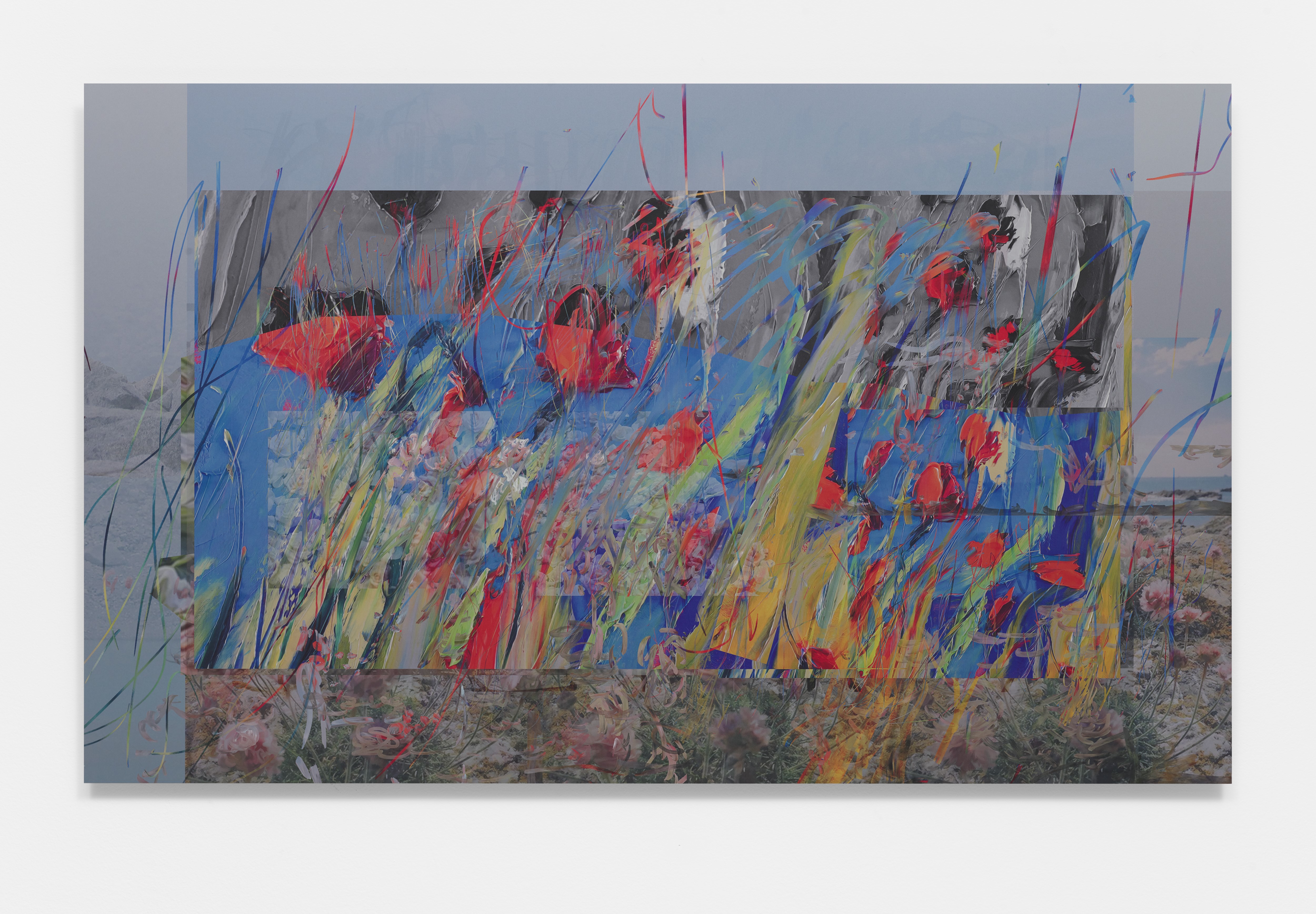
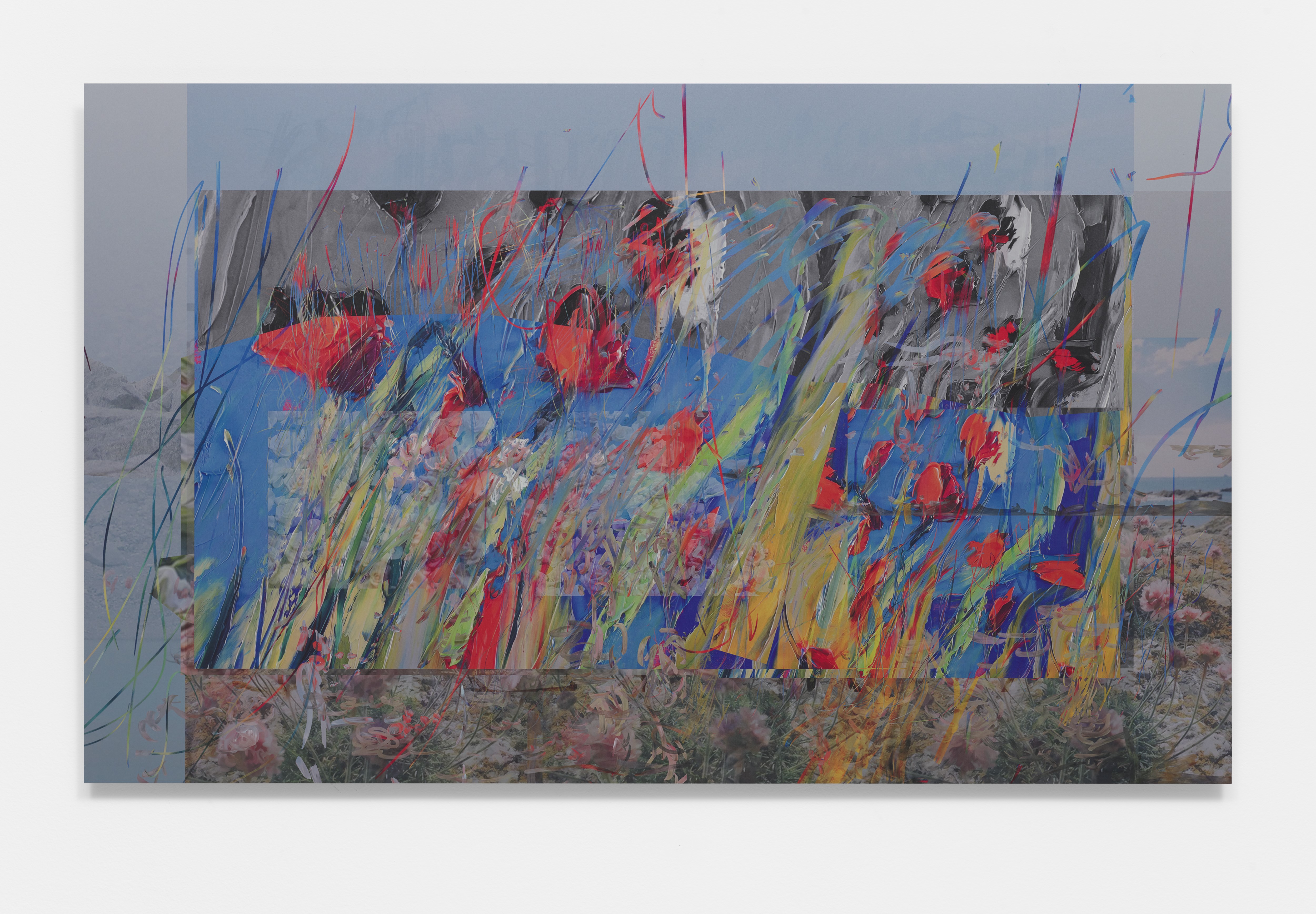
cuban rum cynide +metal +salts/daisy eagle tigershark, 2021
That sensation, equal parts wonder and recognition, is the signature of a Cortright, and it has established her as one of the most genuinely exciting artists working anywhere in the world today. Cortright was born in 1986 and grew up in Santa Barbara, California, a place whose particular quality of coastal light, warm and diffused and relentlessly beautiful, seems to have left a permanent impression on her visual sensibility. She studied at the San Francisco Art Institute and later at the Parsons School of Design in New York, immersing herself in an art education that was, almost by accident, perfectly timed. She came of age as an artist precisely when the internet was transforming from a communication tool into a genuine cultural environment, a space with its own aesthetics, its own textures, its own emotional registers.
Where other artists of her generation treated that environment with suspicion or irony, Cortright moved into it with curiosity and genuine affection. Her earliest recognition came through video work, including the now celebrated piece "VVEBCAM" from 2011, uploaded to YouTube, in which she filmed herself in front of her laptop camera surrounded by cascading digital filters, animated butterflies, falling snow, and the full arsenal of early internet visual culture. The work was playful and serious in equal measure, a meditation on self representation in the age of social media that managed to be both entirely of its moment and entirely timeless. It announced an artist who understood, at a fundamental level, that the internet was not a medium separate from life but a new layer of it, as rich with feeling and possibility as any other.
Petra Cortright
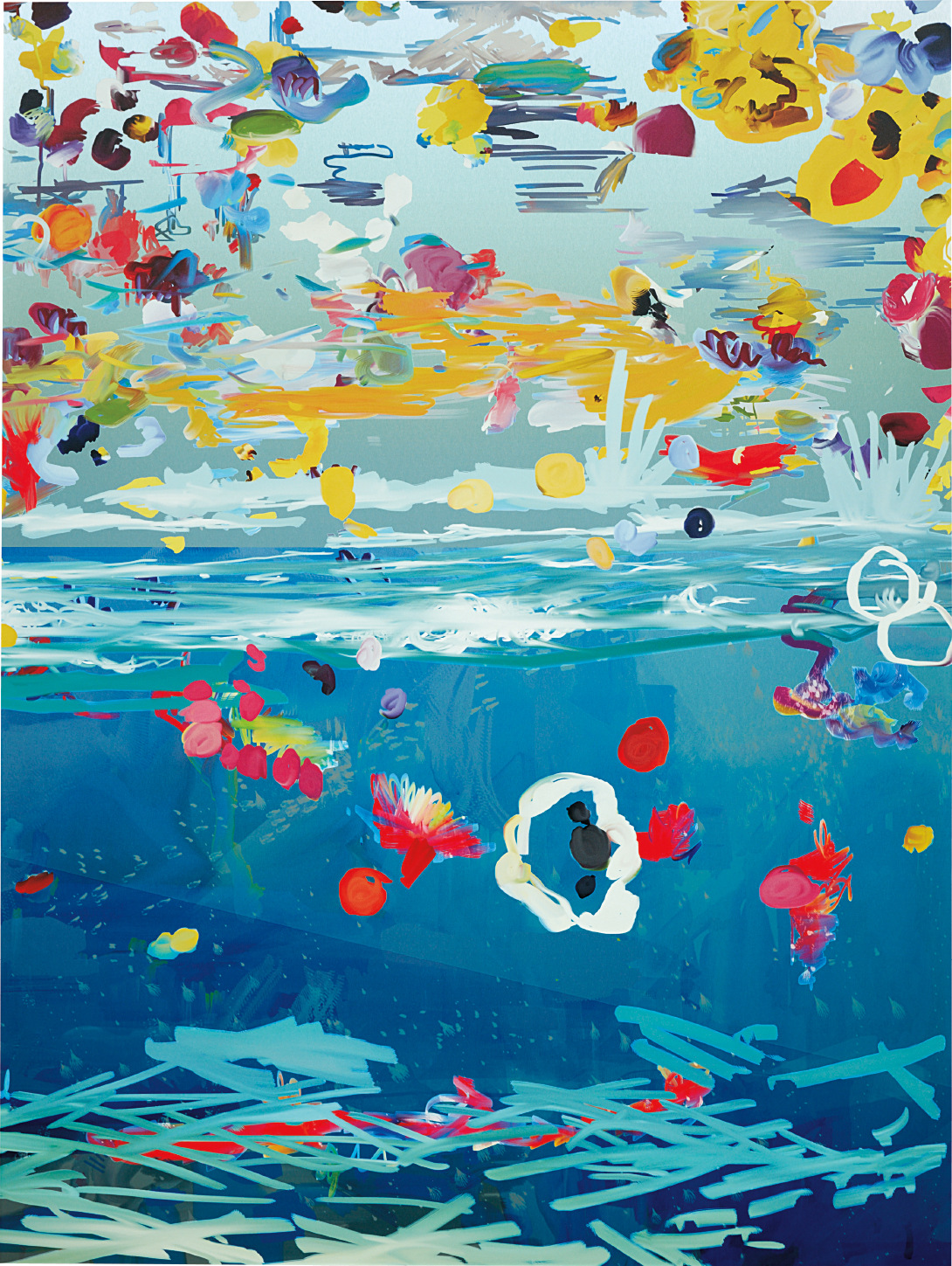
Might and magic and the mandate of heaven, 2014
The pivot toward digital painting on aluminum marked the great maturation of her practice, and it is here that Cortright's work achieves something genuinely unprecedented. Using proprietary digital painting software and drawing on an enormous personal archive of found imagery, filters, webcam footage, and her own painted marks, she builds layered compositions of extraordinary complexity and beauty. These files are then printed onto anodized aluminum or archival paper, surfaces that give the works a luminosity no canvas could replicate. The aluminum, in particular, does something remarkable: it catches ambient light and feeds it back into the image, making the painting seem to generate its own glow.
Works like "Might and Magic and the Mandate of Heaven" from 2014 and "salad dressings orange yogart," also from 2014, exemplify this quality perfectly. They are dense with gestural marks and translucent layers, simultaneously abstract and richly associative, paintings that reward extended looking in the way the greatest works in any medium always do. The titles of Cortright's works are themselves a kind of art form. Drawn from internet search strings, product names, spam subject lines, and the detritus of digital language, they carry a found poetry that is funny, strange, and unexpectedly moving.
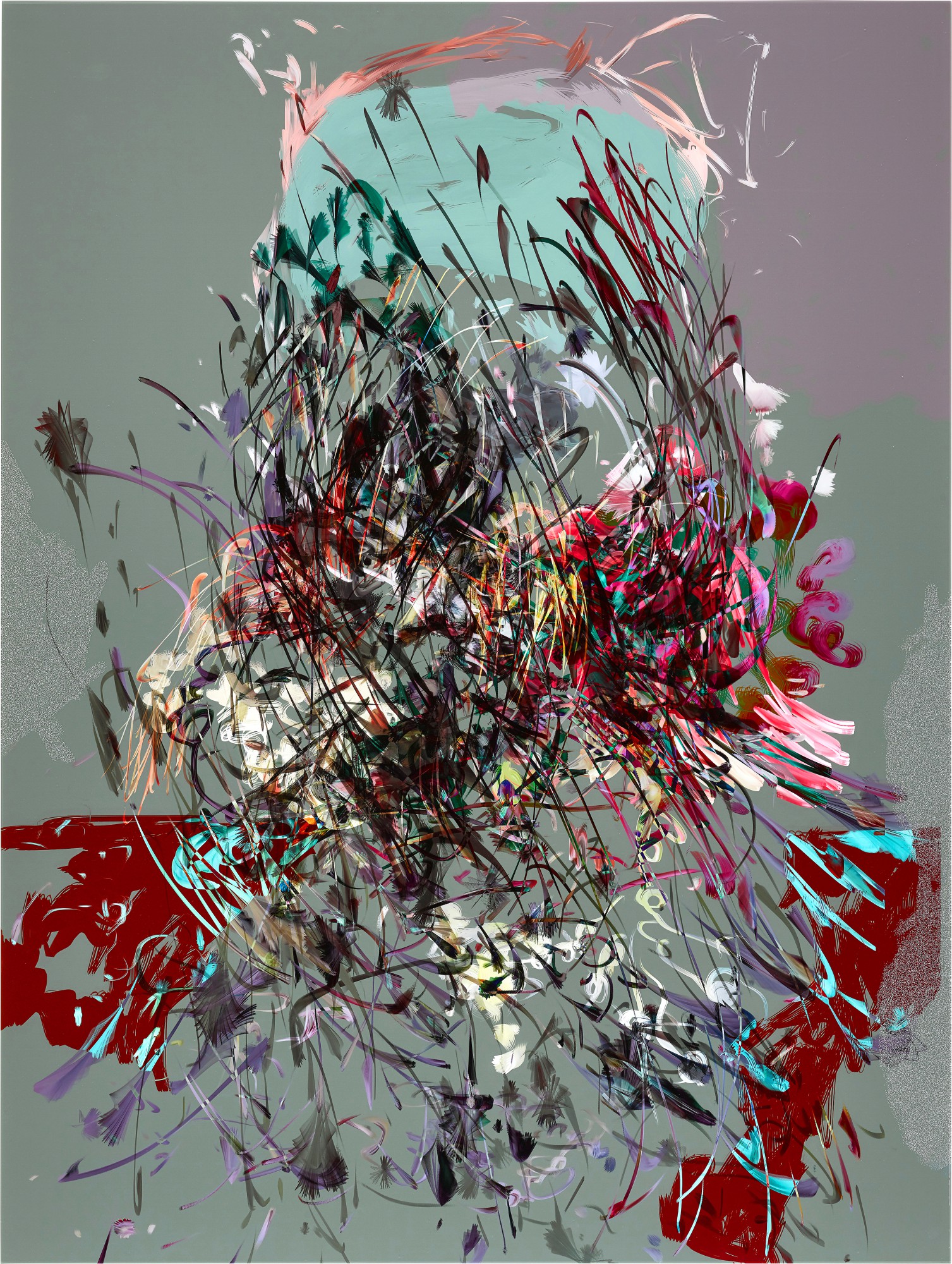
Petra Cortright
Roger Moore_rebirth 1.0 crack_pay-perclick, 2018
"cuban rum cynide +metal +salts/daisy eagle tigershark" from 2021 reads like a corrupted algorithm's dream, and yet the painting it names is a thing of genuine visual lyricism. "Roger Moore_rebirth 1.0 crack_pay perclick" from 2018, printed on gloss paper and face mounted, pairs a movie star's name with the language of software piracy and internet advertising in a way that captures something true and poignant about how culture circulates online. These titles are not jokes, exactly, but they are absolutely in on the joke, and that quality of knowing warmth runs through everything Cortright makes.
From a collecting perspective, Cortright's work occupies a fascinating and increasingly important position. She was among the first artists to develop a rigorous and thoughtful approach to selling works as digital files, engaging seriously with questions of authenticity, ownership, and value at a time when those questions were only beginning to be asked. Her aluminum editions and unique works have attracted sophisticated collectors across Europe, the United States, and Asia, drawn by the combination of visual intensity and conceptual depth the works offer. The market for her work has grown steadily and with real purpose, reflecting genuine institutional and critical recognition rather than speculative enthusiasm.
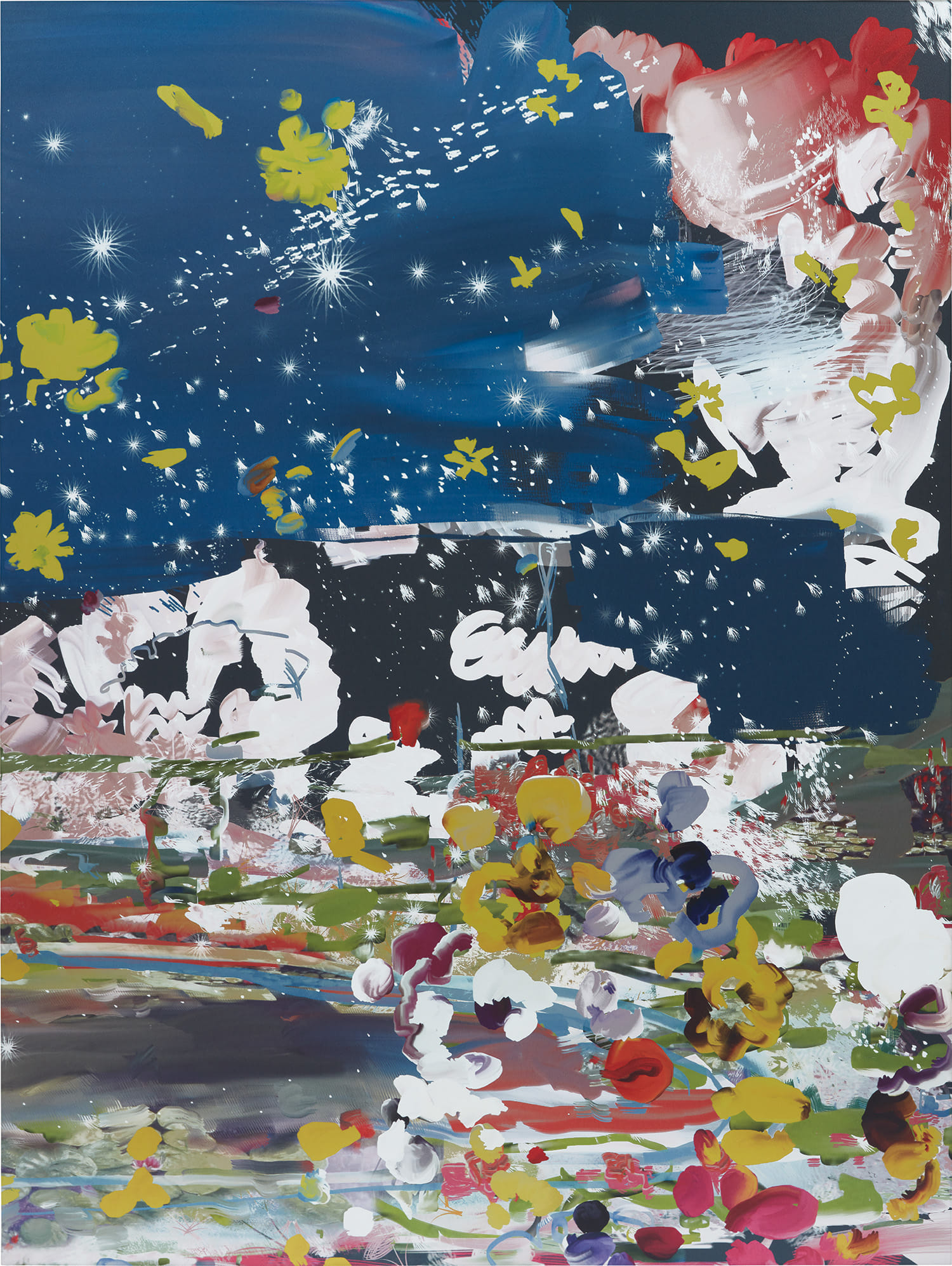
Petra Cortright
salad dressings orange yogart, 2014
For collectors building collections that speak to the present moment and to the future, a Cortright is among the most considered acquisitions one can make. The works hold their presence magnificently in both domestic and institutional environments, and they photograph extraordinarily well, an increasingly relevant quality in an era when collections are experienced and shared digitally as much as in person. Cortright sits at the center of a constellation of artists who have collectively redefined what painting means in the twenty first century. Her work is in productive dialogue with artists like Artie Vierkant, whose image objects similarly interrogate the relationship between digital files and physical surfaces, and with figures like Cory Arcangel, whose engagement with software and popular culture shares Cortright's wit and warmth.
She is also, despite the technological mediation of her practice, very much a painter in the tradition of the great colorists, someone for whom the behavior of light within an image is a primary and abiding concern. One feels, looking at her best work, the lineage of painters who understood that luminosity is not a surface quality but a structural one. The legacy Petra Cortright is building is one that will only become clearer and more significant with time. She arrived at the intersection of painting and digital culture before most institutions had language for what she was doing, and she built a body of work there that is formally rigorous, emotionally generous, and historically original.
She has shown that the aesthetics of the internet need not be treated as raw material to be ironized or critiqued but can be inhabited with the same seriousness and love that any great painter brings to the world around them. For collectors, for institutions, and for anyone who believes that painting remains among the most vital and adaptive forms of human expression, her work is simply essential.
Explore books about Petra Cortright