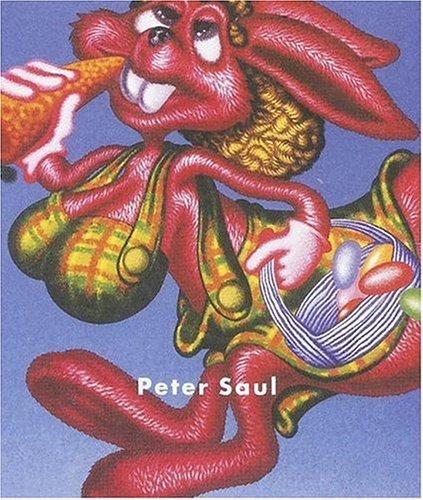
Peter Saul
Peter Saul's Glorious, Unapologetic American Vision
Artist Spotlight · The Collection Editorial
“I want to make a painting that is a little bit too much, that is pushing the situation past what is really acceptable.”
Peter Saul, interview with the Whitney Museum, 2020
When the Whitney Museum of American Art mounted its major retrospective of Peter Saul's work in 2020, the art world was reminded with vivid force that American painting has few voices as bracingly original, as stubbornly independent, or as genuinely funny as his. The exhibition, spanning six decades of production, confirmed what a devoted community of collectors and curators had long understood: Saul is not a footnote to any movement but a singular phenomenon, a painter who constructed his own aesthetic universe entirely on his own terms and has been gleefully expanding it ever since. At an age when most artists have long since settled into a recognizable late style, Saul continues to push, provoke, and astonish. Peter Saul was born in San Francisco in 1934 and grew up in a household where art was not a natural inheritance.
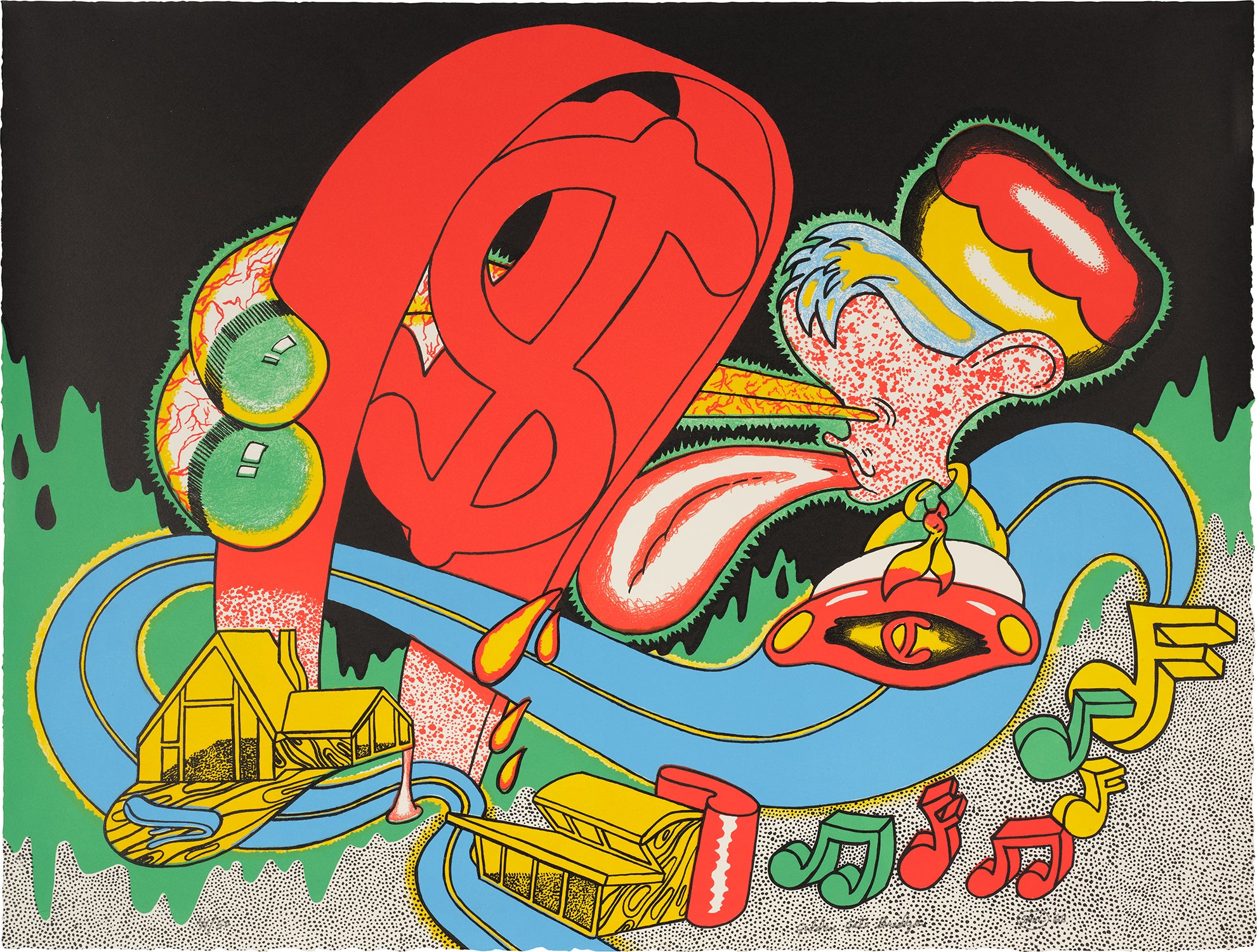
Peter Saul
Golden Gate Bridge
He studied at the California School of Arts and Crafts before moving on to Washington University in St. Louis, where he received more formal training. The decisive break came when he moved to Europe in the late 1950s, living in Amsterdam, Rome, and Paris. It was in Paris that he encountered the work of the Chicago Imagists and began corresponding with American galleries, finding an unlikely early champion in Allan Frumkin, who gave Saul his first New York show in 1961.
Europe freed Saul from the dominant anxieties of the New York School and gave him permission to be as irreverent, as cartoonish, and as aggressively colorful as he wanted to be. The 1960s were the decade in which Saul found his voice, and it was immediately, unmistakably his own. Working at a moment when Abstract Expressionism still held enormous institutional prestige, Saul painted figures, and not dignified ones. He drew openly from the visual language of comic books, advertising, and popular culture, but he twisted these sources into something deeply uncomfortable, staging scenes of violence, desire, and political absurdity with the kind of raw chromatic energy that had nothing polite about it.
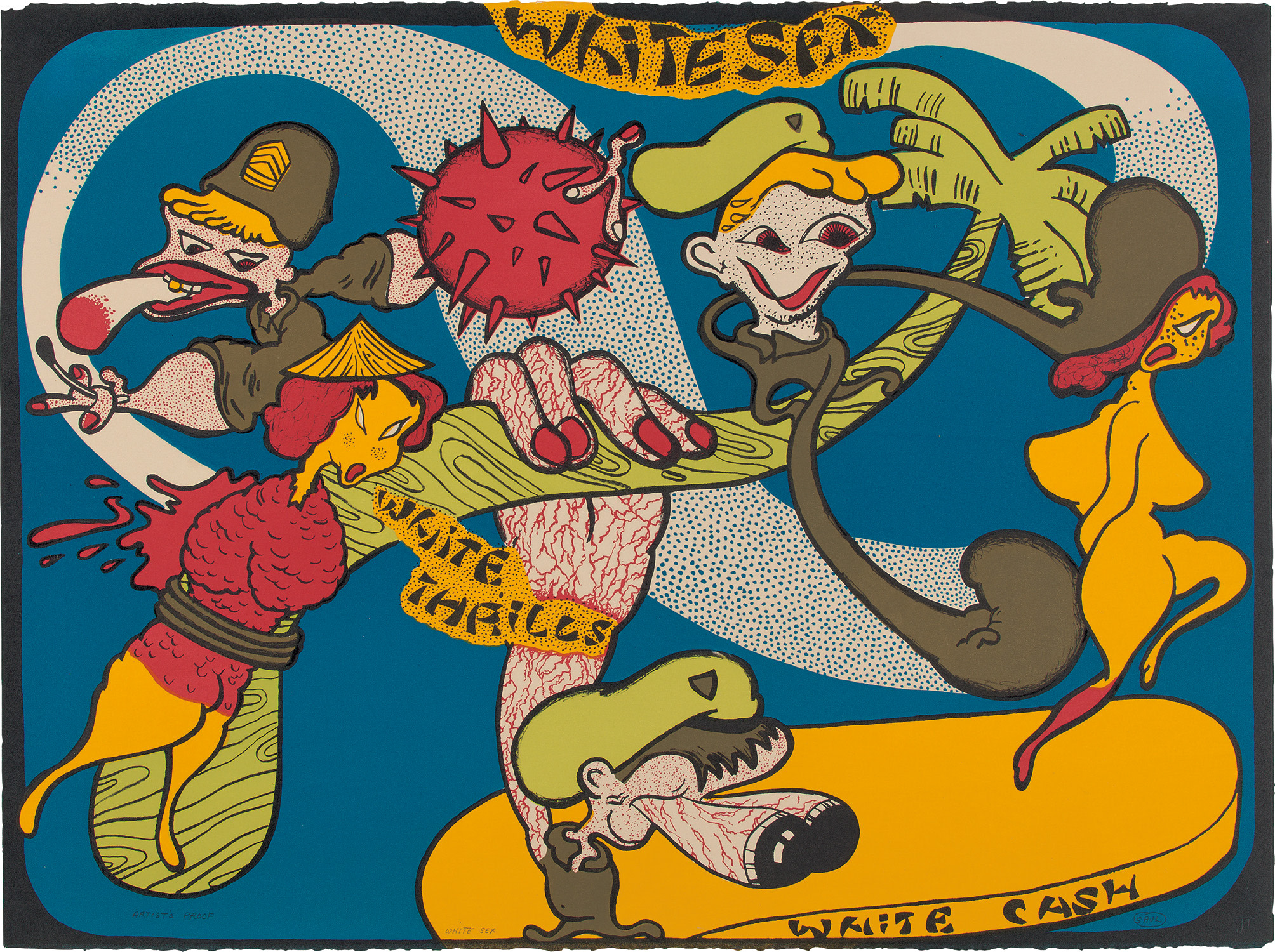
Peter Saul
White Sex
His early paintings of consumer goods, crime scenes, and American foreign policy, executed in acidic yellows, electric pinks, and lurching greens, established him as a painter for whom beauty and grotesquerie were not opposites but inseparable companions. The 1961 oil on canvas "Ice Box No. 3" is a perfect early document of this sensibility: domestic, surreal, slightly menacing, and painted with a confidence that belies the young age of its maker. Through the late 1960s and into the 1970s, Saul turned his attention explicitly to American political life, and the results were among the most confrontational paintings produced in that turbulent era.
“I am trying to make the most offensive, the most peculiar painting I can think of.”
Peter Saul
His images addressing the Vietnam War and the figure of Lt. William Calley, including his 1970 work "Lt. Calley" rendered in acrylic, gouache, and colored pencil on cardboard, were works that did not merely comment on events but seemed to physically enact the chaos and moral disorder they depicted. His portraits of political figures and his engagement with the civil rights era, including his lithograph honoring Angela Davis, demonstrated that Saul's outrageousness was never gratuitous.
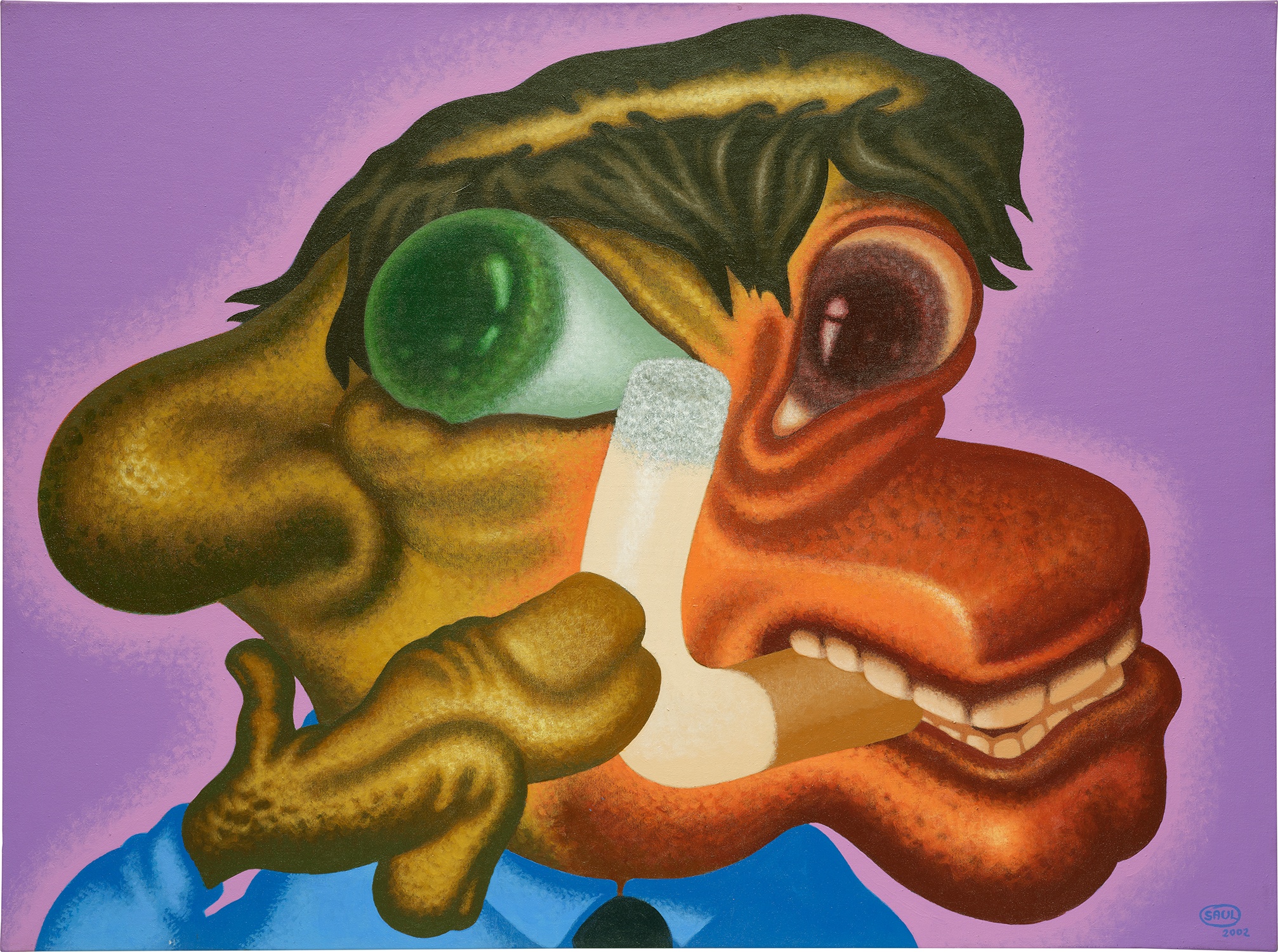
Peter Saul
Moment of Decision, 2002
There was always a moral intelligence operating beneath the surface spectacle, a refusal to aestheticize suffering while somehow transforming it into something that demanded sustained looking. These works sit in the tradition of Goya and Daumier, artists who understood that satire can carry a heavier charge than solemnity. Saul's relationship to art history is one of the great pleasures of studying his career. He has never been content to work inside a single lineage.
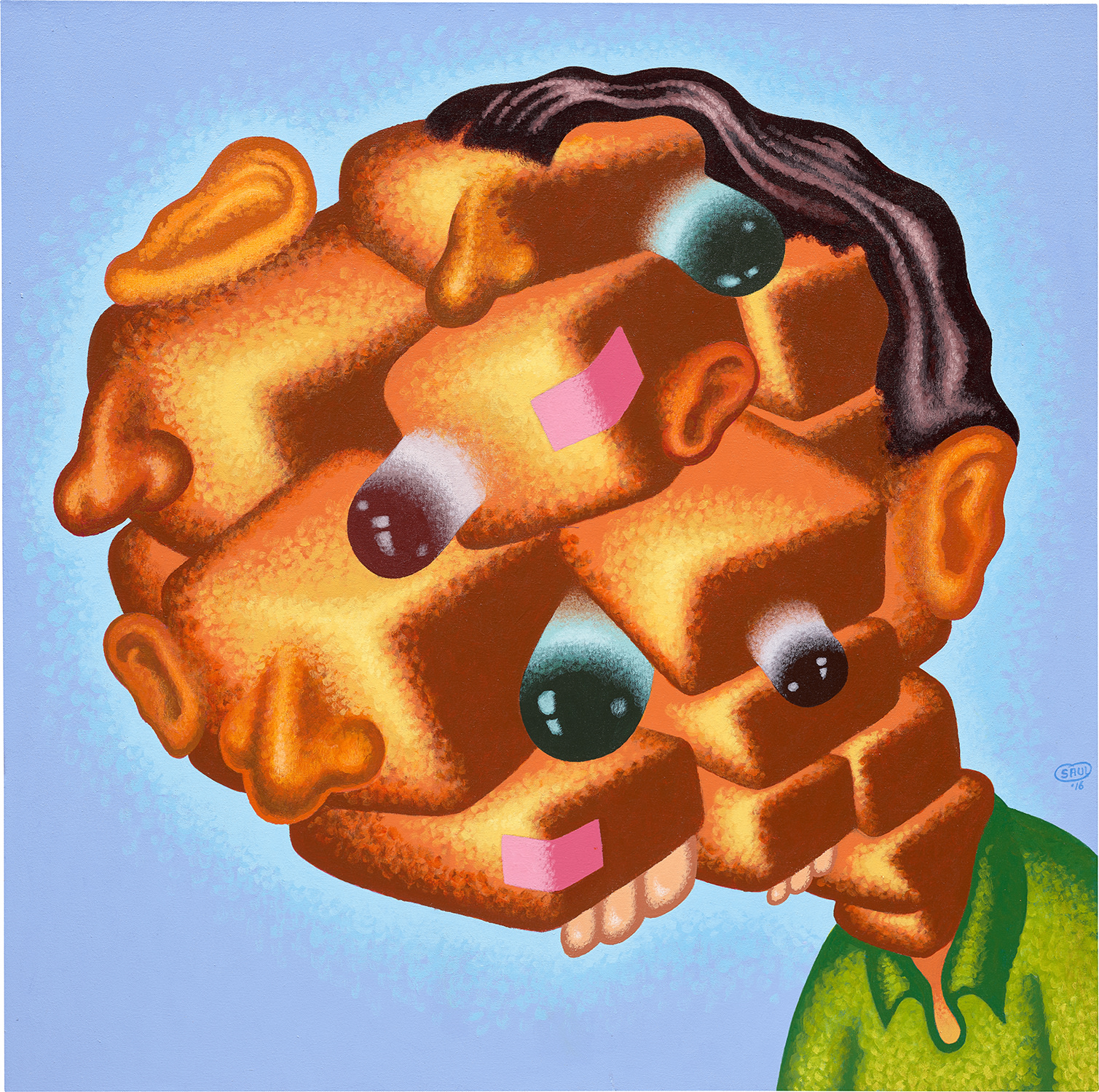
His work absorbs and distorts influences ranging from de Kooning and Picasso to the Sacramento junk aesthetic and the Chicago Imagists, while consistently refusing to be claimed by any of them. The lithograph "Chinese Cubist," realized as a painting in acrylic on canvas in 2016, is characteristic of his mature practice: a work that simultaneously parodies and celebrates the formal ambitions of Cubism while pushing those ambitions through a funhouse mirror. Artists who share something of his territory, whether in spirit or in market, include contemporaries like Robert Williams, Kenny Scharf, and the earlier precedents of Philip Guston, whose own turn to figuration in the late 1960s was met with a critical hostility that Saul would have recognized immediately. The Orange County Museum of Art retrospective further cemented his reputation as a figure whose influence on younger figurative painters, from Jamian Juliano Villani to others working in a darkly comic mode, is now widely acknowledged.
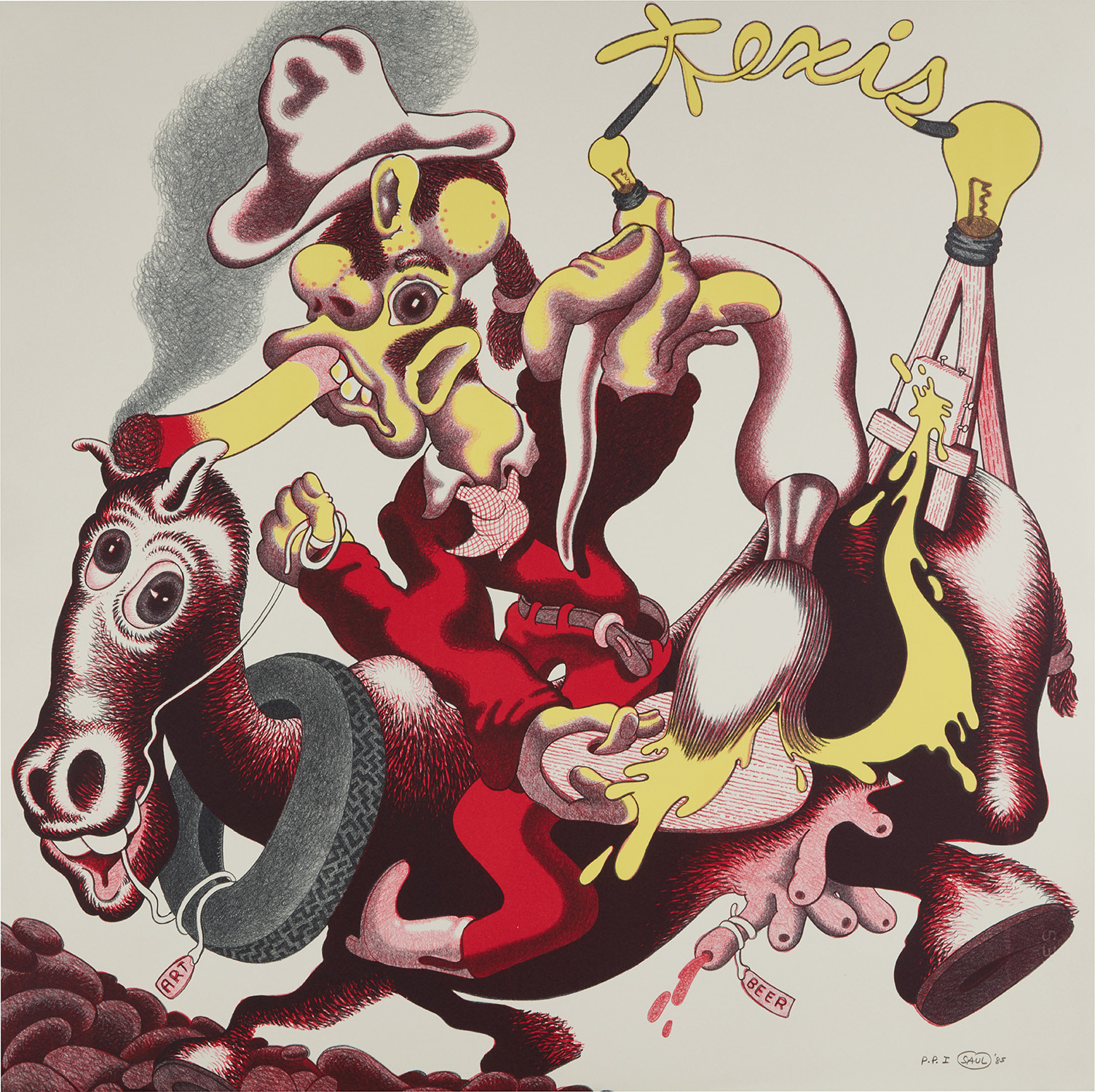
Peter Saul
Texis
From a collecting perspective, Saul presents a genuinely compelling proposition across multiple entry points. His prints and lithographs, including striking works such as "Golden Gate Bridge," "White Sex," and "Texis," produced in limited editions on fine papers including German Etching paper and Rives BFK, offer access to his imagery at a range that welcomes collectors at various stages. These are not secondary works but fully realized expressions of his vision, produced with the same irreverence and chromatic intensity as his paintings. The paintings themselves, when they appear on the market or through galleries, have attracted serious institutional and private attention, and the trajectory of his auction results over the past decade reflects the growing scholarly and market consensus around his importance.
Works from the 1960s and early 1970s carry particular historical weight, but his recent paintings, such as "He Forgot Something" from 2019 and "Moment of Decision" from 2002, demonstrate that the market for his current production is equally robust. Collectors drawn to the intersection of figuration, political history, and visual humor find in Saul a painter who rewards both immediate impact and long study. What makes Saul genuinely important to art history, and what ensures that his legacy will only deepen with time, is the consistency and integrity of his vision over more than sixty years of relentless production. He never retreated to safety, never softened his imagery to accommodate critical fashion, and never allowed the market's enthusiasm or indifference to alter his fundamental project.
At a moment when the art world is newly engaged in questions of political representation, the limits of satire, and the relationship between popular culture and high art, Saul's career looks less like an eccentric outlier and more like a prescient model. The Whitney retrospective was not a rehabilitation but a recognition long in the making. For collectors who want to live with paintings that are alive, argumentative, and endlessly surprising, Peter Saul remains one of the most rewarding investments of attention and resources that contemporary art has to offer.
Explore books about Peter Saul