Peter Dreher
Peter Dreher, Painter of Infinite Presence
Artist Spotlight · The Collection Editorial
“I paint the same glass every day. Every painting is a new experience.”
Peter Dreher, interview on his Tag um Tag practice
There is a glass on a table. It is empty. It has been painted more than five thousand times. This is not a provocation or a puzzle but rather one of the most quietly radical commitments in postwar European painting, and it belongs entirely to Peter Dreher, the German painter who has spent more than half a century asking what it means to truly look at something.
Peter Dreher
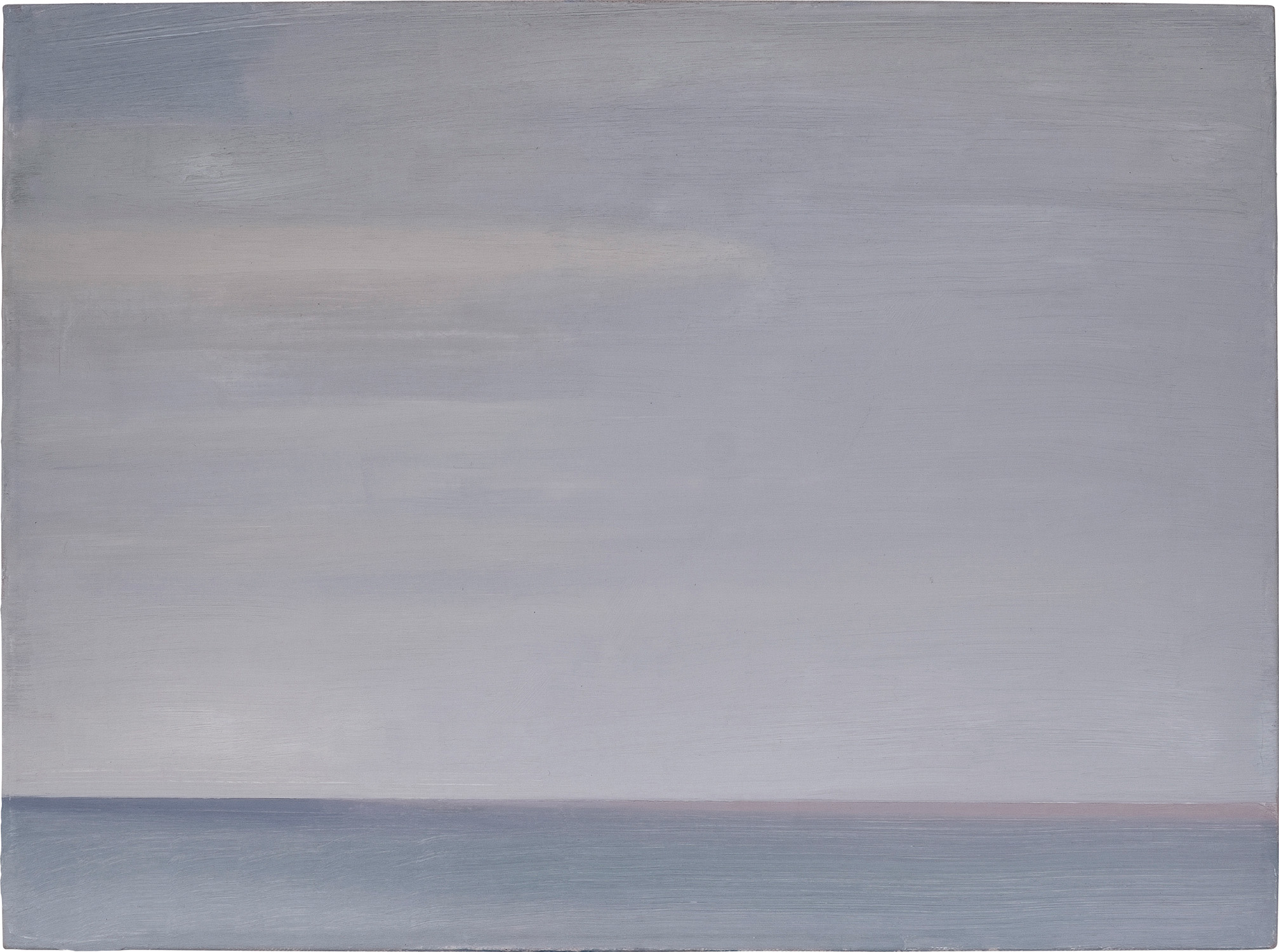
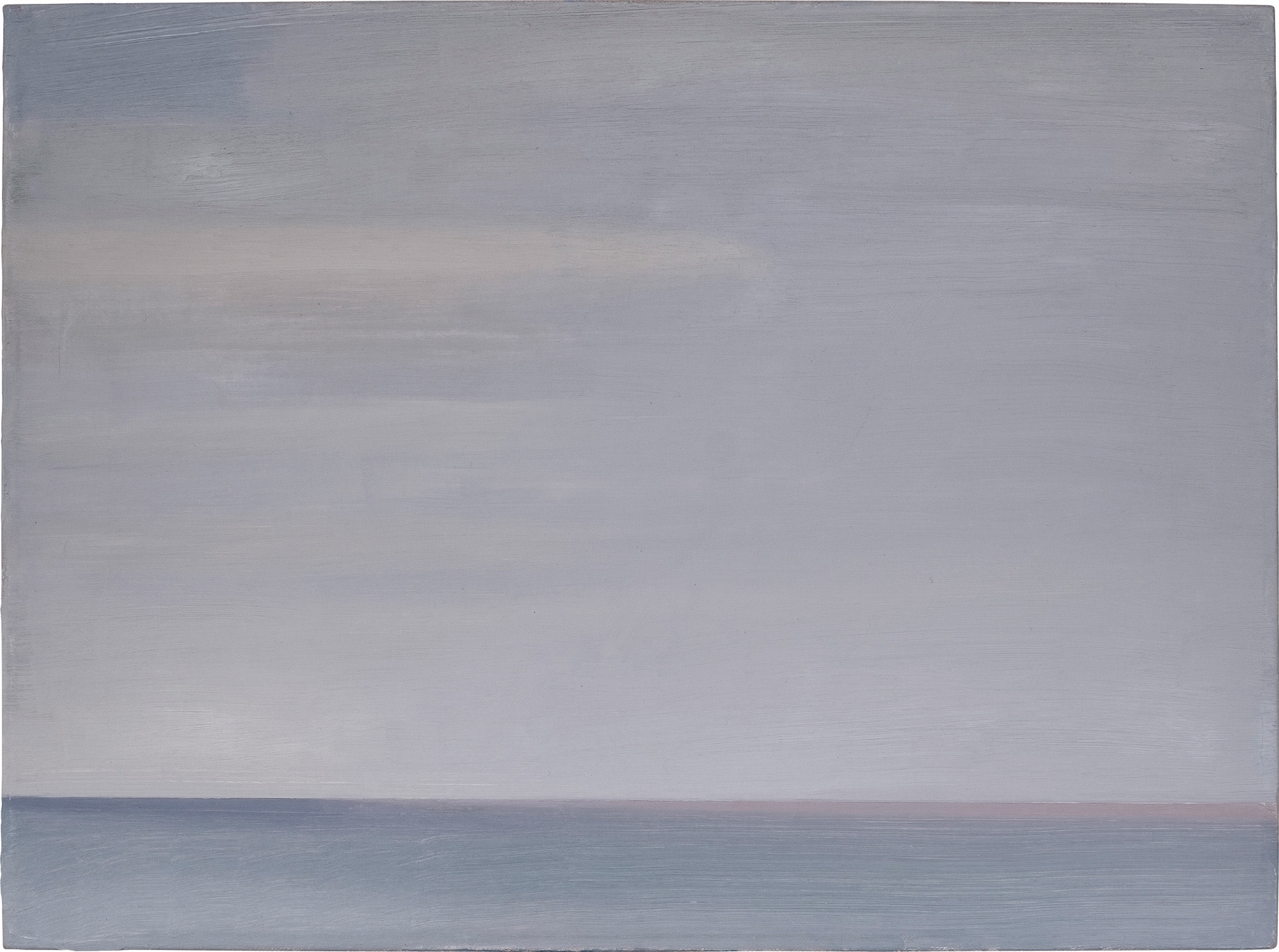
Seascape #11, 1998
In recent years, major institutions across Europe have returned again and again to his extraordinary project, and the art market has followed, with collectors and curators alike recognising that Dreher's singular practice occupies a space that few artists have ever dared to inhabit with such sustained devotion. Dreher was born in 1932 in Mannheim, Germany, and came of age in a country rebuilding itself from ruin. He studied at the Staatliche Akademie der Bildenden Künste in Karlsruhe, one of Germany's most distinguished art academies, where he would later spend decades as a professor, shaping generations of German painters. His formation was rooted in the great traditions of European figurative painting, and his early work showed a facility with landscape and still life that placed him comfortably within the postwar realist tendency gathering momentum in Germany during the 1960s.
But Dreher was already listening for something quieter and more demanding beneath the surface of representation. The pivotal turn in his practice arrived in 1974, when Dreher began what would become the defining project of his life. He placed a simple drinking glass on a table in his studio in Freiburg, and he painted it. Then he painted it again the next day, and the day after that.
Peter Dreher
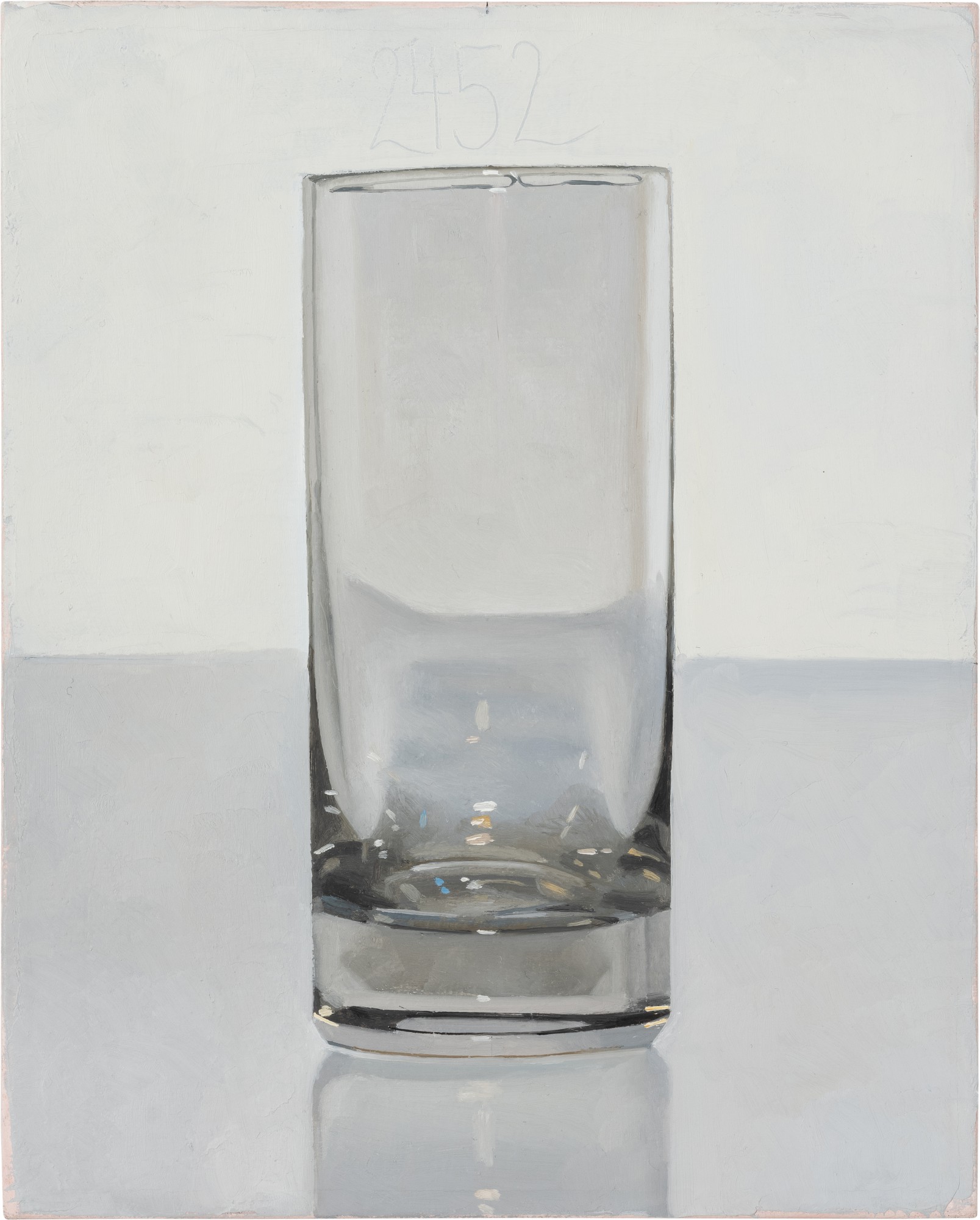
Tag um Tag guter Tag (Day by Day good Day) Nr. 2452 (Night)
The project, which he titled 'Tag um Tag guter Tag' (Day by Day Good Day), took its name from a Zen koan, and the spiritual dimension of the work was never incidental. Each canvas records the same motif observed under different conditions of light, at different hours, across different seasons and decades. The glass does not change. Everything else does.
The accumulation of canvases over more than fifty years constitutes something unprecedented in the history of painting: a sustained phenomenological diary in which time itself becomes the true subject. What distinguishes Dreher's project from mere conceptual exercise is the quality of his painting. He is a consummate technician whose surfaces reward close looking. Working in oil on linen, he renders the glass with a photorealistic precision that captures the way light bends through curved surfaces, the faint shadows cast on white grounds, and the almost imperceptible variations that occur as natural light shifts through his studio windows across morning, afternoon, and night.
![Peter Dreher — Tag um Tag guter Tag (Day by Day good Day) [Three Works]](https://rtwaymdozgnhgluydsys.supabase.co/storage/v1/object/public/artwork-images/auction-lots/N11780-20250226-lot95.jpg)
Peter Dreher
Tag um Tag guter Tag (Day by Day good Day) [Three Works], 2006
The nocturnal works, painted under artificial light, carry a particular stillness that many collectors find deeply compelling. Works such as 'Tag um Tag guter Tag (Day by Day good Day) Nr. 2452 (Night)' and 'Tag um Tag Guter Tag, n. 2290 (Night)' from 2007 are not merely paintings of a glass in a dark room; they are meditations on solitude, attention, and the passage of hours that feel increasingly rare and necessary in contemporary life.
Dreher's practice never collapsed into the single motif entirely. His landscapes, including the remarkable 'Schwarzwald Panorama Doppelt' from 1977, an oil on card in seven parts presented in the artist's own frames, reveal a painter of considerable range and ambition. The Schwarzwald work, with its panoramic sweep of the Black Forest rendered in multiple joined panels, demonstrates how deeply rooted Dreher is in the German landscape tradition while simultaneously pushing toward something more structural and considered. His 'Seascape #11' from 1998, painted in oil on linen, brings the same quality of sustained attention he lavishes on the glass to the infinite variability of open water, finding in both subjects the same essential question: what do we see when we truly look?

Peter Dreher
Schwarzwald Panorama Doppelt, 1977
For collectors, Dreher presents a compelling proposition that sits at the intersection of conceptual rigor and painterly beauty. Works from the 'Tag um Tag' series are sought after both individually and as groups, and a pairing such as 'Two works: (i)' from 2006 or the triptych grouping 'Tag um Tag guter Tag (Day by Day good Day) [Three Works]' from the same year demonstrates how powerfully the project reads when individual canvases are experienced in relation to one another. The subtle differences between paintings in a group make visible the philosophy underlying the entire enterprise: that repetition is not sameness, that each act of looking is unrepeatable, and that the differences between nearly identical things can carry more meaning than the differences between wildly contrasting ones. Collectors drawn to the meditative traditions of Japanese art, to the phenomenological painting of Giorgio Morandi, or to the more recent investigations of Luc Tuymans and Gerhard Richter will find in Dreher a natural and deeply rewarding companion.
The art historical context for Dreher's work is rich. Morandi, the great Italian painter of bottles and vessels, is perhaps the most obvious precedent, sharing with Dreher a devotion to a small repertoire of objects observed across a lifetime. But Dreher's conceptual framework also connects him to process art and durational practices more broadly associated with the 1970s, and his photorealist precision places him in dialogue with painters like Gerhard Richter, whose own explorations of painting's relationship to photography and time have made him one of the most discussed artists of the past half century. Dreher operates with less institutional fanfare than some of these contemporaries, but this quality of quiet persistence is itself part of what makes his practice so distinctive and so admirable.
Peter Dreher is now in his nineties and, by all accounts, still painting. The glass is still on the table. The light is still changing. What began as a conceptual proposition more than fifty years ago has become something closer to a spiritual practice, a record of one person's sustained attention to a single corner of the world across an entire lifetime.
There are few artists working in any medium who have made such an uncompromising and ultimately moving commitment to the act of looking. For collectors who seek work that rewards patience and deepens with time, who are drawn to the idea that a painting can be both rigorously intellectual and intimately human, Dreher is not simply a discovery. He is a revelation.
Explore books about Peter Dreher
Peter Dreher: Werkkatalog
Peter Dreher, Various Contributors
Peter Dreher: Das Ganze und der Augenblick
Gregor Stemmrich
Peter Dreher: Bilder 1960-1980
Museum Folkwang
Peter Dreher: Monographie
Klaus Honnef
Peter Dreher: The Glass of Water
Various Critics