Peter Doig
Peter Doig: Painter of Infinite Reverie
Artist Spotlight · The Collection Editorial
“I am interested in the idea of painting being a kind of place that you can enter.”
Peter Doig, interview with Judith Nesbitt, Tate
When the Fondation Beyeler in Basel mounted a major Peter Doig retrospective in 2014, visitors found themselves standing in rooms that felt less like galleries and more like the interior of a half remembered dream. The Swiss institution, one of the great temples of postwar and contemporary art, gave Doig's monumental canvases the space they demand, and the effect was overwhelming. Critics reached for poetry rather than analysis. Here was a painter who had, over three decades of sustained and serious work, managed to make landscape painting feel urgently new, emotionally raw, and philosophically rich all at once.
Peter Doig
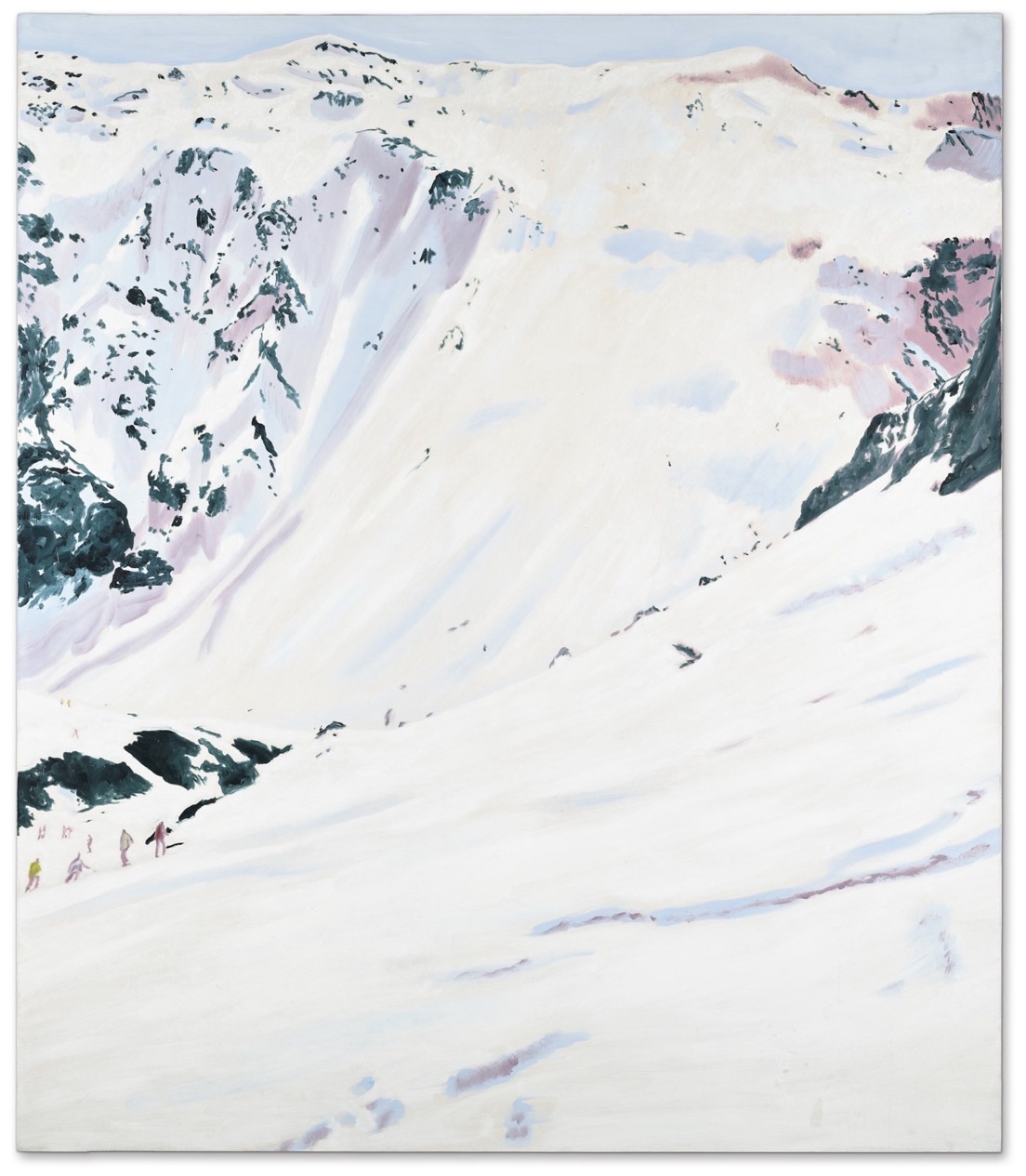
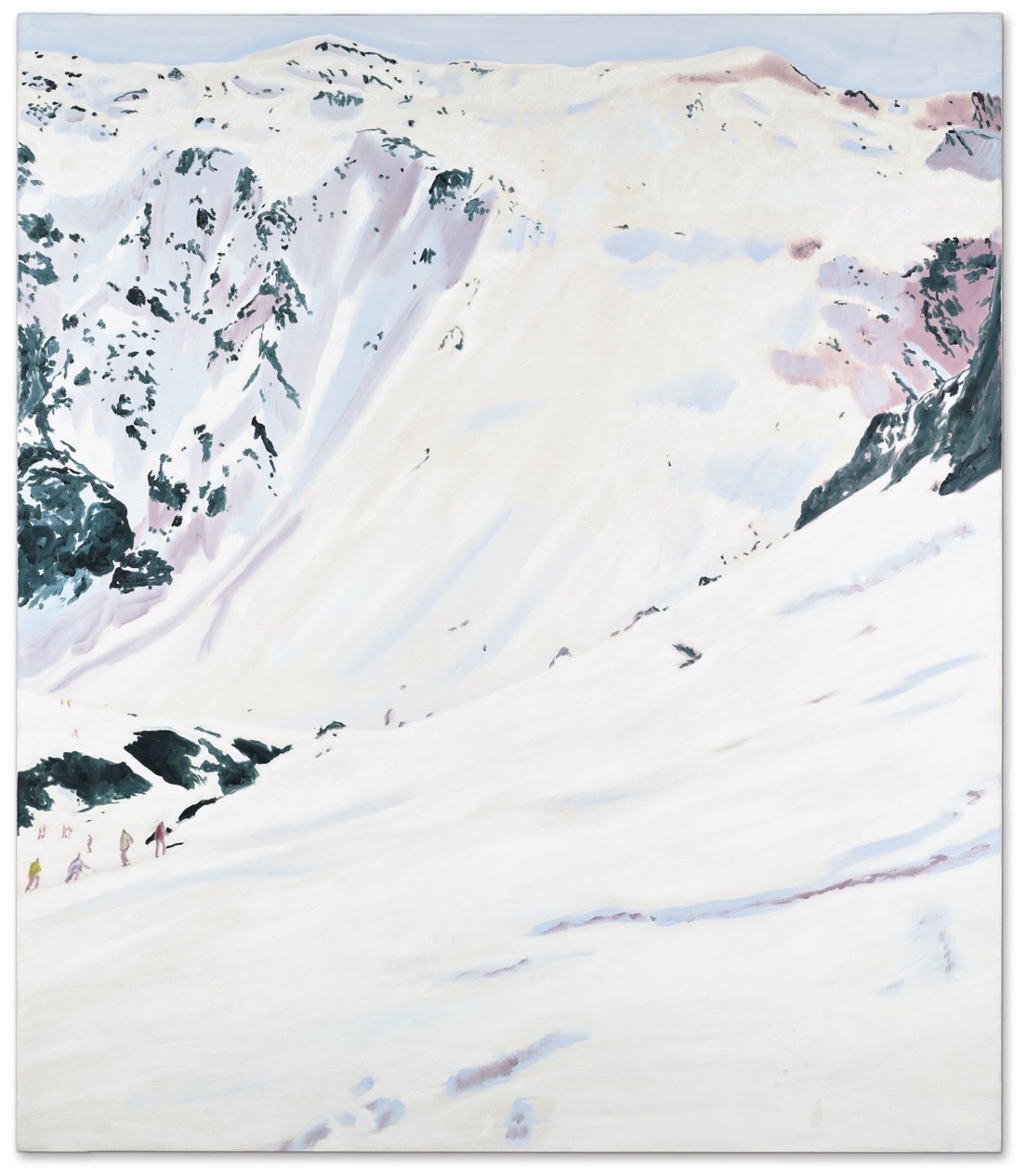
Alpinist
That exhibition travelled and resonated deeply, cementing Doig's reputation not merely as one of the finest British painters of his generation but as one of the essential voices in contemporary art anywhere in the world. Peter Doig was born in Edinburgh in 1959, and his early life was shaped by a restless geography that would prove formative in ways he could not have anticipated. His family moved first to Trinidad when he was a young child, then to Canada, where he spent his adolescence in Toronto and Montreal. This layering of climates, cultures, and landscapes, the dense green heat of the Caribbean, the vast white winters of Quebec, settled into his visual imagination like geological strata.
He returned to Britain to study, completing his fine art education at the Wimbledon School of Art and then at Saint Martin's School of Art in London, before undertaking a postgraduate degree at Chelsea College of Art in the late 1980s. It was a rigorous formation, taken during years when painting itself was embattled and conceptualism dominated critical discourse. Doig's breakthrough came in the early 1990s, at a moment when a renewed confidence in painting was beginning to reassert itself in Britain and internationally. His work entered public consciousness with force when he was shortlisted for the Turner Prize in 1994, a recognition that placed him alongside some of the most discussed artists of the Young British Artists era, though his sensibility was always quieter and more inward than the provocations that dominated tabloid coverage of that scene.
Peter Doig
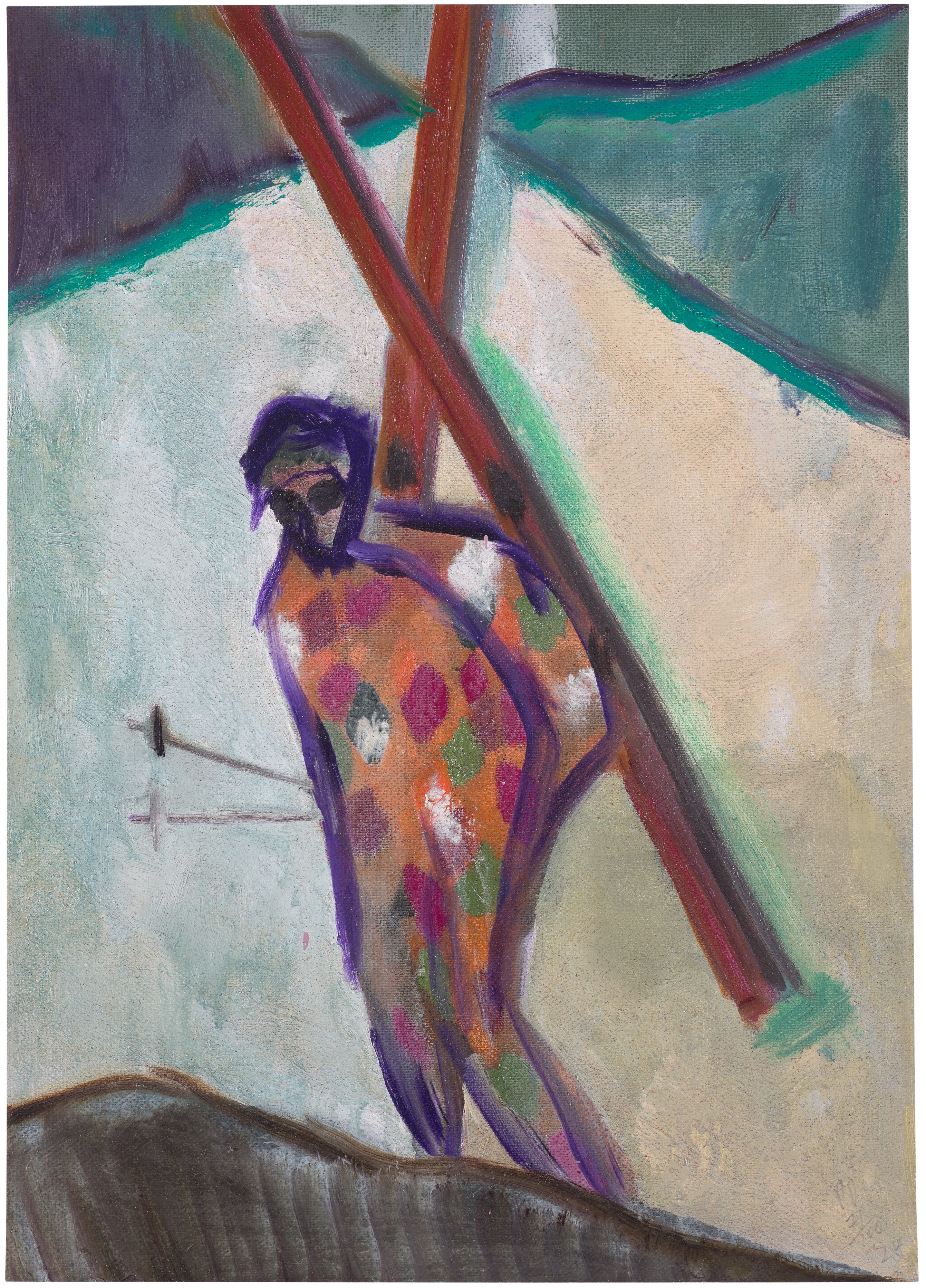
Alpiniste
The canvases he showed in those years, dense with paint and suffused with an atmosphere of solitude and wonder, announced an artist whose relationship to art history was deep and whose emotional ambitions were singular. He was looking at Edvard Munch, at Paul Gauguin, at the Canadian landscape painters of the Group of Seven, and filtering all of it through something unmistakably his own. The works from the 1990s remain among the most celebrated of his career. Paintings such as Cobourg 3+1 (1994) and Blotter (1993) established the visual language that collectors and institutions have come to cherish: figures dwarfed by their environments, surfaces built up with obsessive layering, time rendered ambiguous so that it is never entirely clear whether we are looking at memory or anticipation.
“I want the paintings to be as open as possible, so that people can find their own way into them.”
Peter Doig, interview with Contemporary magazine
His 1991 work Bomb Island, an oil on canvas of mysterious intensity, belongs to this early period of confident experimentation, when Doig was finding the terms of his own mythology. These are not narrative paintings in any straightforward sense. They resist easy reading and reward sustained looking, which is precisely why they have proven so enduring. In 2002, Doig made a decisive move and returned to Trinidad, where he has maintained a studio and a profound artistic engagement with the island ever since.
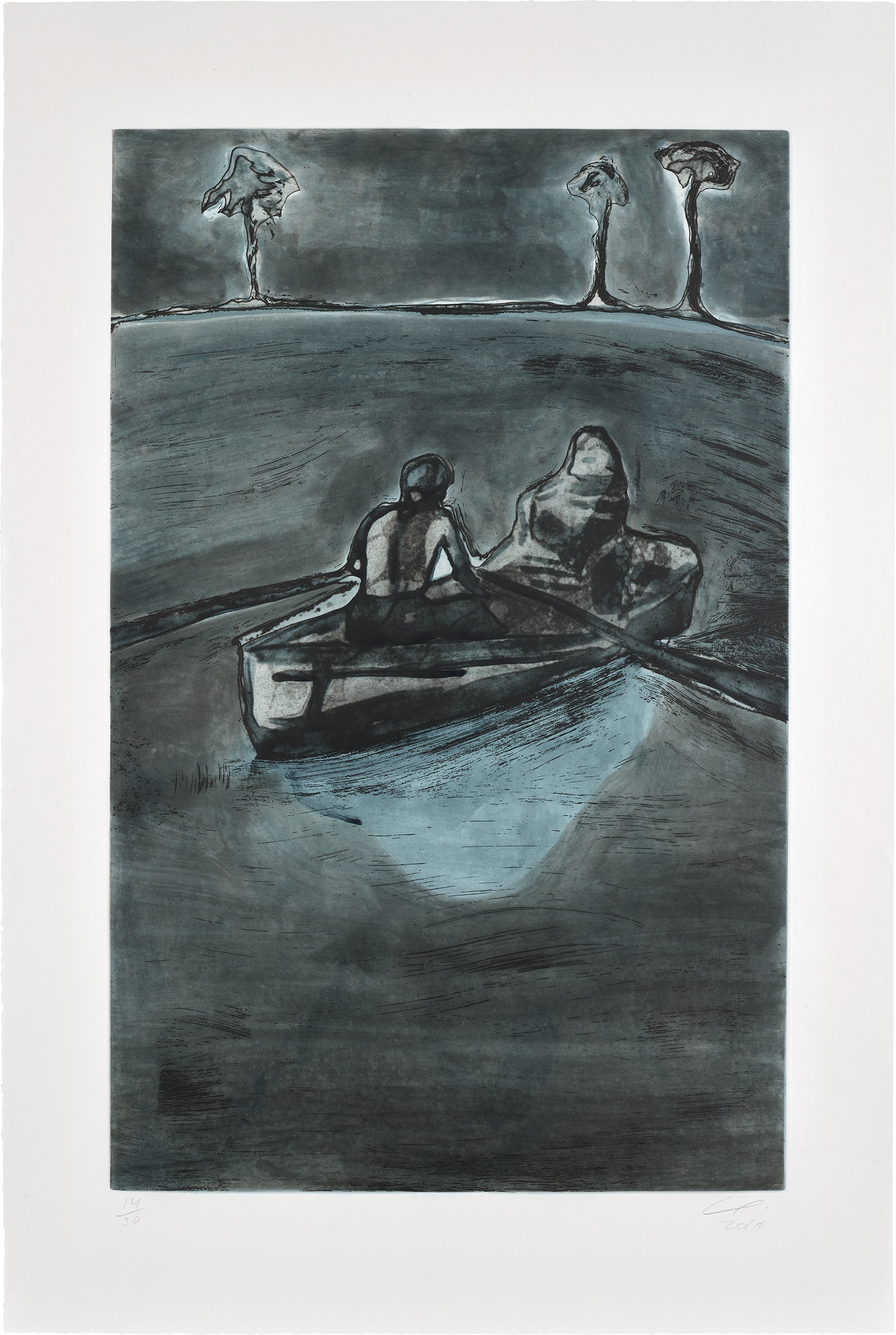
Peter Doig
Two People at Night (Indigo)
This relocation transformed his palette and expanded his iconographic range. The Caribbean light, the vegetation, the local culture, and the particular social textures of Port of Spain became new sources of inspiration without displacing the northern imagery that had made his name. Works incorporating canoe figures, tropical foliage, and the interplay of water and reflection deepened in ambition. His prints, including etchings and aquatints produced in collaboration with skilled publishers, brought his imagery to collectors who might not have access to his major paintings.
Works such as Surfer, Cave Boat Bird (Saut D'Eau), and Two People at Night (Indigo) demonstrate that Doig approaches printmaking with the same seriousness and inventiveness he brings to oil on canvas. On the market, Doig occupies a position of exceptional strength. His auction record was set in 2015 when The Architect's Home in the Ravine (1991) sold at Christie's London for just over eleven million pounds, a result that confirmed what serious collectors had understood for years: that major Doig paintings are among the most coveted objects in the contemporary art market. His galleries have included Michael Werner in New York and London, and his institutional exhibition history spans Tate Britain, the Scottish National Gallery of Modern Art, and the Museo Reina Sofía in Madrid.
Peter Doig
Country-rock (wing-mirror) 鄉村搖滾(後視鏡)
For collectors building a serious collection of contemporary painting, a Doig work at any level, whether a large oil, a work on paper such as Maracas' Study (2005), or a signed and numbered print from editions like Alpinist or Paragrand 2, represents an acquisition of genuine art historical weight. The prints in particular offer a compelling entry point, combining the full force of his imagery with accessibility and the pleasure of owning a work the artist has personally considered and approved. To place Doig within art history is to appreciate how skillfully he navigated a period in which painting was declared dead by some and reborn by others. His closest affinities lie with a tradition of northern European romantic landscape painting filtered through the anxieties and freedoms of the late twentieth century.
Collectors drawn to the atmospheric intensity of Luc Tuymans or the psychological landscape painting of Neo Rauch will find in Doig a kindred spirit, though his emotional register is distinctly warmer and more generous. His willingness to court beauty, at a time when beauty was considered suspect in serious art, was a form of quiet courage that the decades have vindicated completely. The legacy of Peter Doig is, above all, a demonstration of what painting can achieve when an artist refuses to be hurried or distracted. He has worked slowly, thoughtfully, and with uncommon fidelity to his own vision across more than thirty years.
His images, once seen, do not leave the viewer. They settle into the memory the way that certain places do, or certain pieces of music, becoming part of the private landscape of the imagination. For collectors who believe that painting retains the capacity to move, to haunt, and to illuminate, Doig remains an essential figure, one whose work will be studied and loved for generations to come.
Explore books about Peter Doig