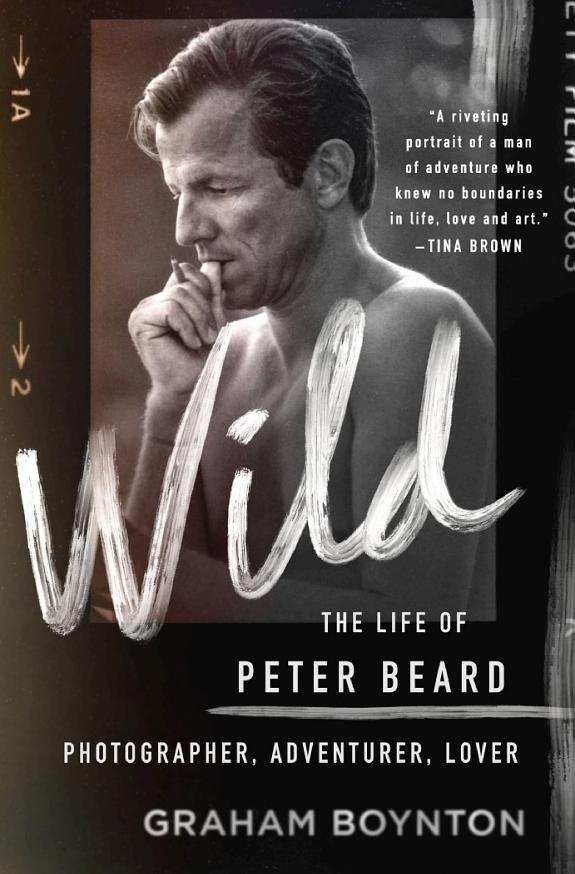
Peter Beard
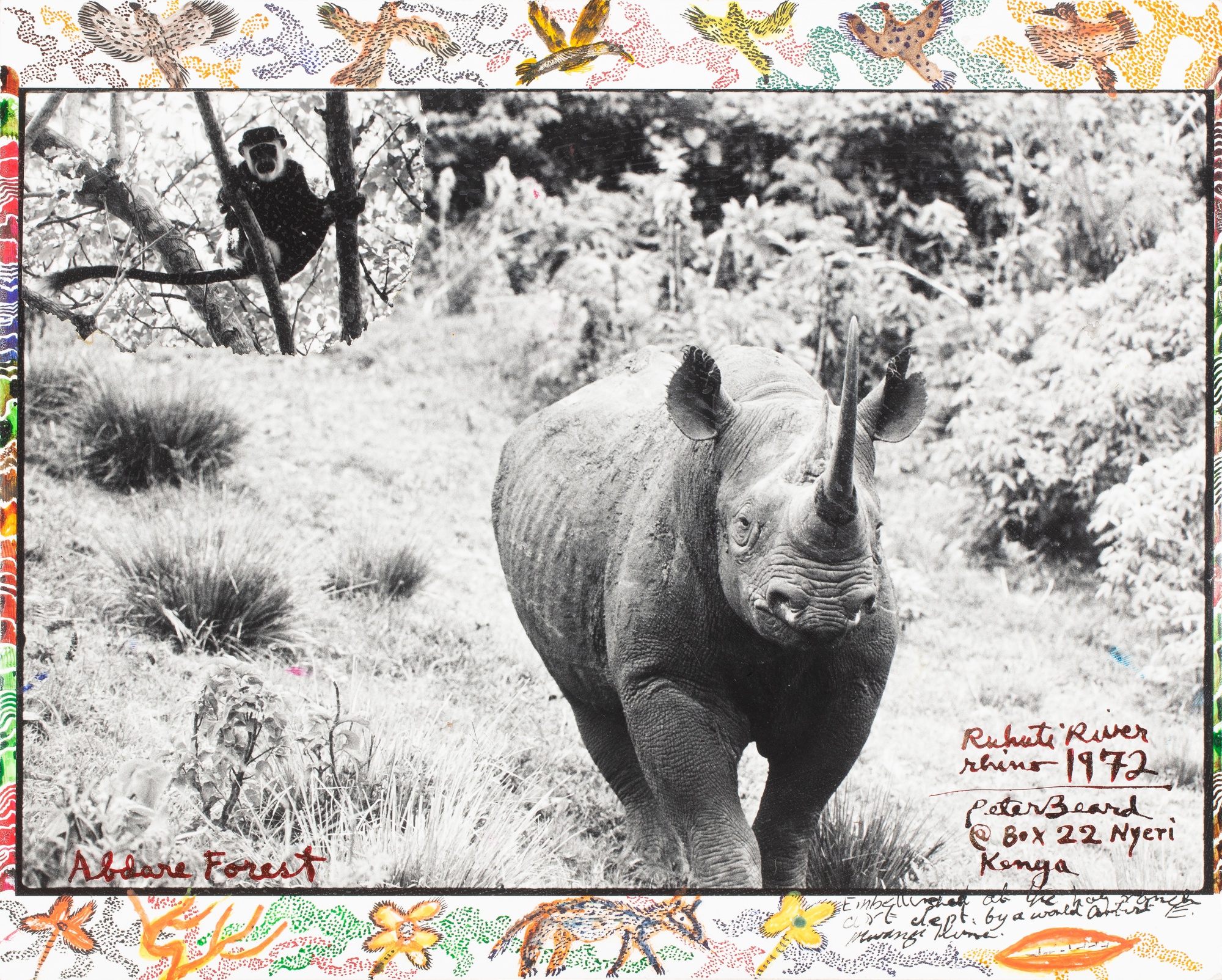
Peter Beard: Africa's Most Passionate Visual Witness
Artist Spotlight · The Collection Editorial
“The natural world is being taken apart piece by piece and nobody seems to give a damn.”
Peter Beard, The End of the Game
There are artists who document the world, and there are artists who bleed into it. Peter Beard belonged entirely to the second category. When a major survey of his work toured international institutions in the years before his passing in 2020, audiences encountered something that defied easy categorization: photographs covered in handwritten text, pressed insects, animal blood, collaged snapshots, and urgent marginal notes that read like dispatches from a civilization in freefall. The experience was overwhelming, intimate, and like nothing else in the history of photography or visual art.
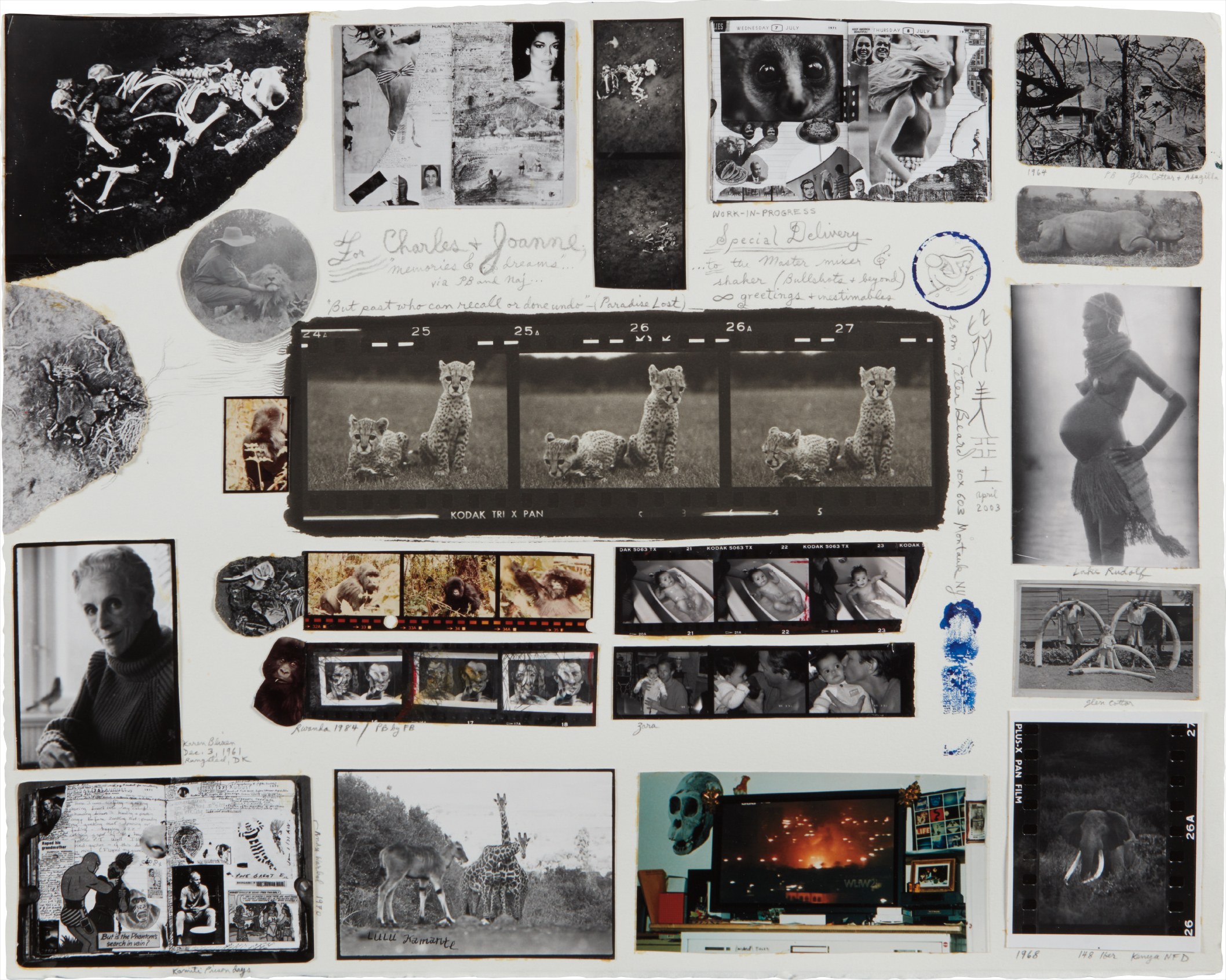
Peter Beard
Orphaned Cheetah Cubs (Last Word from Paradise), Mweiga Park Headquarters, near Nyeri, Kenya, 1968 and Beside the carcass of a beast, 1909
It remains so today, and the market for his work has reflected that singularity with growing conviction. Born in New York City in 1938 into a family of considerable social standing, Beard grew up with access to elite education and patrician expectation. He attended Yale University, where he studied art under the influence of Josef Albers, absorbing lessons about color, form, and the constructed image that would quietly underpin everything he made thereafter. But it was a trip to Kenya in 1955, taken at the age of seventeen, that truly split his life into before and after.
The country seized him completely. He returned again and again, eventually establishing a home at Hog Ranch, a forty acre property on the edge of Nairobi National Park that would become the mythological center of his creative universe. Beard's early photographic practice drew direct inspiration from Karen Blixen, whose memoir Out of Africa had enchanted him, and from the great hunting photographer Peter Pickford. He immersed himself in the landscapes of Tsavo and the Maasai Mara, living alongside conservationists, rangers, and nomadic communities at a moment when East Africa was undergoing the violent political and ecological transformations of independence and rapid modernization.
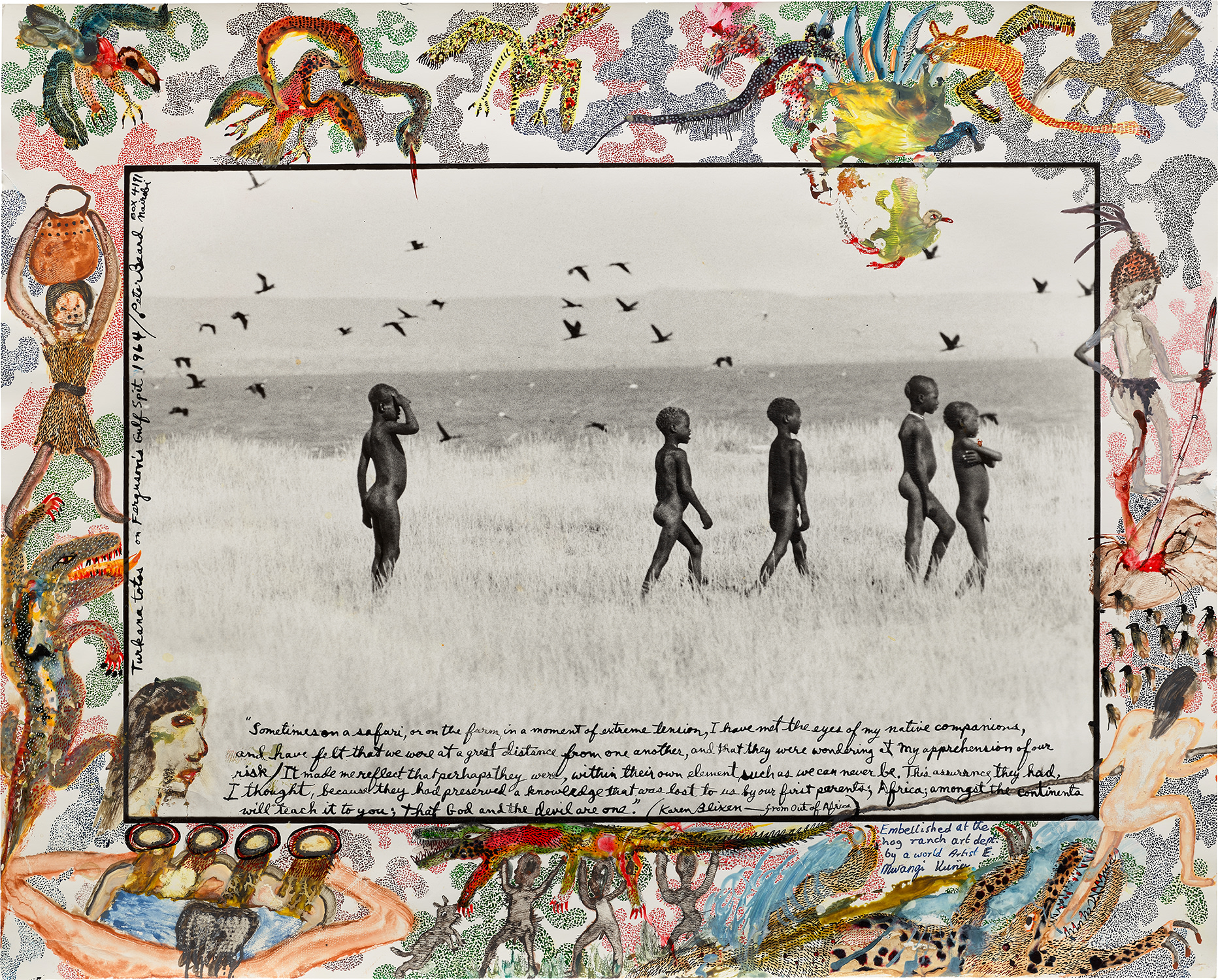
Peter Beard
Turkana Totes on Fergusons Golf Spit
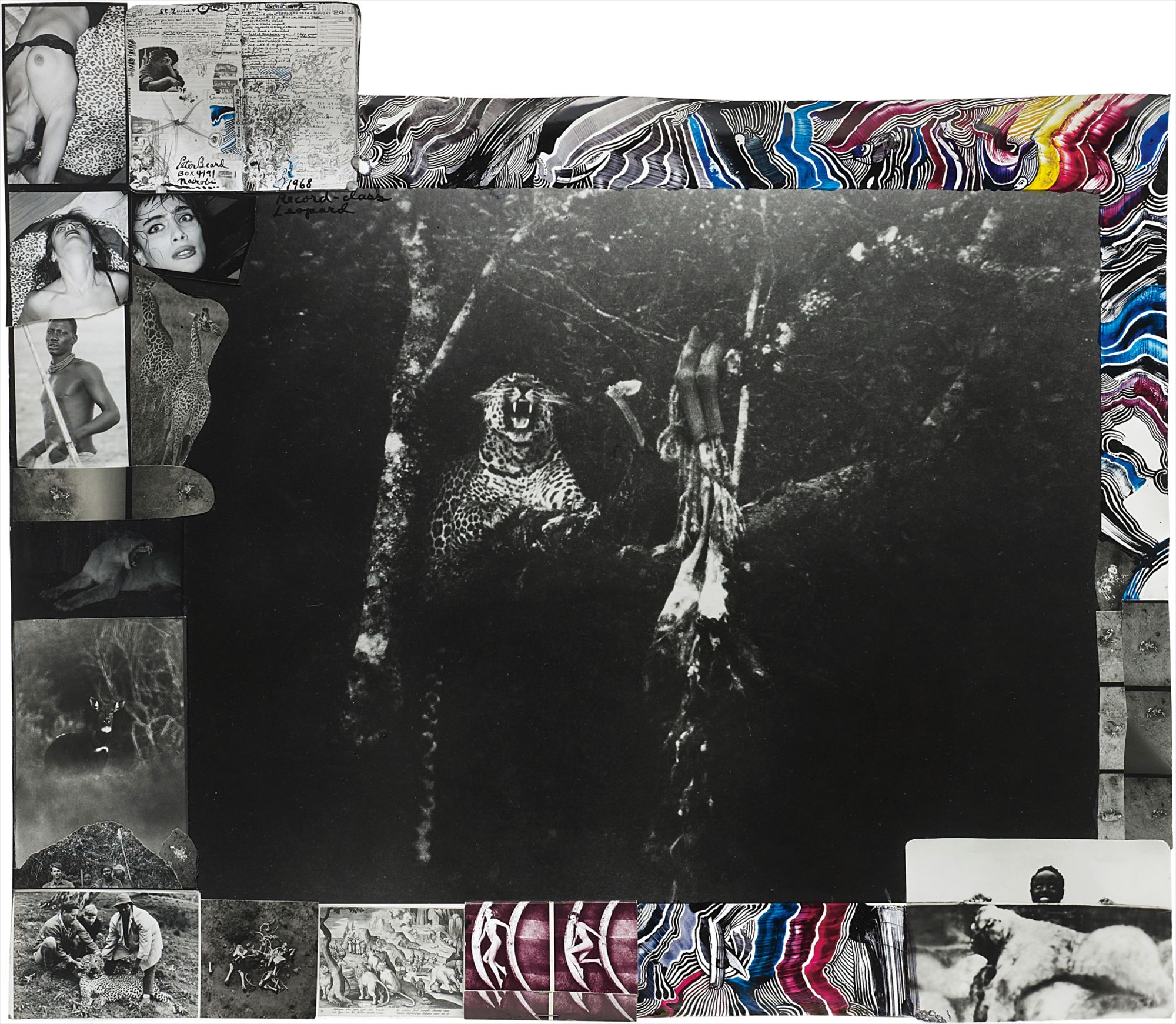
His 1965 book The End of the Game, a stunning visual record of the destruction of African wildlife and the collapse of a wilderness he had come to love with ferocious devotion, established him immediately as both an artist and a polemicist. The book was praised by Romain Gary and reissued multiple times, each edition expanding its argument and its visual scope. What distinguished Beard from every other photographer working in Africa was his refusal to let the photograph be a finished thing. Beginning in earnest through the late 1960s and accelerating through the 1970s and 1980s, he transformed his prints into dense, layered objects by writing directly onto them, pressing animal remains and botanical specimens into the emulsion, applying paint and ink, and affixing additional photographs to create works that functioned more like illuminated manuscripts than documentary images.
“Africa is a dying world. I wanted to document it before it disappeared completely.”
Peter Beard, interview
These were not edits or afterthoughts. They were the work itself, a record of consciousness in real time, anxiety and wonder and grief all living on the same surface. Works like Lion Pride near Ndutu, Southern Serengeti, which incorporates ink and blood alongside an affixed gelatin silver print, carry an almost physical charge. The blood is not a provocation.
Peter Beard
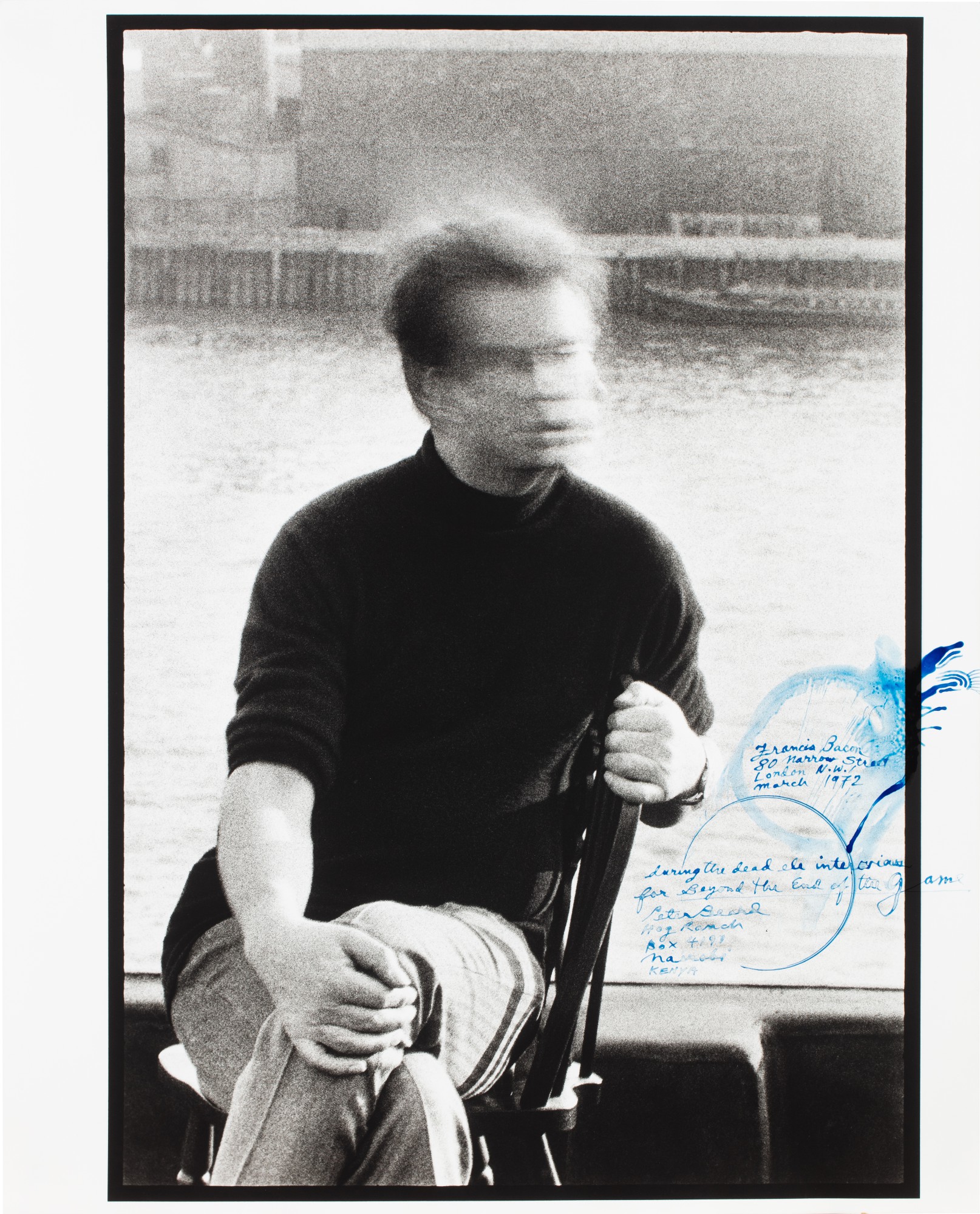
Francis Bacon, 80 Narrow Street, London N.W.1 March 1972, 1972
It is testimony. His portraits deserve particular attention. The 1972 photograph of Francis Bacon at 80 Narrow Street in London captures the painter with a directness and psychological compression that only a fellow artist could achieve. Beard and Bacon were genuine friends, and the image carries the weight of that mutual understanding.
Bacon himself was drawn to Beard's work, recognizing in those layered, annotated surfaces something akin to his own interest in the image as a site of distortion and revelation rather than mere record. Beard also turned his lens on figures including Andy Warhol, Mick Jagger, and Lee Radziwill, with whom he had a celebrated relationship, creating portraits that belonged equally to the world of fashion and the world of fine art without fully surrendering to either. For collectors, the appeal of Beard's work operates on multiple registers. His unique works, those gelatin silver prints transformed by hand into singular objects, represent the deepest expression of his vision and carry the most significant market weight.
Peter Beard
Record-Class Leopard
The collaboration with artists from his Hog Ranch Art Department, including Kivoi Mathenge, E. Mwangi Kuria, and Mutasa Isaiya, produced works of remarkable warmth and collective energy, pieces like Turkana Totes on Fergusons Golf Spit and the layered Impala print that feel genuinely joyful despite the ecological urgency running beneath them. Auction results at Christie's and Sotheby's over the past decade have demonstrated sustained collector appetite, with his most elaborately worked unique pieces attracting serious competition. What collectors consistently respond to is the irreducibility of the objects: no reproduction can approximate the experience of standing before the actual thing.
Beard occupies a singular position in art history that resists the usual taxonomies. He shares certain affinities with the diary impulse of artists like Cy Twombly, whose own layered surfaces of text and mark sit in productive conversation with Beard's notebooks and print interventions. His documentary ambitions connect him to photographers like Ernst Haas and Eliot Porter, who were also trying to make the natural world feel morally urgent through image making. His collage sensibility and his insistence on the photograph as raw material rather than finished product place him in dialogue with Robert Rauschenberg's combine paintings, works that similarly refuse the boundary between image, object, and text.
Yet none of these comparisons fully accounts for Beard, who remains stubbornly himself. His legacy today is both an artistic and an environmental one. The wildlife populations he photographed and mourned in the 1960s have continued to face the pressures he documented so presciently. Tsavo, Lake Rudolf, the Aberdare Forest: these are not merely locations in his works but ongoing arguments about what human civilization is willing to sacrifice.
A new generation of collectors and curators is returning to his work with fresh appreciation, drawn by the combination of formal daring and moral seriousness that feels rare in any era. The Collection at collctn.art gathers a remarkable range of his output, offering a genuine opportunity to encounter the full arc of a practice that was, in every sense of the word, lived. Peter Beard did not stand apart from his subjects and press a shutter.
He pressed himself into the world, leaving marks on everything he touched.
Explore books about Peter Beard