Pedro Angel González
Pedro Angel González, Venezuela's Radiant Modernist Voice
Artist Spotlight · The Collection Editorial
There is a particular quality of light in the Venezuelan landscape, a warmth that saturates everything it touches, turning ochre hillsides into gold and casting long, amber shadows across the haciendas of the interior. It is this light that Pedro Angel González spent a lifetime learning to capture, and which makes encountering his work today feel less like looking at a painting and more like stepping into a memory of the tropics. As institutions across Latin America continue to reassess the full breadth of Venezuelan modernism, González has emerged as a figure whose contribution demands fresh attention, a painter who brought European sophistication home and pressed it gently but firmly into the service of a distinctly Venezuelan vision. González was born in Venezuela in 1901, entering the world at a moment when the country was still finding its cultural footing and its artistic community was beginning to dream of a language that was neither colonial echo nor simple imitation of European fashion.
Pedro Angel González
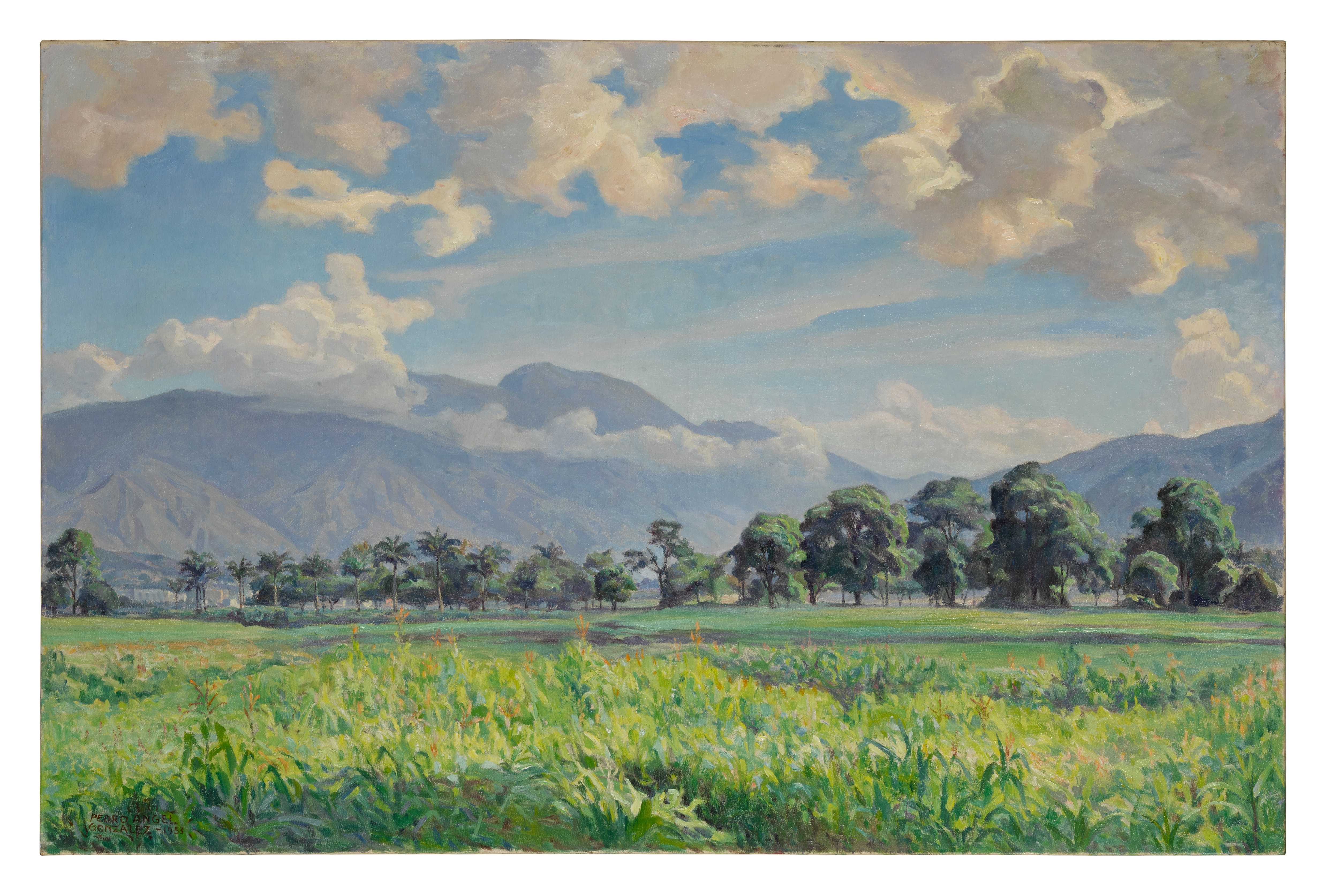
Desde la hacienda La Vega
Like many ambitious young artists of his generation in Latin America, he understood that Paris was the essential pilgrimage, the place where the new visual grammar of the twentieth century was being written. He made that journey, immersing himself in the ferment of the French capital during one of its most generative periods, when fauvism, expressionism, and post impressionist color theory were reshaping what paint on canvas could mean. These were not merely aesthetic lessons for González. They were tools he was quietly preparing to carry back across the Atlantic.
His time in Paris placed him in the company of ideas that would define his practice for decades. The liberation of color from strict descriptive duty, the willingness to let form breathe and exaggerate, the understanding that a painting could be emotionally true without being photographically accurate: all of these principles took root in González during his European years. Yet what distinguished him from painters who simply absorbed European modernism and reproduced it was his insistence on returning those principles to a Latin American context. He was not interested in making Venezuelan versions of French paintings.
He was interested in using what he had learned to see Venezuela more clearly, and to render what he saw with a new kind of expressive honesty. Back in Venezuela, González developed a practice centered on the rhythms of everyday life, the landscapes of the countryside, the textures of domestic and rural experience that formed the backbone of Venezuelan identity. His work is characterized by a generosity of color that feels both learned and instinctive, as though the palette he brought home from Paris had been left out in the tropical sun long enough to deepen and intensify. His figuration is expressive rather than academic, shaped by feeling and observation in equal measure.
The compositions have a solidity to them, a sense that the painter knew exactly where he was standing and what he wanted to say, without any of the anxious over refinement that can sometimes afflict painters caught between two worlds. Among his known works, "Desde la hacienda La Vega" stands as a particularly eloquent example of his mature vision. An oil on canvas, it draws the viewer into the Venezuelan countryside with a confidence that feels deeply personal. The hacienda, as a subject, carries enormous cultural weight in Venezuela: it is a site of labor and leisure, of history and daily life, of a particular relationship between people and land that defines much of the national experience.
González approaches this subject not as a documentarian but as someone for whom the scene is alive with meaning. The color is bold without being brash, the composition anchored by a sense of place that speaks to years of looking and living. It is the kind of painting that rewards sustained attention, revealing new details and emotional registers the longer one stands before it. From a collecting perspective, González occupies a position of genuine art historical importance within the canon of Venezuelan modernism, a category that has attracted growing international interest over the past two decades.
Latin American modern and contemporary art has seen significant appreciation at major auction houses including Christie's and Sotheby's, with Venezuelan artists benefiting from broader regional enthusiasm and from the efforts of scholars and curators to tell a more complete story of twentieth century modernism beyond its European and North American centers. Works by González offer collectors the opportunity to engage with a pivotal chapter in Venezuelan cultural history, and with a body of painting that holds its own aesthetically against the broader currents of mid century modernism. For collectors building thoughtful positions in Latin American art, his work represents both cultural significance and aesthetic pleasure, a combination that is rarer than it might seem. To understand González fully, it helps to place him within a generation of Venezuelan artists who collectively forged a national modernism out of the encounter between local experience and international influence.
Artists such as Armando Reverón, who developed a singular practice rooted in the Venezuelan coast and its blinding light, and Héctor Poleo, whose figuration evolved across decades of stylistic experimentation, provide useful points of comparison and context. González shares with Reverón a commitment to the specificity of Venezuelan light and landscape, and with Poleo an embrace of expressive figuration as a vehicle for emotional and cultural content. Together, these painters constitute a tradition that deserves to stand alongside the celebrated schools of Mexican muralism and Argentine modernism in any serious account of Latin American art in the twentieth century. Pedro Angel González lived until 1981, long enough to see Venezuelan art undergo several further transformations and to witness his own early commitments vindicated by time.
His legacy is that of a painter who understood that modernism was not a destination but a method, a set of liberations that could be applied anywhere in the world by anyone willing to look hard at the place and people around them. In a moment when the art world is genuinely, if belatedly, broadening its sense of where important art was made in the twentieth century, González feels not like a rediscovery but like a proper discovery, an artist whose work has been waiting patiently for the audience it always deserved.