Pavel Tchelitchew
Pavel Tchelitchew: Visionary of the Luminous Form
Artist Spotlight · The Collection Editorial
“I want to paint the interior of things, not their surface.”
Pavel Tchelitchew
There is a moment, standing before Pavel Tchelitchew's most ambitious canvases, when the eye stops trusting itself. Figures dissolve into foliage, children become roots, skin becomes light. It is a disorienting and utterly beautiful experience, and it captures something essential about this singular artist: that he was never content to paint what the eye simply sees. He painted what the mind dreams beneath the surface of the visible world.
Pavel Tchelitchew
BATHERS
As major institutions continue to revisit the Neo Romantic currents of the mid twentieth century, Tchelitchew's work occupies an increasingly central position in that reappraisal, recognized not merely as a curiosity of its era but as a genuine philosophical and technical achievement of enduring power. Pavel Fyodorovich Tchelitchew was born in 1898 into an aristocratic Russian family outside Moscow, a background that would shape both his aesthetic sensibility and his eventual displacement. The upheaval of the Russian Revolution forced him from his homeland as a young man, and he made his way through Kiev and Istanbul before arriving in Berlin in the early 1920s. By 1923 he had settled in Paris, where the city's electric confluence of emigre artists, writers, and intellectuals became the crucible of his early formation.
He entered the orbit of Gertrude Stein, who became one of his most important early champions, and he forged connections with the world of the Ballets Russes, designing sets and costumes that revealed his instinct for theatrical transformation and his sensitivity to the human figure in motion. His Paris years produced work of extraordinary intimacy and formal intelligence. The 1925 portrait known as "Portrait of Vladimir Dukelsky" exemplifies the directness and psychological warmth of his early figurative output. Rendered with a bold, painterly confidence, the portrait captures a young man in a grey suit and spotted cravat adorned with a pink flower, his face flushed with those characteristic rosy blushes that recur throughout Tchelitchew's portraits.
Pavel Tchelitchew
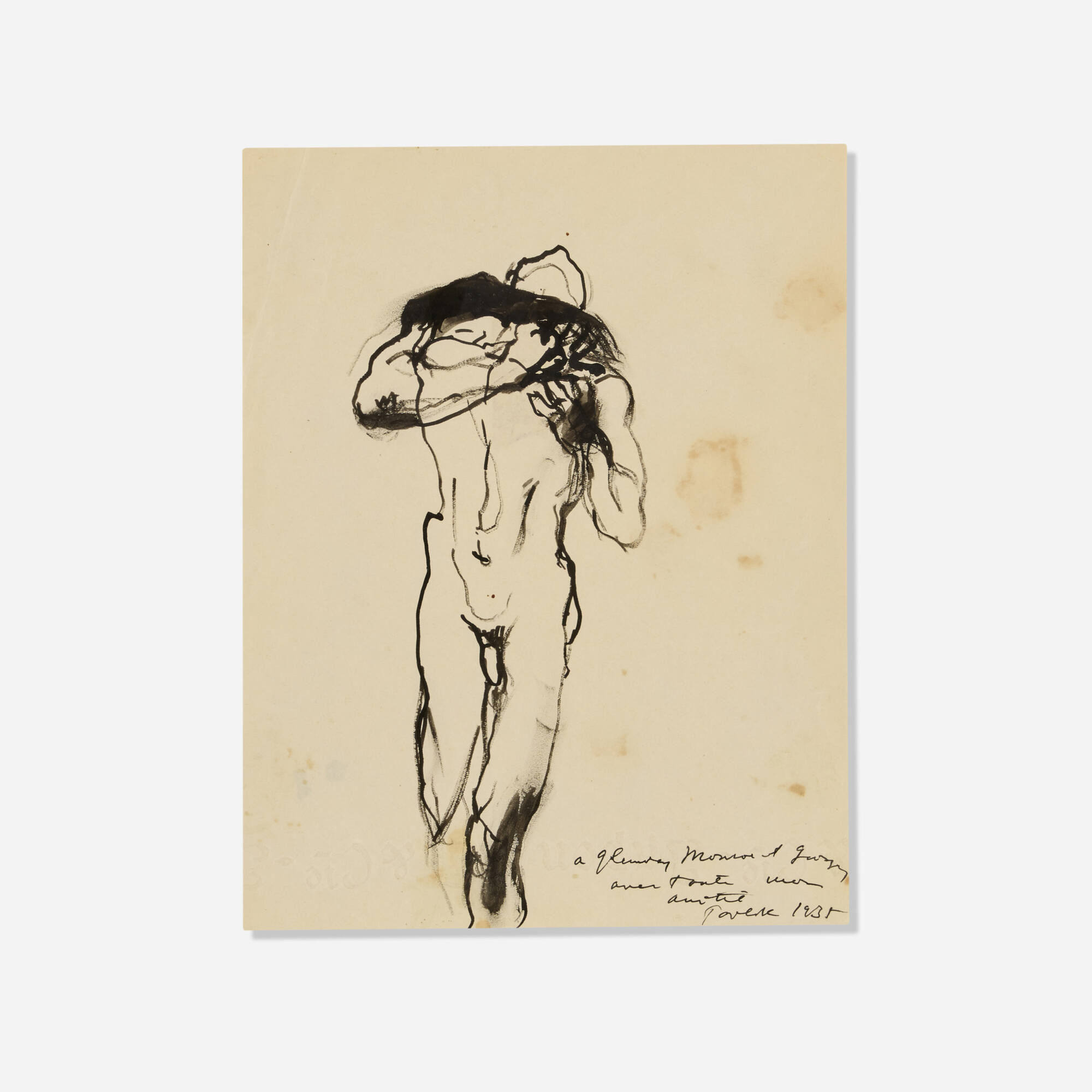
Untitled, 1935
The palette is deliberately compressed, anchored in grey, warm brown, and coral, and the handling is loose enough to feel alive while precise enough to carry unmistakable presence. There is an intimacy here, a sense of genuine affection between painter and subject, that distinguishes his portraiture from the cooler distance of much contemporaneous modernism. When Tchelitchew moved to New York in 1934, his practice entered a new and increasingly visionary phase. He had already demonstrated his mastery of the human figure in traditional terms, but now he began to push that mastery toward something stranger and more inward.
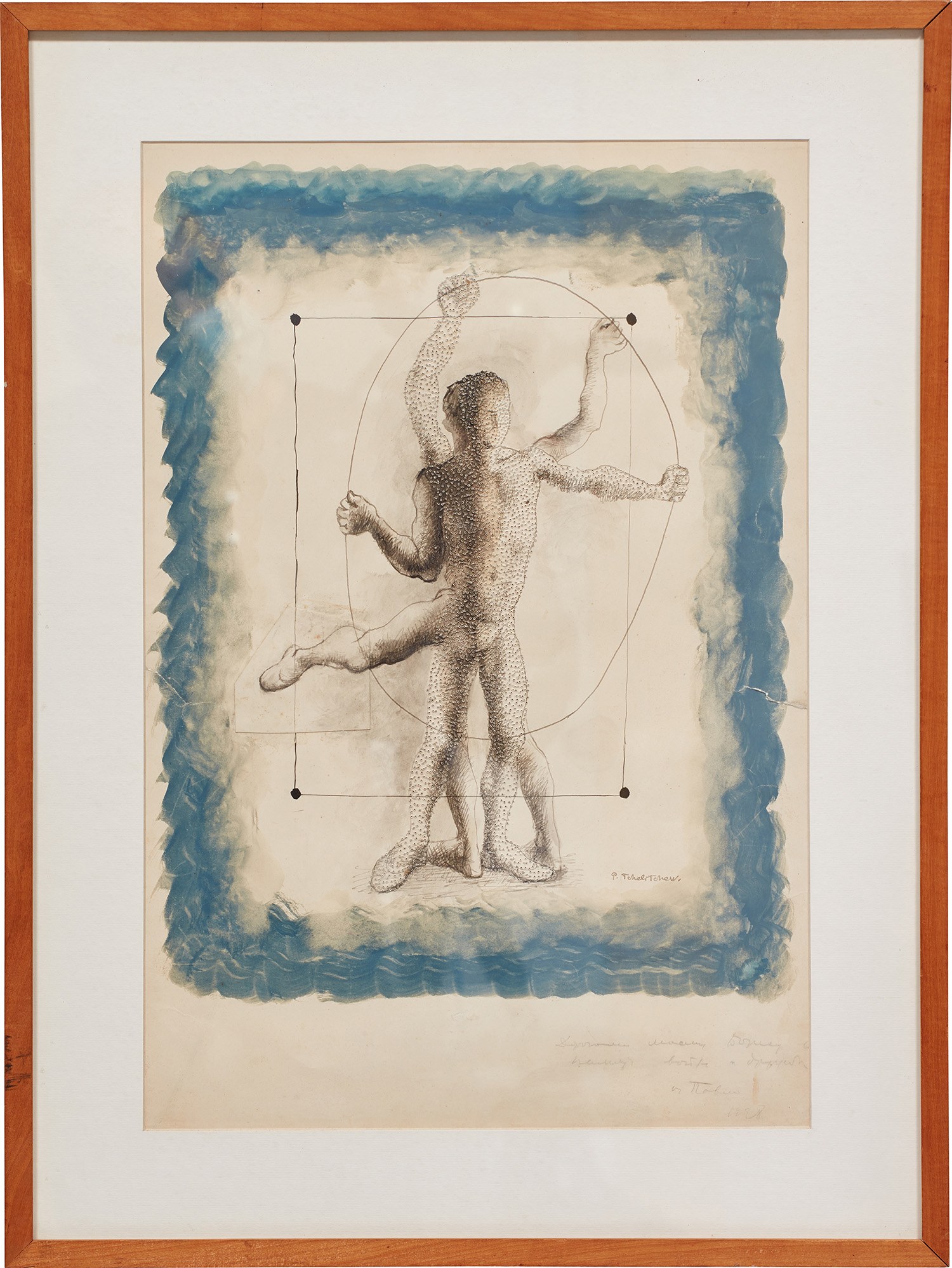
The works on paper from this period reveal a restless experimental intelligence. One stunning example in the present context is a figure study in which a standing male form is inscribed within a geometric matrix of rectangle and oval, the figure rendered in stippled ink that gives the body an almost cellular quality, as though it were being assembled from particles rather than observed from life. The blue watercolor border that frames the composition lends it the character of an illuminated diagram, somewhere between Leonardo's anatomical studies and something altogether more mystical. This is Tchelitchew thinking about the body as a cosmological proposition.
Pavel Tchelitchew
Russian Erotica, 1984
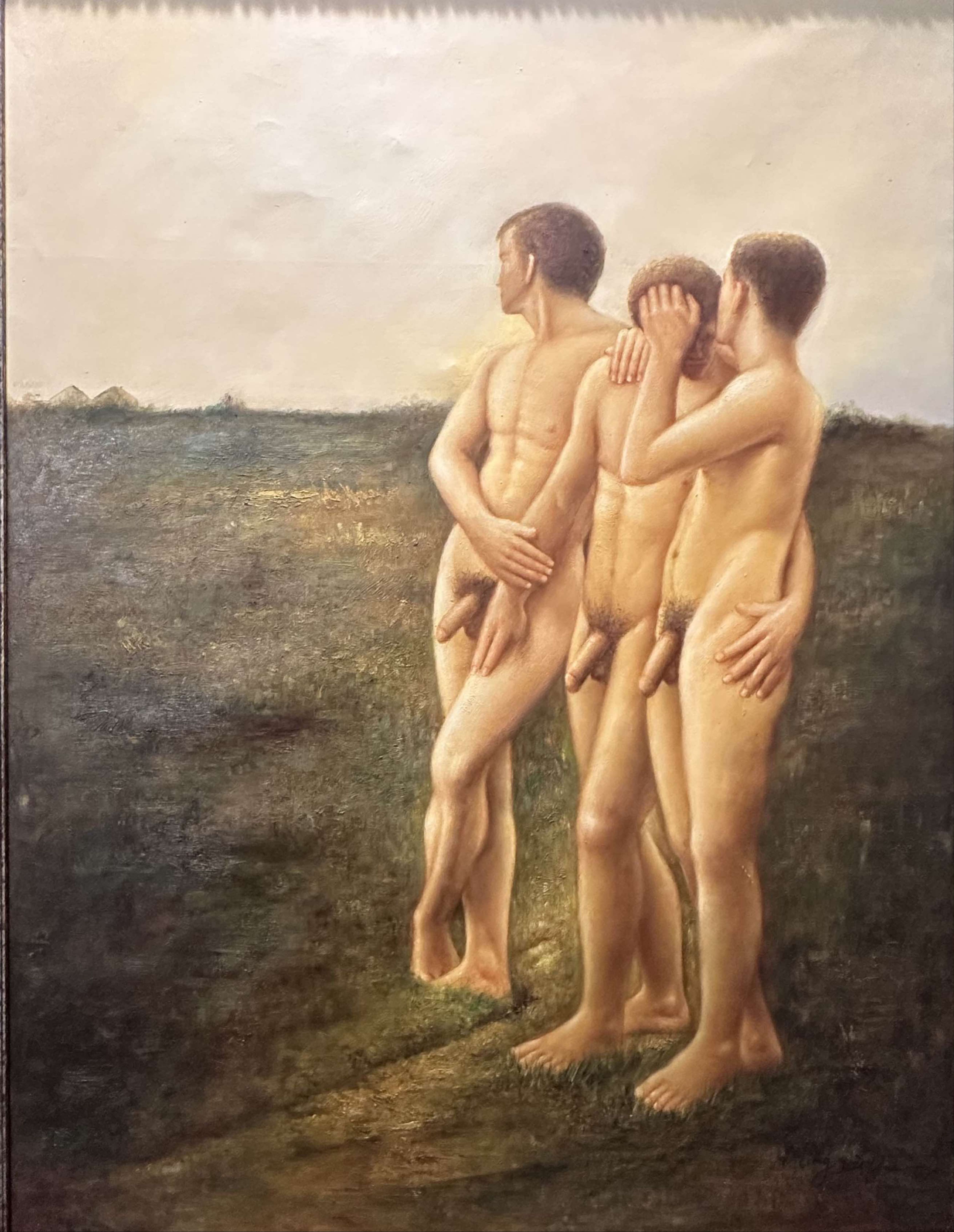
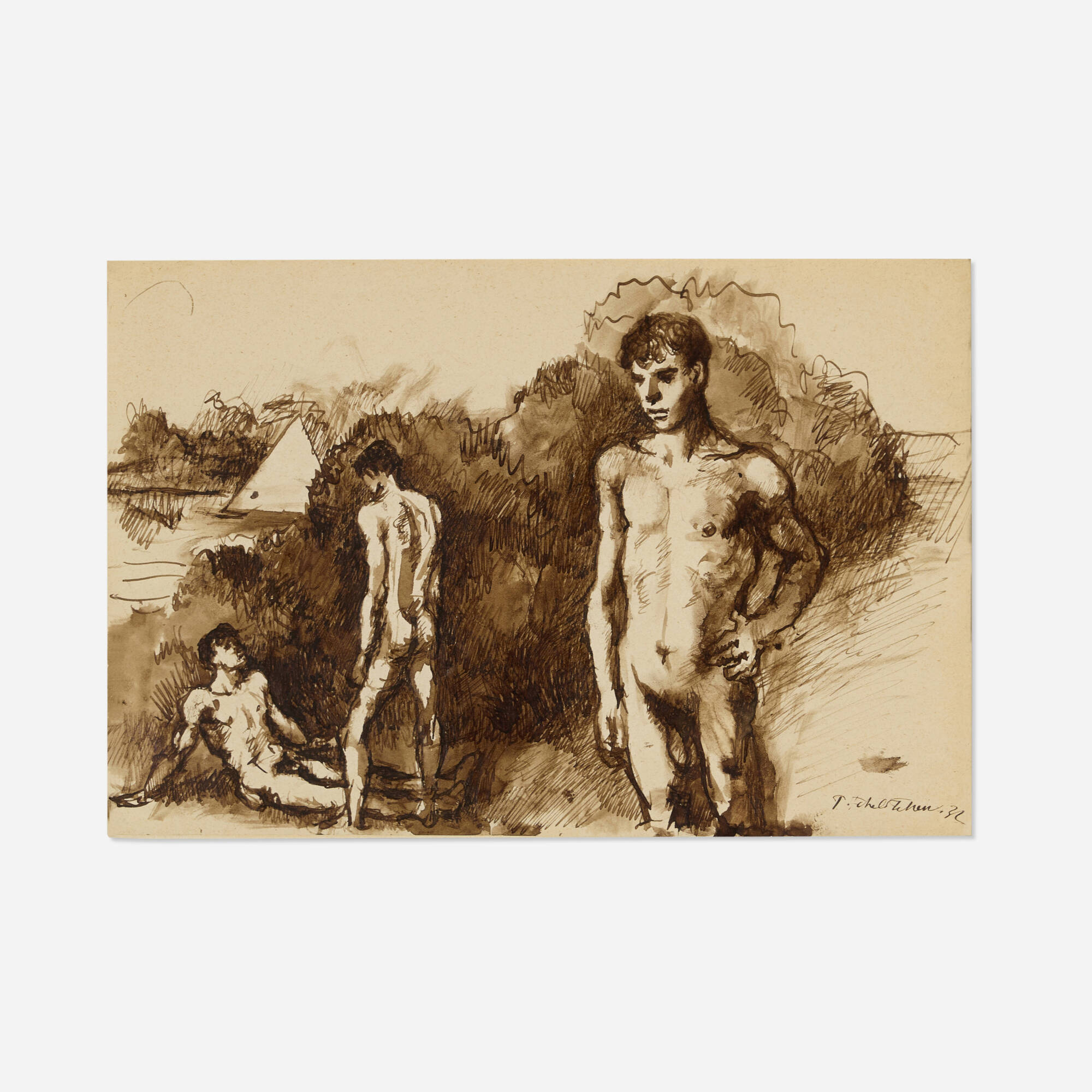
The oil painting of three male bathers in a landscape, present here in vivid detail, demonstrates another register of his extraordinary range. Three nude male figures stand grouped on a grassy rise, their bodies warm against a pale, overcast sky. The handling of flesh is classical in its confidence, indebted to the great tradition of European academic painting but charged with an emotional directness that lifts it beyond mere technical exercise. The figures embrace with a tenderness that feels neither programmatic nor theatrical but genuinely felt.
The landscape behind them, rendered in deep greens and distant ochres, situates them in a timeless pastoral world, removed from the pressures of any particular moment. This is Tchelitchew working within the Neo Romantic mode at its most assured. Perhaps the most startling work visible here is the large drawing of a face constructed entirely from swirling lines of white and gold against a ground of charcoal grey and black. Two enormous eyes anchor the composition, their irises rendered as radiant gold and blue spirals, while the entire face appears to be made of luminous filaments, as though the nervous system has been turned inside out and made visible.
Pavel Tchelitchew
Bathers by a Bridge, 1932
This is Tchelitchew in full visionary flight, and it connects directly to the concerns that animate "Hide and Seek," his monumental masterwork from 1940 to 1942 held at the Museum of Modern Art in New York. In that painting and in works like this one, the human form becomes a map of inner experience, a diagram of energies and metamorphoses that the ordinary eye cannot perceive. The technical ambition is staggering, and the emotional effect is one of awe. For collectors, Tchelitchew presents a compelling and multidimensional proposition.
His works on paper, including ink drawings, watercolors, and mixed media studies, offer points of access across a range of scales and price points, and they often reveal his thinking with a directness that even his large canvases cannot match. His portraits, particularly those from the Paris years, carry the intimacy of a deeply social artistic sensibility, a man who moved among brilliant and extraordinary people and looked at them with genuine love and curiosity. Works from the 1930s and 1940s, when his visionary experiments were at their most intense, represent the fulcrum of his contribution and are increasingly sought by collectors who understand the depth of his engagement with questions about the body, light, and consciousness. Related artists who illuminate his context include Eugene Berman and Leonid Berman, his close contemporaries within the Neo Romantic circle, as well as Salvador Dali, with whom he shares a commitment to startling psychological imagery, though Tchelitchew's emotional register is ultimately warmer and more lyrical than Dali's theatrical provocations.
What Tchelitchew offers the present moment is something rare: a genuinely spiritual ambition held in the hands of a genuinely gifted technician. He was not content with beauty alone, though beauty is everywhere in his work, nor was he content with idea alone, though his ideas are profound and searching. He believed that painting could be a form of seeing that went beyond ordinary sight, that the human figure could be a vehicle for revelation. In an era when figurative painting has returned to the center of critical conversation and collectors are looking beyond the obvious names for artists who reward deep and sustained attention, Tchelitchew stands as one of the twentieth century's most rewarding rediscoveries.
His canvases and drawings ask everything of the eye, and they give back something that is very difficult to name but impossible to forget.
Featured Works
Explore books about Pavel Tchelitchew