Pavel Pepperstein
Pavel Pepperstein Dreams the Future Into Being
Artist Spotlight · The Collection Editorial
When the Venice Biennale opened its doors to Pavel Pepperstein's work, something unusual happened in the pavilions along the lagoon: visitors slowed down. In a context engineered for spectacle and statement, Pepperstein's imagery demanded a different kind of attention, one that hovered between decoding and surrender. His pictures do not resolve into simple meanings. They accumulate, layer by layer, like sediment from civilizations that have not quite arrived yet.
Pavel Pepperstein
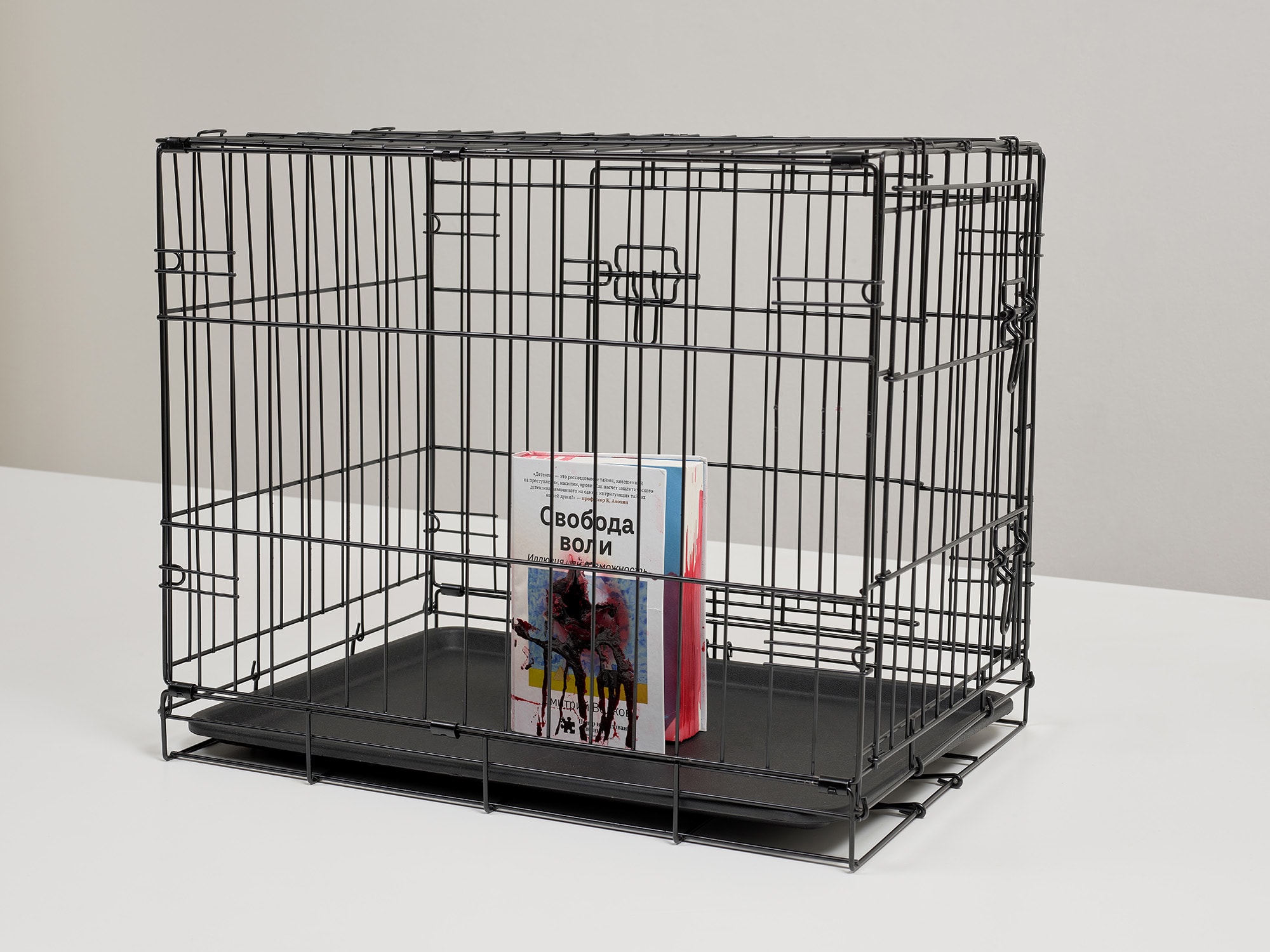
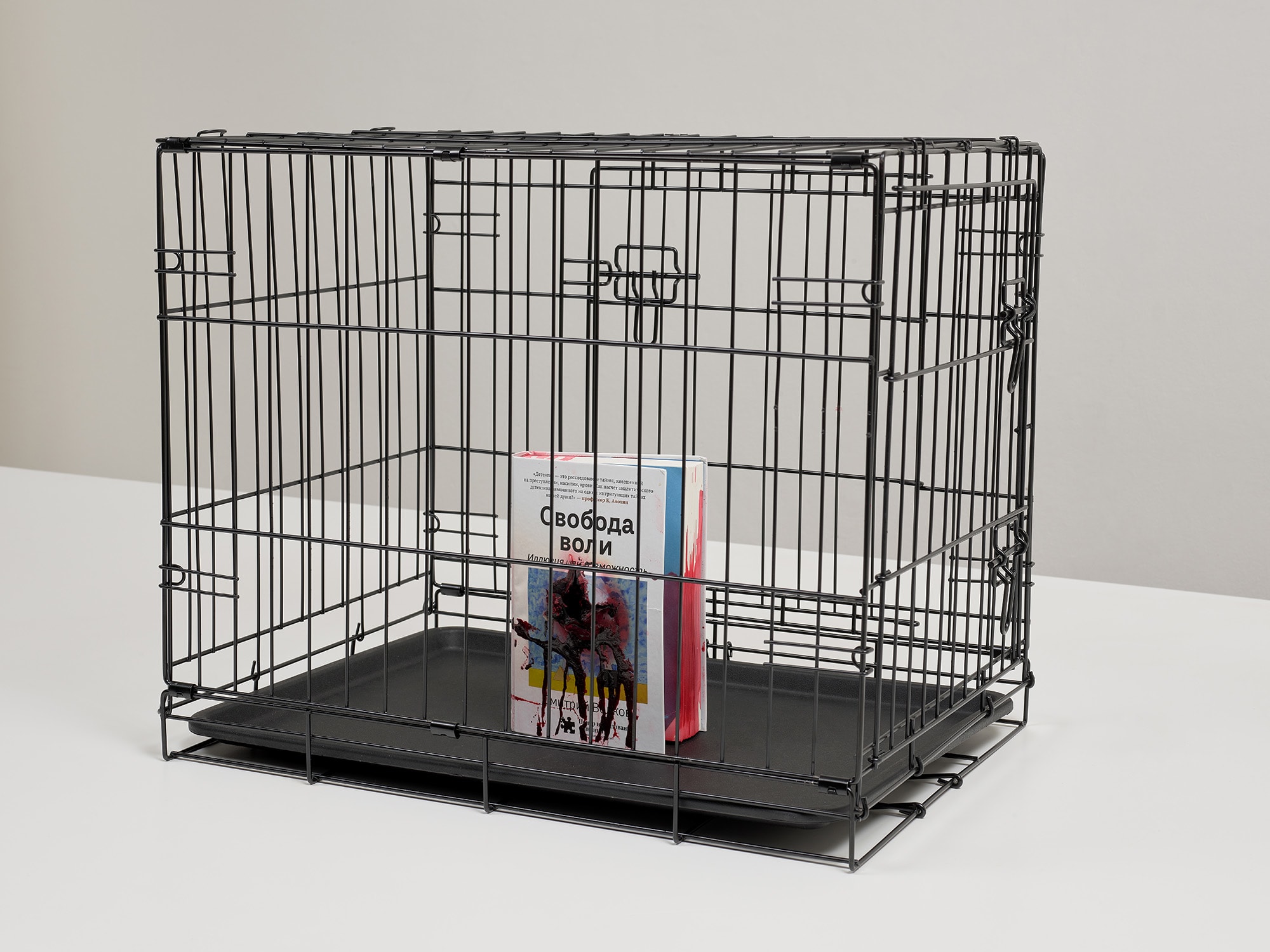
This is not a book, 2019
Pepperstein was born in Moscow in 1966 into an extraordinary cultural milieu. His father was Viktor Pivovarov, one of the founding figures of Moscow Conceptualism, and his childhood unfolded in intimate proximity to the underground art world of late Soviet Russia. That world was not hidden so much as parallel, running alongside official culture with its own rituals, its own humor, and its own sustained act of imaginative defiance. Growing up inside that conversation shaped Pepperstein in ways that are visible in every work he has made: a deep familiarity with the language of ideology, and an equally deep delight in subverting it.
In the late 1980s, Pepperstein co founded Inspection Medical Hermeneutics alongside Sergei Anufriev and Yuri Leiderman. The group became one of the most intellectually distinctive collectives to emerge from the Soviet and post Soviet art world, developing a practice that blended psychedelic philosophy, literary experiment, and visual art into something that resisted easy categorization. Medical Hermeneutics produced texts and objects and performances that operated like systems of thought rather than individual artworks, drawing freely on Freud, on structuralism, on mysticism, and on the peculiar dreamlife of late Soviet consumer culture. Pepperstein was the group's most prolific visual voice, and the aesthetic he developed during those years, intricate, narrative, simultaneously childlike and erudite, has remained the foundation of his practice ever since.
Pavel Pepperstein
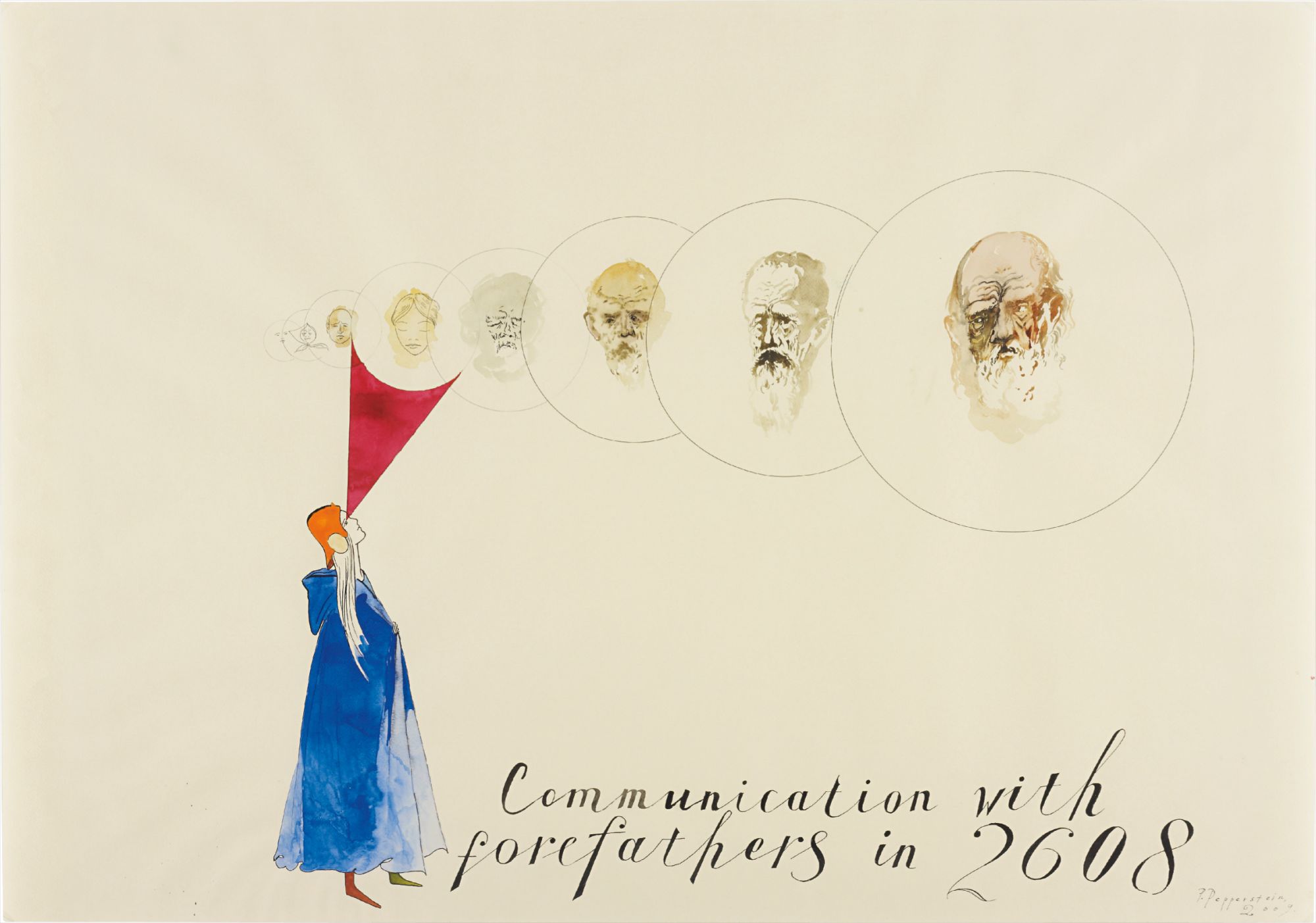
Communication with forefathers in 2608
What distinguishes Pepperstein's mature work is its relationship to time. He does not paint the past or the present so much as he maps imagined futures projected backward onto recognizable forms. Works like "Communication with Forefathers in 2608" and "In the period 3033 to 3104 the system 'Black Square' was used as a portal for the contact with extra terrestrial civilisations" (2009) treat history as a substance that can be folded, extended, or compressed. That 2009 watercolour, acrylic and pen work is among the most quietly radical things he has produced.
By inserting Malevich's foundational abstraction into a speculative future narrative, Pepperstein neither parodies the canon nor reverently preserves it. He simply continues it, as though the history of art were an ongoing story rather than a completed monument. "Talking Clouds at 2999" performs a similar operation, giving meteorological phenomena the dignity of language and situating them in a future so distant it loops back around to feeling mythological. His 1999 paintings carry a particular weight for collectors and historians alike.
Pavel Pepperstein
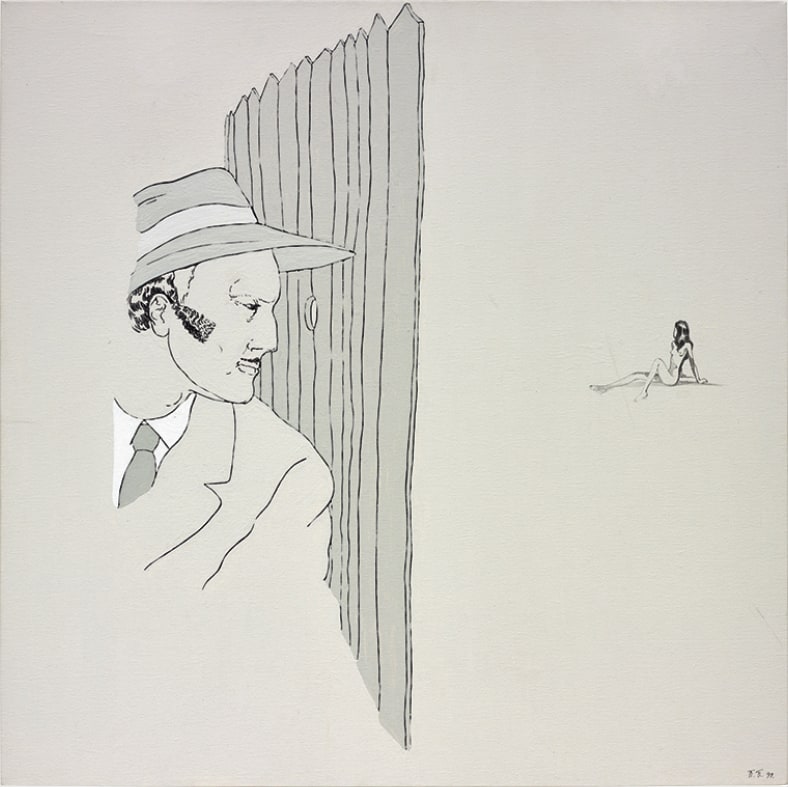
Voyeur, 1999
"Voyeur," rendered in acrylic on canvas, and "Sleeping People," in oil on canvas, both date from a period of intense productivity following the dissolution of Medical Hermeneutics as a formal collective. These works show Pepperstein thinking through questions of observation and consciousness, about who watches and who dreams, with a directness that feels almost confessional against the more elaborate cosmological work that surrounds them. "Triumph of Mermaid" (2008), acrylic on canvas, belongs to a body of work in which mythological figures move through landscapes that are simultaneously Soviet and timeless, heroic and absurd, with a tenderness that keeps the irony from curdling into cynicism. The mixed media work "This is not a book" (2019), incorporating a book and metal cage across two parts, is among his most object oriented and conceptually layered recent works, nodding toward Magritte's famous refusal while staging its own distinct argument about language and containment.
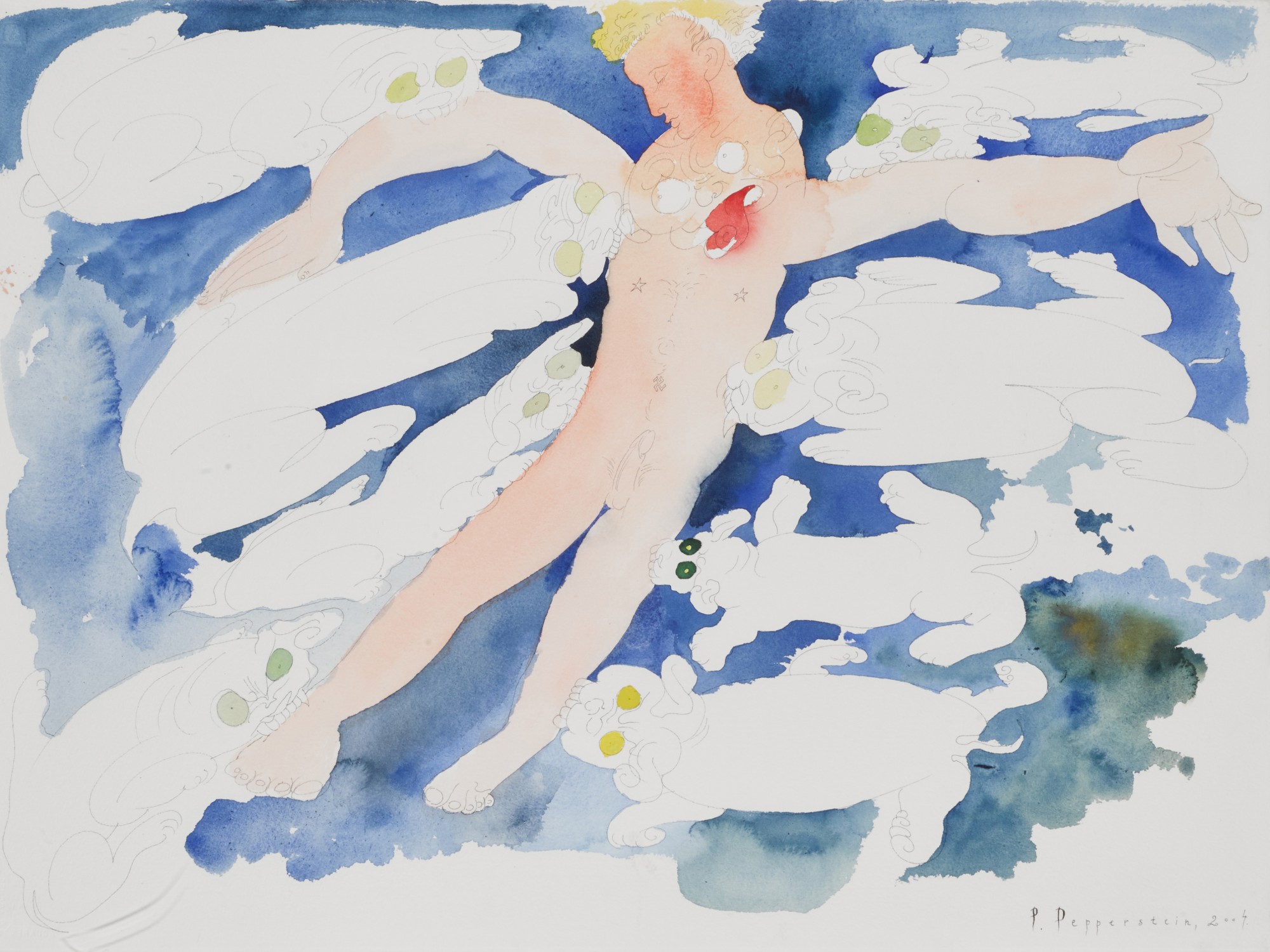
For collectors, Pepperstein represents something genuinely rare: an artist who is both historically significant and still producing work of expanding ambition. His watercolours and works on paper, including pieces like "And from Granddad he Didn't Escape" and "Who is to Blame," offer a point of entry that feels intimate without being minor. These works on paper are not studies or peripheral productions. They are central to how Pepperstein thinks, and they carry the full density of his conceptual world in a format that rewards close and repeated looking.
Pavel Pepperstein
Untitled
Collectors drawn to the Moscow Conceptualist tradition, to figures like Ilya Kabakov, Eric Bulatov, and Pepperstein's own father Viktor Pivovarov, will find in his practice a bridge between the foundational generation and the concerns of contemporary art today. His work holds its own in dialogue with Western contemporaries working at the intersection of text, image, and speculative thought, artists like Raymond Pettibon or Maria Lassnig, though Pepperstein's roots in a distinctly Russian intellectual tradition give his imagery a flavour that has no precise equivalent elsewhere. The broader art world has been steadily catching up with what a committed group of European collectors and institutions recognised some time ago. Major European institutions have shown his work, and critical attention in both Russian and Western contexts has grown considerably since the mid 2000s.
There is an argument to be made that Pepperstein is among the most significant artists to have emerged from the post Soviet space, and that the full scope of his contribution, as painter, as writer, as one of the great imaginative mythographers of our era, is still being absorbed. His willingness to take the long view, to set his paintings in the year 3033 or 2608, is not escapism. It is a philosophical position: a belief that art participates in something larger than the moment of its making, and that the future is as available to memory as the past. For anyone who has spent time with his pictures, that belief is entirely convincing.