Paul Nash
Paul Nash: England's Most Visionary Landscape Dreamer
Artist Spotlight · The Collection Editorial
“I am a messenger who will bring back news from the land of the dead.”
Paul Nash, letter, 1917
In the spring of 2016, Tate Britain mounted a landmark retrospective of Paul Nash that drew extraordinary crowds and reaffirmed his place among the most significant British artists of the twentieth century. The exhibition traced his arc from lyrical Pre Raphaelite influenced draughtsman to a painter whose canvases crackled with Surrealist energy and metaphysical unease. Critics marvelled at the range and the consistency of vision, the sense that across four decades of work, one restless, searching intelligence had remained in constant dialogue with the landscapes, objects, and forces that shape human experience. For collectors and art lovers encountering Nash for the first time, the retrospective was a revelation.
Paul Nash
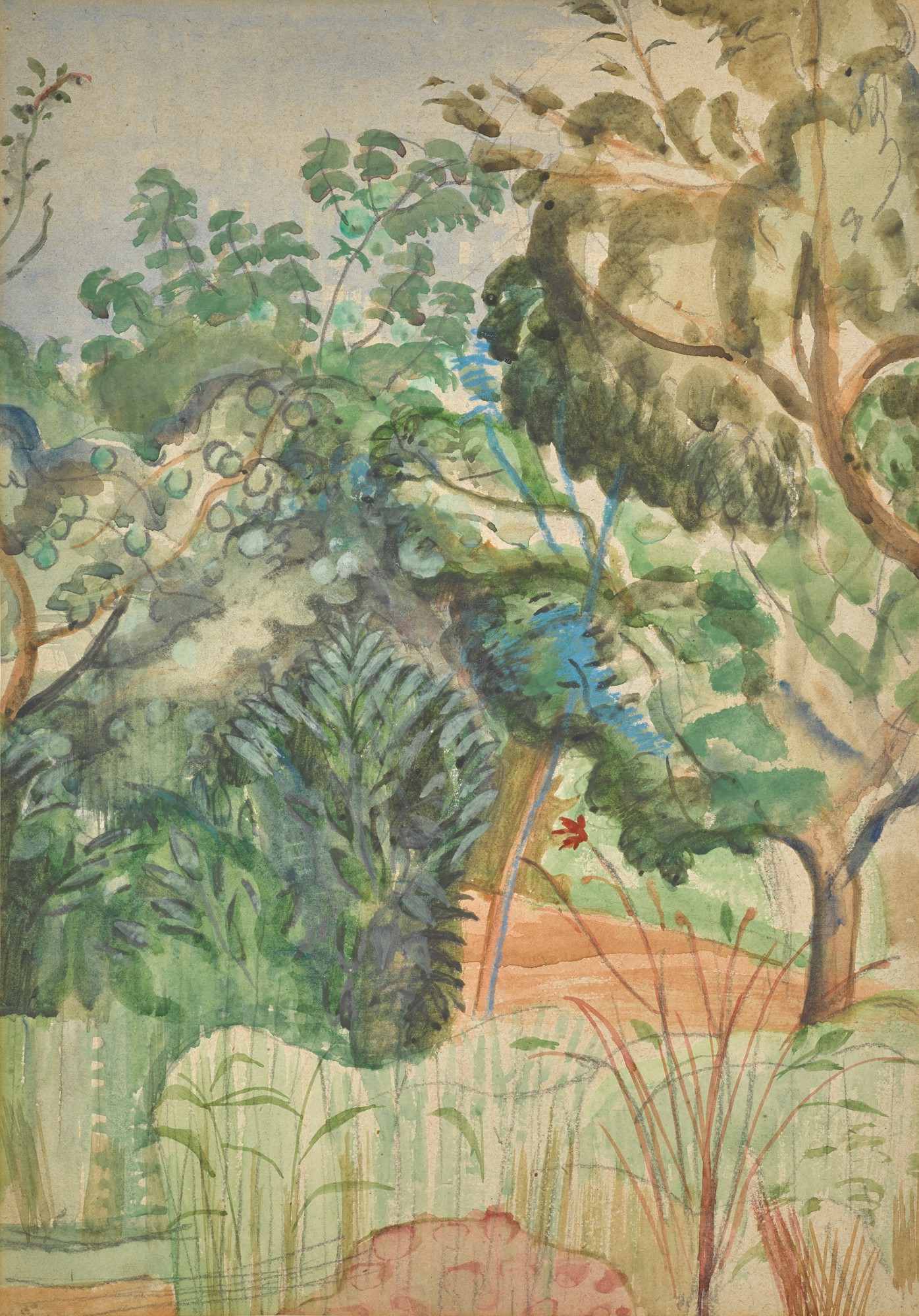
The Garden, 1914
For those who had long admired him, it was simply confirmation of what they already knew. Paul Nash was born in London in 1889 and spent formative years in the English countryside, particularly around Buckinghamshire, where his mother's fragile health and eventual death left a lasting emotional impression. He studied at the Slade School of Fine Art from 1910, though he spent only a short time there before striking out on his own path, shaped more by long walks through the English landscape and by the encouragement of the poet and artist Gordon Bottomley than by formal academic training. From the beginning, Nash possessed a quality rare among young artists: he saw the land not as scenery but as presence, as something alive with history, mood, and spiritual charge.
His early drawings of trees, hills, and hedgerows carry an intensity that already suggests a sensibility tuned to frequencies others could not quite hear. The First World War transformed Nash entirely. He served on the Western Front and was invalided home in 1917 before returning as an official war artist. What he witnessed in Flanders, the obliterated trees, the churned earth, the eerie silence of a devastated landscape, gave him a subject that demanded a new pictorial language.
Paul Nash
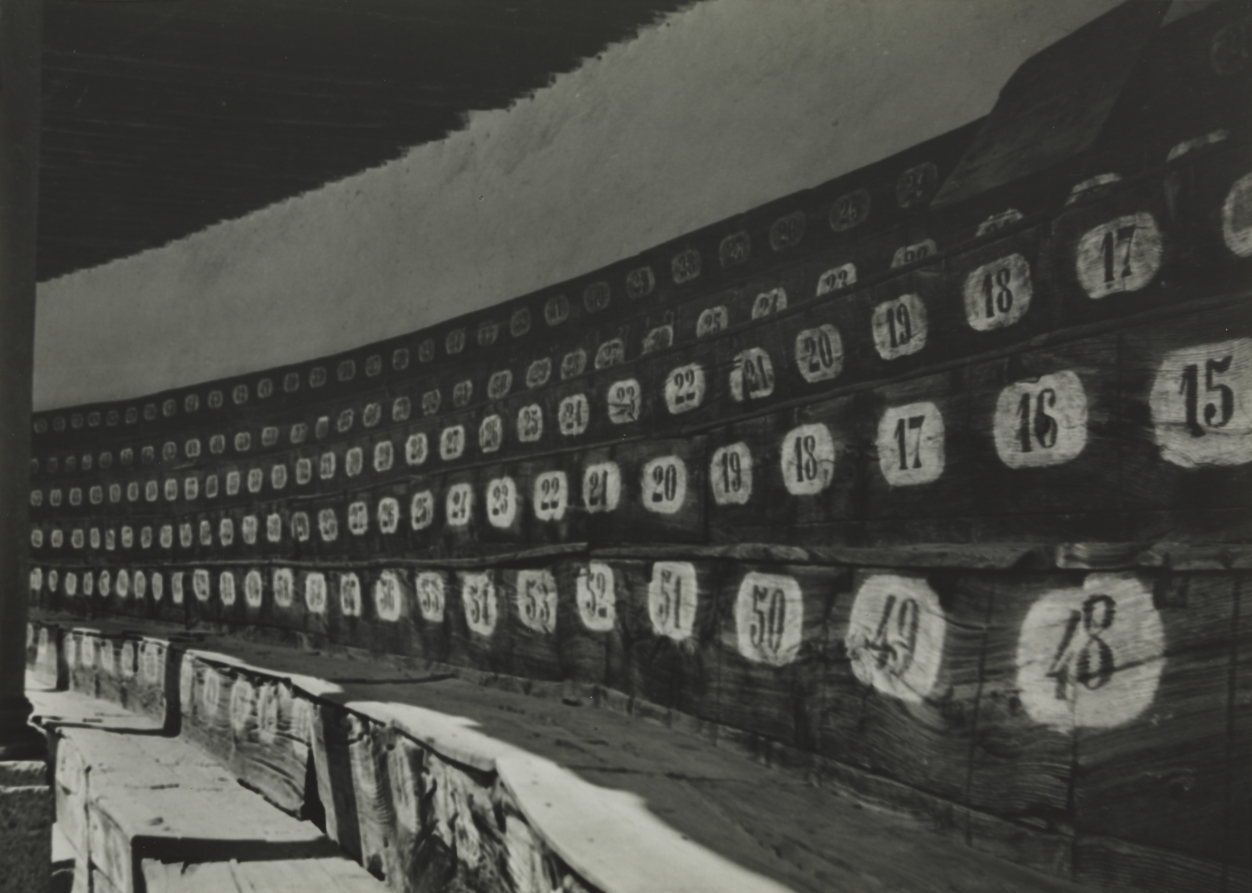
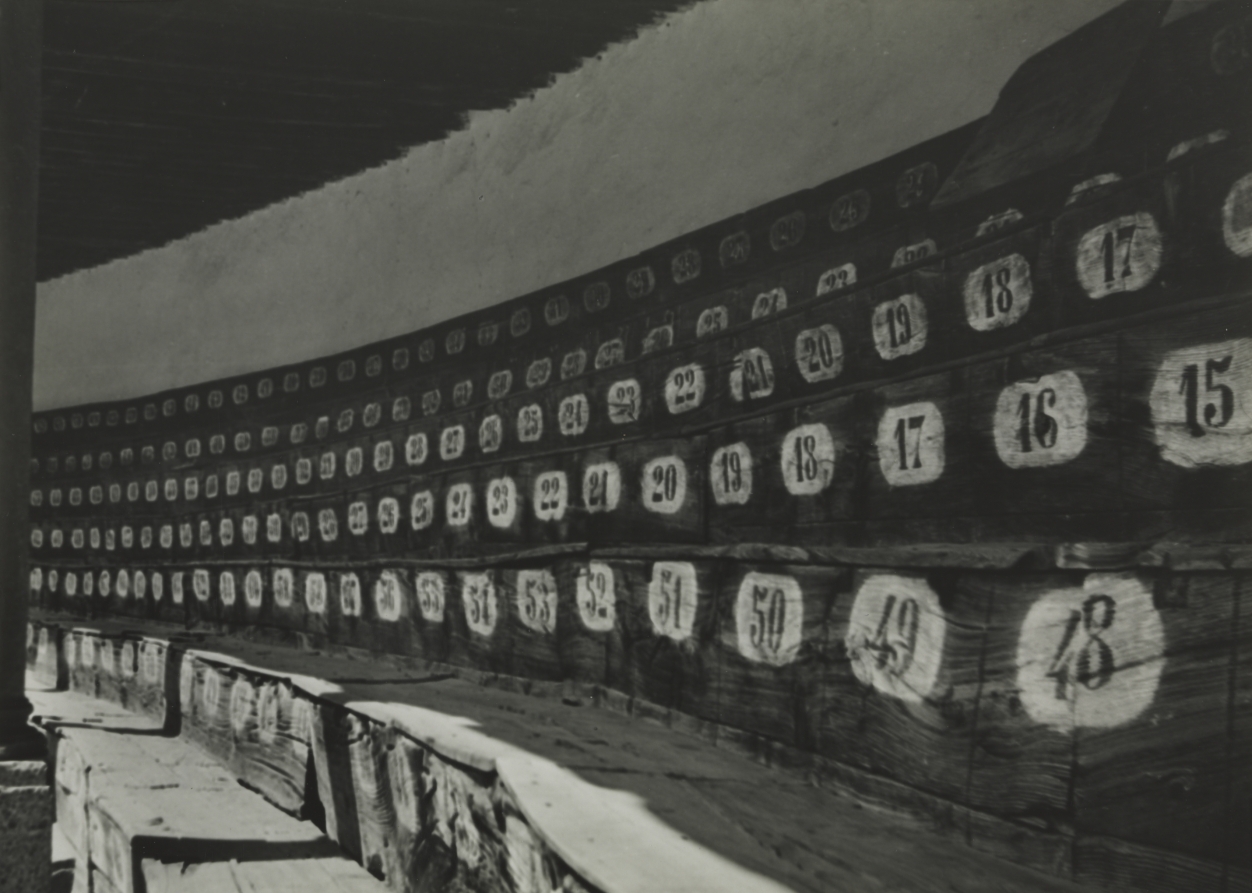
The Bull Ring, Ronda, Spain, 1934
His war paintings, including the shattering "We Are Making a New World" of 1918, now in the Imperial War Museum, established him as a painter of uncommon moral and aesthetic force. The war did not break Nash; it focused him. It confirmed that landscape, for him, was never merely decorative but always a site of meaning, memory, and consequence. In the years that followed, Nash developed a practice of remarkable breadth.
“I am not a war artist in any accepted sense of the term. I am an artist haunted by a vision.”
Paul Nash, 1918
He worked in watercolour, oil, printmaking, and photography, and each medium revealed different facets of his preoccupations. The wood engraving "Dyke by the Road" from 1922 shows his mastery of line and shadow, the way a simple agricultural feature can become a boundary between the known and the unknown. "Dymchurch," his sustained series of works depicting the sea wall on the Kent coast throughout the 1920s, pushed his interest in geometric abstraction and elemental encounter to new heights. The great walls of water pressing against engineered stone became, in Nash's hands, something close to metaphor: the individual standing before overwhelming, indifferent natural force.
Paul Nash
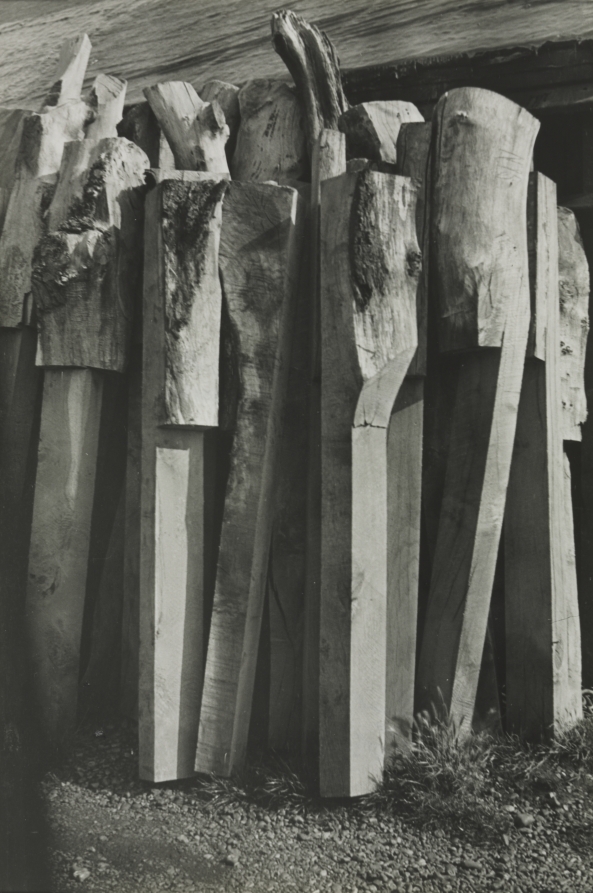
Totems, Old Shipyard, Rye, 1932
These works place him in a tradition of sublime landscape painting that runs from Turner and Constable through to the present day. By the 1930s, Nash had embraced Surrealism with characteristic intelligence and independence. He was a founding member of the British Surrealist group and organised the International Surrealist Exhibition held in London in 1936. Yet his engagement with Surrealism was always on his own terms.
Where continental Surrealists often explored the unconscious through figuration and dreamlike narrative, Nash found his uncanny imagery in the arrangement of found objects within landscape, in the strange conversations between ancient standing stones, bleached wood, and open sky. "Environment for Two Objects" from 1936, held on The Collection, exemplifies this beautifully: two forms, ambiguous and sculptural, inhabit a space that is simultaneously real and utterly otherworldly. The painting asks questions rather than answers them, which is precisely where Nash's greatest power lies. His photography, perhaps less celebrated than his painting but equally rewarding, offers a fascinating parallel practice.
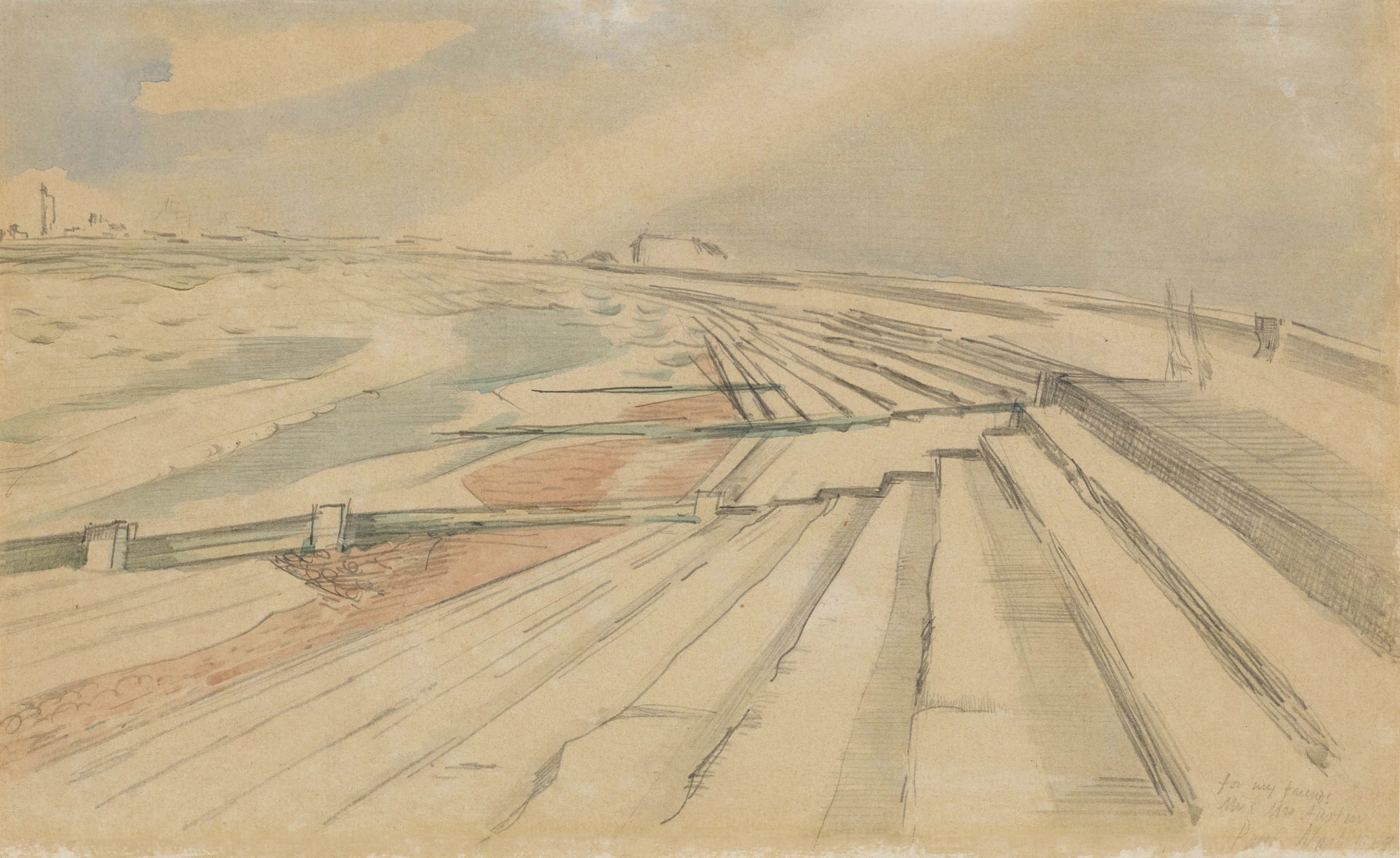
Paul Nash
Dymchurch
Works like "The Bull Ring, Ronda, Spain" and "Totems, Old Shipyard, Rye," both from the early 1930s, reveal a photographer's eye alert to the same tensions that animate his paintings: the tension between the manufactured and the organic, between ruin and vitality, between the ordinary and the numinous. In the gelatin silver prints available on The Collection, one sees Nash discovering in the photographic medium a way to fix the fleeting quality of light and form that he then translated back into paint and printmaking. His photographs are not preparatory sketches but finished meditations in their own right. For collectors, Nash presents an unusually rewarding field of engagement.
His work appears across a wide range of media and price points, from early watercolours and pencil drawings through wood engravings, lithographs, oil paintings, and photographs. Each category rewards careful attention. The watercolours, such as "The Garden" from 1914, show the tenderness and botanical precision of his earliest vision. The prints, including the lithograph "The Sluice" and the wood engraving "Leda" from 1925, demonstrate his technical fluency and his instinct for the poetic image.
At auction, significant Nash oils have achieved prices well into the six figures at Christie's and Sotheby's, while works on paper and prints remain accessible to a broader collecting audience. What unites all categories is quality of conception: Nash never made a careless work. Nash belongs to a constellation of British modernists whose reputations have only grown with time. His peers and contemporaries include Ben Nicholson, Christopher Wood, and Eric Ravilious, artists who shared his commitment to finding in the English landscape a vehicle for genuinely modern expression.
He was also a close friend of the sculptor Henry Moore and shared with him a fascination with ancient and prehistoric forms found in the British terrain. To collect Nash is to position oneself within one of the richest and most distinctly national strands of European modernism, one that drew on Surrealism, abstraction, and landscape tradition simultaneously. Paul Nash died in 1946, worn down by the asthma that had plagued him for years. He was fifty six years old and had compressed into his working life an achievement that would have satisfied two careers.
What he leaves behind is a body of work that continues to reward return visits, that deepens with each encounter, and that speaks with undiminished freshness to anyone who has ever stood before an English landscape and felt that it was trying to tell them something. His art is a reminder that vision, in the fullest sense, is a practice: something cultivated, tested, and renewed across a lifetime of looking.
Explore books about Paul Nash
Paul Nash: Paintings and Drawings
Andrew Causey
Paul Nash
David Boyd Haycock
Paul Nash: The Master of the Image 1889-1946
Andrew Causey
Outline: An Autobiography and Other Writings
Paul Nash
Paul Nash: Ethereal Landscape
Margaret Causey
Paul Nash: Modern Artist, Ancient Landscape
Andrew Causey
The Art of Paul Nash
Herbert Read