Paul Klee
Paul Klee: The Poet Who Painted Dreams
Artist Spotlight · The Collection Editorial
“A line is a dot that went for a walk.”
Paul Klee, Pedagogical Sketchbook, 1925
In the spring of 2016, the Zentrum Paul Klee in Bern mounted one of the most illuminating reassessments of the artist's final years, drawing global attention back to the late works he produced as his body failed him and his world collapsed around him. The exhibition reminded visitors that even as fascism dismantled the institutions he had helped build and a degenerative illness robbed him of his fine motor control, Paul Klee kept working with a ferocity and an invention that younger artists could only marvel at. That resilience, that insistence on transformation, is precisely why Klee remains one of the most beloved and sought after figures in twentieth century art. His work does not age.
Paul Klee
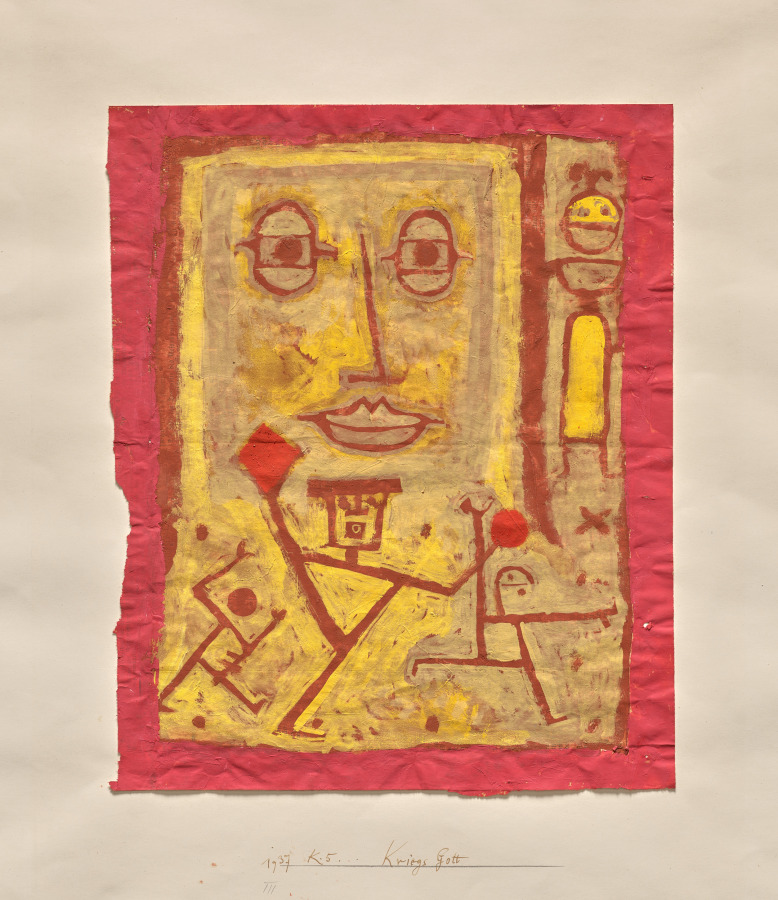
God of War, 1937
It breathes. Paul Klee was born in Münchenbuchsee, near Bern, in 1879, the son of a German music teacher and a Swiss mother. Music ran through everything he did, and that is not a metaphor but a literal truth: he was a gifted violinist who played professionally and who thought about visual composition the way a musician thinks about rhythm, tempo, and counterpoint. He studied at the Academy of Fine Arts in Munich at the turn of the century, absorbing the influence of Symbolism and Jugendstil, and a transformative journey to Tunisia in 1914 with his fellow artists August Macke and Louis Moilliet unlocked something elemental in his relationship to color.
Standing in the light of North Africa, Klee famously understood that color and he were one, and from that moment his palette became something altogether new. Klee's artistic development unfolded across an extraordinary range of movements without ever being fully claimed by any single one of them. He exhibited with Der Blaue Reiter alongside Wassily Kandinsky and Franz Marc in 1912, a moment that placed him within the most vital current of German Expressionism. He contributed illustrations to the journal of that group and formed a lifelong friendship with Kandinsky that would prove artistically defining.
Paul Klee
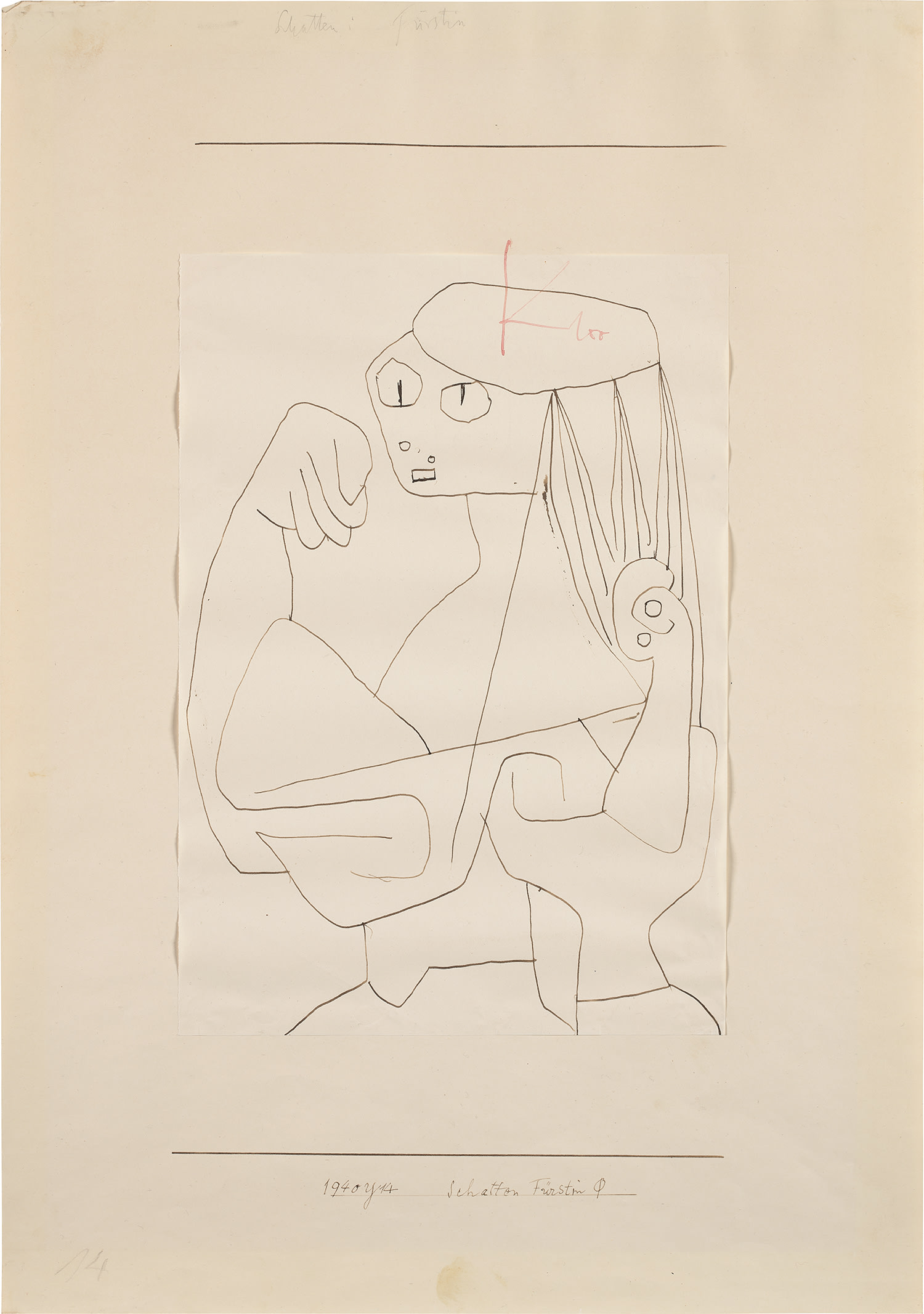
Schatten Fürstin (Princess of the Shadows), 1940
Yet Klee was never a pure Expressionist. His sensibility was too playful, too ironic, too tenderly philosophical for any single school to contain. When he joined the Bauhaus in 1921, first in Weimar and then in Dessau, he taught alongside Kandinsky and László Moholy Nagy and developed his famous notebooks on color theory and pictorial form, writings that remain essential reading for artists and designers alike. The Bauhaus years crystallized his thinking and gave his work a structural rigor that deepened rather than constrained its dreamlike quality.
“Color has taken possession of me; no longer do I have to chase after it. It has possession of me forever.”
Paul Klee, diary entry, 1914
The works on view through The Collection represent the full arc of Klee's genius. "Gedenkstein für N. (Memorial for N.)" from 1918, executed in watercolor on chalk ground paper with delicate borders of silver paper tape, shows the young Klee at his most tender and precise, constructing a miniature world with the care of a watchmaker.
Paul Klee
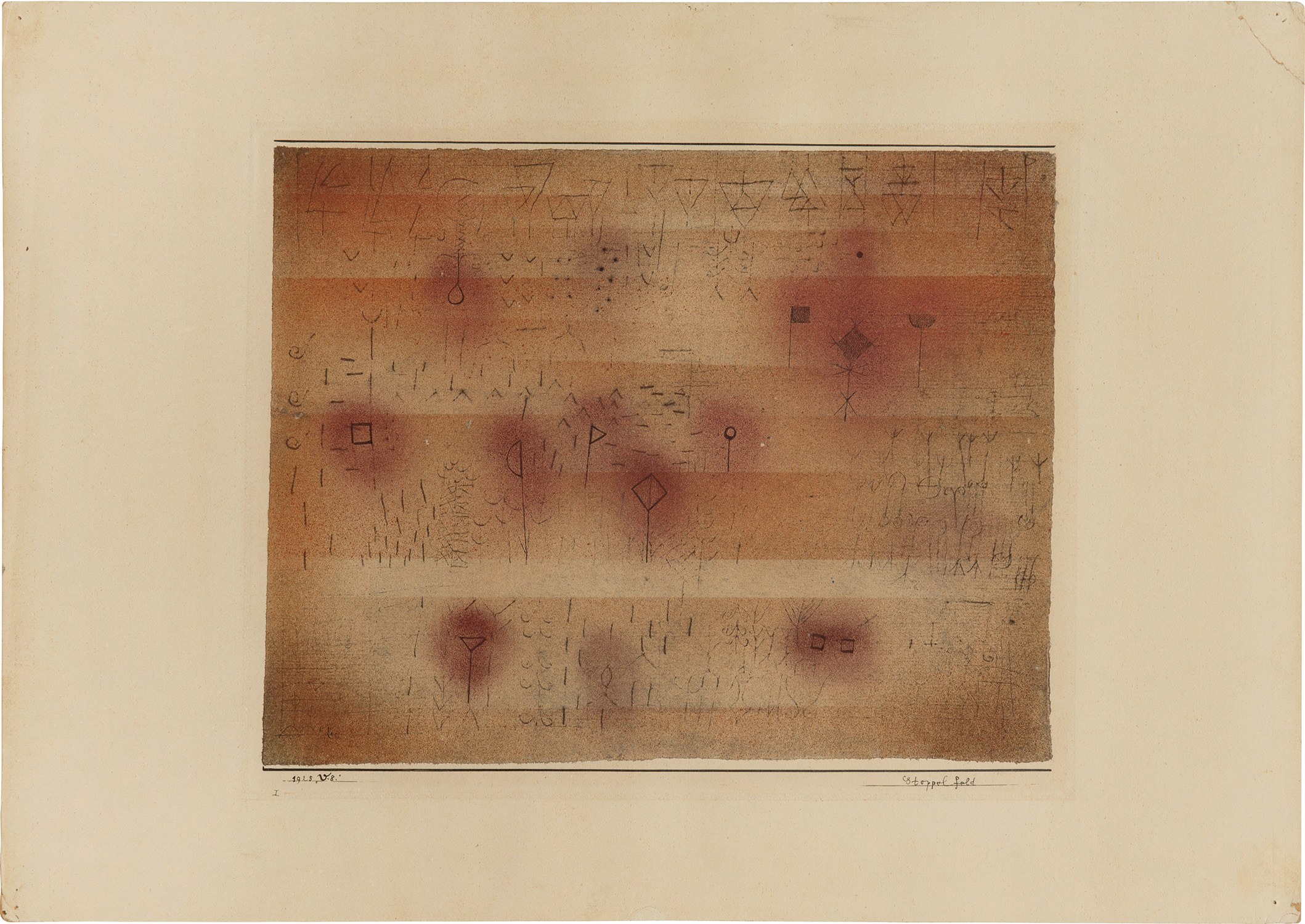
Stoppelfeld, 1925
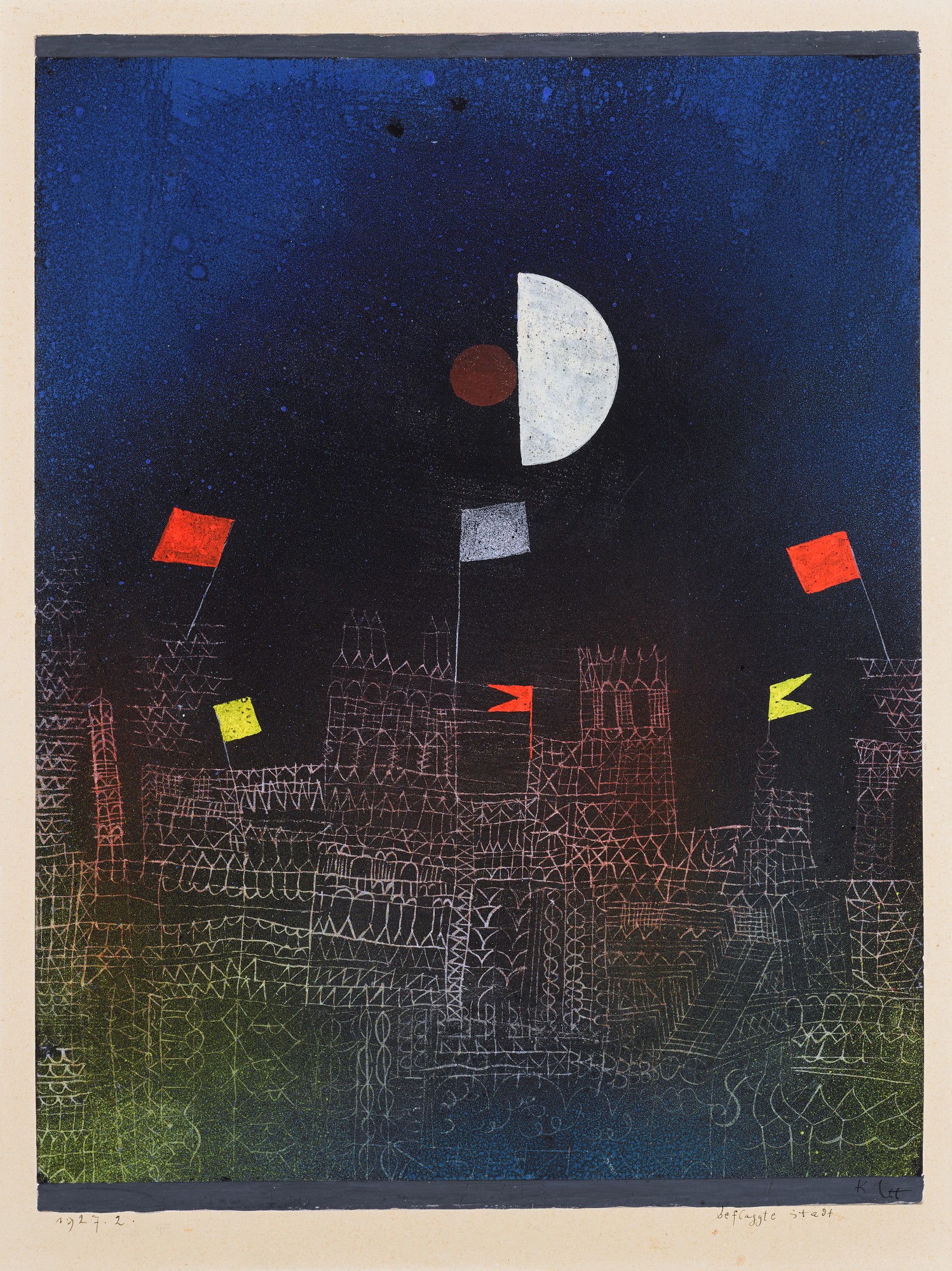
By 1927, in "Beflaggte Stadt (Town Decked with Flags)," he is deploying gouache, watercolor, and the sprayed technique known as Spritztechnik to build shimmering architectural fantasies that feel simultaneously ancient and utterly modern. The extraordinary "Gebirgsbewegung" of 1928 translates musical structure directly into visual form, the mountains themselves moving in rhythmic measures as though scored for performance. Then there are the late works: "God of War" from 1937, rendered in gouache and tempera with a grimness that reflects the political catastrophe unfolding around him, and the haunting "Schatten Fürstin (Princess of the Shadows)" from 1940, one of the last things he made before his death, in pen and ink, its lines both frail and absolute. These are not merely beautiful objects.
“Art does not reproduce the visible; rather, it makes visible.”
Paul Klee, Creative Credo, 1920
They are documents of a singular human consciousness. From a collecting perspective, Klee occupies a position that is at once firmly canonical and genuinely accessible across a range of price points. His works on paper, which constitute a significant portion of his output given his love of watercolor, gouache, and ink, regularly appear at the major auction houses and have achieved strong results at Christie's, Sotheby's, and Bonhams over the past two decades. Collectors are drawn to the intimacy of the works: most are modest in scale, designed to be held and studied close up, and they reward sustained attention in a way that large format paintings sometimes do not.
Paul Klee
Beflaggte Stadt (Town Decked with Flags), 1927
The variety of his technique is also a draw. Klee worked on paper, canvas, gauze, burlap, and unconventional grounds, often preparing his own supports with chalk or gesso, and the material intelligence of each object is part of what makes it so satisfying to live with. For new collectors, watercolors and works on paper from the 1920s and early 1930s represent a particularly rewarding area of focus, combining the mature Bauhaus period thinking with the lightness and lyricism that define his best work. To understand Klee fully is to understand the broader conversation of European modernism in the first half of the twentieth century.
His close relationship with Kandinsky connects him to the origins of pure abstraction, while his friendship with artists such as Franz Marc and August Macke roots him in the spiritual ambitions of German Expressionism. The Surrealists claimed him as a kindred spirit, and André Breton admired the way his work tapped into unconscious imagery without ever abandoning formal control. In this sense Klee forms a bridge between movements, between Expressionism and abstraction, between the rational program of the Bauhaus and the irrational energies of Surrealism. Collectors who bring his work into a collection will find that it speaks fluently to Kandinsky, to Joan Miró, to early Mark Rothko, and even to Jean Dubuffet, whose interest in the art of children and the untrained owes something to Klee's long meditation on primal mark making.
Klee died in Muralto, Switzerland, in June 1940, just weeks after the Nazis had overrun Western Europe and just weeks after he had applied for Swiss citizenship, which was granted posthumously. He left behind more than nine thousand works, an output of almost incomprehensible variety and consistency. The Zentrum Paul Klee in Bern, designed by Renzo Piano and opened in 2005, holds the largest single collection of his work in the world and stands as a permanent testament to his place in the cultural life of his homeland. But Klee does not belong to any single nation or institution.
He belongs to everyone who has ever looked at a painting and felt that the world behind their eyes was larger and stranger and more luminous than the one in front of them. That is his gift, and it remains as vital now as it was when he first opened his notebook and began to take a line for a walk.
Explore books about Paul Klee

Paul Klee: His Life and Work
Will Grohmann
Paul Klee: The Thinking Eye
Paul Klee
Paul Klee: Genius of the Modern Line
Marina Salomon
Klee
Felix Klee

Paul Klee: An American Perspective
John E. Bowlt
Paul Klee Painting Music
Alessandra Iannicello
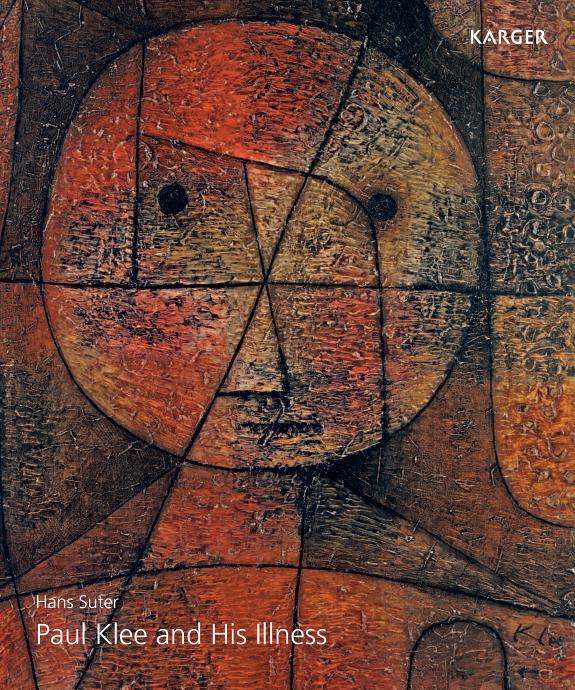
Klee and Nature
Stefan Frey

Paul Klee: Life and Work
Michael Levey