Paul Jenkins
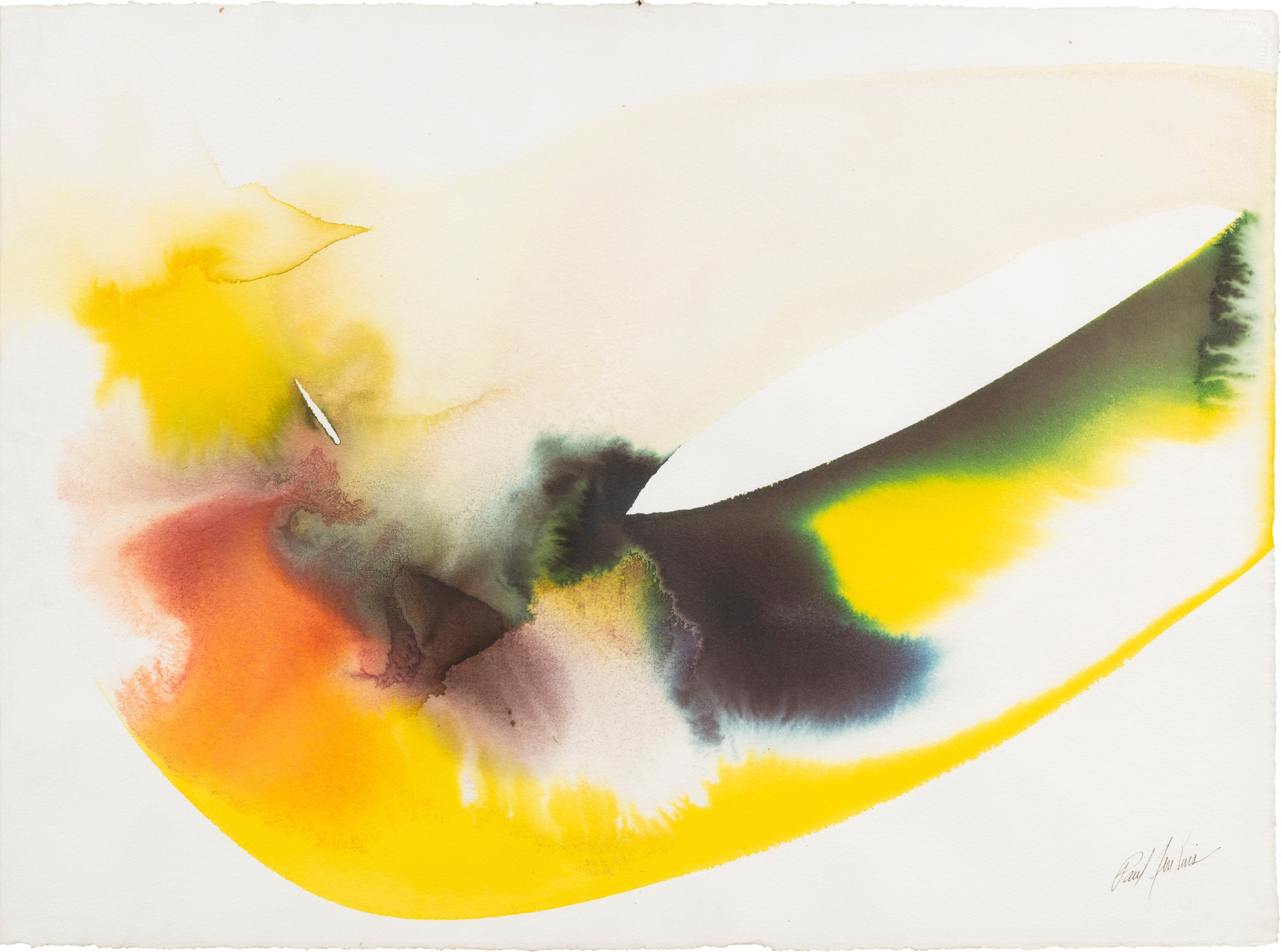
Paul Jenkins: Light Poured Into Being
Artist Spotlight · The Collection Editorial
“I am not an action painter. What I want is for the force within the paint to be what acts.”
Paul Jenkins, interview circa 1960s
Stand in front of a Paul Jenkins canvas long enough and something strange and wonderful happens. The colors begin to feel less like paint and more like atmosphere, like standing at the edge of a weather system or watching dawn break through Arctic ice. It is a sensation that collectors and museum visitors have described again and again across six decades, and it speaks to the singular achievement of an artist who found a way to make abstraction feel as elemental as nature itself. Jenkins, whose work continues to attract serious attention at auction and in museum retrospectives internationally, belongs to that rare category of artists whose formal innovations are inseparable from a genuine spiritual vision.
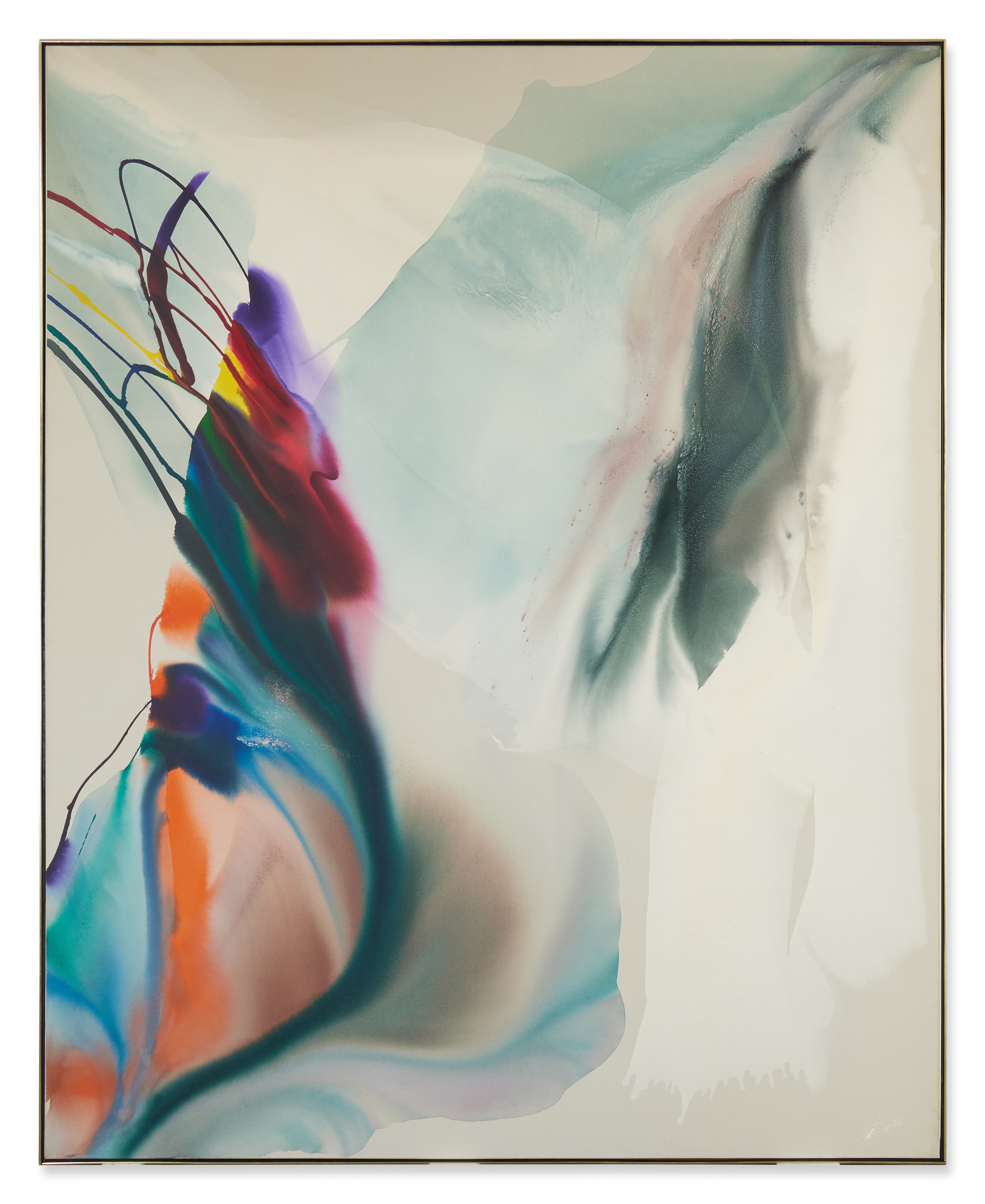
Paul Jenkins
Phenomena Nacreous Gray Veil, 1969
Paul Jenkins was born in Kansas City, Missouri, in 1923, and his early formation was shaped by a powerful combination of Midwestern directness and an almost mystical sensitivity to light and color. He studied at the Kansas City Art Institute before moving to New York in the late 1940s to attend the Art Students League, where he worked under Yasuo Kuniyoshi and Morris Kantor. New York in those years was the most electrically charged environment in the art world, with Abstract Expressionism in full flower and a generation of painters rethinking what a canvas could hold. Jenkins absorbed that energy but was never entirely contained by it.
He moved to Paris in the early 1950s, a decision that would prove formative, exposing him to European modernism and allowing him to develop his practice at a thoughtful remove from the competitive intensity of the New York scene. In Paris, Jenkins made the breakthrough discoveries that would define his life's work. He began experimenting with pouring and tilting liquid paint across the canvas surface, guiding the flow of translucent acrylic pigments without ever fully controlling them. This technique, which Jenkins developed with extraordinary refinement over decades, placed the artist in a collaborative relationship with chance and material.
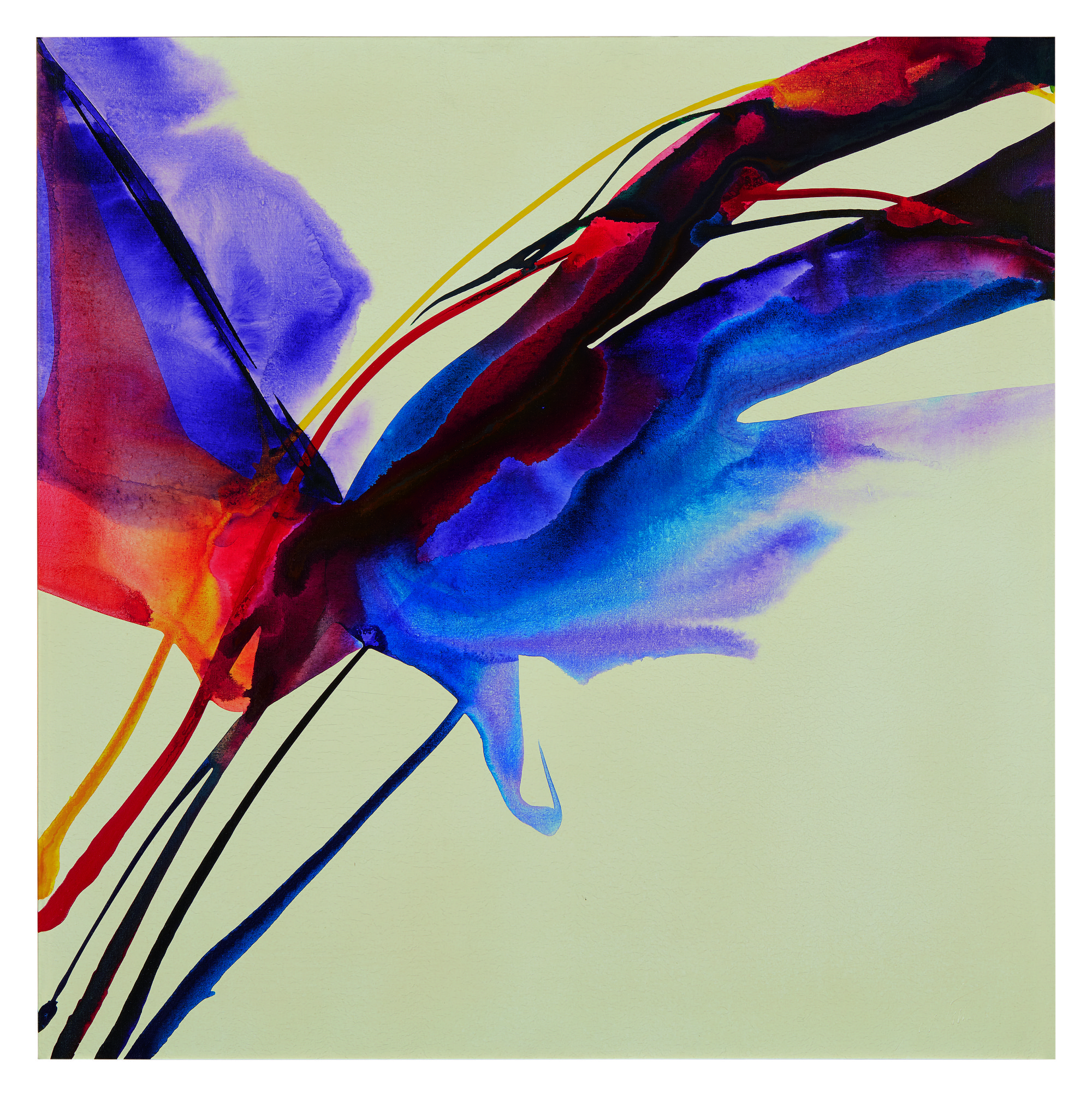
Paul Jenkins
Phenomena Nether Near
He famously used an ivory knife to part and direct the flowing paint, a gesture he described in almost ritualistic terms. The resulting surfaces are prismatic and layered, pools of color that bleed into one another with a luminous softness that recalls stained glass, aurora phenomena, and the shifting light on still water. It is a technique with no real predecessor and very few true successors. Jenkins gave almost all of his mature paintings titles beginning with the word Phenomena, a choice that tells you everything about his intentions.
“I set up the conditions and then I listen to what the painting tells me it needs.”
Paul Jenkins
Works such as Phenomena Aurora Borialis Stay from 1966 and Phenomena Lunar Prism from 1980 are not depictions of natural events but rather invocations of them, attempts to capture in paint the felt quality of light moving through atmosphere. Phenomena Nacreous Gray Veil, painted in 1969 in acrylic on canvas, is among the most quietly commanding of his works, a study in restraint and translucency that rewards extended looking. Phenomena Mirror Shield from 1972 and Phenomena Entrance to Peking from 1989 demonstrate the range of his palette and the consistency of his vision across more than two decades. The Phenomena series is one of the most coherent and ambitious bodies of work in postwar American abstraction, a sustained meditation on perception, light, and the threshold between the seen and the unseen.
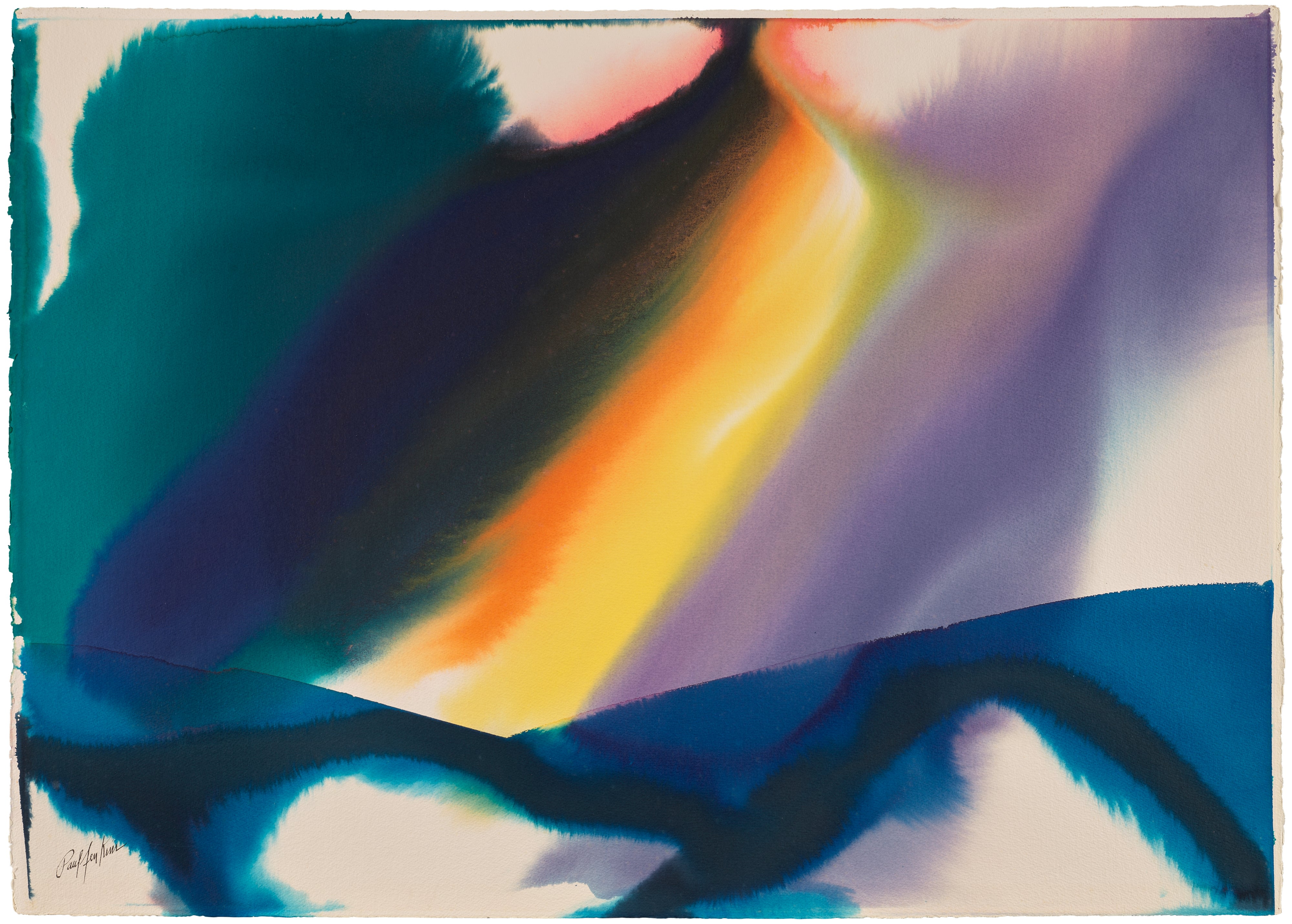
Paul Jenkins
Phenomena Lunar Prism, 1980
Jenkins enjoyed remarkable institutional recognition during his lifetime and that recognition has only deepened since his death in New York in 2012. His work entered the permanent collections of the Solomon R. Guggenheim Museum in New York, the Whitney Museum of American Art, the Smithsonian American Art Museum, and major European institutions including the Centre Georges Pompidou in Paris and the Tate in London. In 1973 a documentary film about his practice, The Ivory Knife, brought his working method to a broader audience and remains a vivid record of an artist entirely at home in his own vision.
Gallery relationships with Gimpel Fils in London and the Galerie Karl Flinker in Paris helped build his European reputation at a time when American abstraction was crossing the Atlantic with enormous cultural momentum. From a collecting perspective, Jenkins represents a genuinely compelling proposition. His works span a wide range of mediums, from large acrylic canvases of real ambition to intimate watercolors on paper that distill his chromatic intelligence into smaller, often ravishing formats. Works like Phenomena Prism Basin on heavy wove paper and Phenomena Aurora Borialis Stay in watercolor show that his pouring technique translated with equal success across mediums.
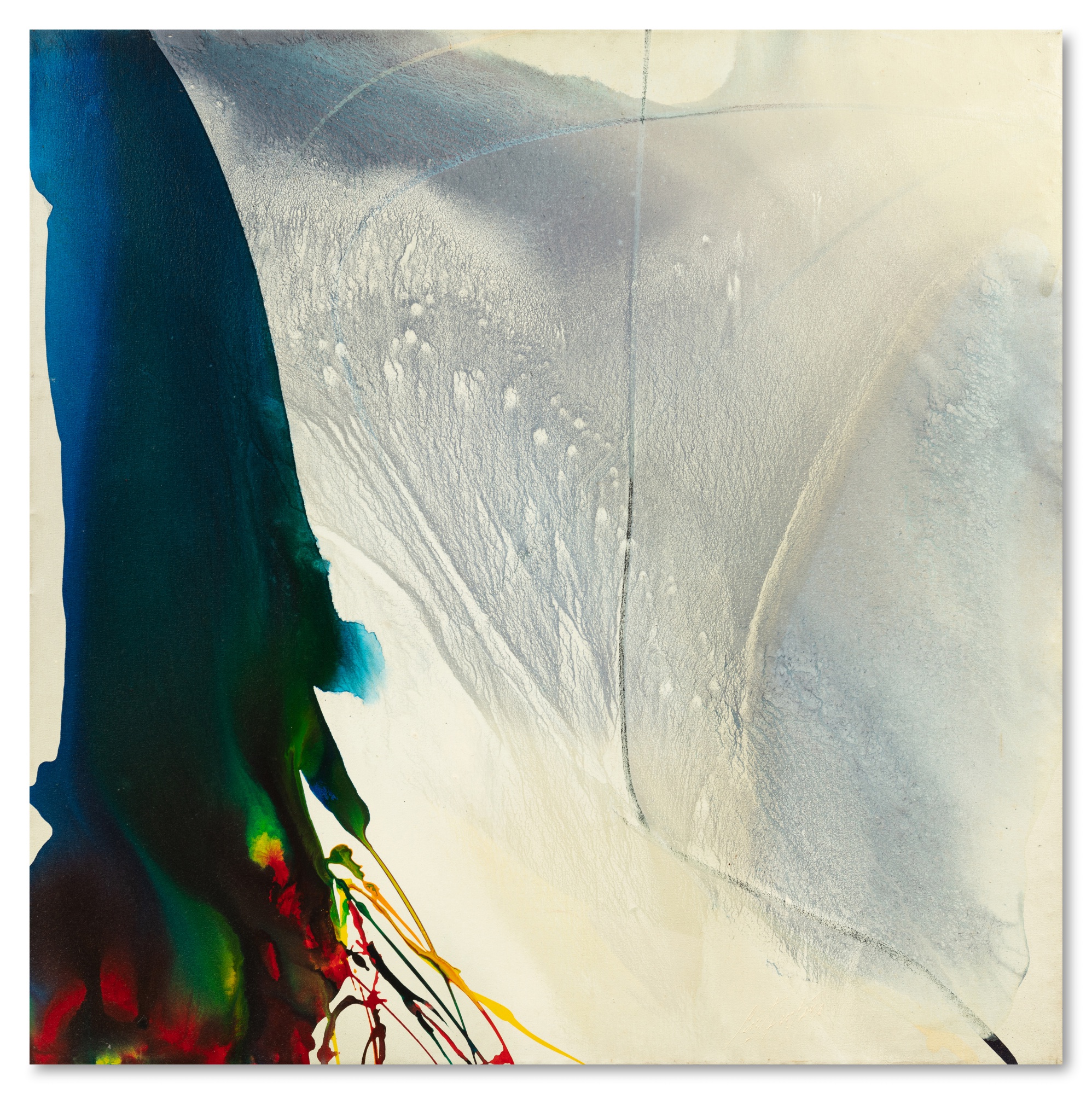
Paul Jenkins
Phenomena Mirror Shield, 1972
The watercolors and works on paper are particularly worth noting for collectors newer to the artist, offering an accessible entry point into a practice of genuine historical importance. At auction, his canvases have attracted consistent attention from informed collectors, and the relative availability of works on paper makes this a practice with real range for a serious collection. The key qualities to seek are the characteristic translucency of his layers, the coherence of his color relationships, and the elegant resolution of his edges, where the poured paint settles into forms that feel simultaneously inevitable and surprising. Jenkins occupied a distinctive position within the broader landscape of Color Field painting, sharing certain commitments with Helen Frankenthaler, Morris Louis, and Kenneth Noland, all of whom explored the expressive possibilities of staining and pouring paint to create fields of luminous color.
But where Frankenthaler and Louis tended toward a more purely formal investigation, Jenkins brought to his work a persistent interest in the phenomenological and the spiritual, a desire to make painting that touched something beyond the retinal. This places him in a lineage that also includes Mark Rothko in his late chapel paintings and the atmospheric abstractions of Sam Francis. Jenkins was genuinely international in his outlook, as comfortable in the Parisian art world as in New York, and that transatlantic breadth gave his career a distinctive character that distinguished him from his purely American contemporaries. The legacy of Paul Jenkins is one that deserves sustained attention now, at a cultural moment when questions of perception, consciousness, and our relationship to the natural world feel more urgent than ever.
His paintings do not illustrate these concerns; they embody them. To own a Jenkins is to live with a work that changes in different light conditions, at different hours, in different moods, a quality that the best Color Field painting shares with the best music. There is a generosity in his art, an openness to the viewer's own experience, that makes it enduringly livable and enduringly meaningful. For collectors building a collection with genuine depth and historical range, the work of Paul Jenkins is not simply a worthy addition.
It is an invitation to look differently at everything else on the wall.
Explore books about Paul Jenkins
Paul Jenkins: A Retrospective
Paul Jenkins

Paul Jenkins: Paintings and Works on Paper
Barbara Rose
Paul Jenkins: Phenomena
Paul Jenkins
Paul Jenkins: The Eye and the Leaf
Sam Hunter
Paul Jenkins: Catalogue Raisonné
Gérald Schurr