Paul Henry
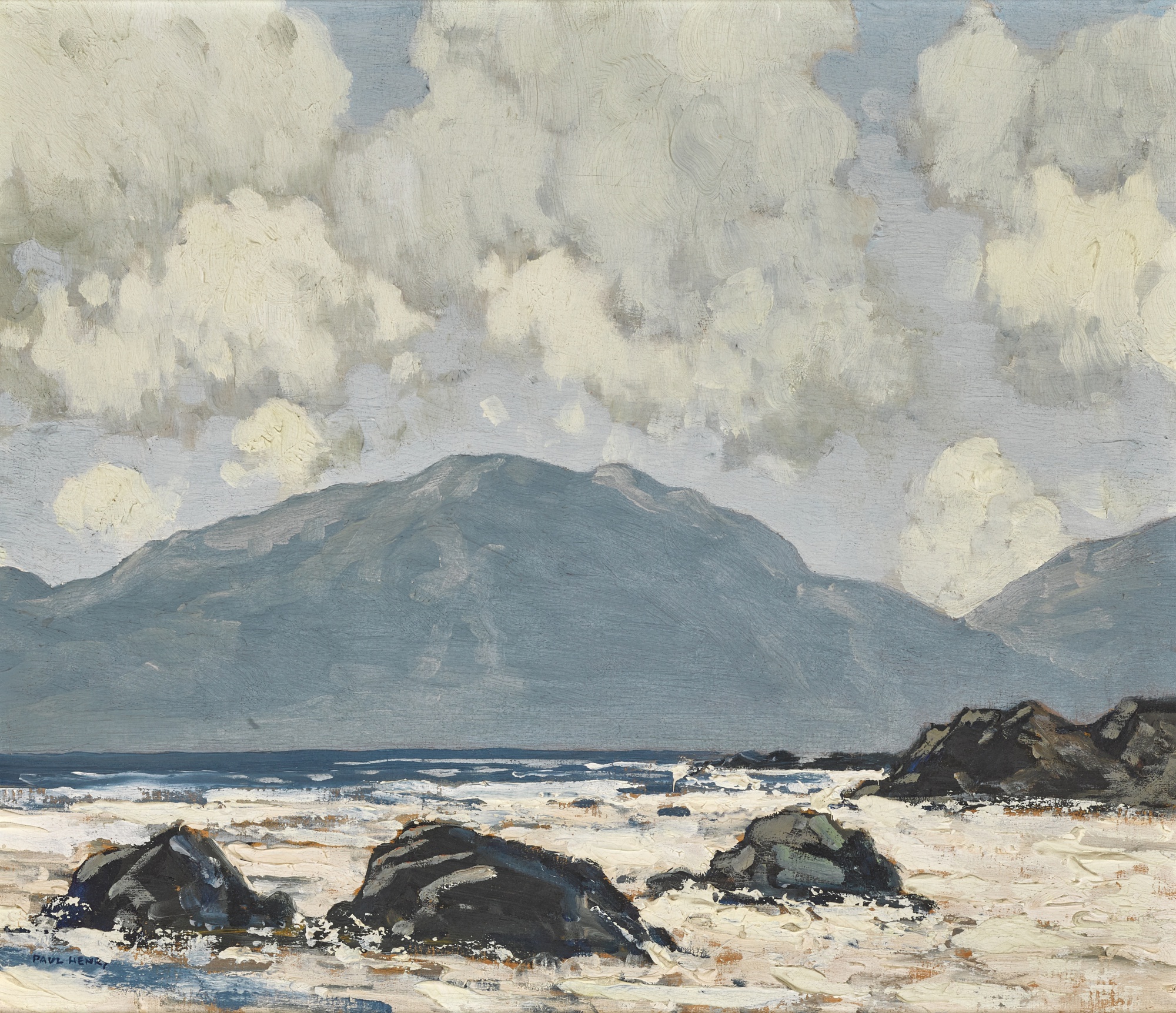
Paul Henry: Ireland's Sky, Forever Luminous
Artist Spotlight · The Collection Editorial
Stand before a Paul Henry canvas and something remarkable happens. The sky opens, the bog stretches wide, and the whitewashed walls of a Connaught cottage seem to breathe in the Atlantic light. It is an experience that has moved collectors, curators, and ordinary viewers for over a century, and it shows no sign of losing its power. The National Gallery of Ireland has long held Henry's work as among the most treasured in its permanent collection, and major auction houses in Dublin and London continue to see his oils command serious attention whenever they appear on the market.
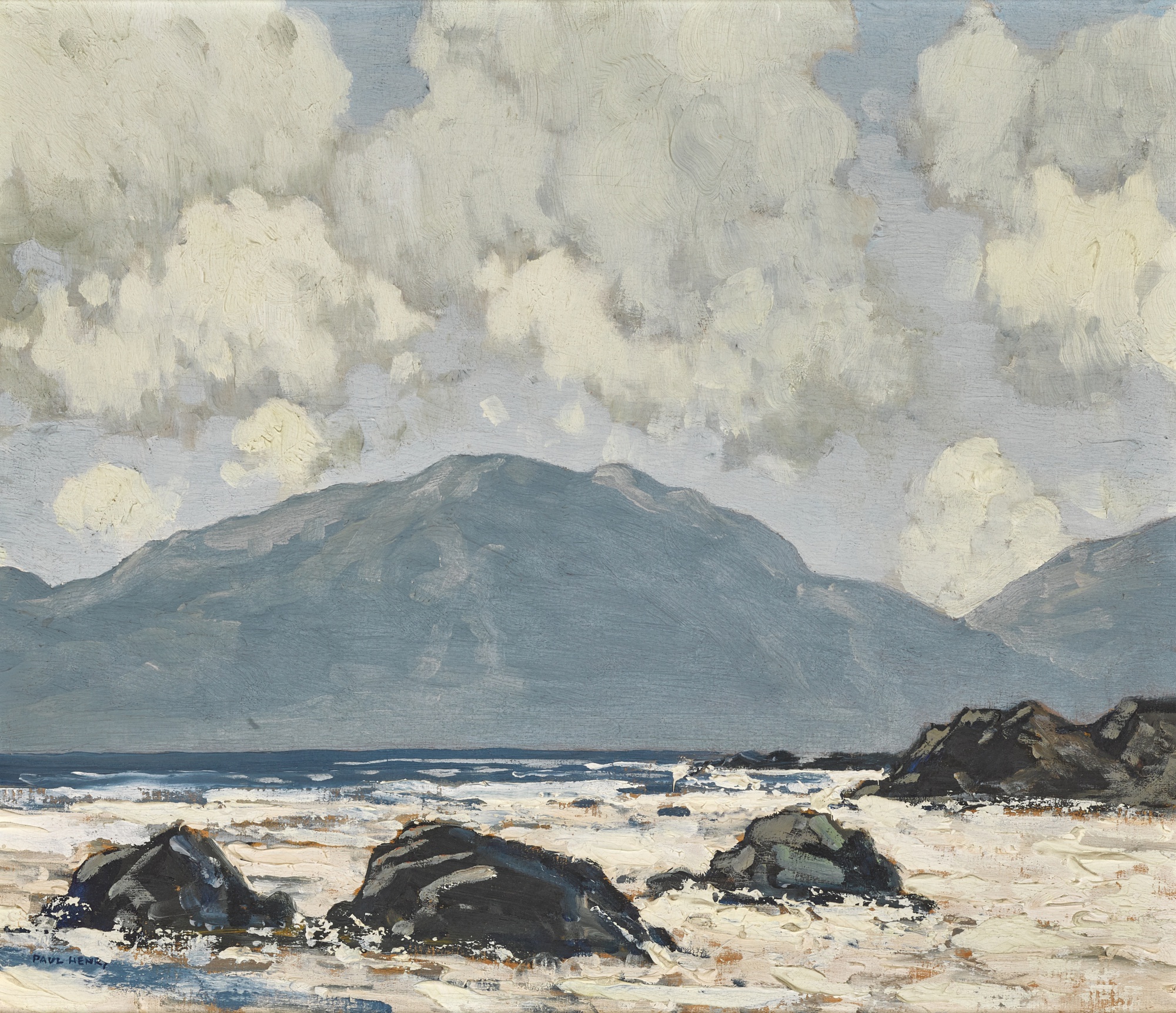
Paul Henry
The Entrance to Killary Bay, 1936
Paul Henry was born in Belfast in 1876, into a family shaped by Protestant faith and intellectual seriousness. His father was a Baptist minister, and the household was one in which discipline and learning were prized. Henry showed an early aptitude for drawing, and by his late teens he had resolved to pursue art seriously. He left Ireland for London, studying at the Westminster School of Art, before making what would prove the defining journey of his formative years: a move to Paris, where he enrolled at the Académie Julian and later studied under James McNeill Whistler at the Académie Carmen.
Paris in the late 1890s was a crucible of new ideas, and Henry absorbed its lessons in tonalism, in the quiet authority of muted colour, and in the conviction that a painting could carry emotional weight without theatrical gesture. Henry returned to Britain and eventually to Ireland, and it was in 1910 that he made the journey that would transform his art and his reputation. He and his first wife, the painter Grace Henry, travelled to Achill Island off the coast of County Mayo intending a short visit. They stayed for nearly a decade.
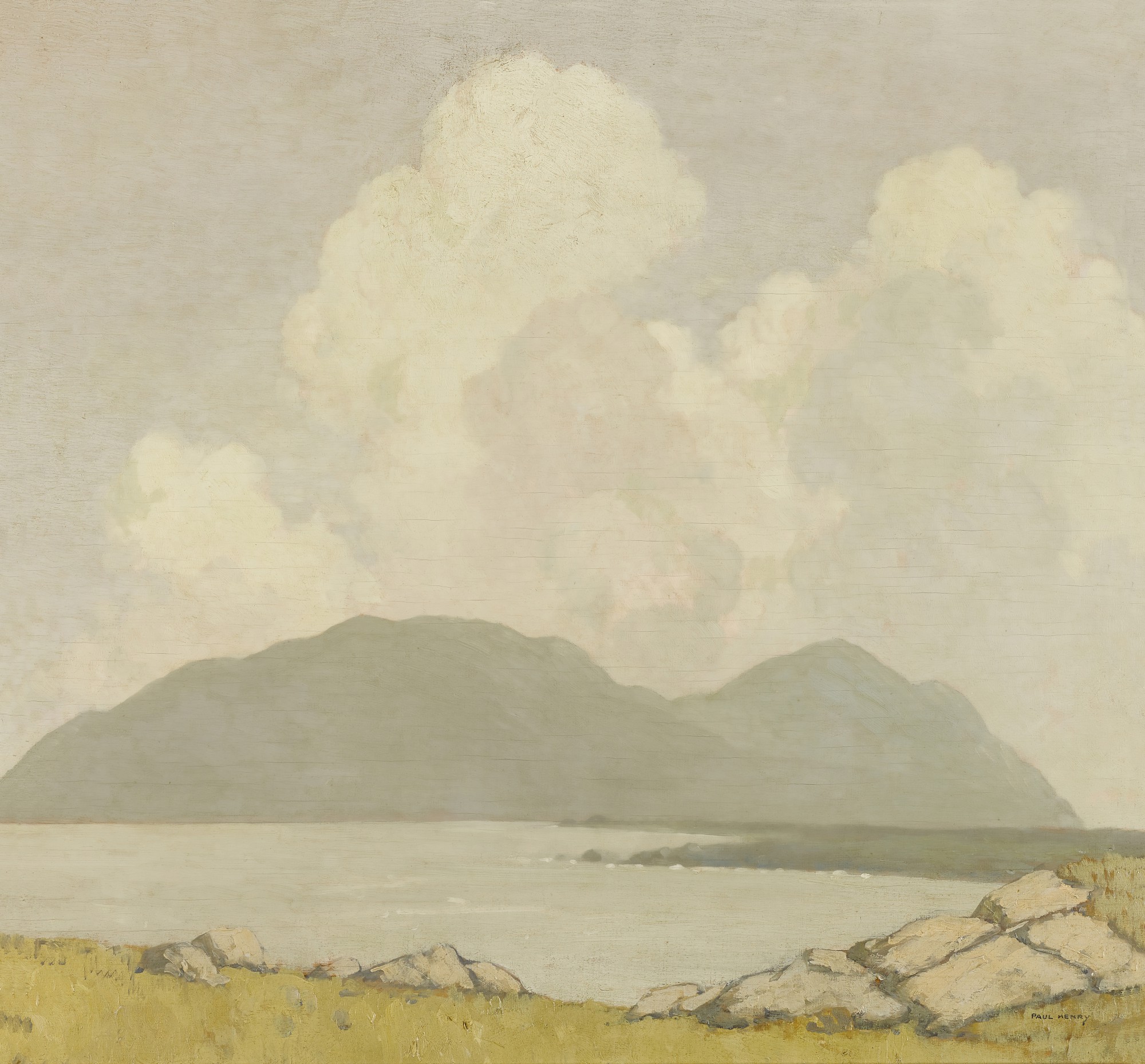
Paul Henry
The Great Blasket Island, Kerry, 1934
Achill in those years was remote and largely untouched by modernity, a landscape of stacked turf, mountain shadow, and sea light that changed by the hour. Henry was transfixed. He set up a studio and began painting with an urgency and a focus that had not been present in his earlier work. The island gave him everything: a subject, a palette, a sense of purpose.
The paintings that emerged from the Achill years established the visual language Henry would refine for the rest of his career. His skies became his signature, vast and architecturally constructed, built from layered tones of grey, cream, and pale blue, with clouds that seem to possess weight and intention. Below them, the boglands lie in horizontal bands of ochre, sienna, and muted green, and the whitewashed cottages anchor the composition with a stillness that feels almost devotional. Henry was not a painter of anecdote or narrative.
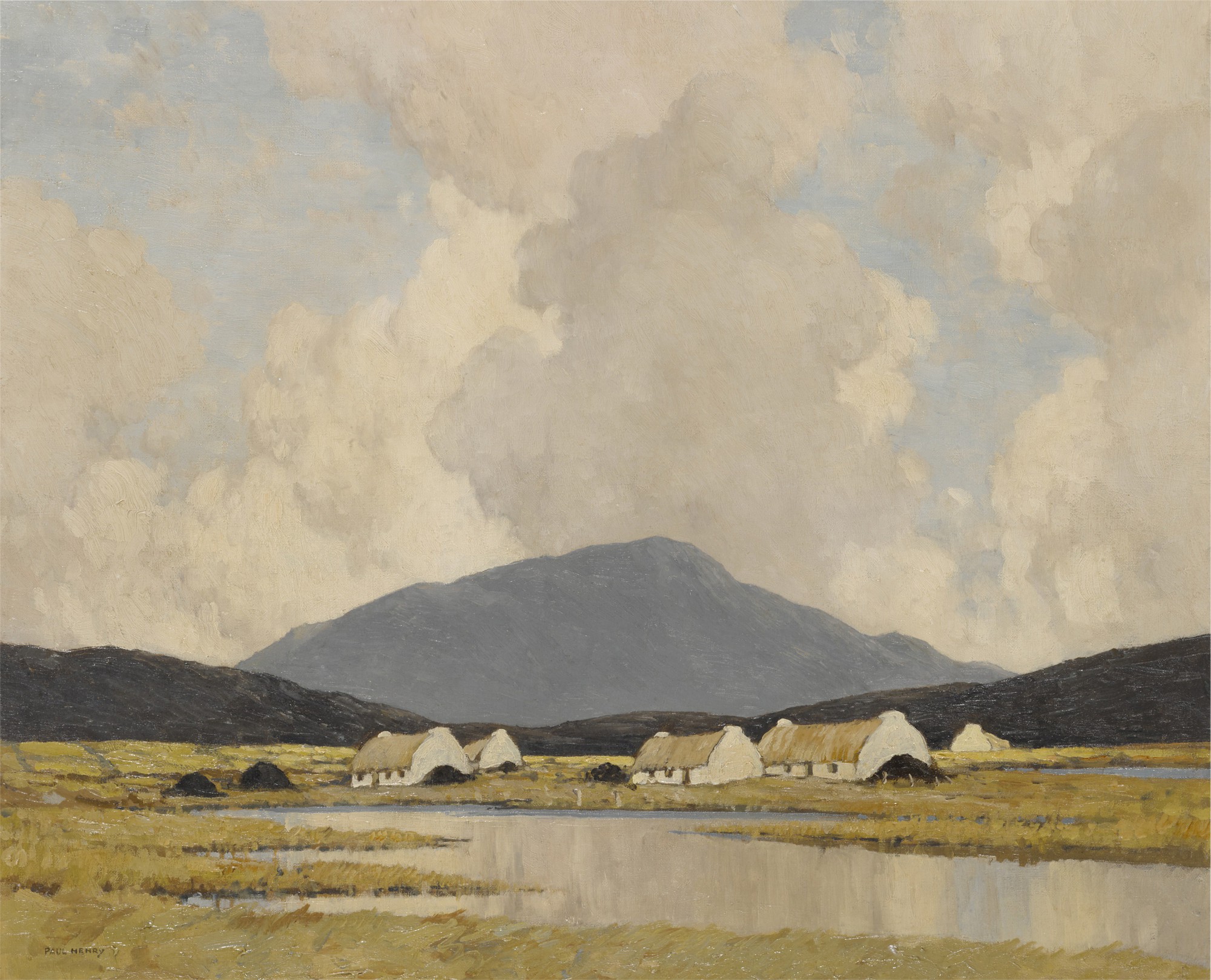
Paul Henry
The Village by the Lake, 1935
He was a painter of atmosphere, of the particular quality of light in the west of Ireland, and of the deep, unhurried relationship between people and landscape. Works such as Digging Potatoes, Achill Island show figures absorbed in labour, present in the land rather than posed before it, and the effect is one of quiet dignity rather than romantic sentimentality. Among the works available on The Collection, several demonstrate the full range of Henry's achievement. The Entrance to Killary Bay, painted in 1936 in oil on board, captures the drama of that extraordinary fjord with a compositional confidence that speaks to decades of practice.
The Great Blasket Island, Kerry from 1934 shows his ability to render the particular character of different western landscapes, the Blaskets carrying a different emotional register from Achill, more austere, more final. The Village by the Lake from 1935, in oil on canvas, is a masterclass in his tonal balancing, the settlement and the water and the sky held in a relationship of perfect equilibrium. West of Ireland Landscape from 1928 is an earlier example of his mature style, showing how thoroughly he had absorbed and synthesised his influences by that point in his career. These works together offer a coherent and deeply satisfying survey of one of the twentieth century's most distinctive regional voices in European painting.
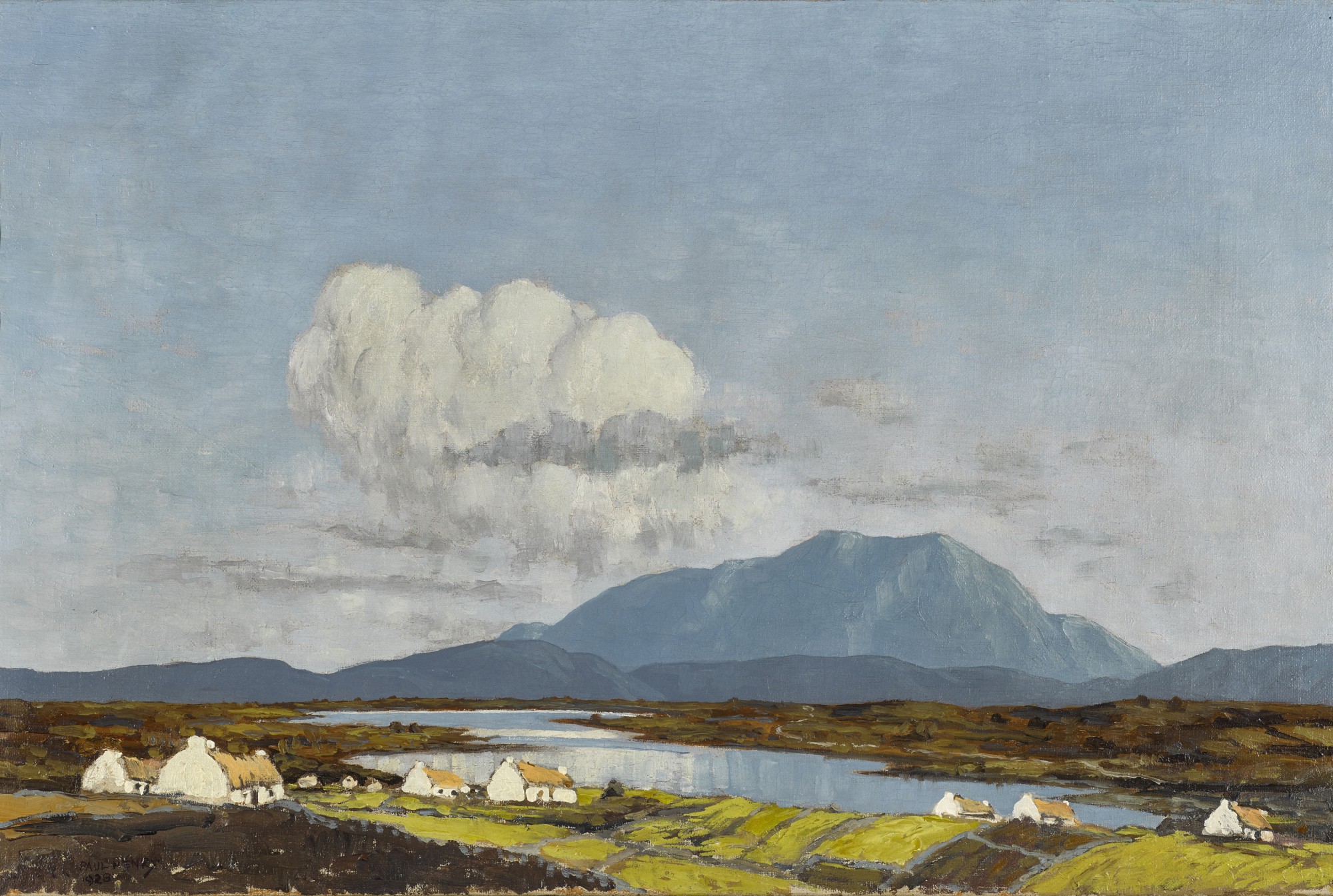
Paul Henry
West of Ireland Landscape, 1928
Henry's reach extended well beyond gallery walls. His imagery was adopted for official tourism promotion by bodies seeking to represent Ireland to the world in the early decades of the Irish Free State, and his vision of the western landscape became, for many people at home and abroad, the image of Ireland itself. This is a remarkable thing for any painter to achieve, and it speaks both to the power of his work and to the particular moment in which Irish national identity was being consciously constructed and projected. Henry did not paint propaganda.
He painted what he saw and felt. But what he saw happened to coincide perfectly with a cultural need, and the result was a kind of iconic status that few artists of any nationality attain. For collectors considering Henry's work today, several factors are worth understanding. His oils on board, which include some of his most focused and intimate compositions, tend to offer exceptional value relative to his larger canvases, which have historically attracted the highest prices at auction.
Works from the 1920s and 1930s represent the heart of his mature achievement and are the most sought after. Collectors should pay close attention to the quality of the sky passage in any given work, since this is where Henry's particular genius is most fully expressed and where the difference between a strong example and a lesser one is most visible. His work sits comfortably alongside that of contemporaries such as Jack Butler Yeats, Seán Keating, and Charles Lamb, all of whom engaged with the west of Ireland as a subject, though Henry's vision is the most purely lyrical of that generation. In an international context, his tonal restraint and landscape focus invite comparison with the Scottish Colourists and with certain strands of Scandinavian painting from the same period.
Paul Henry died in 1958, having lost his sight in his final years, a cruelly appropriate loss for a man whose entire life had been organised around looking. His legacy is secure and growing. The renewed international interest in regional modernisms, in artists who worked outside the metropolitan mainstream but developed genuinely original responses to place, has brought new attention to Henry's achievement and new collectors to his work. To own a Paul Henry is to possess something more than a beautiful object.
It is to hold a particular quality of light, a particular silence, a particular way of being in the world that the west of Ireland, at its most luminous and most itself, can still produce.
Explore books about Paul Henry