Paul Delaroche
Paul Delaroche, Master of History's Tender Drama
Artist Spotlight · The Collection Editorial
Stand before a painting by Paul Delaroche and you will understand immediately why nineteenth century Paris could not get enough of him. His canvases do not shout. They draw you close, lower their voice, and make you feel the weight of a single human moment suspended in time. At a period when French painting was torn between the austere classicism of the academy and the volcanic emotionalism of Romanticism, Delaroche found a third path, one built on psychological intimacy, meticulous research, and a storyteller's instinct for the charged pause before everything changes forever.
Paul Delaroche
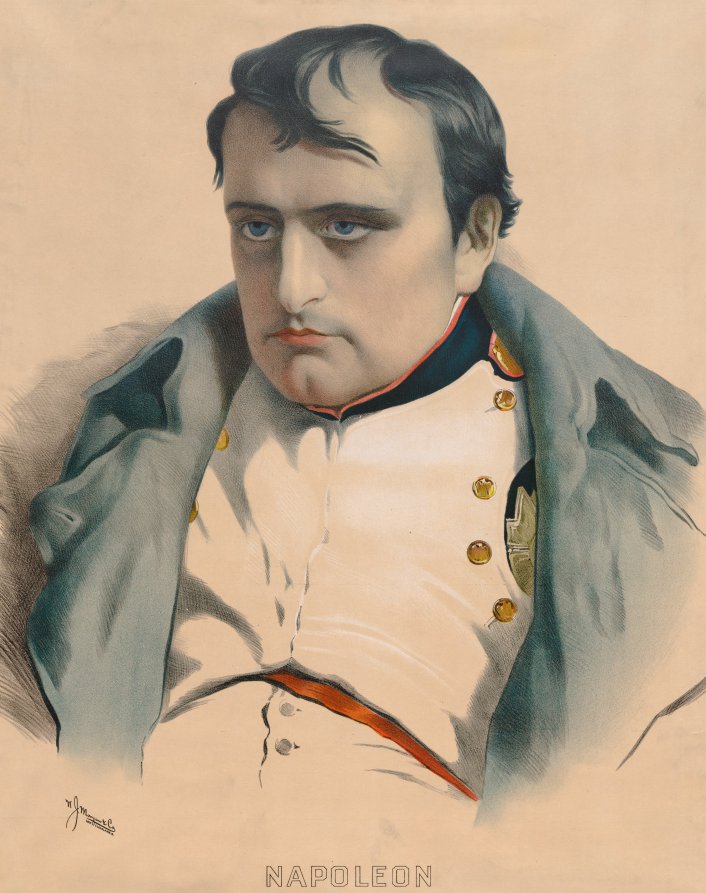
Bust Portrait of Napoleon, 1852
Hippolyte Delaroche was born in Paris in 1797, the son of an art dealer, which meant that beauty and commerce were part of the household air from the very beginning. He studied under the landscape painter Louis Étienne Watelet before entering the studio of Antoine Jean Gros, one of the dominant forces of French neoclassicism and a painter who had turned the Napoleonic epic into monumental theater. Under Gros, Delaroche absorbed the mechanics of large scale composition and the discipline of academic draughtsmanship, but he was already looking elsewhere for his emotional vocabulary. He found it in the northern European tradition, in the sober realism of the Dutch masters and in the emerging English school of history painting, whose practitioners like Benjamin West and his successors had begun treating historical narrative with a novelistic specificity that enchanted Delaroche.
By the time Delaroche made his Salon debut in the early 1820s, it was clear that he possessed something rare: an ability to select the single instant within a grand historical event that contained its entire human meaning. His breakthrough came with works depicting scenes from English history, subjects that felt exotic and morally complex to French audiences. Paintings such as The Children of Edward IV, exhibited at the 1831 Salon, produced a sensation. Here were the young princes in the Tower of London, painted not as symbols or allegories but as frightened children, their vulnerability rendered with a tenderness that bordered on the unbearable.
Paul Delaroche
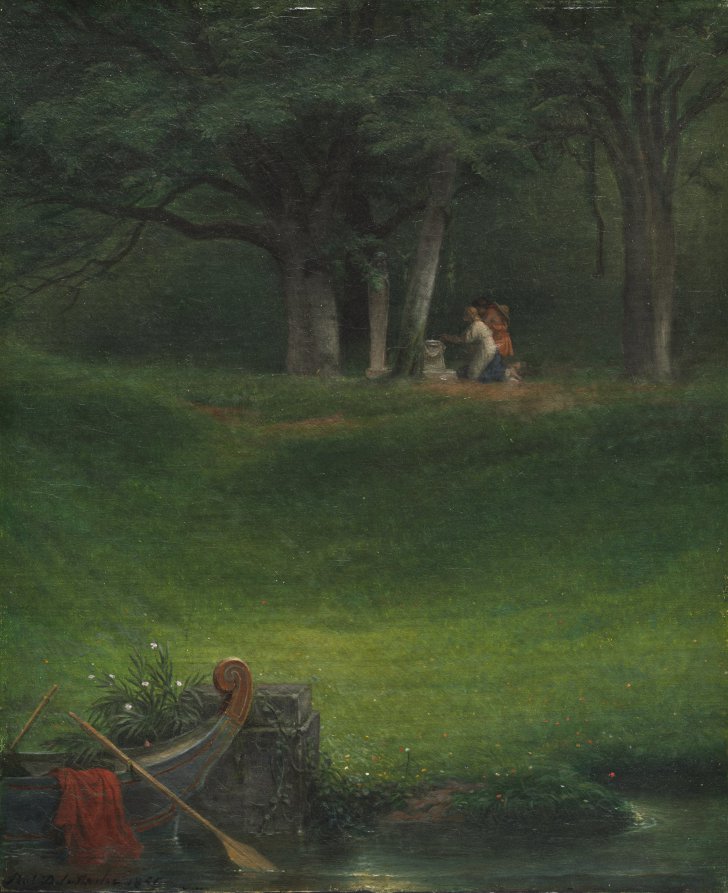
Offering to the God Pan, 1855
Critics who had expected either the cool grandeur of David or the swirling passion of Delacroix found themselves confronted with something that felt almost modern in its refusal to resolve the tension it created. The 1830s marked the height of Delaroche's public renown. His 1833 painting The Execution of Lady Jane Grey, now one of the treasures of the National Gallery in London, cemented his international reputation and demonstrated the full range of his gifts. The composition is theatrical but restrained, the young queen blindfolded and kneeling, her white gown luminous against the darkness of the Tower, the executioner waiting with a patience that feels almost merciful.
Delaroche understood that tragedy is most devastating when it is quiet. He was elected to the Institut de France and received commissions that placed him among the most celebrated painters in Europe. His enormous hemicycle mural for the École des Beaux Arts in Paris, depicting great artists of history assembled in timeless congress, remains one of the defining decorative programs of the nineteenth century. Two works currently available through The Collection offer a compelling lens through which to encounter Delaroche at different registers of his practice.
The 1852 color lithograph Bust Portrait of Napoleon reveals his sustained fascination with the Napoleonic legacy that had shaped his earliest training under Gros. Delaroche brought to Napoleon's image neither the propaganda of the imperial period nor the romanticism of retrospective myth, but rather a measured psychological attention that asks us to see the man behind the monument. The 1855 oil on fabric Offering to the God Pan represents a different and perhaps surprising facet of his talent, his engagement with mythological and classical themes handled with the same luminous specificity he brought to history. That this work was painted just a year before his death in 1856 makes it especially poignant as evidence of an artist still exploring, still curious, still finding new territory within a practice of more than three decades.
For collectors, Delaroche occupies an extraordinarily interesting position in the market. He is a painter of the very first historical rank whose work appears with relative infrequency at auction, which means that genuine examples carry both scholarly significance and considerable rarity value. His prints and lithographs, which circulated widely during his lifetime and brought his compositions to audiences across Europe and beyond, offer an accessible entry point into his world while also holding real art historical importance. The major oil paintings, particularly those tied to his English history subjects, command serious attention when they appear, drawing interest from institutional collectors and private buyers alike who recognize that academic realism of this quality and emotional intelligence is not merely period furniture but living painting.
Delaroche's position within art history becomes richer when considered alongside his contemporaries and successors. He was a friend and admirer of Ingres, though their temperaments could not have been more different. His interest in psychological realism places him in productive dialogue with the slightly younger Gustave Courbet, and his influence on later academic painters including William Adolphe Bouguereau and Lawrence Alma Tadema is clearly traceable. Across the Channel, the Pre Raphaelites who emerged in 1848 owed something to the precise, jeweled surfaces and literary seriousness that Delaroche had pioneered, even if they would have been reluctant to acknowledge the debt.
He was also admired and studied by artists working in America, where his prints were widely collected and his approach to historical narrative left traces in the work of painters throughout the second half of the nineteenth century. To return to Delaroche today is to rediscover a painter who was never truly lost, only temporarily eclipsed by the twentieth century's preference for abstraction and its suspicion of narrative sentiment. The scholarly reassessment of nineteenth century French academic painting that has gathered momentum since the 1970s, led by exhibitions at the Petit Palais and major American museums, has restored painters like Delaroche to the serious critical conversation they deserve. He was not a revolutionary.
He was something in many ways more difficult to achieve: a painter of absolute mastery who used that mastery in the service of human empathy. His canvases remind us that history is not an abstraction but a collection of specific moments lived by specific people, and that painting at its best can make us feel their reality across the distance of centuries.
Explore books about Paul Delaroche
Paul Delaroche: History Painted
Charlotte Gere
Paul Delaroche 1797-1856
Lee Johnson
The Paintings of Paul Delaroche
Pierre Miquel
Paul Delaroche and the Melodramatic Imagination
Nicholas Tromans
Delaroche et son temps
Régis Laissus
The Art of Paul Delaroche: History and Memory
Elizabeth Prettejohn