Paul César Helleu
Helleu: The Poet of Parisian Elegance
Artist Spotlight · The Collection Editorial
There is a particular kind of beauty that belongs entirely to its moment, and yet refuses to age. Such is the art of Paul César Helleu, whose portraits of fashionable Parisian women feel as vivid and alive today as they did during the golden decades of the Belle Époque. In recent years, major institutions and private collectors alike have returned to Helleu with fresh eyes, recognizing in his drypoints and pastels not mere social documents of a gilded age, but works of profound formal intelligence, technical brilliance, and genuine emotional warmth. His canvases and papers seem to breathe, his sitters perpetually mid thought, caught in a shaft of afternoon light or the quiet privacy of a dressing room.
Paul César Helleu
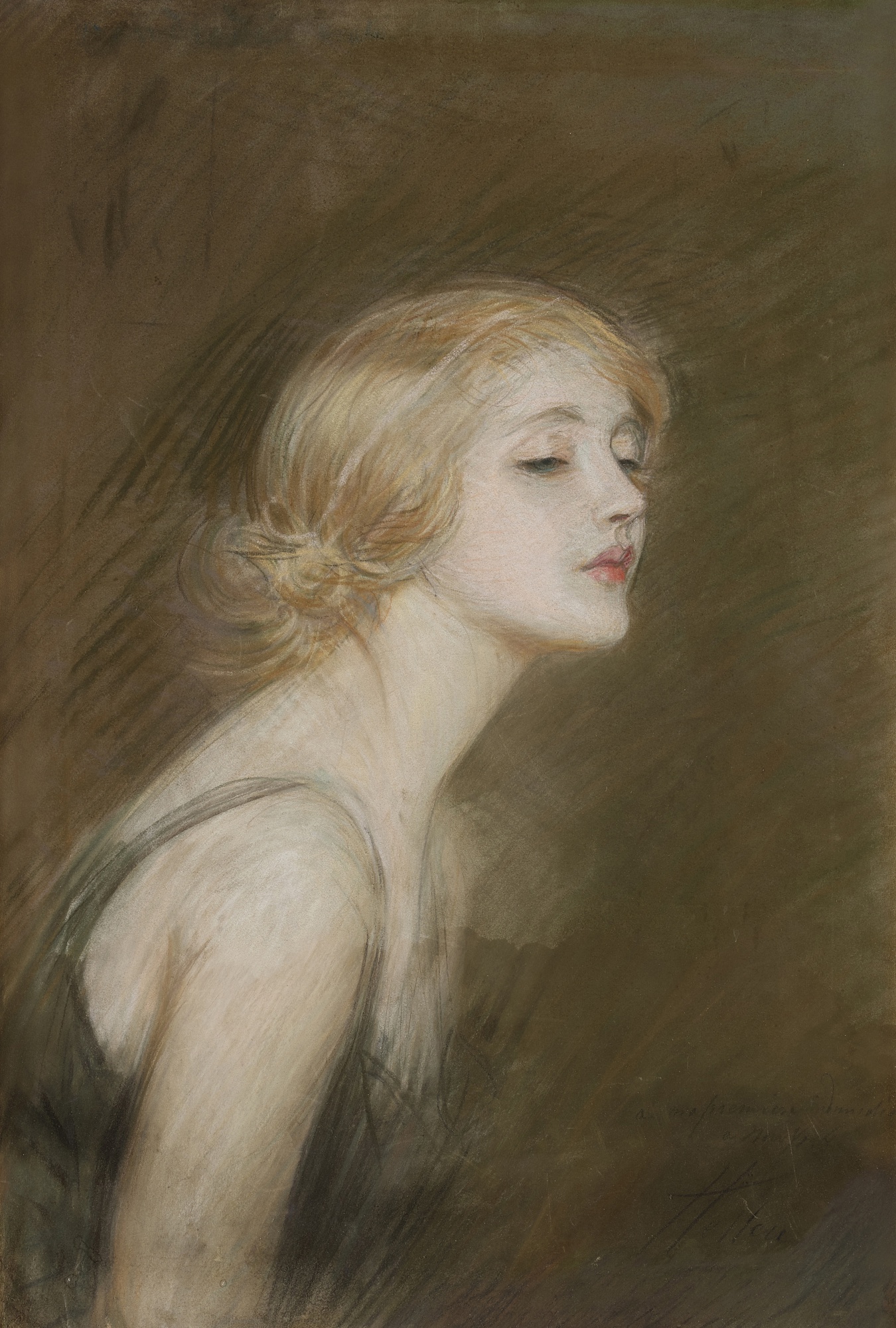
Portrait of Mae Murray
Helleu was born in Vannes, in the Brittany region of France, in 1859. He arrived in Paris as a young man to study at the École des Beaux Arts, entering the city at precisely the moment when its artistic culture was undergoing the most thrilling transformation in modern memory. The academic tradition was still powerful, but something looser, more luminous, and more honest was pressing up through it. Helleu absorbed both currents, learning the disciplines of classical draughtsmanship while falling under the spell of the Impressionist circle that was reshaping everything around him.
His gifts were apparent early, and they attracted the attention of people who mattered. Among the friendships that most profoundly shaped Helleu's artistic identity were those with John Singer Sargent, Claude Monet, and James McNeill Whistler. These were not casual acquaintances but genuine creative relationships, the kind that leave fingerprints all over a body of work. From Whistler in particular, Helleu absorbed a commitment to refined linearity, to the expressive potential of a single assured mark, and to the idea that elegance was itself a form of truth.
Paul César Helleu
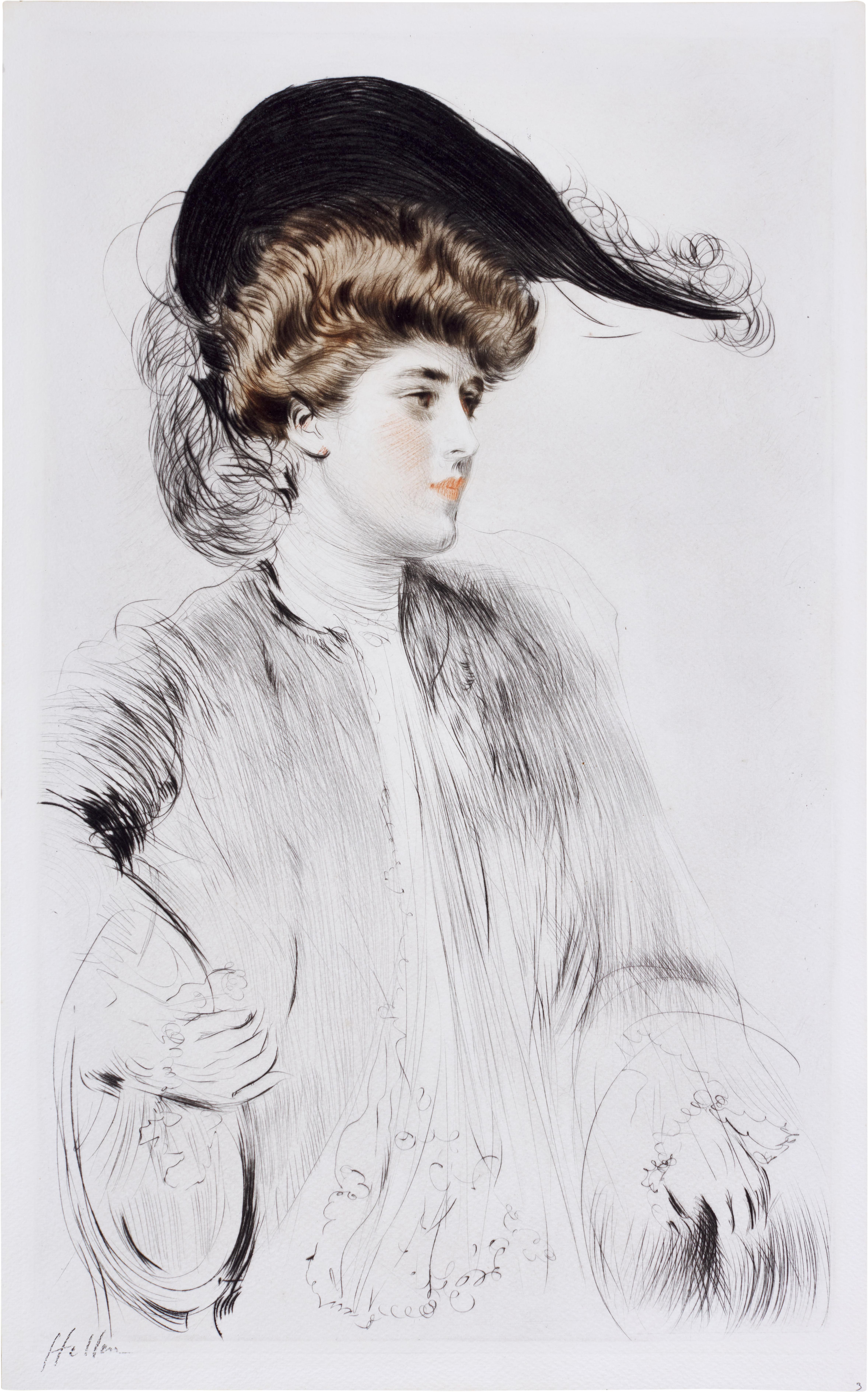
Portrait of Consuelo Vanderbilt, The Duchess of Marlborough, 1901
Sargent and Helleu were famously close, and the mutual admiration between these two portraitists of high society produced some of the most sophisticated social portraiture of the era. Monet's influence can be felt in Helleu's sensitivity to atmosphere and his instinct for catching the transient quality of light on skin, fabric, and hair. Helleu's practice centered on two techniques that he mastered with exceptional distinction: drypoint etching and pastel drawing. His drypoints in particular represent one of the great achievements in that medium during the nineteenth and early twentieth centuries.
The drypoint process, which involves scratching a design directly into a metal plate and printing from the resulting burr, rewards confidence and spontaneity above all else, qualities that Helleu possessed in abundance. Works such as his 1897 portrait of James McNeill Whistler and his arresting Head of a Woman from 1880 demonstrate the extraordinary economy of means he could deploy to conjure a complete and compelling presence. His portrait of Consuelo Vanderbilt, the Duchess of Marlborough, completed in 1901 and rendered in drypoint with hand colouring on wove paper, stands as one of the defining images of aristocratic femininity from the period, a work in which social authority and personal grace are held in exquisite balance. In pastel and chalk, Helleu was equally formidable.
Paul César Helleu
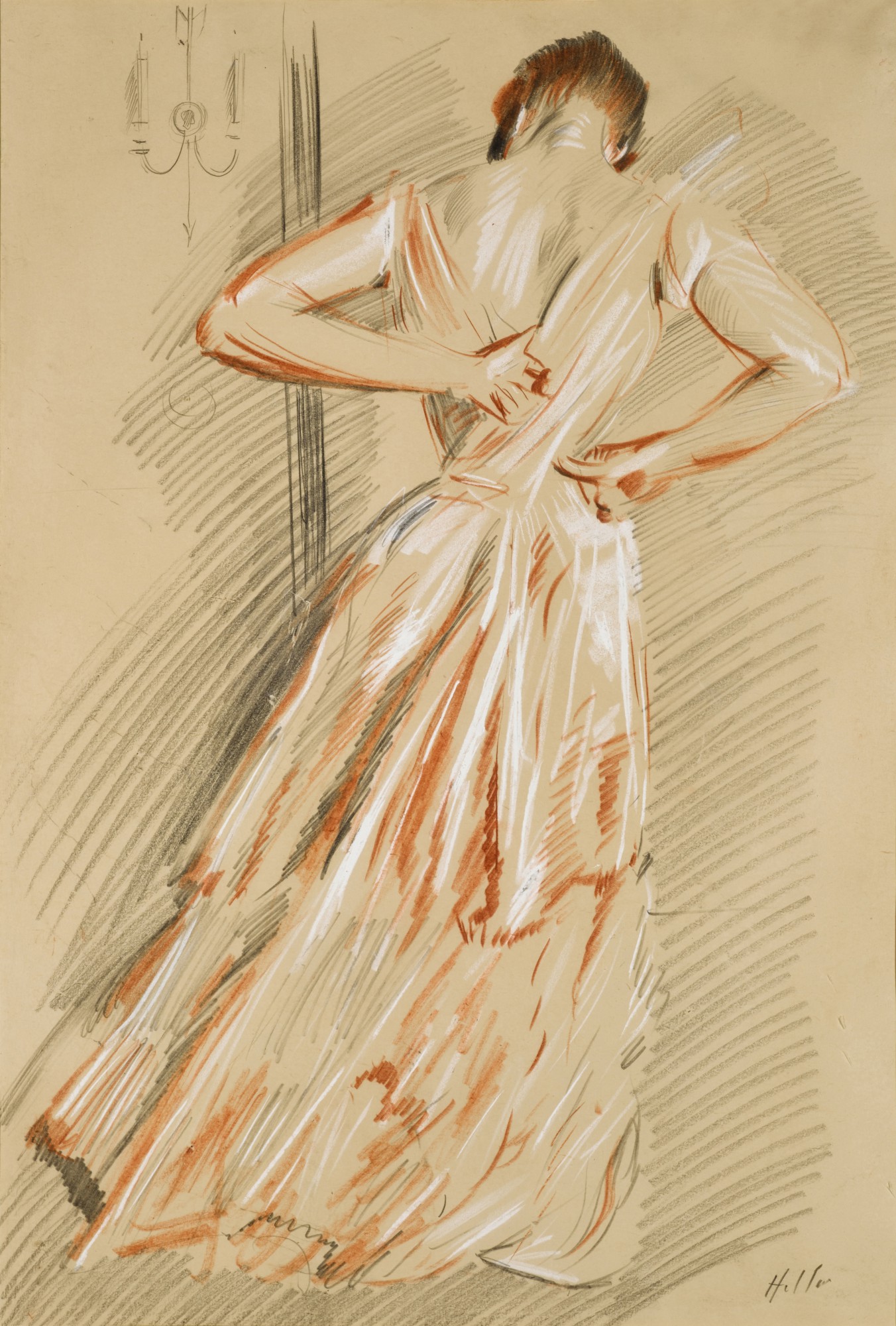
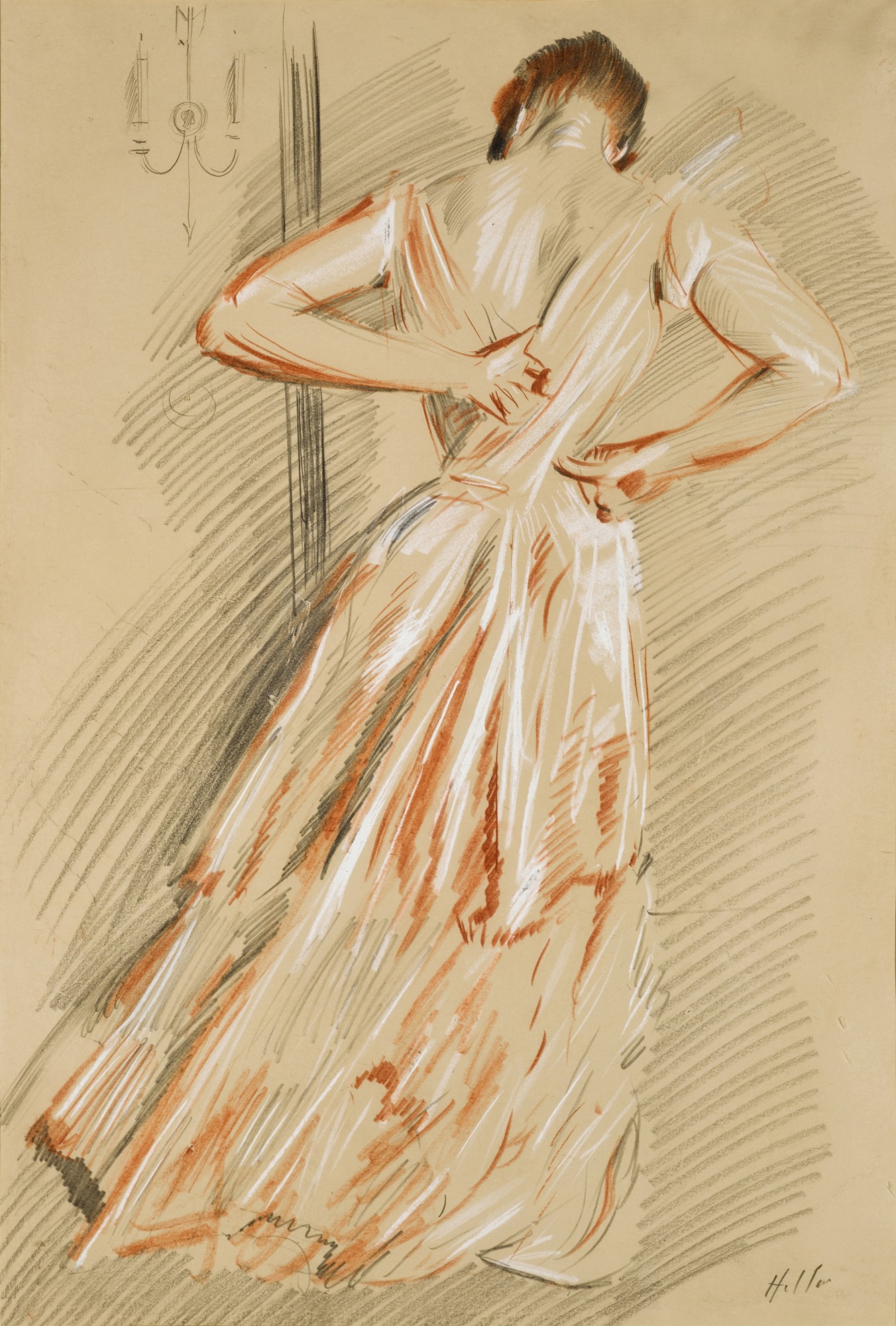
Madame Helleu Dressing
His Portrait of Mae Murray, executed in pastel on linen, reveals the full range of his tonal subtlety, with flesh rendered in layered warmth and garments suggested rather than described. Madame Helleu Dressing, worked in black, red, and white chalks on paper, offers an intimate domestic moment of rare tenderness: his wife Alice is not posing for posterity but simply living, and Helleu has caught her in that unguarded state with the affection of a man who looked at her, really looked, for decades. The work titled Woman, possibly Madame Alice Helleu, Looking at a Drawing from 1890 deepens this portrait of a marriage conducted through observation, as if the act of looking were itself the deepest form of love. These works of Alice are among the most touching in his entire output, and collectors who encounter them rarely forget them.
The market for Helleu has been consistently strong among collectors who value technical mastery, Belle Époque subject matter, and the particular poetry of works on paper. His drypoints appear regularly at the major auction houses, where fine impressions in good condition command serious attention. Pastels and chalk works, especially those depicting his wife or the celebrated mondaines of Parisian society, are prized for their intimacy and their exceptional quality of line. Collectors drawn to John Singer Sargent, Giovanni Boldini, or Jacques Émile Blanche will find in Helleu a kindred spirit whose work holds its own in the most distinguished company.
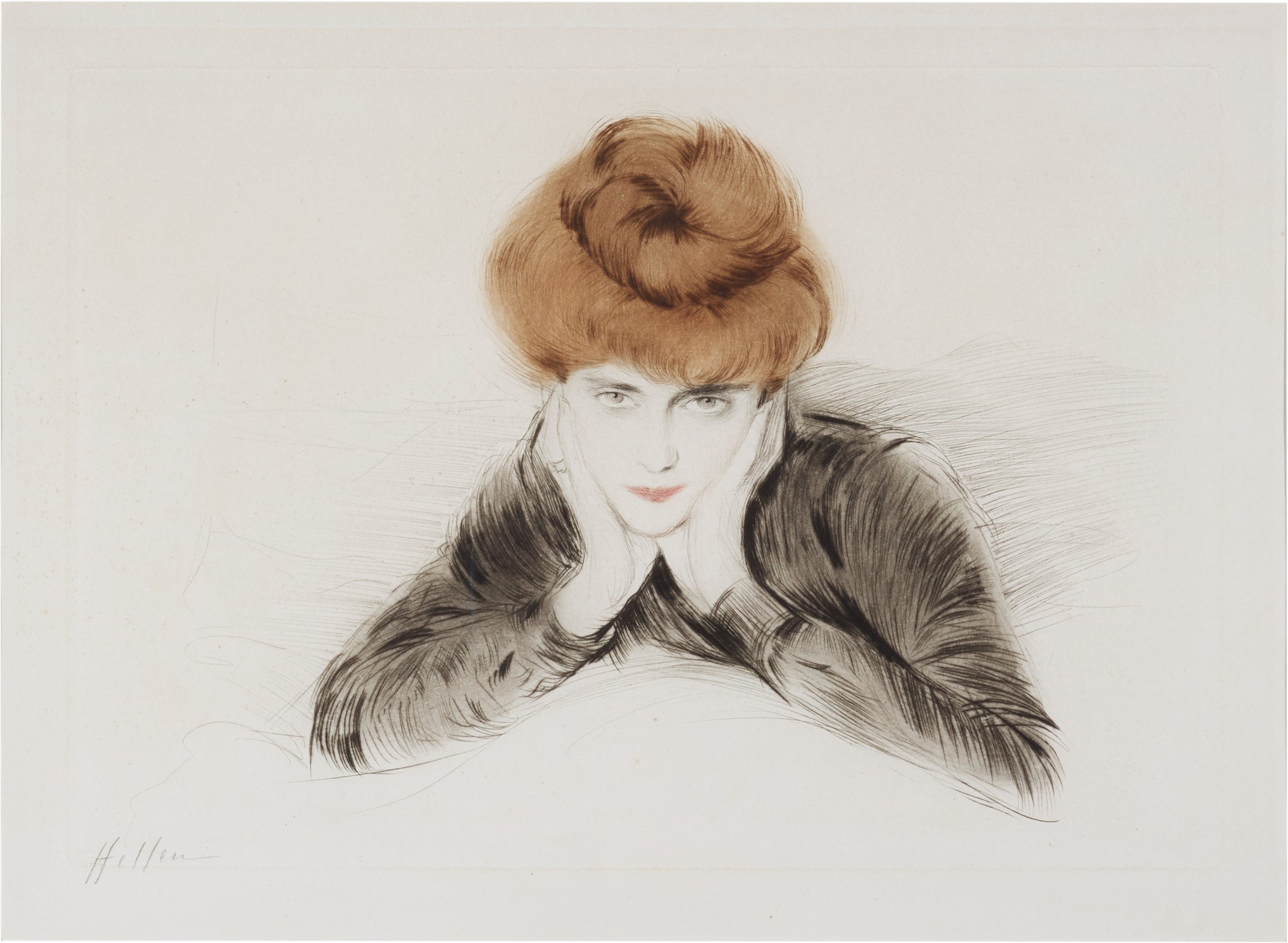
Paul César Helleu
Three Portraits (including 'Le Visage Encadré, Madame Helleu')
As with any printmaker of this period, condition and impression quality are paramount: early impressions with the characteristic soft burr of fresh drypoint are significantly rarer and more desirable than later pulls. His lithographs, such as the 1898 color lithograph Parisienne, offer a more accessible entry point to a body of work that rewards sustained collecting. Helleu occupies a distinctive place in the history of late nineteenth and early twentieth century European art. He was never a radical in the programmatic sense, never issuing manifestos or breaking with tradition for the sake of it.
What he did instead was something perhaps more difficult: he took an existing vocabulary and refined it to a point of near perfection, finding within the portrait and the figure study depths of feeling and formal interest that lesser artists would have missed entirely. His peers recognized this. Sargent reportedly called him a genius, and Proust, who moved in overlapping social circles, is said to have admired him greatly. These associations are not incidental: they place Helleu at the heart of the cultural life of his era, not on its margins.
Today, Helleu speaks to a collecting culture increasingly attuned to works on paper, to the intimacy of the drawn line, and to artists who understood that beauty and seriousness need not be in opposition. His women are not decorative ciphers but individuals, observed with genuine curiosity and rendered with the full resources of a sophisticated technique. In an art historical moment when the Belle Époque is being reassessed with greater nuance, recognizing both its pleasures and its complexities, Helleu emerges as one of its most gifted and humane chroniclers. To acquire a work by Paul César Helleu is to bring into a collection a piece of an extraordinary world, filtered through the eye of a man who loved it, and who had the rare skill to make others love it too.
Explore books about Paul César Helleu
Paul Helleu: His Life and Work
Germain Seligmann
Paul Helleu (1859-1927): Catalogue Raisonné of the Etchings
Susan Casteras
Paul Helleu: Master of the Belle Époque
Katherine Rothkopf