Patrick Hughes
Patrick Hughes: Master of Magnificent Visual Paradox
Artist Spotlight · The Collection Editorial
“The further away something looks, the closer it actually is. That is the basic paradox I am working with.”
Patrick Hughes
Walk into any room containing a Patrick Hughes and something quietly extraordinary happens. The painting moves. Not in the metaphorical sense that great art always seems alive, but in a literal, almost alarming way: as you shift your weight from one foot to the other, the receding corridors and painted skies surge forward, the distant horizons rush toward you, and the entire composition pivots and breathes as though it were a living thing. This is reverspective, the optical technique Hughes invented and has refined over more than five decades, and it remains one of the most genuinely astonishing perceptual experiences available in contemporary art today.
Patrick Hughes
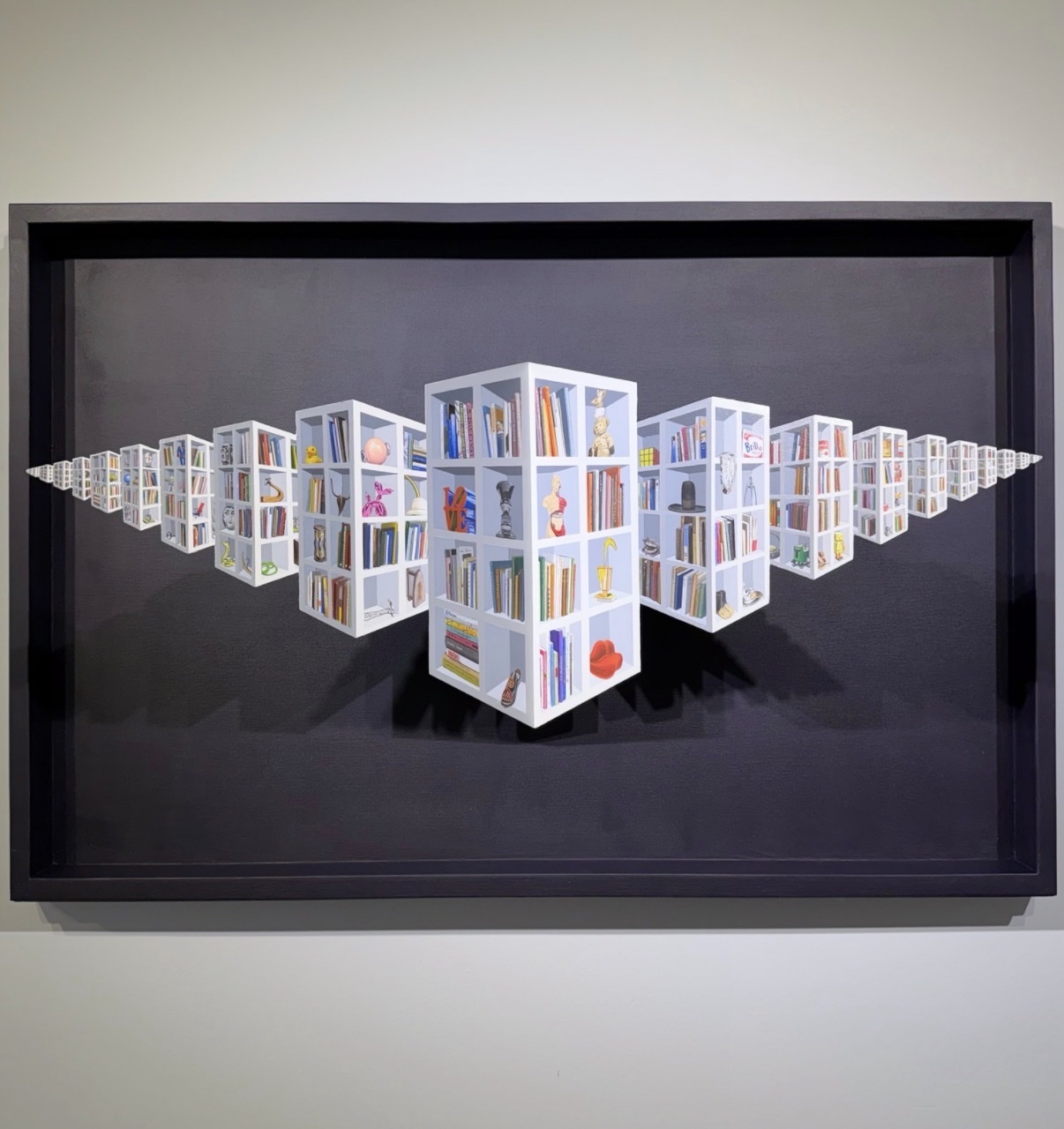
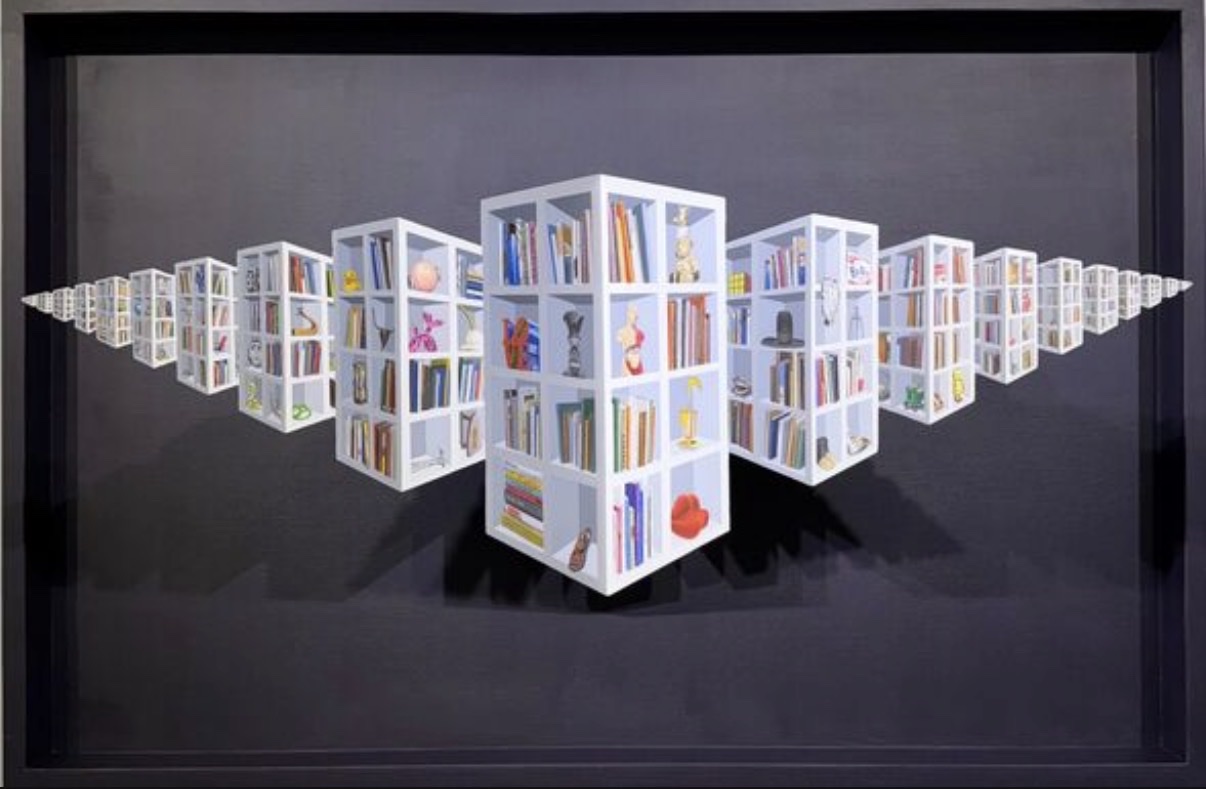
Shelf Contained, 2026
In recent years, galleries from London to New York have reported that Hughes works are among the most socially shared pieces on their walls, with visitors compelled to film themselves walking in front of the canvases, unable to believe what their eyes are telling them. In an era saturated with digital spectacle, Hughes achieves this wonder with oil paint, wood, and the oldest raw material in art: the paradox of seeing. Patrick Hughes was born in Birmingham in 1939 and grew up in a Britain still shaped by the austerities and textures of mid century working life. He studied at James Graham College in Leeds during the late 1950s, a period of tremendous ferment in British culture when the first stirrings of Pop Art and a renewed engagement with language, humor, and popular imagery were beginning to challenge the dominance of abstraction.
This environment proved formative. Hughes absorbed a particular British sensibility, one that prizes wit alongside seriousness, that finds philosophical depth in wordplay, and that refuses to separate intellectual rigor from pleasure. These qualities have never left his work. His early career in the 1960s placed him squarely within the orbit of British conceptual and language based art.
Patrick Hughes
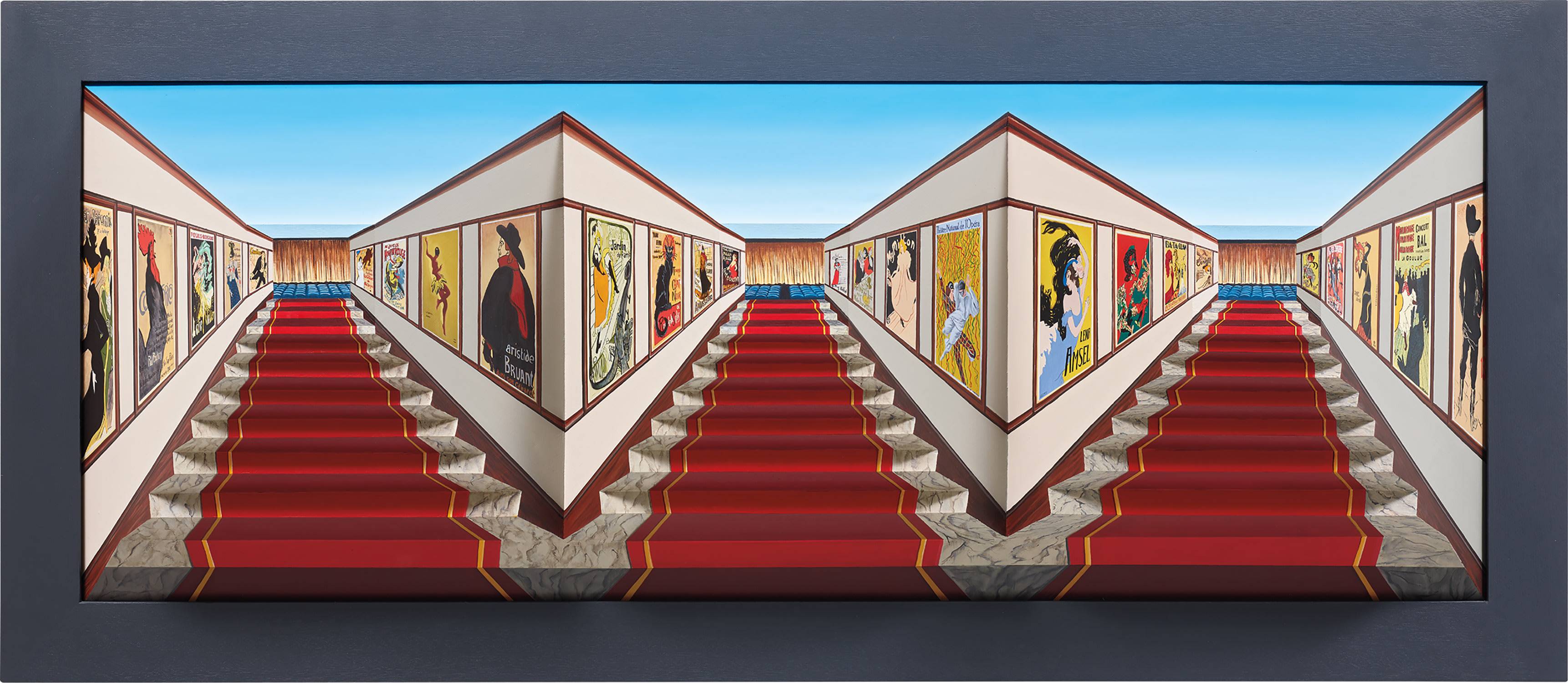
Stairs to the Stars, 2016
He collaborated with the writer and philosopher George Brecht and produced work that engaged directly with paradox as a subject, publishing the book "Vicious Circles and Infinity" in 1975, which examined paradox through images and text. This grounding in paradox was not merely a formal curiosity but a genuine philosophical commitment. Hughes has long been interested in the ways that perception deceives and reveals simultaneously, the ways that what we see and what is actually present can diverge so dramatically as to make reality itself feel provisional. It is this conviction, worn lightly but held deeply, that animates everything he makes.
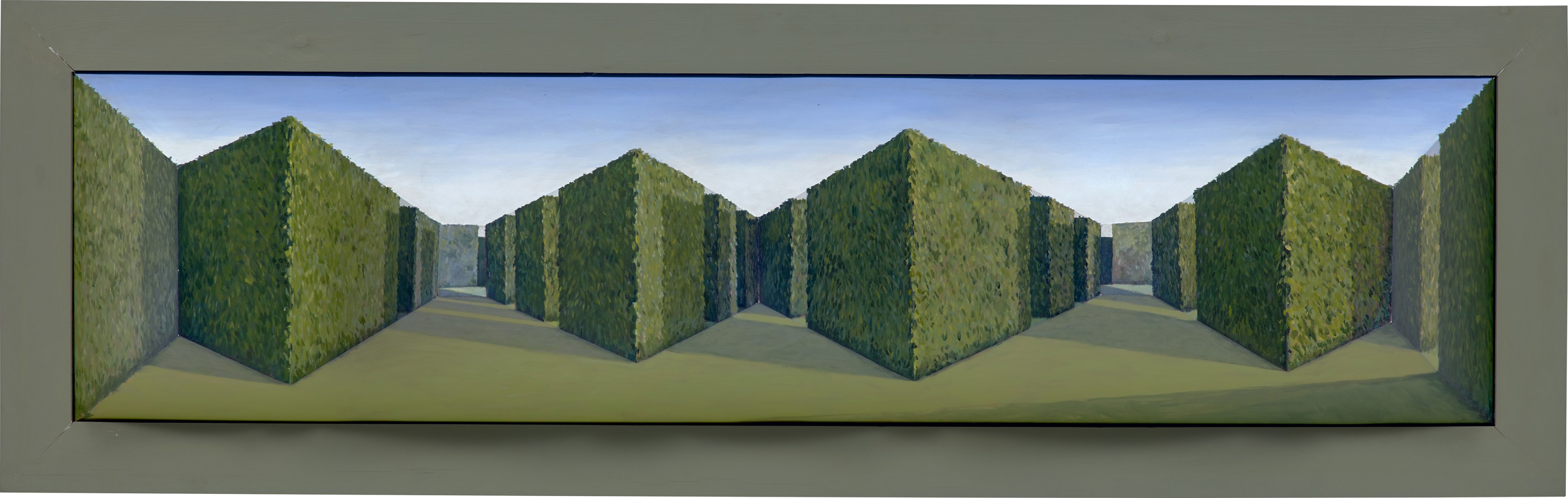
The breakthrough invention of reverspective arrived fully formed in the 1990s. The technique involves constructing a three dimensional painted surface in which the forms that project most toward the viewer are painted as though they recede into the far distance, while the surfaces that physically sit furthest away are painted as foreground elements. The brain, committed to the conventions of single point perspective, inverts the geometry entirely, and the result is a painting that appears to rotate in three dimensional space as the viewer moves. Works such as "Panoramania" from 1994 demonstrated the full maturity of this invention, with Hughes deploying row upon row of painted panoramic views that seem to sweep and pivot with cinematic grandeur.
Patrick Hughes
Panoramania, 1994
These early reverspective works established him as something genuinely new in British art: an artist who had invented not just a style but a perceptual technology. The decades since have seen Hughes deepen and expand his vocabulary with remarkable consistency. Works such as "Stairs to the Stars" from 2016 and "Appropriately" from 2018 show an artist in full command of his language, weaving together his characteristic wit, his love of art historical reference, and the vertiginous spatial drama of reverspective into compositions of great beauty and formal intelligence. His titles are always worth attending to: punning, layered, and carefully chosen, they function as a second artwork running alongside the visual one.
"Shelf Contained," listed among his most recent works with a date of 2026, speaks to an artist whose practice remains restlessly productive and whose engagement with ideas shows no sign of diminishing. The medium across these works, typically oil on board construction and occasionally within the artist's own designed frames, reflects a craftsman's attention to the physical object as well as the visual experience it generates. For collectors, Hughes presents a compelling and relatively rare proposition. His works exist at the intersection of Op Art, conceptual practice, and a distinctly British tradition of wit and literary intelligence, placing him in meaningful conversation with artists such as Bridget Riley, whose scientific investigation of optical sensation transformed painting in the 1960s, and with the broader legacy of M.
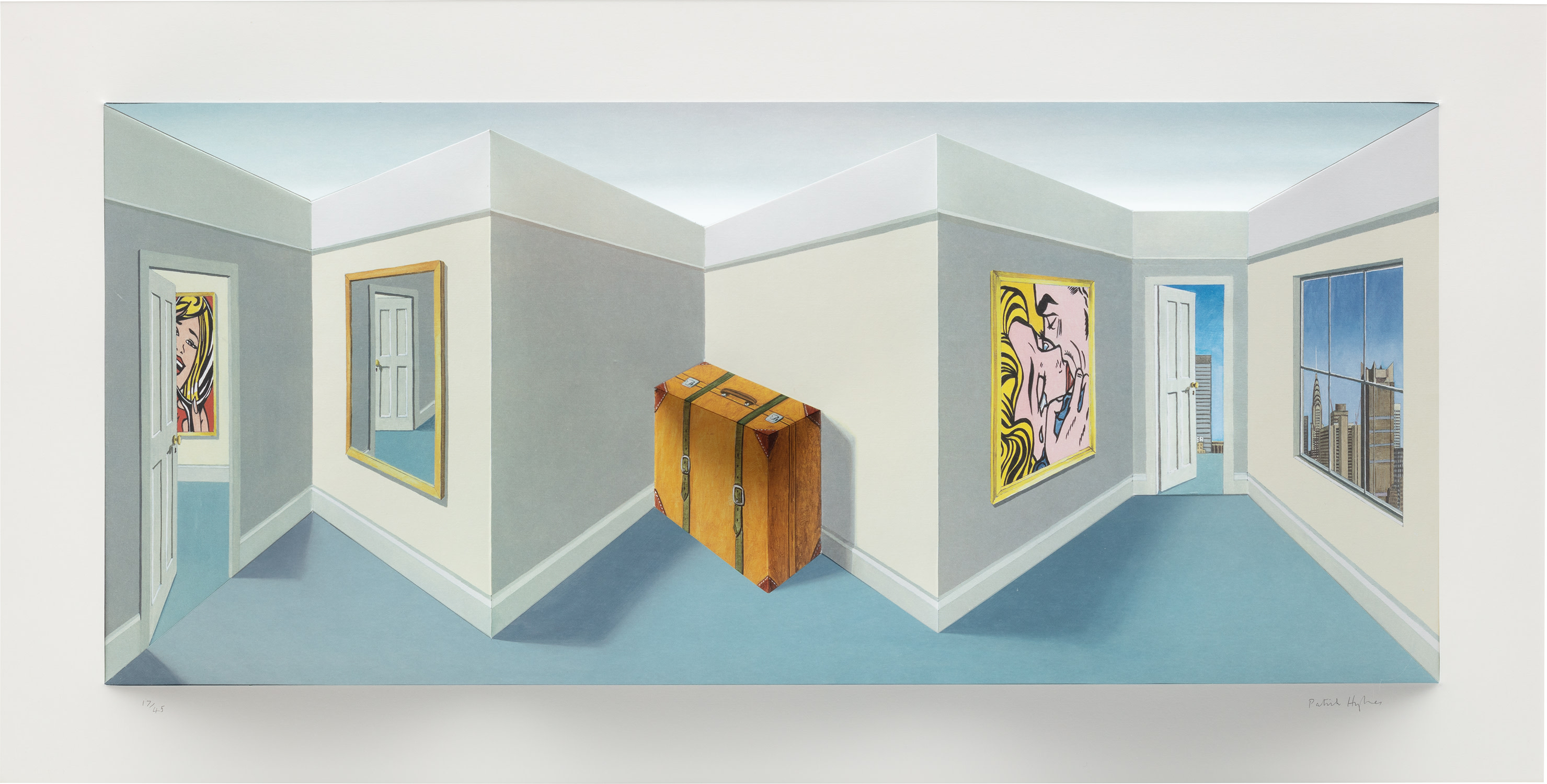
Patrick Hughes
Travel
C. Escher's impossible geometries, though Hughes's humor and painterly warmth distinguish him clearly from both. His multiples and prints, including works produced in collaboration with the master printer Jack Shirreff, offer entry points into his practice at various scales and price points, while his unique oil on board constructions represent the full immersive power of reverspective and have attracted serious institutional and private attention. Hughes is represented by Flowers Gallery in London and has exhibited extensively in the United States, building a transatlantic collector base that values both the conceptual substance and the sheer joyful spectacle of the work.
What makes Hughes particularly attractive to thoughtful collectors is the work's extraordinary accessibility without any sacrifice of depth. A Hughes painting delights children and stops conversation at dinner parties, but it also rewards sustained looking and thinking over years of ownership. The paradox he investigates, the gap between what is and what appears to be, is one of the oldest questions in philosophy and one of the most urgent questions in contemporary life, when the nature of images and their relationship to reality has never been more contested. Owning a Hughes is owning a daily reminder that perception is constructed, that seeing is an act of interpretation, and that this fact, far from being troubling, can be a source of continuous delight.
Patrick Hughes turns eighty six this year and occupies a position of quiet but genuine distinction in British art history. He invented something that had never existed before, refined it across half a century of committed practice, and in doing so created a body of work that is immediately recognizable, intellectually serious, formally innovative, and deeply, generously pleasurable. That combination is rarer than it should be. Institutions, curators, and collectors who have spent time with his work tend to become advocates with real conviction, because the experience of a Hughes is not one that fades or grows familiar.
It rewards return. It rewards standing still and then moving. It rewards, above all, the willingness to let your eyes be proven wrong and to take delight in the fact.