Otto Piene
Otto Piene: Light, Fire, and Wonder
Artist Spotlight · The Collection Editorial
“I want to make the sun a work of art available to everyone.”
Otto Piene
In the summer of 2014, the art world paused to mourn and to celebrate one of its most genuinely visionary figures. Otto Piene, who died in Berlin on July 17 of that year, had spent six decades transforming the most elemental forces of nature into art of breathtaking beauty. He left behind a body of work that spans intimate smoke drawings on paper, monumental sky ballets performed above open fields, and luminous canvases where light itself becomes a collaborator. Today, as institutions across Europe and North America continue to reassess the achievements of the ZERO movement, Piene's reputation has never felt more vital or more deserved.
Otto Piene
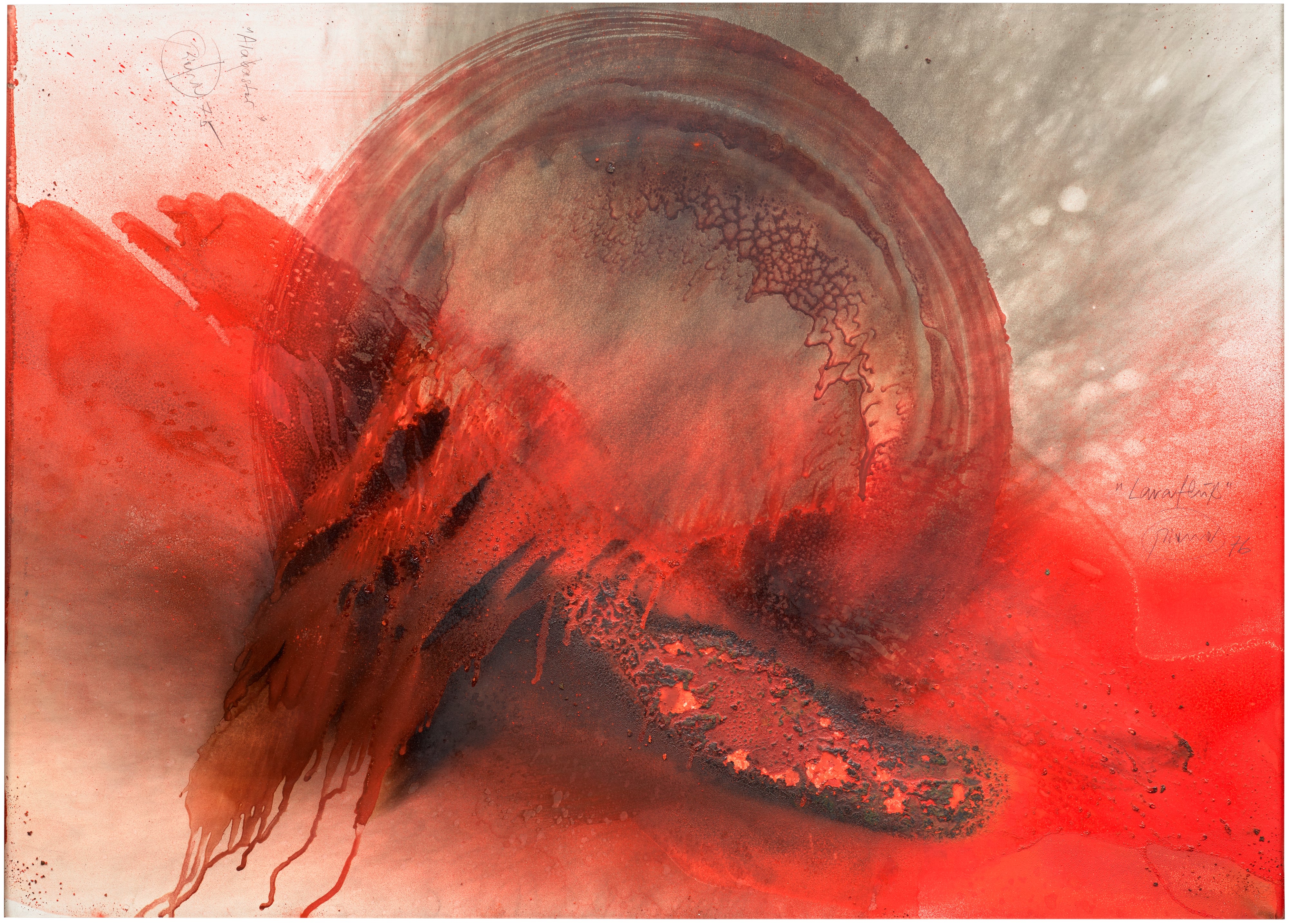
Lavafluß, 1976
Piene was born on April 18, 1928, in Laasphe, in the Westphalian region of Germany. His childhood unfolded against the catastrophic backdrop of the Second World War, and as a teenager he served as a military lookout, an experience that left him with a profound and lasting sensitivity to light in darkness, to the signal fire, to the lone illuminated form against an infinite sky. After the war he studied painting and art education at the Blocherer School in Munich, then continued at the Kunstakademie Düsseldorf and later at the University of Cologne, where he deepened his philosophical engagement with the nature of perception and the role of the artist in a shattered society. These were formative years not only technically but spiritually: Piene emerged from them convinced that art had an obligation to move beyond the trauma and the gestural anxiety of Abstract Expressionism and toward something luminous, open, and fundamentally hopeful.
In 1957, alongside fellow artist Heinz Mack, Piene founded the ZERO group in Düsseldorf, a movement that would reshape European avant garde art for the following decade. The name itself was a statement of intent: zero as a point of new departure, a clearing away of everything exhausted and broken. ZERO attracted artists including Günther Uecker, Yves Klein, Jean Tinguely, and Lucio Fontana, forming an international network committed to pure sensation, material investigation, and the rehabilitation of beauty as a serious artistic category. Piene organized a series of legendary evening exhibitions in his Düsseldorf studio between 1957 and 1966, intimate and electric gatherings that introduced audiences to kinetic light sculptures, fire performances, and works that seemed to breathe and pulse with autonomous life.
Otto Piene
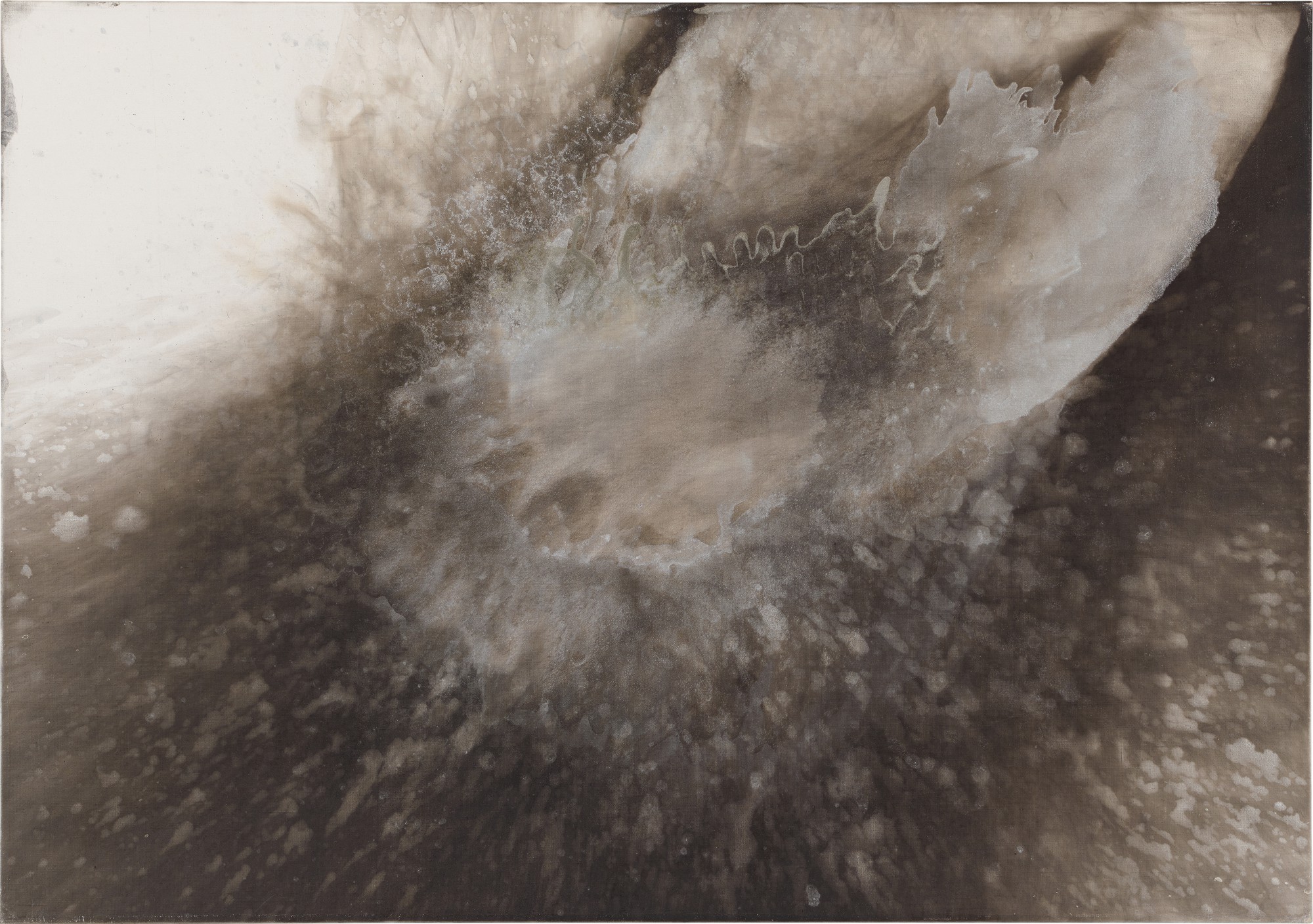
Ohne Titel (Untitled)
These evenings are now recognized as among the most significant artistic events of postwar Europe. Piene's practice evolved through several distinct but interconnected phases. His earliest mature works from the late 1950s explored the grid as a means of structuring light, using perforated metal screens to project shifting constellations of dots onto gallery walls. From there he moved into fire, developing a technique in which he passed open flames across paper or canvas coated with pigment, allowing soot to settle in organic, unpredictable patterns.
“Fire is the most important medium I use. It is alive.”
Otto Piene
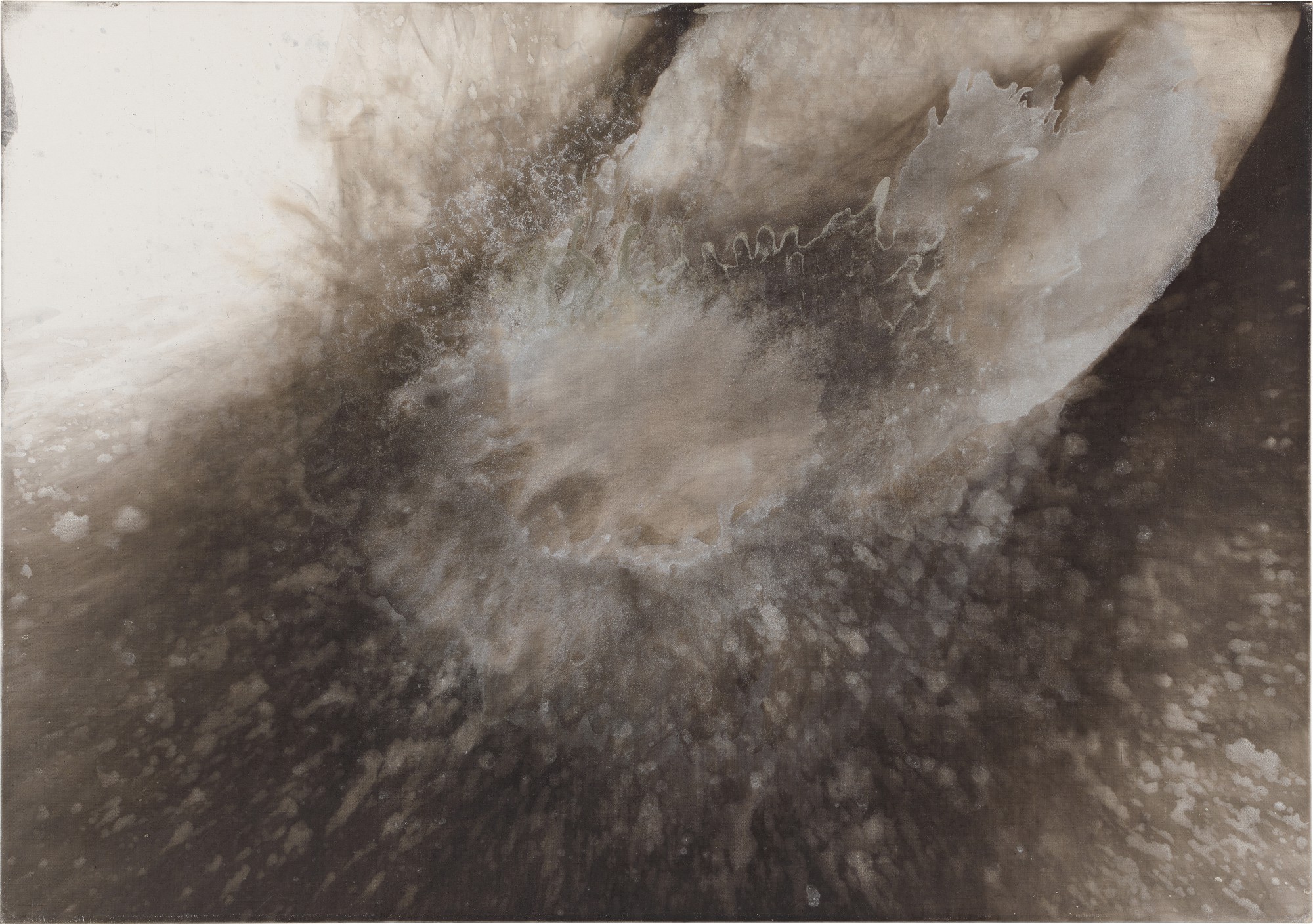
The resulting works, known as Rauchzeichnungen or smoke drawings, are among the most quietly astonishing objects in postwar art. One such work from 1960, titled simply Rauchzeichnung, exemplifies the method: the surface holds the memory of combustion, soft and velvety in its blacks, with an atmospheric depth that recalls both Abstract Expressionism and ancient mark making. These are not aggressive gestures but tender ones, records of a conversation between the artist and an element he could guide but never fully control. The canvases in oil and soot represent another strand of this investigation.
Otto Piene
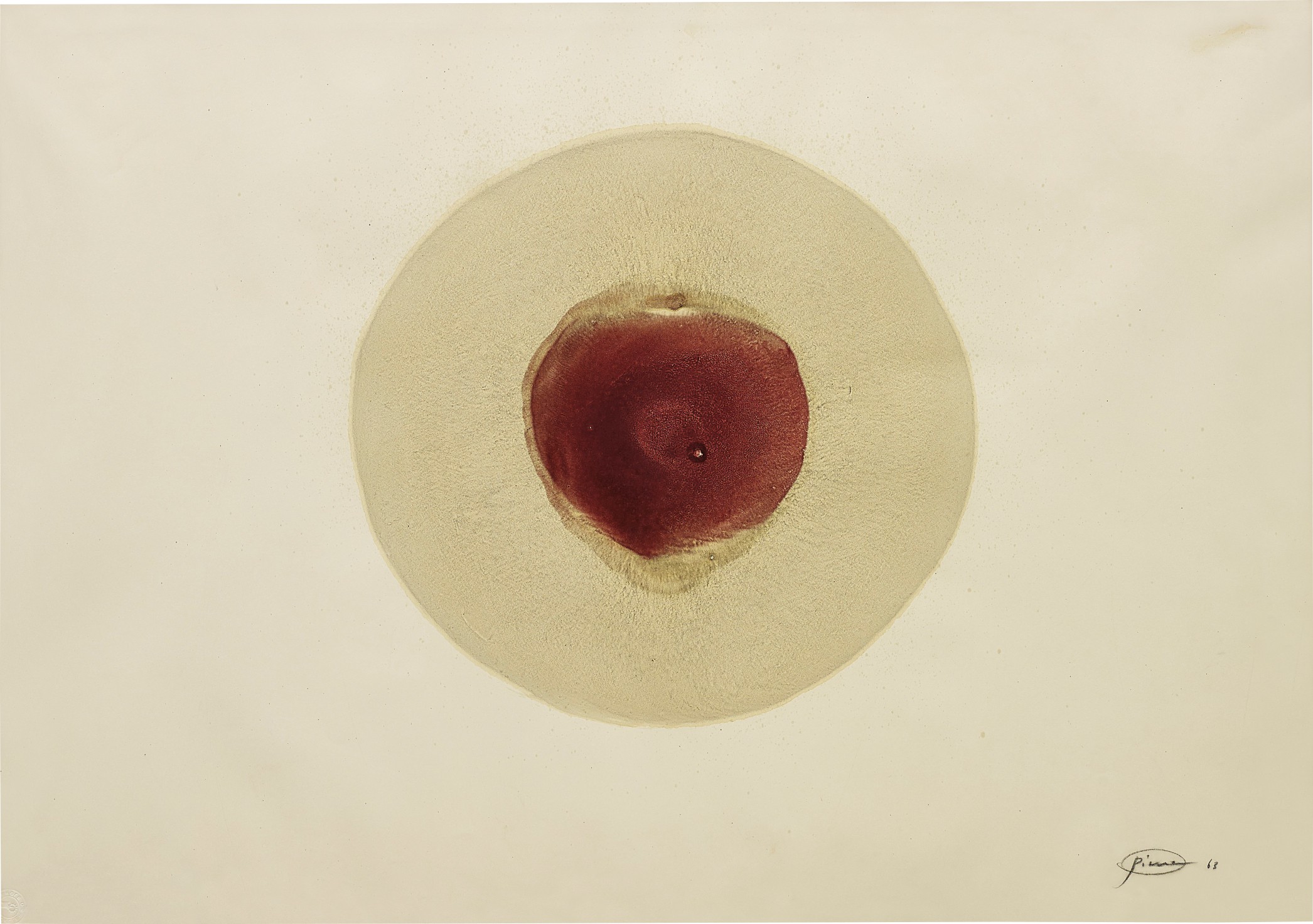
Ohne Titel, 1963
Works such as Ohne Titel, painted in oil and soot on canvas, demonstrate how Piene used the residue of fire not as a destructive agent but as a medium of extraordinary nuance. The surfaces of these paintings possess a quality that is almost geological, layered and stratified, with passages of carbon black giving way to areas of deep pigment that seem to glow from within. Lavafluß, a 1976 work in gouache, pigment, and soot on cardboard, extends this volcanic imagination into color, the title itself evoking molten flow and geological time. Fire Eye from 1979, in oil and soot on canvas, distills the ocular symbolism that runs through much of Piene's work: the eye as aperture, as organ of wonder, as the meeting point between the inner world of the artist and the light of the world outside.
These works sit beautifully together as a coherent body of inquiry. For collectors, Piene's work offers a rare combination of historical significance and genuine visual pleasure. The smoke drawings and soot canvases have attracted sustained institutional attention, with major examples held by the Museum Ludwig in Cologne, the Städtische Galerie im Lenbachhaus in Munich, and the Smithsonian Institution in Washington, where Piene spent decades as a professor at the Massachusetts Institute of Technology's Center for Advanced Visual Studies, which he directed from 1974 to 1993. His works on paper in particular represent an accessible entry point into a practice of considerable depth, while the larger canvases command serious attention from collectors with an eye toward postwar European abstraction.
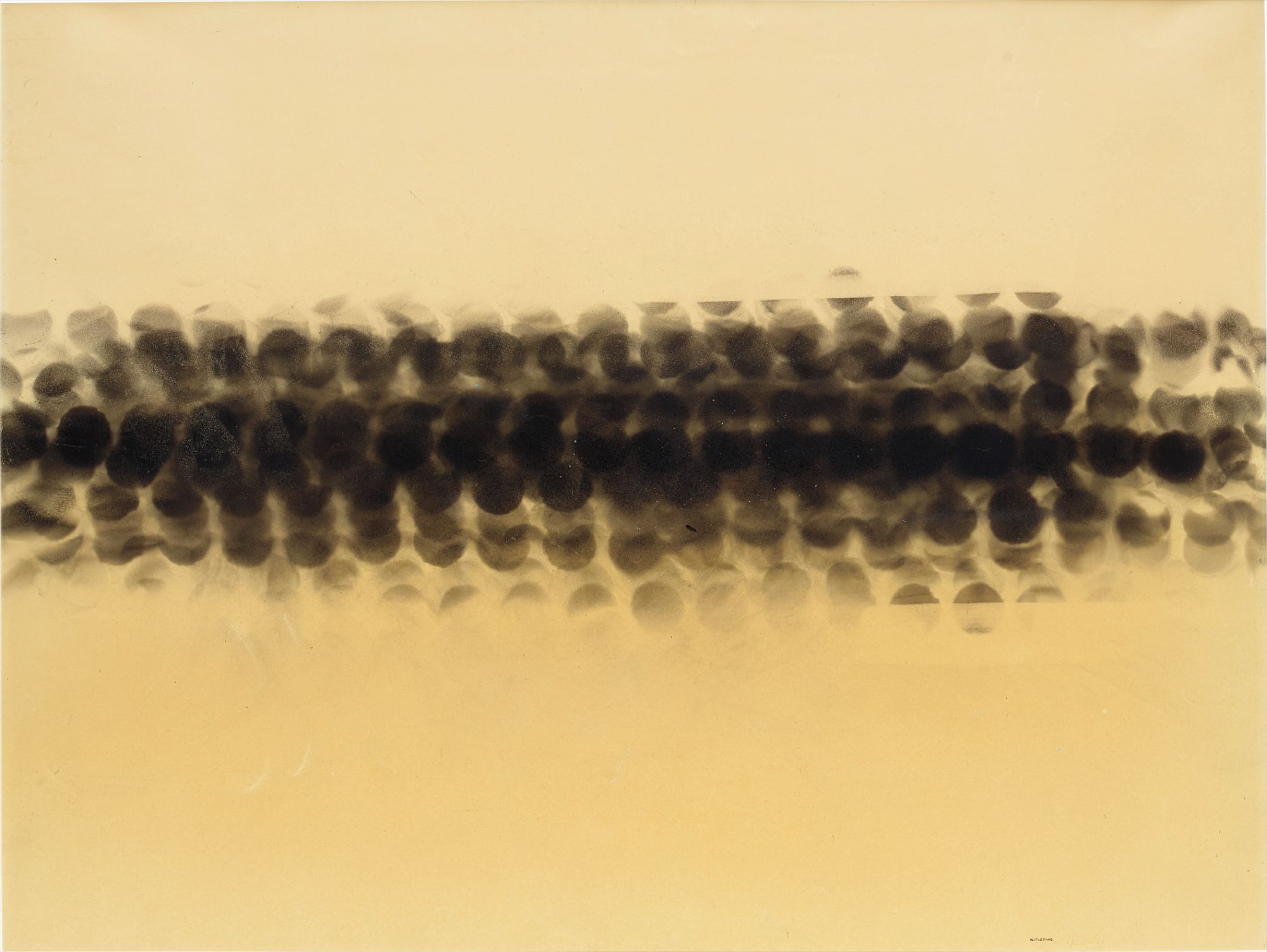
Otto Piene
Rauchzeichnung, 1960
Artists working in adjacent territory include Yves Klein, whose own fire paintings share a fascination with elemental process, Günther Uecker with his nail reliefs and their obsessive engagement with surface, Lucio Fontana whose spatial concepts anticipate similar concerns, and Heinz Mack whose light reliefs illuminate the same fundamental questions. Understanding Piene in this company helps clarify both his singularity and his centrality. The PAX portfolio, published by Edition Rottloff in Karlsruhe and dated 1969 to 1970, reveals yet another dimension of Piene's practice and his values. A limited edition work signed, dated, and numbered by the artist, it reflects the political consciousness that ran beneath even his most formally abstract endeavors.
The title is a statement: peace, in the immediate aftermath of the upheavals of 1968, was not a passive condition but an active aspiration. Piene believed that beauty itself was a form of political argument, that to create luminous and life affirming art in the shadow of catastrophe was an act of genuine courage. Piene's legacy today is secure and still expanding. The ZERO Foundation in Düsseldorf, established in 2008, has done extraordinary work in documenting and promoting the movement, and major retrospectives in recent years at the Guggenheim Museum in New York and the Stedelijk Museum in Amsterdam have introduced new generations of collectors and curators to the full ambition of what these artists achieved.
Piene himself always insisted that art belonged to the sky as much as to the gallery, and his sky art events, in which enormous inflatable sculptures were floated above landscapes and stadiums, remain among the most genuinely joyful public artworks of the twentieth century. To collect Piene is to participate in that joy, to bring into one's home a piece of work made by an artist who understood fire and light as gifts to be shared.
Explore books about Otto Piene
Otto Piene: Light and Movement
Peter Selz
Otto Piene: Catalogue Raisonné
Piene, Otto and others
Otto Piene: Electric Dreams
Toni Del Renzio
Zero: Chance and Change, Light and Movement
Heinz Mack and Otto Piene
Otto Piene: Works from 1955-1980
Guggenheim Museum