Oli Epp
Oli Epp Paints the World We Recognize
Artist Spotlight · The Collection Editorial
Something is happening in the conversation around British painting, and Oli Epp sits at its most energized center. Still only in his early thirties, Epp has built a body of work that feels both instantly familiar and quietly unsettling, a achievement that places him among the most compelling figurative painters to emerge from Britain in the past decade. His canvases have found their way into serious private collections, and the demand for his screenprints continues to grow with each new edition release, a sign that collectors at every level of the market recognize something essential in what he makes. Epp was born in 1994, which means he grew up entirely inside the digital age, shaped by the visual language of screens, brand identities, social media performance, and the particular loneliness that can accompany a life lived partly online.
Oli Epp
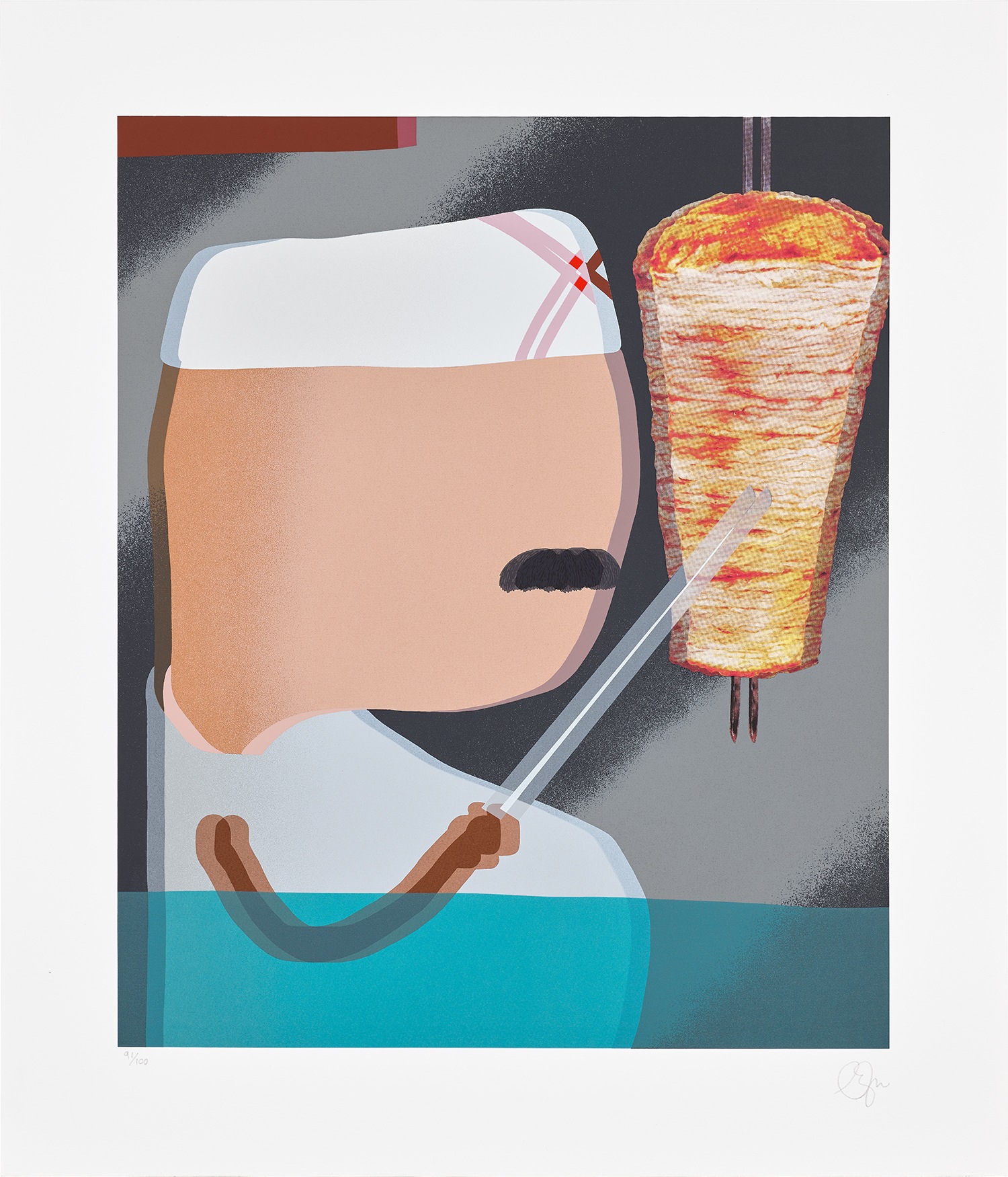
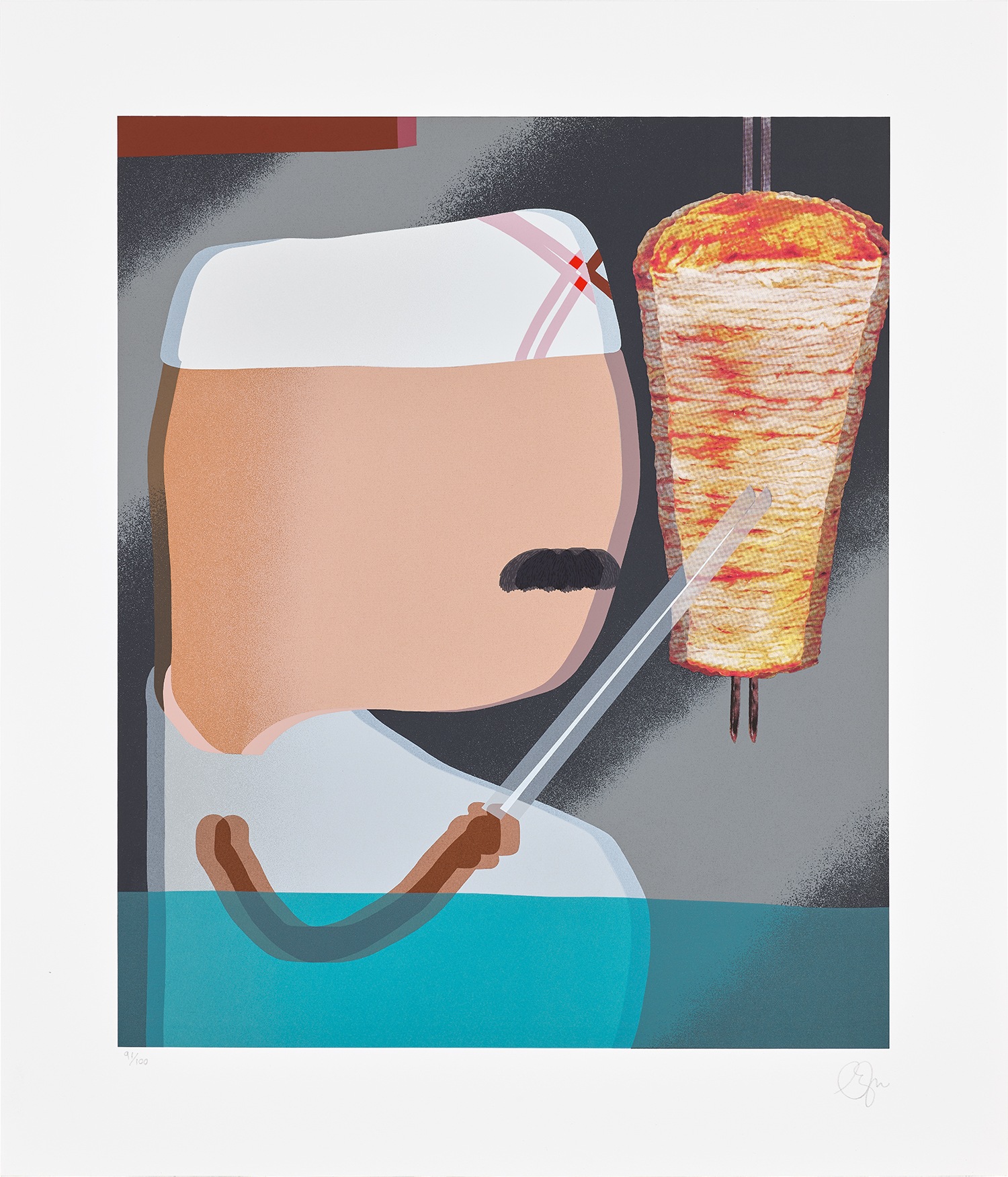
You Spin Me Right Round
That formation is everywhere in his work, not as nostalgia or critique from a distance, but as something lived from within. He studied at the Slade School of Fine Art in London, one of the most prestigious and rigorous painting programs in the world, where the foundations of his remarkably controlled technique were laid. The Slade has a tradition of producing painters who take the human figure seriously, and Epp absorbed that tradition while quietly bending it toward his own obsessions. What distinguishes Epp from many of his contemporaries is the discipline of his formal approach.
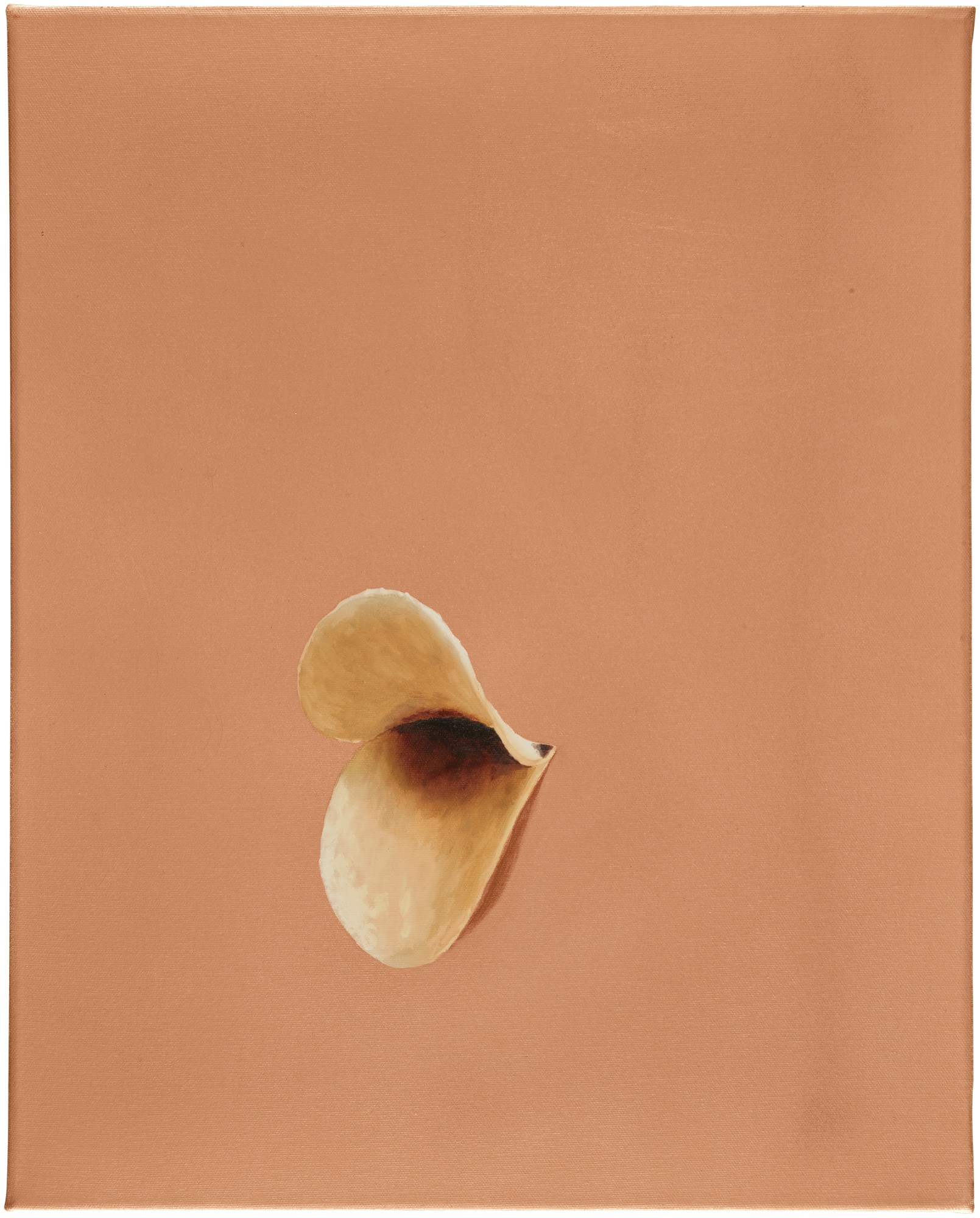
His figures are rendered in smooth, flat fields of color with almost no visible brushwork, giving them a quality that hovers between painting and graphic design. They are anonymous in the most deliberate sense: faces without specific identity, bodies without names, yet somehow deeply expressive of collective emotional states. This is not abstraction but something more philosophically interesting, figuration that insists on universality rather than portraiture. Early works like Pringles Duck from 2016, made in oil and graphite on canvas, and Whistleblower from 2017, painted in oil, showed a young artist already in command of this visual syntax and willing to lean into its stranger possibilities.
Oli Epp
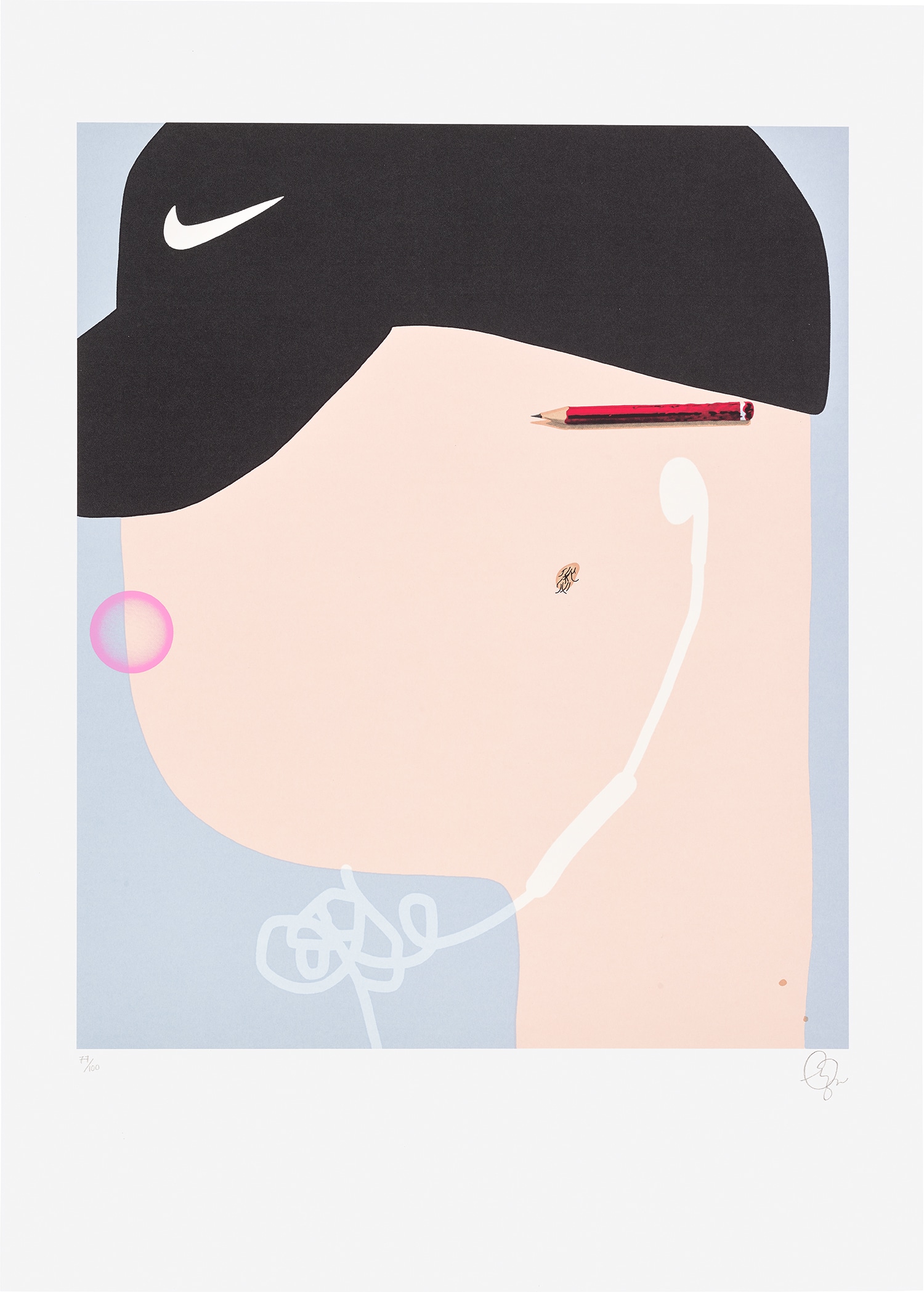
Multi Multitasking
By 2017 and 2018 Epp was developing the themes that would define his reputation. Works from this period, including Supporters, The Exchange, and Neighbourhood Watch, demonstrated an expanding ambition in both scale and conceptual range. These paintings mine the terrain of consumer culture, mass spectatorship, and the way modern life asks us to constantly perform versions of ourselves for invisible audiences. The figures in these canvases are caught in rituals of consumption and display, holding products, watching screens, presenting themselves to a world that watches back.
The acrylic and spray paint surfaces of works like Supporters give them an urban immediacy, a sense that they were pulled directly from the visual noise of contemporary cities. Yet there is always something tender underneath the graphic cool, a recognition that the people Epp paints are also simply trying to get through the day. Choking Hazard from 2019 marked another step forward, with Epp continuing to refine his ability to pack psychological weight into compositions that initially read as almost cheerfully bold. The acrylic and oil combination he favored in this period allowed him to build surfaces that reward close looking, smooth at a distance but subtly layered when approached directly.
Oli Epp
Pringles Duck, 2016
His screenprints, including editions such as You Spin Me Right Round, Multi Multitasking, Quarantine, and Bon Voyage, extended his reach to a broader audience without diluting the power of his imagery. Produced on Somerset and Rivoli papers with exceptional attention to surface and color, these editions have become genuinely sought after in their own right, not merely as affordable alternatives to his paintings but as works that exploit the possibilities of the screenprint medium with real sophistication. For collectors, Epp represents a compelling proposition on several fronts. His paintings have appreciated steadily as his profile has grown, and the consistency of his vision across different scales and media gives a collection built around his work a strong sense of coherence.
There is also the question of cultural relevance: few artists working today have found a visual language so precisely calibrated to the anxieties and aesthetics of life in the 2020s. Collectors drawn to artists who engage seriously with contemporary experience, in the tradition of painters like John Kacere, Alexis Marguerite Teplin, or the broader pop and hyperrealist lineages, will find Epp's work both intellectually satisfying and visually striking. His relationship to artists like Alex Katz, whose flat, refined figuration paved certain roads Epp now travels, or to the graphic surrealism of artists working in the tradition of René Magritte, gives his practice deep art historical roots even as it feels urgently of the present moment. The question of legacy is always premature when an artist is still in their early thirties, but it is not too soon to say that Epp has already made paintings that will matter.
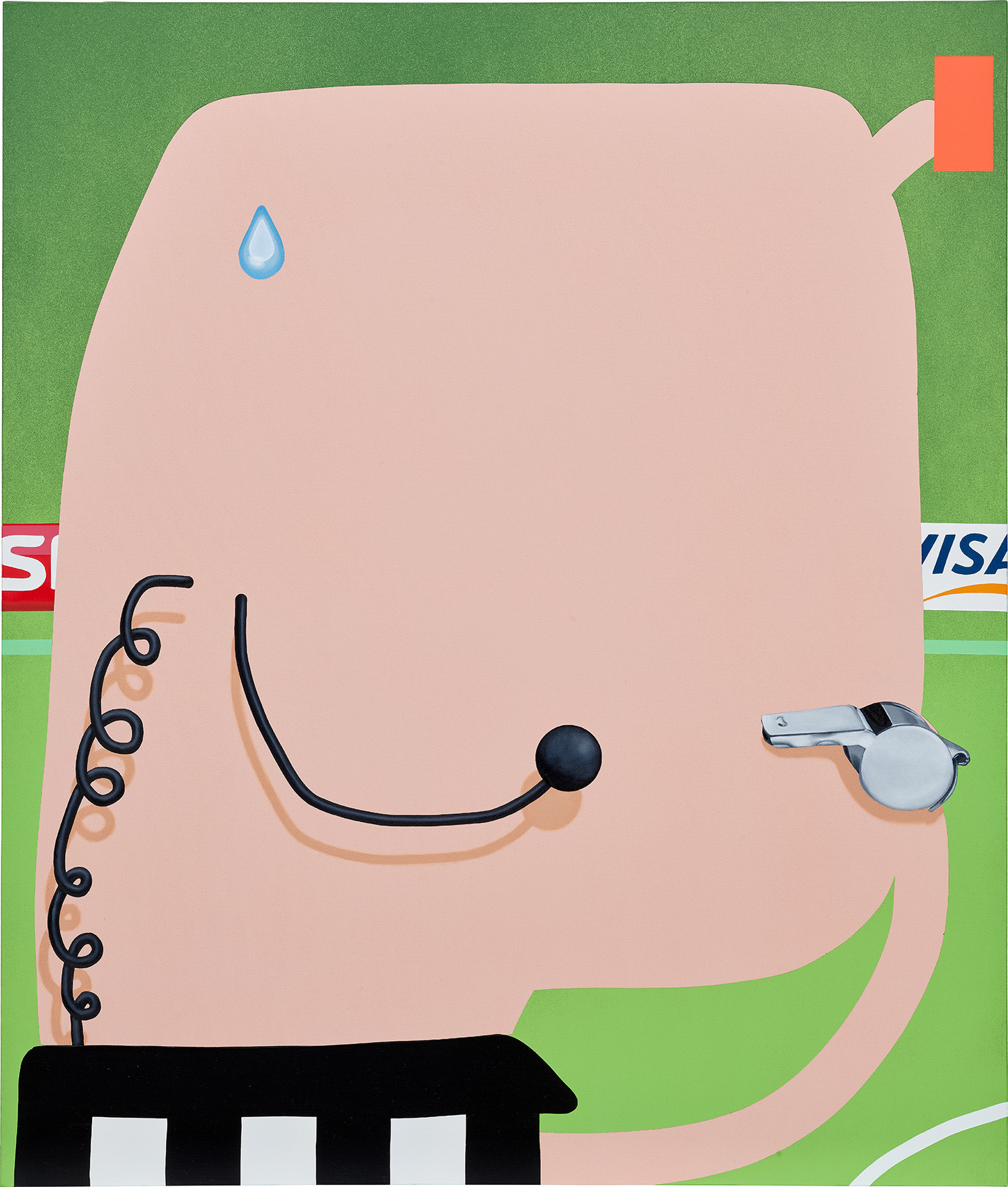
Oli Epp
Whistleblower, 2017
He has captured something true about what it feels like to be alive in a world saturated by images and branded experience, to move through consumer culture as both participant and observer, to wear an identity the way one might wear a product. That combination of formal mastery and genuine cultural insight is rare at any age. The collectors who have recognized it early, the institutions beginning to take notice, and the growing community of enthusiasts drawn to his prints and canvases are all responding to the same thing: the sense that this artist is telling us something real about ourselves, in pictures we will not easily forget.