Oleg Tselkov
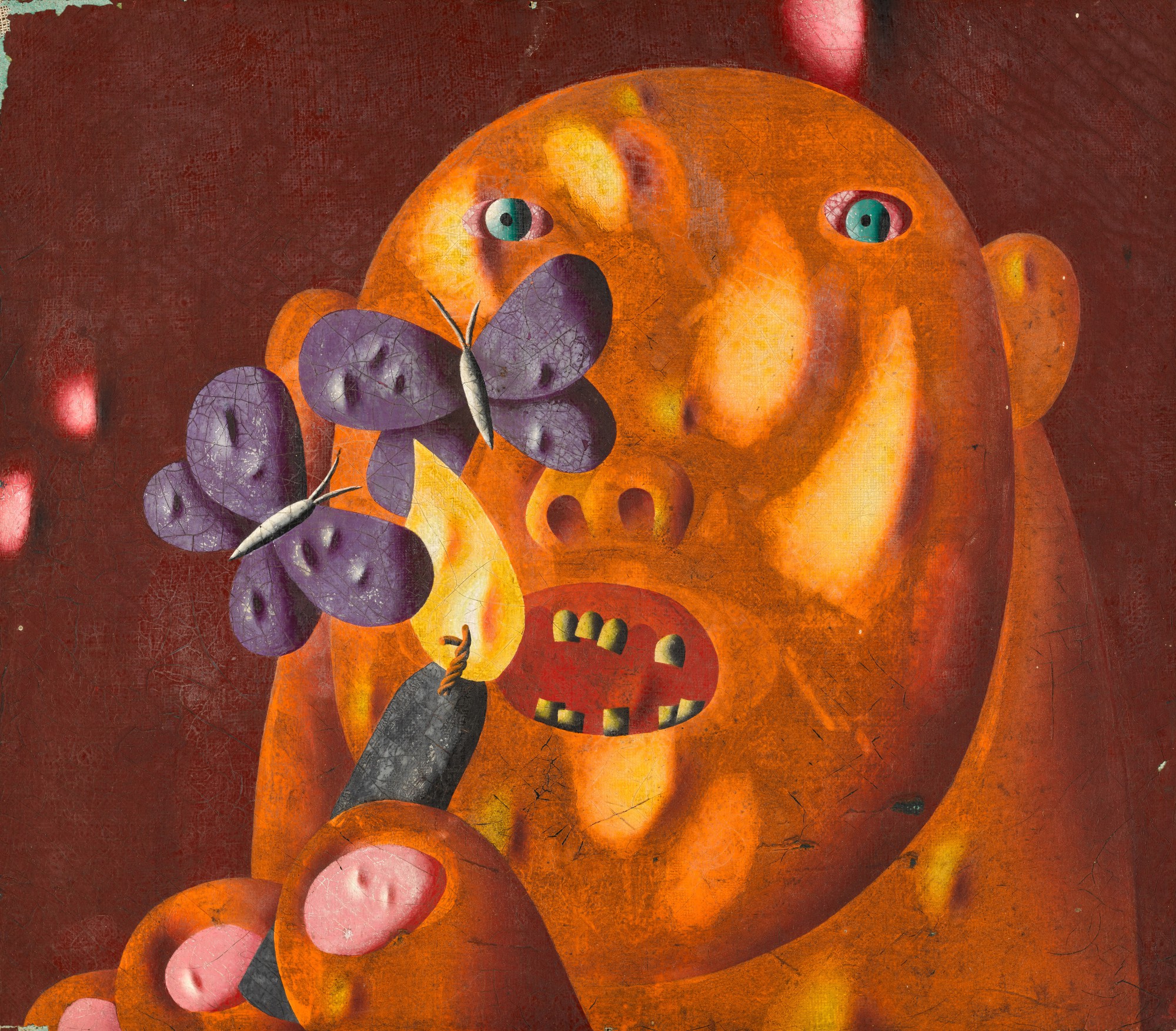
Oleg Tselkov: A Vision Gloriously His Own
Artist Spotlight · The Collection Editorial
There are artists who bend to the demands of their era, and there are artists who stare those demands down with something close to contempt. Oleg Tselkov was emphatically the latter. In the years since his death in Paris in 2021 at the age of 87, appreciation for his singular body of work has only deepened, with collectors and curators alike returning to his canvases with fresh urgency. His paintings, those unforgettable faces bloated and luminous and utterly unlike anything else in the history of Russian art, feel less like historical artifacts than living provocations, as relevant and unsettling and alive as the day they were made.
Oleg Tselkov
Portrait
Tselkov was born in Moscow in 1934, a city and a country already deep in the machinery of Stalinist culture. Growing up under a system that demanded art serve the state, he showed early signs of a temperament that would define his entire career: an absolute refusal to subordinate his vision to ideology. He enrolled at the Leningrad Institute of Theatre, Music and Cinema, and later at the Moscow Art Institute, where his confrontational approach to figuration made him a persistent problem for the authorities. His expulsion from the Moscow Art Institute was not a detour in his story but a declaration of it.
From that moment, Tselkov understood himself to be an artist outside the system, and he embraced that position with remarkable consistency and courage. The Soviet nonconformist art scene of the 1960s and 1970s provided Tselkov with a community of fellow travelers, though even within that context he remained a genuinely eccentric presence. Where many of his peers turned to abstraction or conceptualism as a means of evasion, Tselkov remained stubbornly figurative, insisting on the human form as his central subject. The legendary Bulldozer Exhibition of 1974, in which Soviet authorities sent bulldozers and water cannons to destroy an unofficial outdoor art show in Moscow, became a defining cultural flashpoint for the nonconformist generation.
Oleg Tselkov
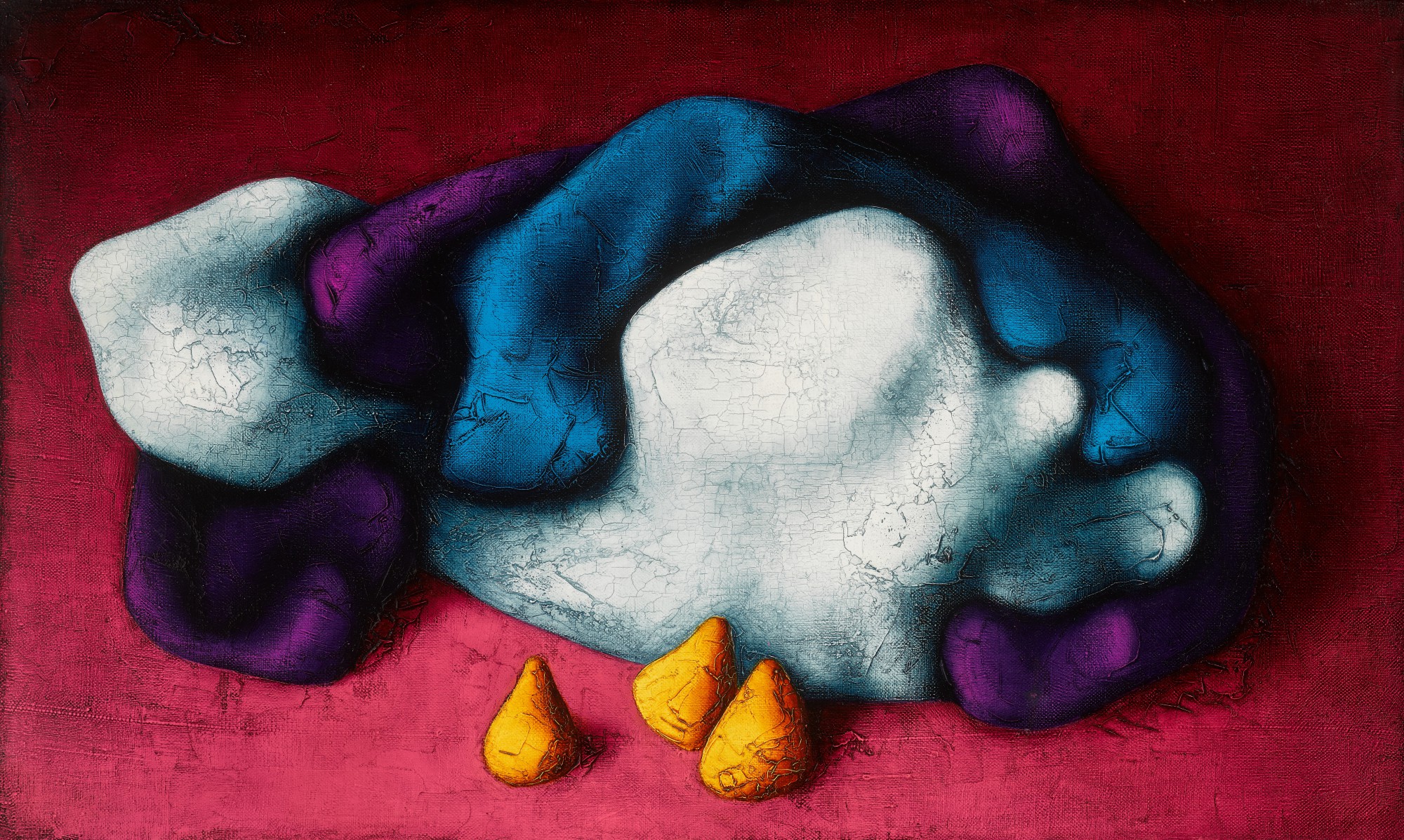
Still Life
Tselkov was among the artists whose work existed in precisely this atmosphere of defiant visibility. By 1977, the pressure of official censure had become untenable, and he emigrated to Paris, a move that gave him physical freedom while deepening the metaphysical displacement that had always charged his work. What Tselkov achieved formally is remarkable for its internal coherence. From relatively early in his career, he arrived at a pictorial language that he then spent decades refining rather than abandoning.
His signature motif, the grotesque mask like face, appears across hundreds of canvases in configurations that range from solitary portraits to crowded tableaux. These faces are not portraits in any conventional sense. They are archetypes, distillations of human presence stripped of individual identity. They stare outward from his canvases with an expression that resists easy categorization, hovering somewhere between menace and pathos, between mockery and grief.
Oleg Tselkov
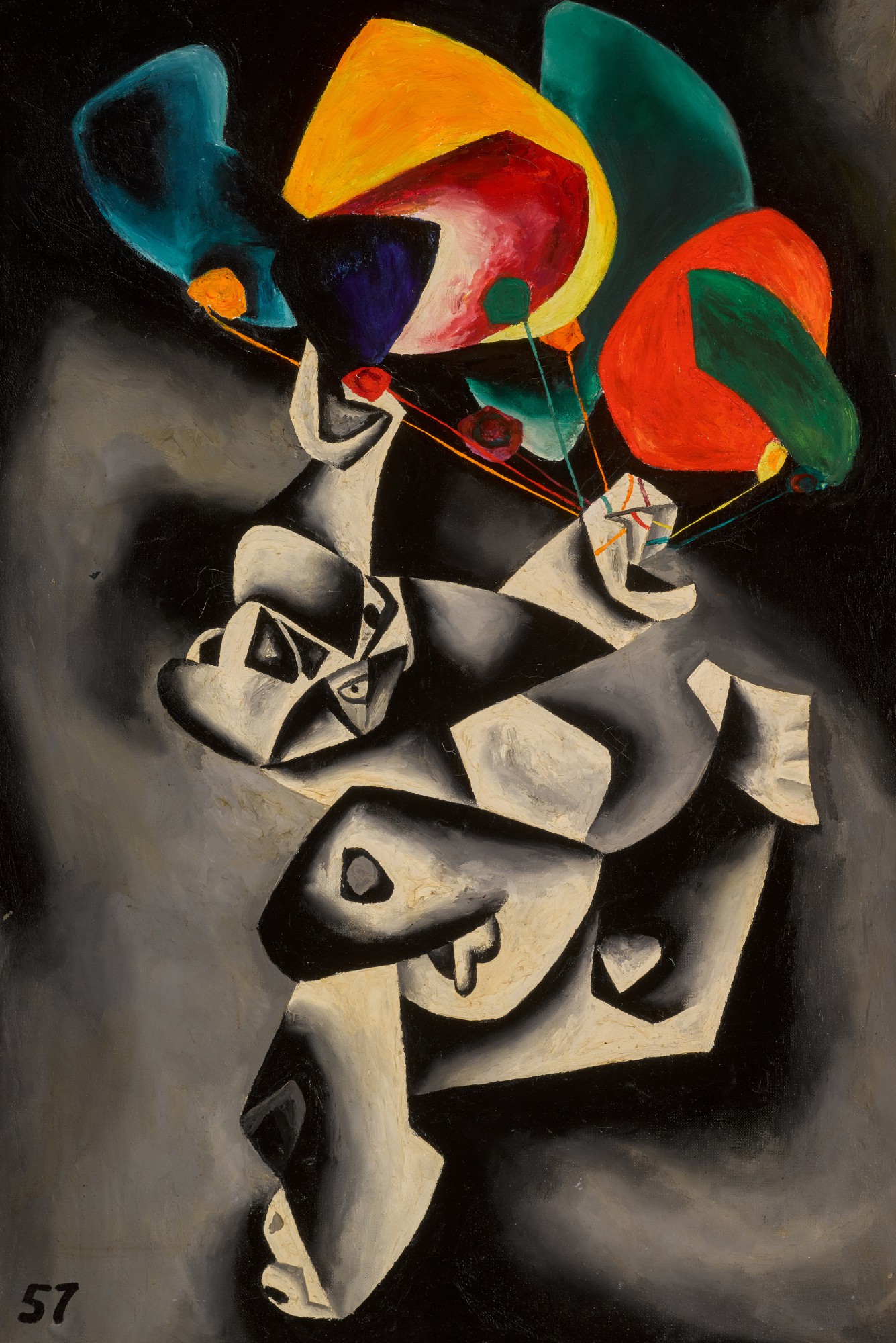
Boy with Balloons
The color is equally distinctive: rich, saturated, almost operatic in its intensity, with deep reds and purples and browns that give his figures the quality of icons rendered in some debased and glorious liturgical tradition. Among the works available through The Collection, pieces such as Boy with Balloons and Woman with Cat and Butterfly demonstrate the range Tselkov could achieve within his self imposed constraints. Boy with Balloons carries a particular emotional charge, placing his archetypal figure within a context that evokes childhood and innocence while the face itself unsettles any easy sentimentality. Woman with Cat and Butterfly similarly layers symbolic elements around the central figure, creating a sense of narrative that is always implied and never resolved.
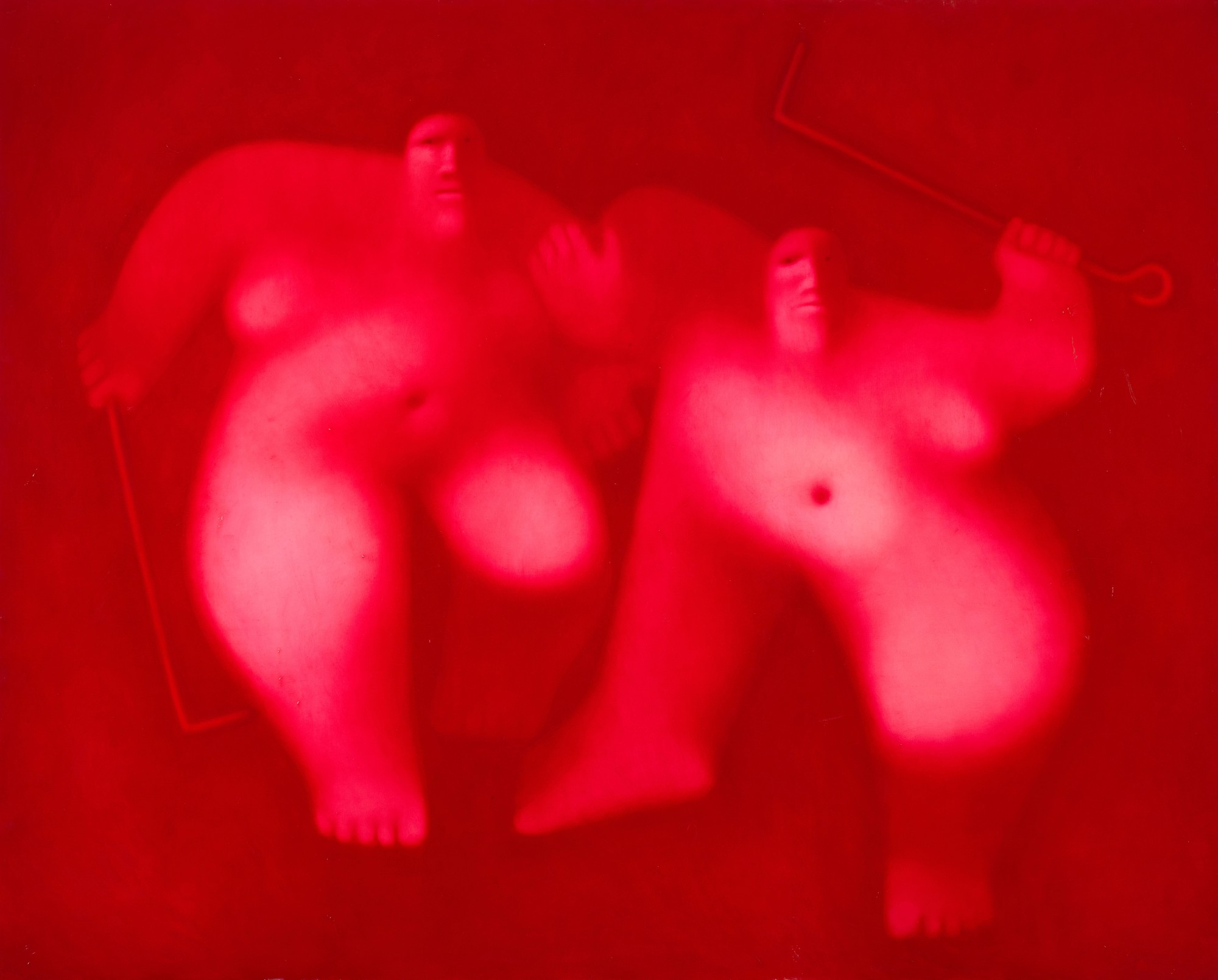
Works such as Two Figures with Beetles and Couple show his interest in the dynamics between figures, the push and pull of human proximity rendered in his characteristically monumental style. Even ostensibly simpler works such as Pear and Vase with Pears reveal his ability to infuse the still life tradition with the same existential weight he brought to his figure paintings. For collectors, Tselkov represents a compelling proposition for several reasons. His work is immediately recognizable, possessing the rare quality of being identifiable from across a room, which speaks to the genuine originality of his pictorial invention.
Oleg Tselkov
Ladies
His career was long and productive, meaning there is meaningful range within his output, but the consistency of his vision means that even lesser known works carry the full authority of his artistic identity. Collectors who have followed the Russian art market closely will know that Tselkov commanded serious attention at auction houses including Sotheby's and Christie's, particularly in their dedicated Russian art sales of the 2000s and early 2010s, a period of intense international interest in Soviet era nonconformist painting. His market reflects both the esteem of specialist collectors and a broader recognition of his importance within 20th century European painting more generally. Placing Tselkov within art history requires thinking across borders and traditions simultaneously.
There are clear resonances with Francis Bacon in the distortion of the human figure as a vehicle for existential inquiry, and with the German Expressionist tradition in the use of color and form as emotional rather than descriptive tools. Within Russian art, his closest point of comparison might be with the spirit if not the style of artists such as Ernst Neizvestny, who similarly refused the terms offered by the Soviet system. But the deeper truth is that Tselkov is not well served by comparison. He arrived at something genuinely sui generis, a visual language with no precise precedent and no direct successors, which is perhaps the most reliable measure of an artist's true originality.
Tselkov's legacy is one of integrity made visible. He spent his career making the same essential argument: that the human face, abstracted and amplified and freed from the obligation of flattery, could bear the full weight of what it means to exist under pressure, whether the pressure of a totalitarian state or the more universal pressure of being alive and conscious in a world that does not explain itself. In a cultural moment when questions of individual identity versus collective conformity feel anything but historical, his paintings speak with a directness that requires no translation. To acquire a work by Tselkov is to bring into your collection not merely a distinguished object but a genuine point of view, one that was earned at considerable personal cost and expressed with extraordinary beauty.