Norbert Goeneutte
Norbert Goeneutte, Poet of Parisian Light
Artist Spotlight · The Collection Editorial
Stand before the Musée d'Orsay's collection of Belle Époque painting and you will feel it almost immediately: a particular quality of attention, a warmth directed at ordinary Parisian life that few artists of any era have matched. Norbert Goeneutte possessed that quality in abundance. Though his name may not ring with the same immediate recognition as Renoir or Degas, connoisseurs and collectors who have encountered his work rarely forget it. There is a growing sense, among those who follow the Impressionist market closely, that Goeneutte is an artist whose moment of fuller recognition is arriving, and that the window to collect him at the level of his true quality remains open, if not indefinitely.
Norbert Goeneutte
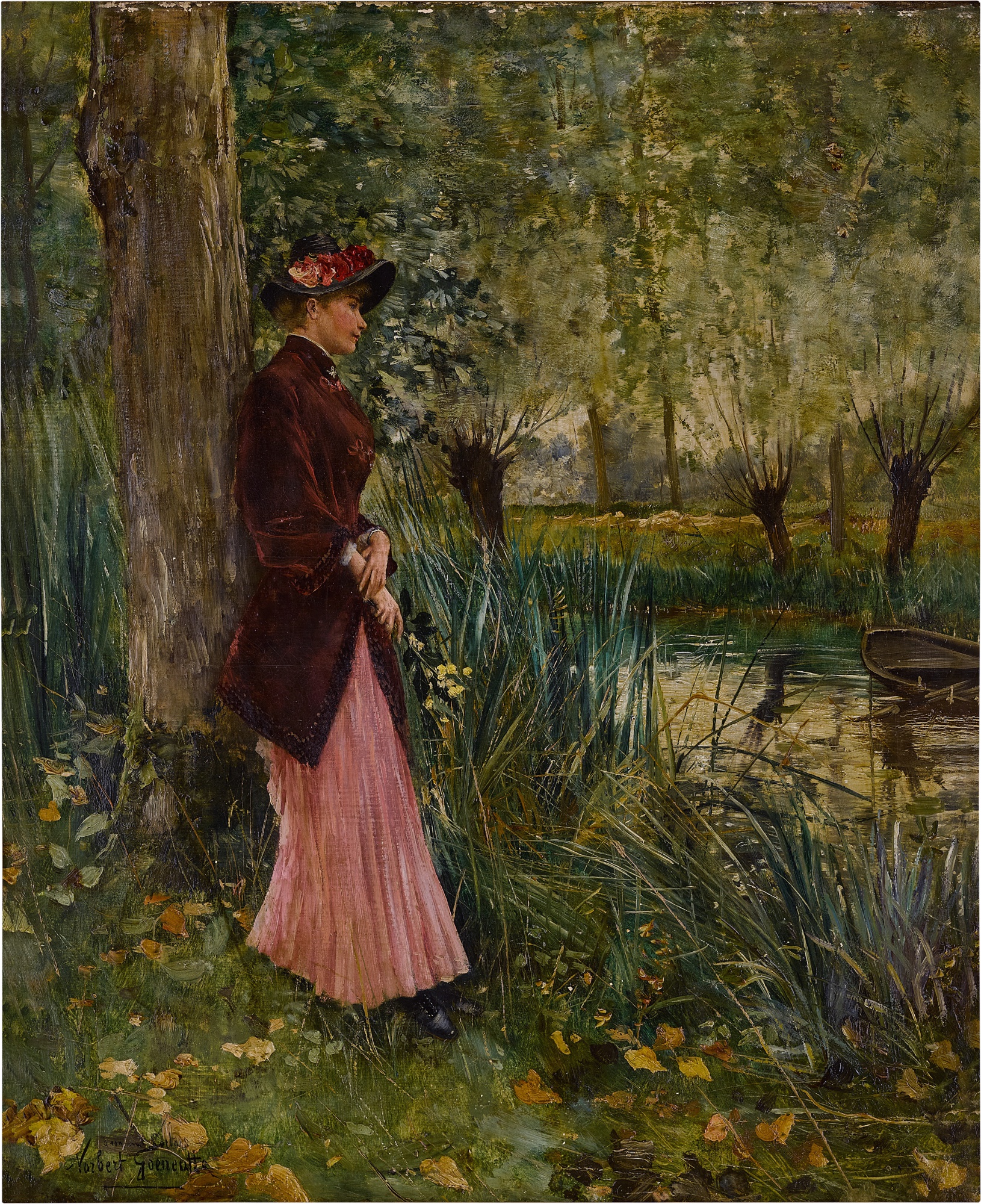
Nathalie Goeneutte, the Artist's Sister, on a Riverbank
Goeneutte was born in Paris in 1854, into the city that would become both his subject and his obsession. He came of age during one of the most electrically creative periods in the history of Western art, a moment when the boulevards, cafés, and riverbanks of the French capital were being reimagined as worthy subjects for serious painting. The young Goeneutte absorbed this atmosphere with an almost documentary hunger. He trained formally and developed the technical fluency that would allow him to work across media with ease, eventually becoming as accomplished a printmaker as he was a painter.
That dual mastery is one of the things that sets him apart from many of his contemporaries. His proximity to Édouard Manet proved formative in ways that went beyond simple influence. Manet, who was a generation older and by the 1870s already a commanding presence in Parisian art circles, shared with Goeneutte a fundamental conviction: that modern urban life, rendered with honesty and painterly intelligence, was as noble a subject as anything drawn from history or mythology. For Goeneutte, this was not merely an aesthetic position but a lived one.
Norbert Goeneutte
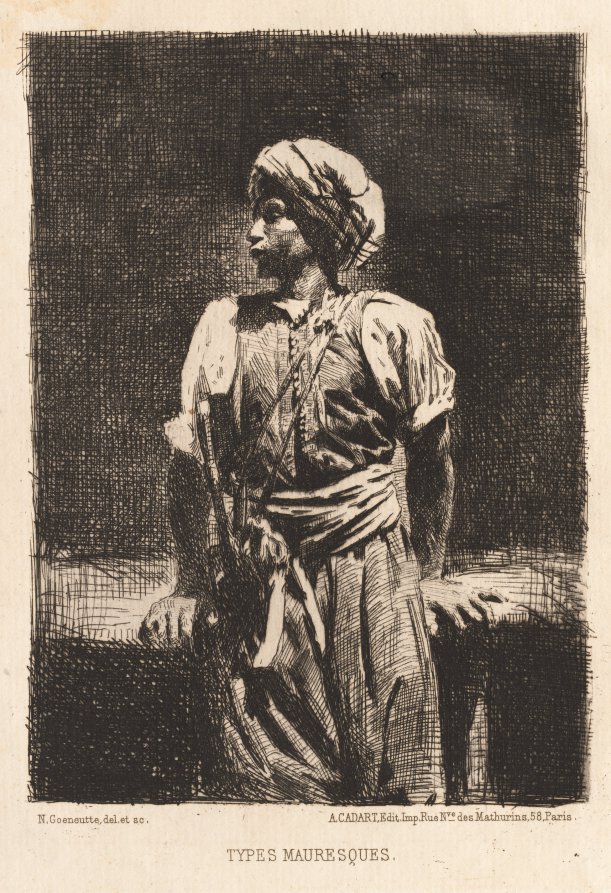
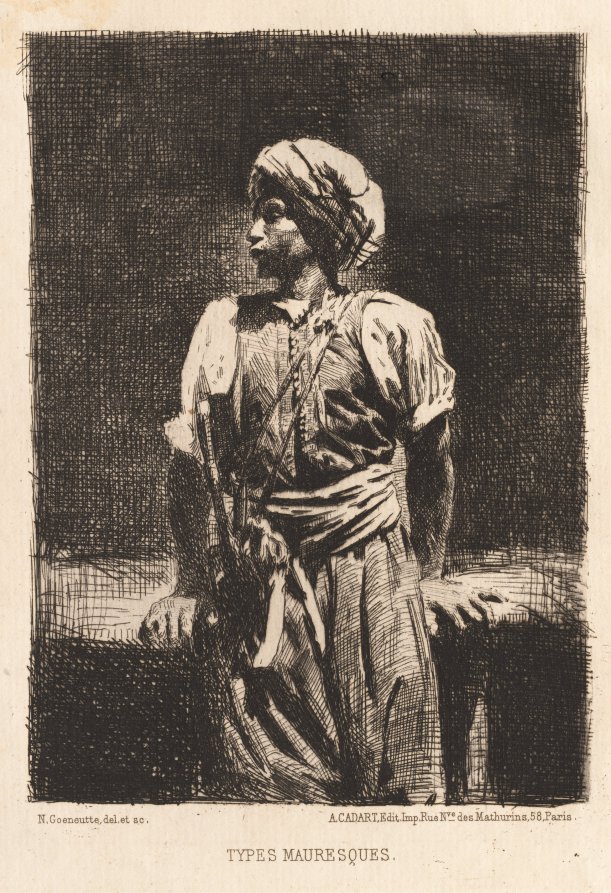
Types Mauresques, 1875
He walked the streets, he sat in the cafés, he watched the way light fell across a riverbank or a crowded boulevard, and he brought that observation directly into his work. His brushwork was light and spontaneous, carrying the energy of direct perception rather than studio elaboration. Goeneutte exhibited regularly at the Salon, that vast and consequential annual exhibition that remained, even as the Impressionists challenged its authority, the primary arena in which a French artist built a public reputation. His presence there was not that of an outsider pushing against the institution but of a confident practitioner who understood how to work within and alongside the structures of the art world of his time.
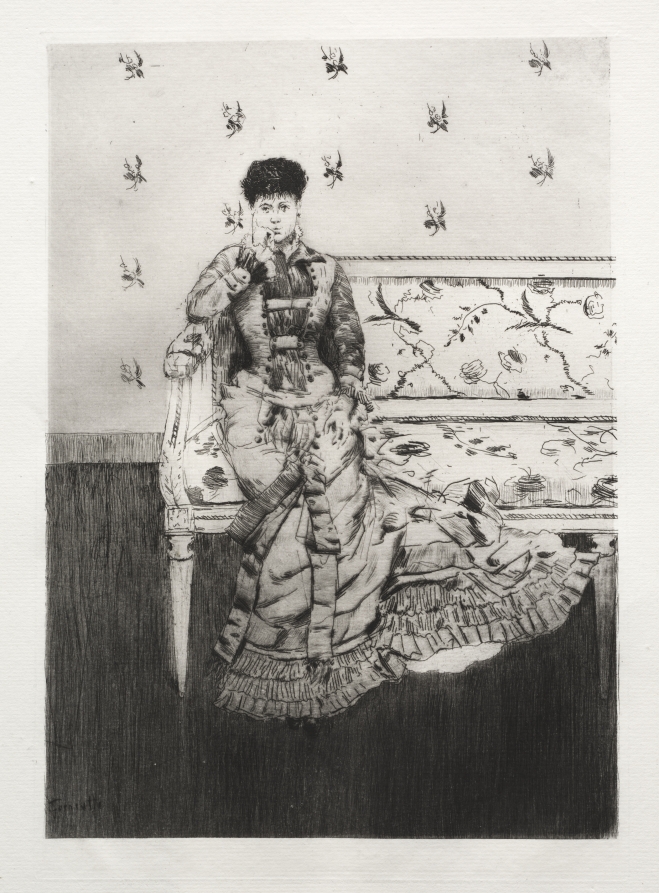
This pragmatic intelligence extended to his printmaking practice. His etchings, including "Types Mauresques" from 1875 and "Fancy" from 1877, demonstrate a command of the medium that is genuinely impressive. The etched line in these works carries the same spontaneous energy as his painted brushwork, and they stand as significant contributions to the printmaking culture of their era. Among his paintings, the portrait of Nathalie Goeneutte, the artist's sister, on a riverbank is perhaps the work that most fully reveals his gifts.
Norbert Goeneutte
Fancy, 1877
There is an intimacy to this canvas that goes beyond technical accomplishment. The figure is rendered with tenderness and specificity, the landscape around her observed with the same care. What Goeneutte understood, and what this painting makes palpable, is that the modern Parisian scene was not an abstraction but a collection of individual human moments, each one deserving of full attention. The painting is a portrait and a landscape and a meditation on leisure and the passage of time, all at once, and it achieves this multiplicity without strain.
For collectors approaching Goeneutte today, several things are worth understanding about the market for his work. His paintings and prints appear at the major London and New York auction houses, with Christie's and Sotheby's both having handled examples of his work over the years. The range of his production, spanning intimate oil paintings and technically refined etchings, means that there are entry points at various price levels, which is itself a form of collecting intelligence. Works on paper and etchings offer an opportunity to live with his line and his vision at a scale that suits many domestic interiors, while his paintings represent the fuller statement of his ambitions.
What to look for is the quality of observation: the best Goeneutte works have a sense of the artist genuinely present in the moment he is recording. In the broader context of art history, Goeneutte sits within a constellation of artists who collectively defined what we now call the Impressionist vision of Paris. Manet is the most significant of his close associations, but his work also invites comparison with Gustave Caillebotte, another painter of Parisian modernity who combined formal accomplishment with an almost sociological attentiveness to the city's rhythms and its people. Like Caillebotte, Goeneutte rewards sustained looking.
The more time you spend with his work, the more you appreciate the intelligence behind what can initially appear to be effortless spontaneity. Goeneutte died in 1894, at the age of forty, which means his career was cut short at the point when many artists are producing their most fully realized work. This biographical fact lends his output a particular poignancy, but it does not define it. What defines it is the quality of seeing that runs through everything he made, from the earliest etchings to the paintings of Parisian street life that represent his mature achievement.
His work is held in the Musée d'Orsay, one of the great temples of exactly this moment in French art, and that institutional presence is both a validation and an ongoing invitation to look again. For collectors who value the Belle Époque tradition and who are drawn to the particular beauty of Paris observed with honesty and love, Goeneutte is not a footnote but a revelation waiting to be properly made.