Nina Chanel Abney
Nina Chanel Abney Paints the World Loud
Artist Spotlight · The Collection Editorial
“I want the work to be accessible. I want people who might not go to galleries to see themselves in it.”
Nina Chanel Abney, Artforum
In the spring of 2023, the Rubell Museum in Miami dedicated a landmark solo exhibition to Nina Chanel Abney, confirming what the art world had long understood: that Abney occupies a singular position in contemporary American painting. The show gathered works spanning more than a decade of her practice, allowing visitors to move through the full arc of an artist who has consistently refused to look away from the most urgent questions of our time. Standing before her large canvases, you feel the cumulative force of someone who has spent years translating the noise and rupture of American life into something visually overwhelming and emotionally true. It is the kind of survey that transforms admiration into conviction.
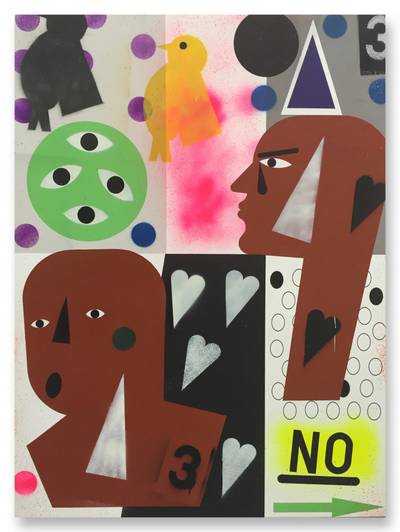
Nina Chanel Abney
Anytime, Anyplace, 2018
Abney was born in 1982 and raised in Harvey, Illinois, a working class suburb just south of Chicago. That geography matters, not as a biographical footnote, but as a formative pressure. Harvey sits at a particular crossroads of American experience, shaped by the legacies of industrial decline, racial segregation, and the resilient cultural life that persists through both. Abney went on to study at the Pratt Institute in Brooklyn, where she earned her BFA, and it was there that her visual language began to crystallize.
The density and pace of New York, layered onto a Midwestern upbringing defined by directness, gave her work a quality that is at once streetwise and deeply considered. Her breakthrough arrived with unmistakable force. Her 2007 senior thesis painting, "Class of 2007," depicted a fictional prison scene with white inmates and a Black guard, inverting the racial dynamics that dominate American carceral imagery. The work was immediately acquired by the Studio Museum in Harlem, signaling an institutional recognition that rarely comes so swiftly.
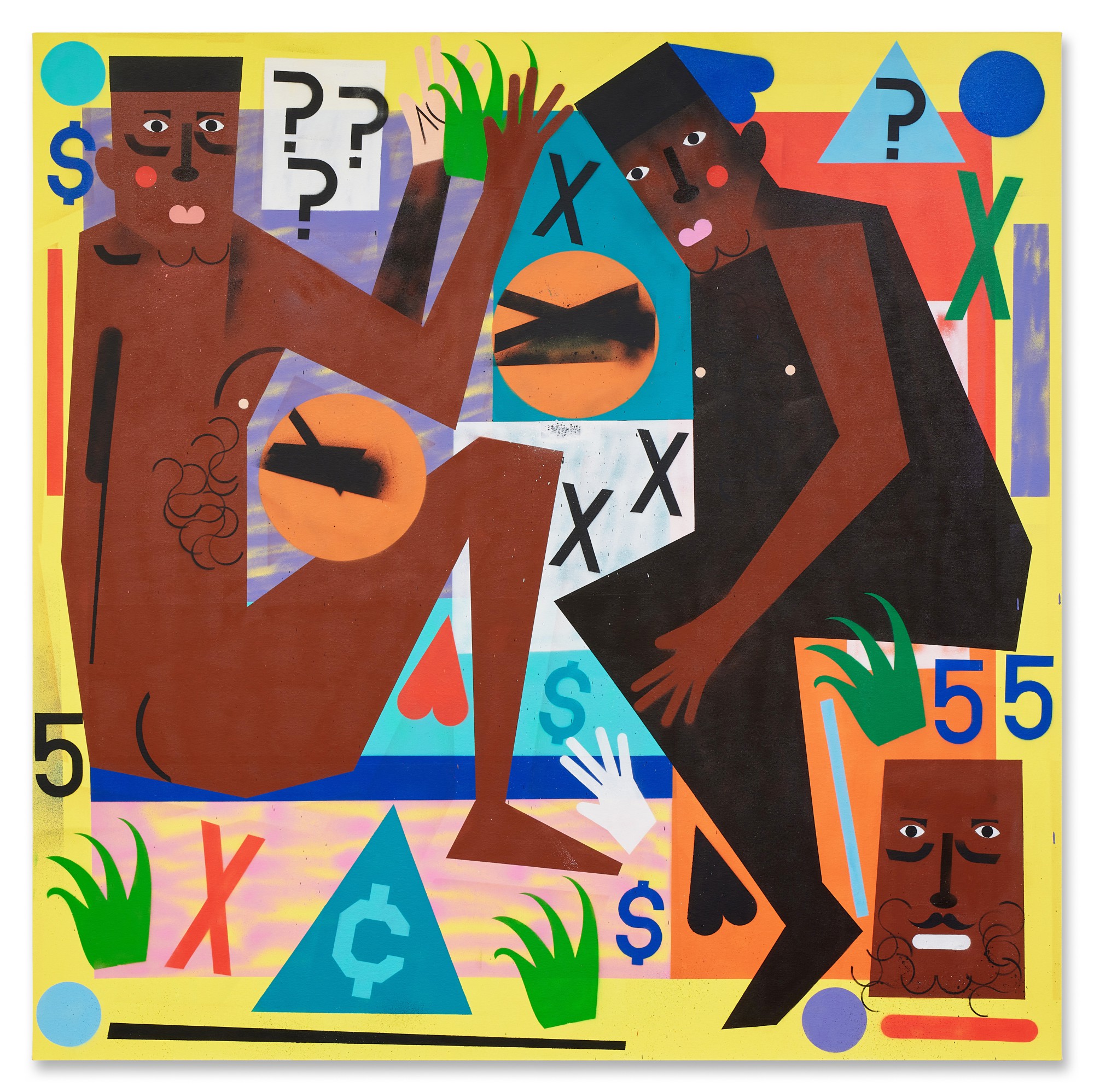
Nina Chanel Abney
Enough (NO), 2015
From that point forward, Abney's development was swift and self assured. She moved through a series of concerns, each building on the last: the spectacle of race in American public life, the visual grammar of sports and celebrity, the mechanics of political violence, the grammar of protest and grief. Her canvases grew more complex and more layered, accumulating the iconographic density of a culture that produces images faster than it can process them. The signature qualities of Abney's work are hard to separate from one another because they function as a unified system.
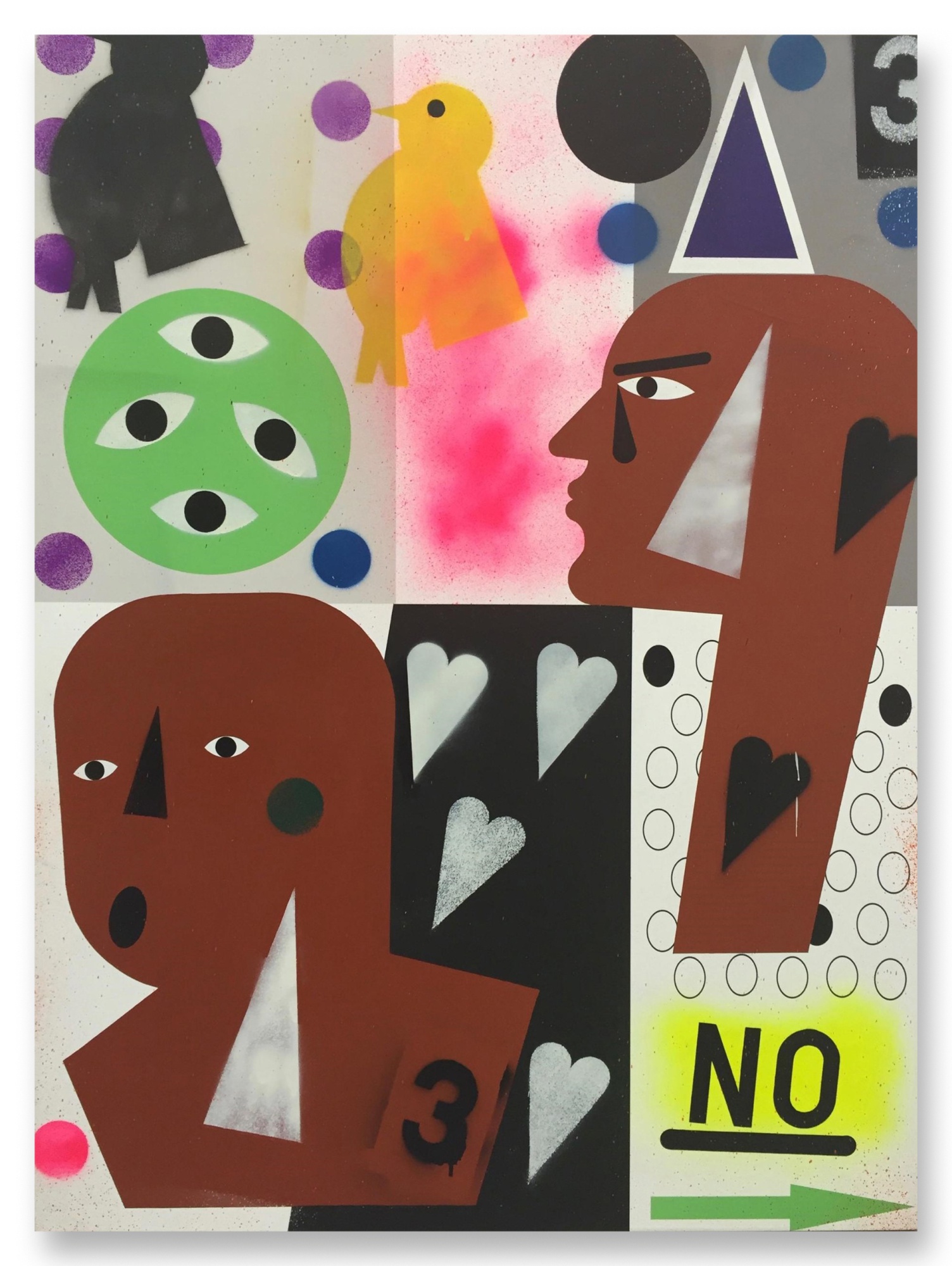
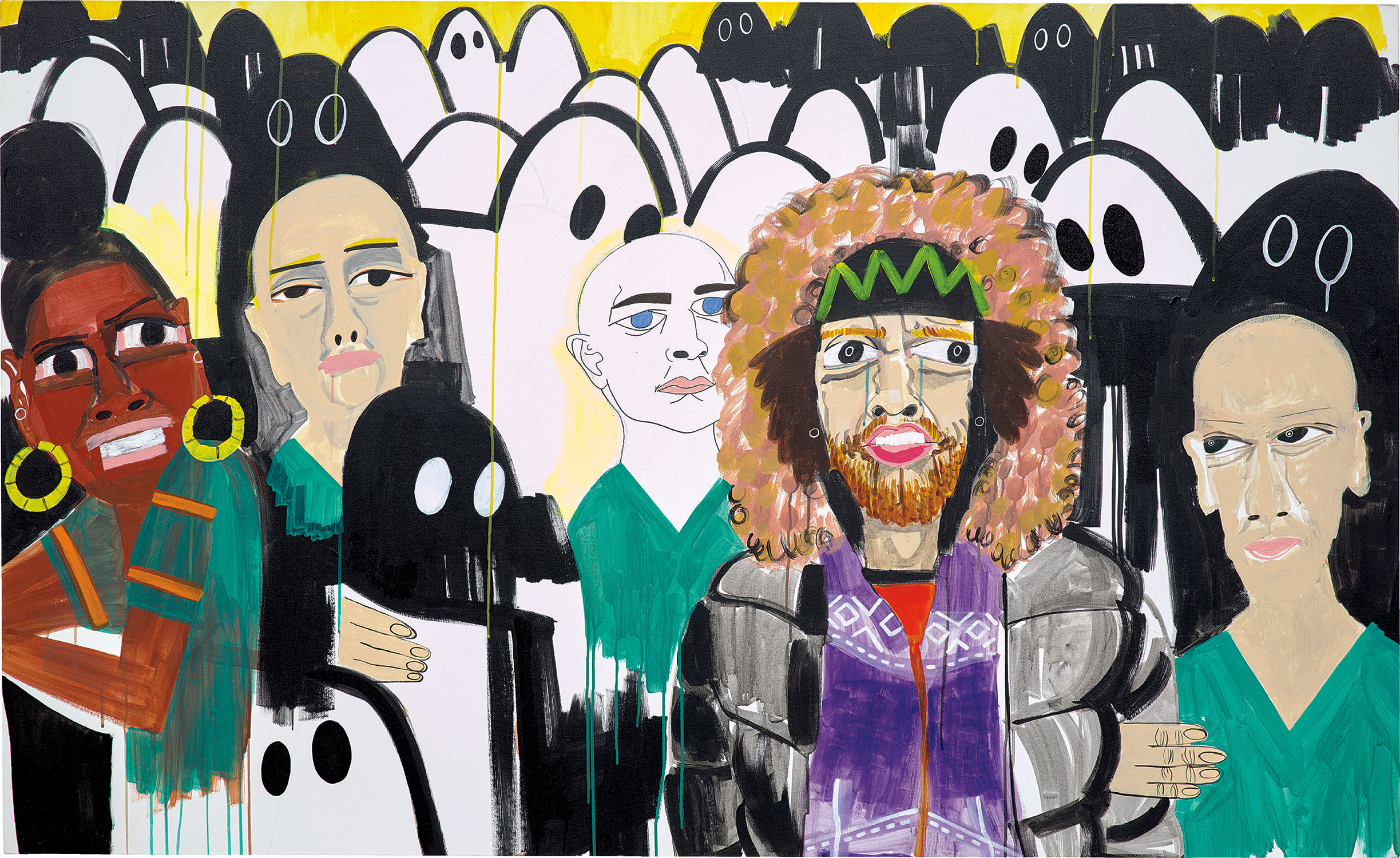
She works in acrylic and spray paint on canvas, combining flat graphic planes of color with cartoon inflected figures, fragments of text, and symbols drawn from news cycles, social media, and popular culture. The effect is somewhere between a mural, a comic strip, and a news feed, all of it compressed into a single surface that rewards sustained looking. "The Money Tree" from 2008 is an early example of this method at its most efficient, using spare figuration and sharp color relationships to make a point about wealth and aspiration that no wall text needs to explain. "Mr.
Nina Chanel Abney
The Money Tree, 2008
Baker" from 2017 and "Pool Party at Rockingham Number 1" from 2016 show a more evolved handling of crowd dynamics and spatial compression, packing scenes with figures whose gestures and proximities carry enormous narrative charge. "Anytime, Anyplace" from 2018 represents perhaps the fullest expression of her mature vocabulary: vivid, percussive, and impossible to reduce to a single reading. "Enough (NO)" from 2015 merits particular attention as a document of its moment. Created in a period of intense national reckoning with police violence and systemic racism, it brings together Abney's graphic instincts with an urgency that feels both immediate and considered.
The work exists as a unique UltraChrome pigment print with acrylic and spray paint, a hybrid form that speaks to Abney's comfort moving between media. Her more recent work, including "Makaveli" from 2021, a paper collage on panel, shows an artist continuing to expand her material thinking without ever abandoning the visual confidence that defines her at any scale or in any format. For collectors, Abney's work presents both a compelling aesthetic proposition and a historically significant one. Her paintings have entered the permanent collections of major institutions including the Studio Museum in Harlem, the Los Angeles County Museum of Art, and the Smithsonian National Museum of African American History and Culture, among others.
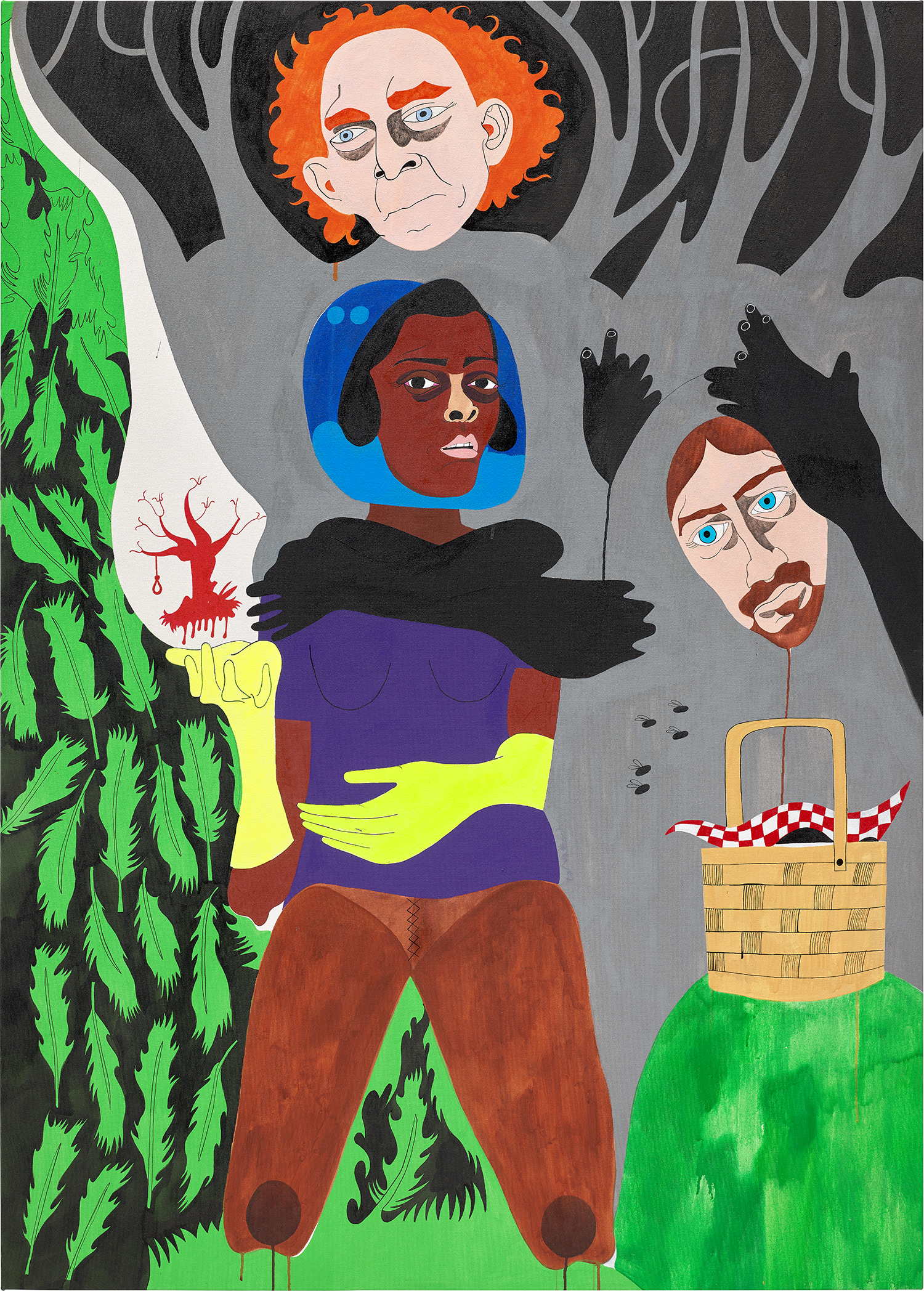
Nina Chanel Abney
The present work,, 2008
This level of institutional validation reflects not just the quality of the work but its importance as cultural documentation. Editions published through Pace Editions, such as "Two Years and Counting," have given a wider range of collectors the opportunity to engage with her practice at an accessible level, and they hold their value precisely because they carry the full force of her visual thinking in a more intimate scale. Works on canvas from her key periods, particularly the middle years of the 2010s when her compositional ambition and painterly confidence were fully aligned, are among the most sought after by serious collectors. Abney's place in art history becomes clearer when you consider her in relation to a broader lineage of American painters who have used figuration as a vehicle for social inquiry.
She is often discussed alongside Kerry James Marshall and Kehinde Wiley as part of a generation that has fundamentally reimagined what figurative painting can do in America, though her approach is more chaotic, more invested in the grammar of popular culture, and more resistant to the grandeur those two artists sometimes embrace. She has affinities with the graphic intensity of Jean Michel Basquiat and the cultural sampling of Kara Walker, though she synthesizes these influences into something that is entirely her own. Her work also speaks to contemporaries such as Henry Taylor and Jordan Casteel, artists who share her commitment to Black life as a subject deserving serious, sustained visual attention. What Nina Chanel Abney has built over the course of her career is something rare: a body of work that is aesthetically thrilling and historically necessary in equal measure.
She paints as though the stakes are real, because they are. Her canvases do not offer comfort or resolution; they offer clarity, the unsettling and ultimately generous act of showing you the world as it actually functions rather than as you might prefer it to be. As her profile continues to rise and her work enters the permanent collections and imaginations of a growing global audience, the case for her as one of the defining painters of her generation becomes not just plausible but irrefutable. To collect her work is to hold something genuinely alive.
Explore books about Nina Chanel Abney