Nicolai Fechin
Nicolai Fechin: Brushwork That Sets Souls Free
Artist Spotlight · The Collection Editorial
Stand before a Fechin portrait and something happens immediately. The paint moves. It breathes. Thick, confident strokes give way to passages of almost translucent delicacy, and the face looking back at you seems to exist somewhere between the canvas and the room you are standing in.
Nicolai Fechin
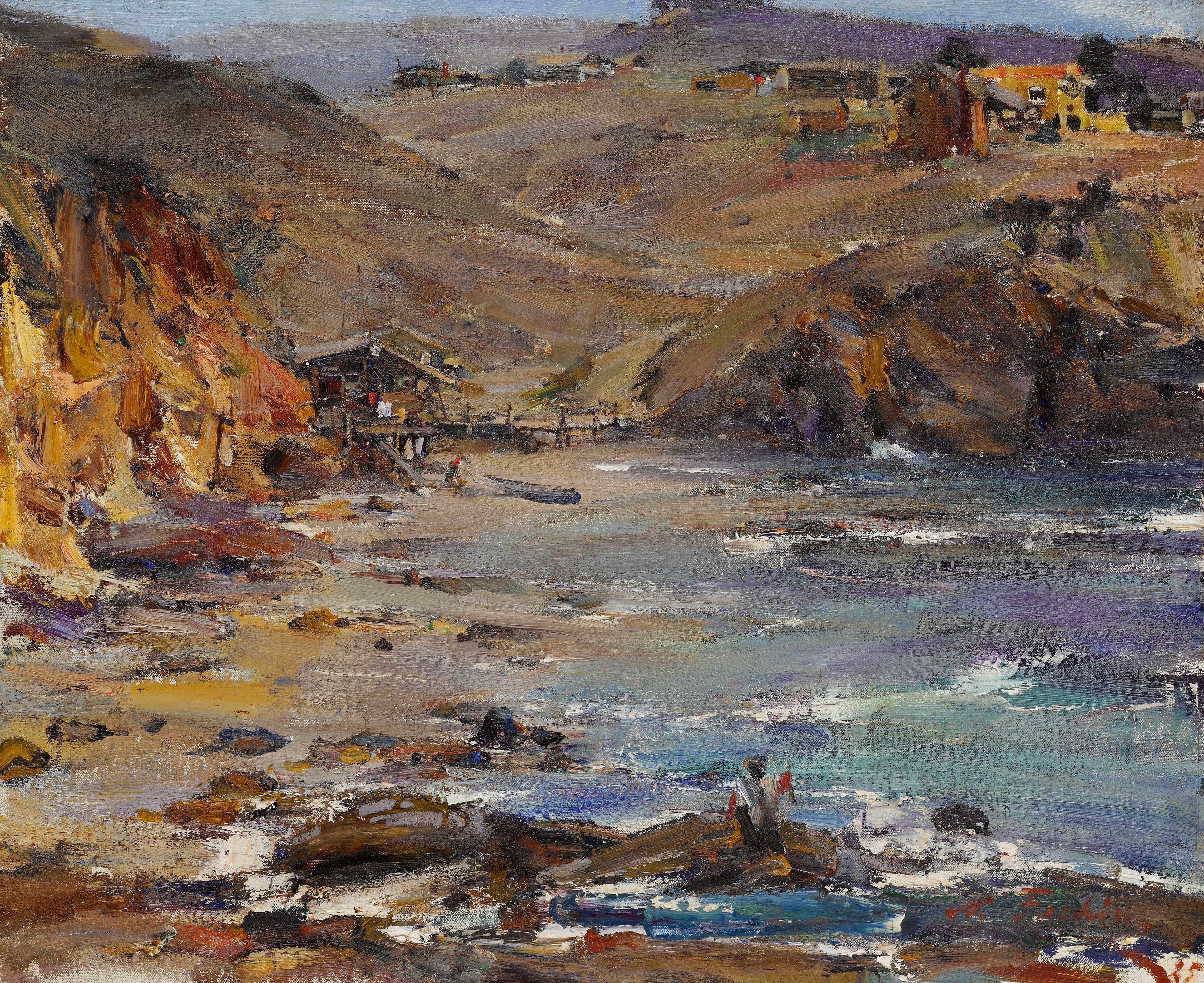
Fisherman's Cove
It is no surprise that when major works by Nicolai Fechin appear at auction at Christie's or Sotheby's, serious collectors take notice, often competing fiercely for paintings that distill a singular, unmistakable vision. His reputation, long celebrated among connoisseurs of Russian and American Western art, has only deepened in recent decades as institutions and private collectors alike have come to understand just how rare his particular gift truly was. Nicolai Ivanovich Fechin was born in 1881 in Kazan, a city on the Volga River in imperial Russia, a place where European and Central Asian cultures met and mingled. His father was a woodcarver and gilder, and the young Fechin grew up surrounded by the making of things, by the tactile pleasure of material shaped by skilled hands.
That early intimacy with craft would never leave him. He entered the Kazan Art School as a young man and quickly distinguished himself before earning a place at the prestigious Imperial Academy of Arts in St. Petersburg, where he studied under Ilya Repin, one of the towering figures of Russian realism. Repin recognized something exceptional in his student, and the influence of that rigorous, humanist tradition would anchor Fechin's practice for the rest of his life.
Nicolai Fechin
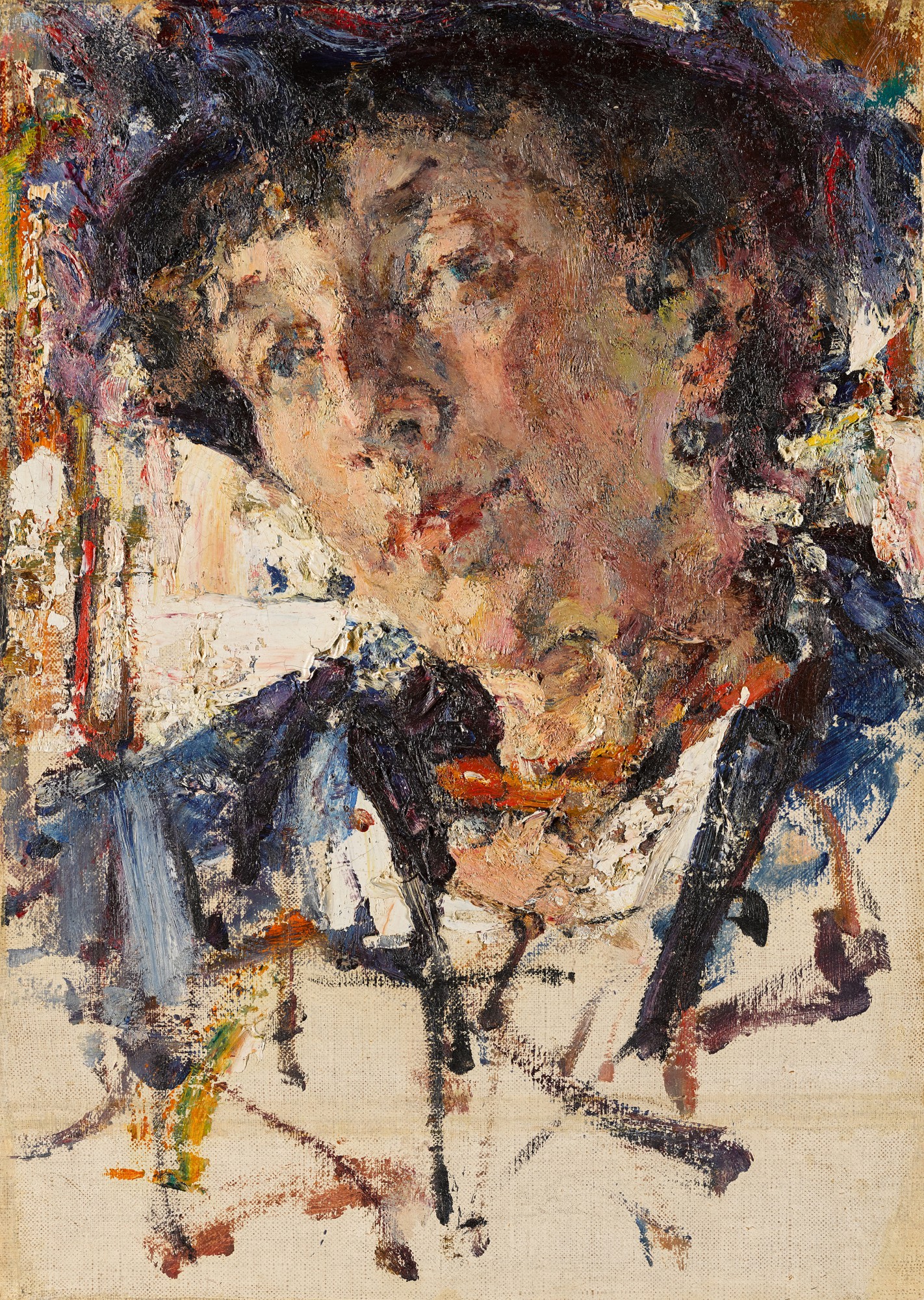
Portrait of Ekaterina Alexeeva, 1920
At the Academy, Fechin developed the technical foundations that would later astound audiences worldwide. He worked in a tradition that prized observation and draftsmanship above all else, and he mastered it completely. But Fechin was never merely a technician. His graduation piece, a large figure painting titled "Cabbage Soup," completed around 1910, won him the coveted title of artist from the Academy and a traveling scholarship to Europe.
The work announced a painter who could render working class Russian life with both documentary precision and genuine warmth. He returned to Kazan, taught at the art school there, and continued to develop his reputation across Russia and beyond, winning medals at international exhibitions including the Panama Pacific International Exposition in San Francisco in 1915, where his work found its first significant American audience. The decision to emigrate to the United States in 1923 was born of necessity as much as ambition. Post revolutionary Russia was a difficult place for an artist of Fechin's independence, and when the American painter and arts patron Winold Reiss helped facilitate his move, Fechin arrived in New York with his wife Alexandra and their daughter Eya.
Nicolai Fechin
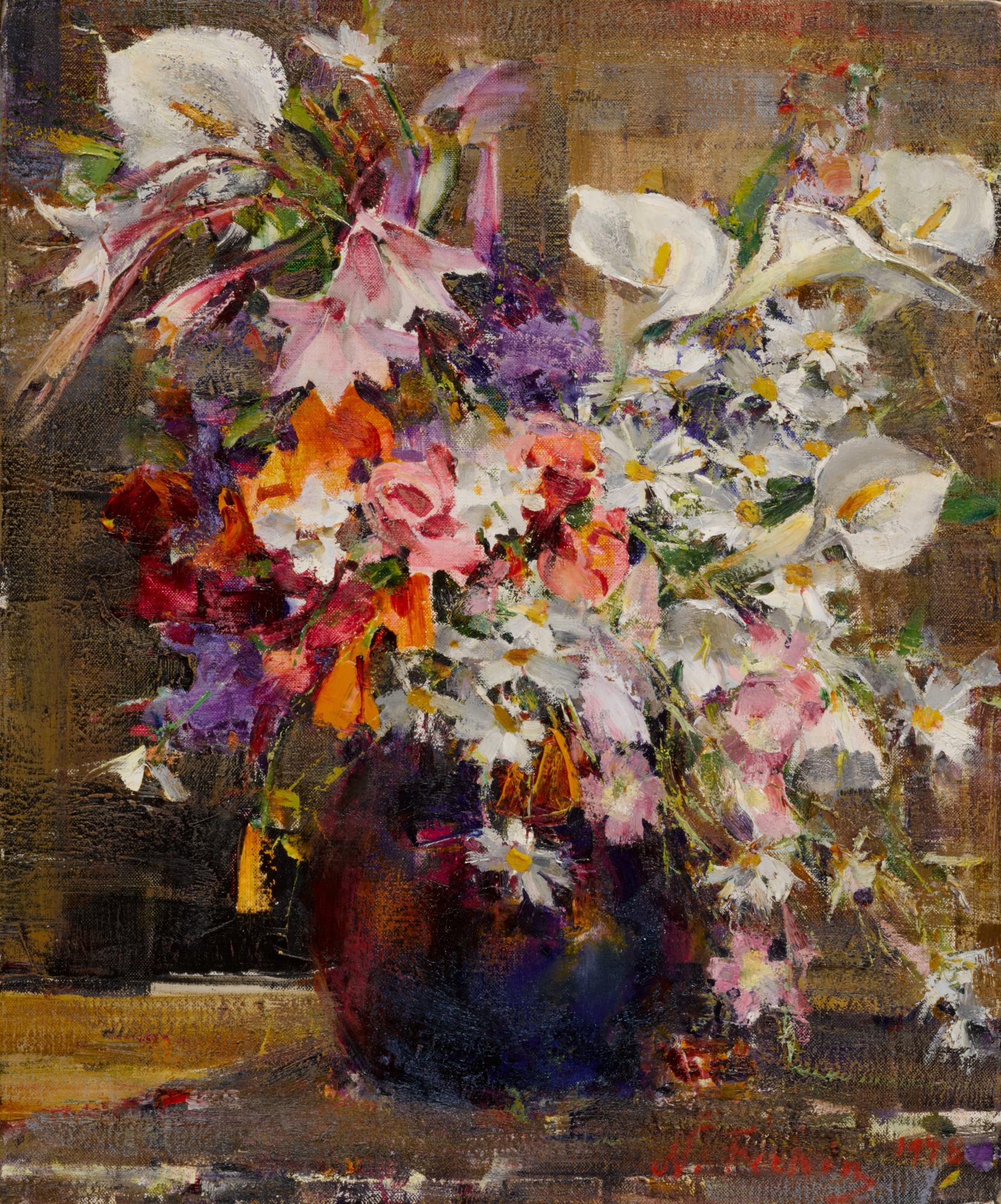
Floral with Daisies
New York welcomed him. His facility and the sheer brilliance of his brushwork made him a sought after portraitist almost immediately, and fashionable sitters came to his studio. Yet it was his move to Taos, New Mexico, in 1927 that proved transformative. The high desert landscape, the Pueblo communities, and the extraordinary quality of light in northern New Mexico unlocked something new in his work.
He built and carved his own home in Taos, a remarkable structure that stands today as a testament to his identity as a maker, and he began painting the people and landscapes of the Southwest with the same penetrating attention he had brought to his Russian subjects. What makes a Fechin painting unmistakable is the quality of his touch. He worked with palette knives, brushes, and sometimes his fingers, building surfaces of extraordinary richness. A typical portrait from his mature period will show passages of almost sculptural impasto alongside areas where the paint is wiped back to near transparency, creating a visual rhythm that draws the eye across the surface in a way that feels musical.
Nicolai Fechin
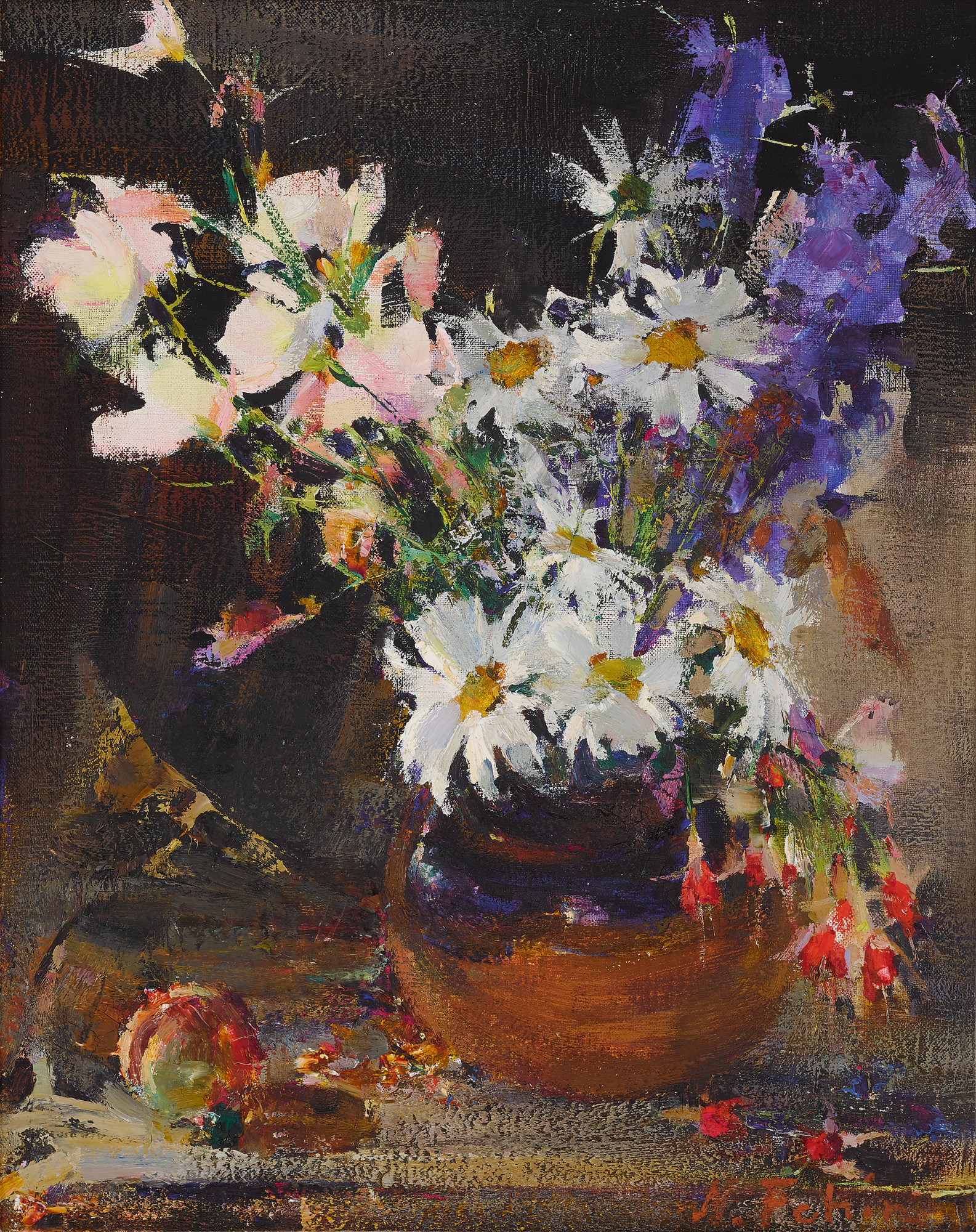
Floral Still Life, 1930
His "Portrait of Ekaterina Alexeeva," painted in 1920, exemplifies this approach. The sitter's face emerges from a swirling ground of gestural marks with startling immediacy, her gaze direct and alive. In his floral paintings, including the luminous "Floral with Daisies" and the richly layered "Floral Still Life" of 1930, the same approach transforms a conventional genre into something genuinely thrilling. Petals seem to have been placed and then reconsidered, scraped and rebuilt, the final image vibrating with the memory of the painter's decisions.
And in a work like "Fisherman's Cove," his handling of water, atmosphere, and reflected light demonstrates a painter equally at ease in the landscape tradition, bringing the same energized touch to the natural world. For collectors, Fechin occupies a rare position. He bridges the Russian academic tradition and the American modernist impulse, which means he appeals to a wide range of serious collectors, from those who focus on Russian masters to those who specialize in American Western art. His works appear regularly at major auction houses, and strong examples can command prices well into the hundreds of thousands of dollars, with exceptional portraits reaching higher still.
Collectors who have studied his work closely advise looking for the full expression of his technical range: paintings where the interplay between tight observation and expressive freedom is most fully realized. His Taos period works, particularly his portraits of Pueblo subjects and his figure studies, are among the most historically significant, capturing a cultural moment with both artistry and deep respect. His florals, sometimes underestimated, reward close attention and have seen growing collector appreciation. Fechin belongs to a tradition of painter virtuosos for whom the physical act of painting was inseparable from the emotional content of the work.
Collectors drawn to his paintings often find themselves thinking of the great Russian masters, of Valentin Serov and Konstantin Korovin, as well as American contemporaries such as Robert Henri, with whom he shared a commitment to painting as an act of direct, vital encounter with the human subject. Like John Singer Sargent, whose bravura surfaces Fechin's work sometimes recalls, he understood that the evidence of process, the visible mark of the artist's hand, was not a flaw to be smoothed away but the very source of a painting's life. Nicolai Fechin died in 1955 in Santa Monica, California, leaving behind a body of work that continues to grow in stature. The Fechin House in Taos is now preserved as a historic site and museum, and his paintings are held in the collections of major American institutions including the Smithsonian American Art Museum and the Gilcrease Museum in Tulsa.
His legacy is that of an artist who brought the full weight of a great tradition to bear on new subjects and a new world, and who never stopped pushing the boundaries of what paint on canvas could do. For collectors fortunate enough to live with his work, that energy is a daily gift.
Explore books about Nicolai Fechin