Munakata Shiko
Munakata Shiko: Spirit Carved Into Wood
Artist Spotlight · The Collection Editorial
“I do not see the wood. I am in a trance when I carve.”
Munakata Shiko
There are moments in art history when a single prize reshapes the world's understanding of an entire tradition. In 1956, at the Venice Biennale, Munakata Shiko walked away with the Grand Prix for printmaking, an honour that announced to Western audiences what Japan had known for years: that this self taught artist from the northern city of Aomori had reinvented the ancient art of woodblock printing from the ground up. The win was not merely a career milestone. It was a cultural earthquake, sending collectors, curators, and institutions scrambling to understand a body of work that seemed to operate on its own sovereign terms, as fierce and tender as anything produced anywhere in the postwar world.
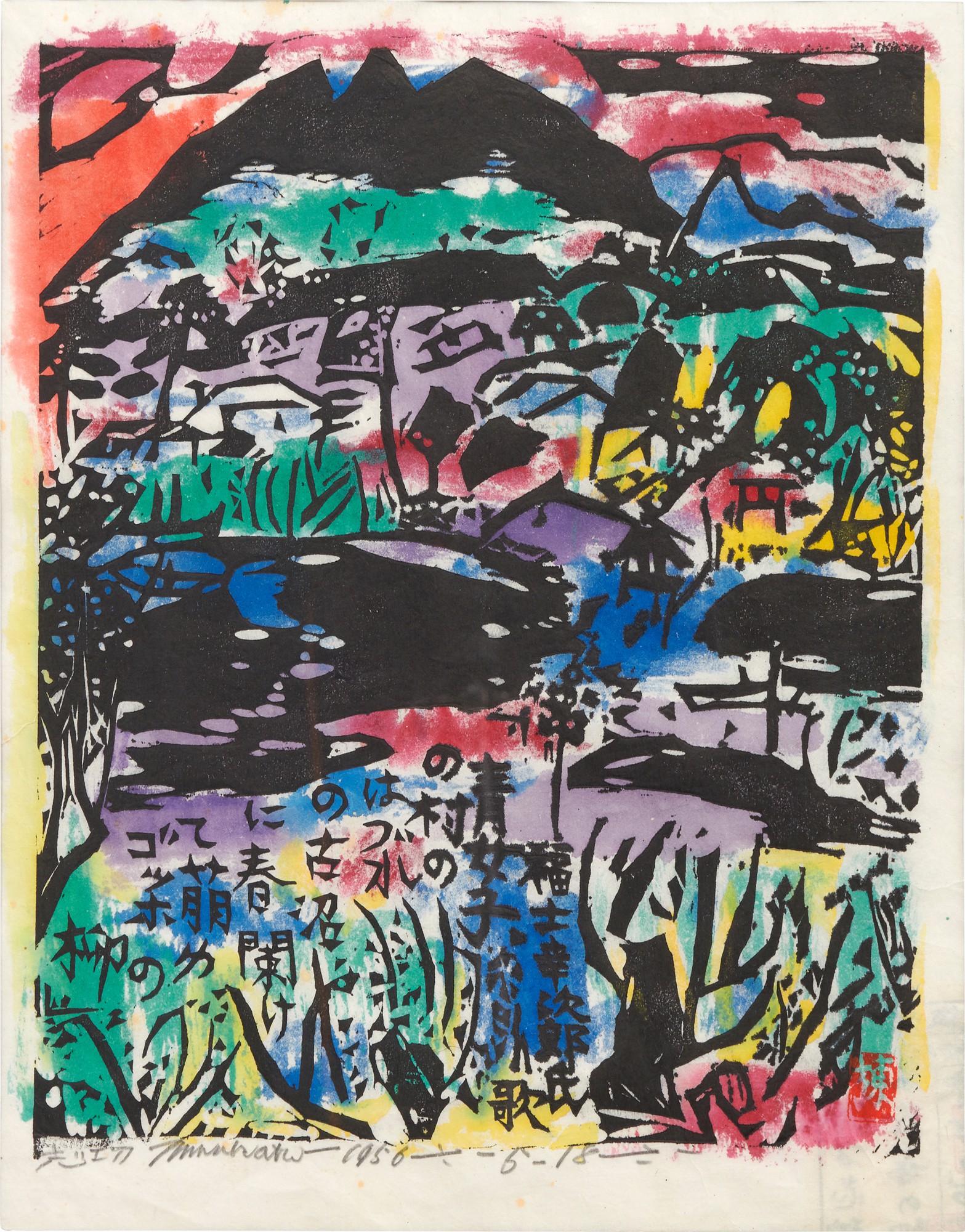
Munakata Shiko
Early Spring (Hoshun no saku) | Showa period, 20th century
Munakata was born in 1903 in Aomori, a port city on the northern tip of Honshu, a region known for its harsh winters and deep folk traditions. He was one of many children in a blacksmith's family, and his early education was modest. What shaped him far more than any formal schooling was an encounter, at around age twenty, with reproductions of Van Gogh's paintings. The raw, surging energy of those images struck him with the force of a revelation, and he resolved to become a painter.
He moved to Tokyo and began studying Western oil painting, submitting works to the Teiten exhibition in the late 1920s. Yet something in the flat, imported medium never fully answered the urgency inside him. It was woodblock printing, with its physical resistance and its roots in Japanese devotional art, that would ultimately become his true language. His turn toward printmaking in the early 1930s proved transformative.
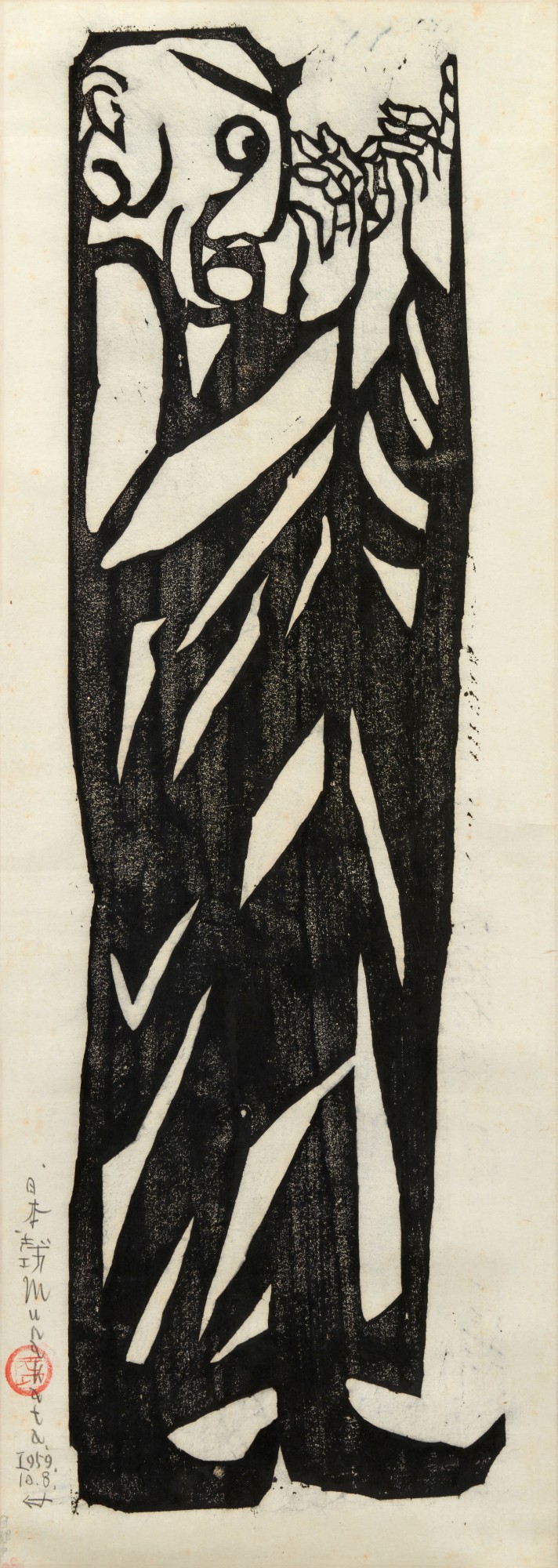
Munakata Shiko
Seven sumizuri-e from the series Ten Great Disciples of the Buddha (Shaka judai deshi) | Showa period, 20th century
Working with simple tools and plain cherry wood, Munakata developed a technique that was almost the opposite of the refined, polished tradition of ukiyo e. Where earlier masters sought perfection of line and delicate gradations of colour, Munakata carved with extraordinary speed, attacking the block with something close to abandon. He described his method as working in a state of near unconsciousness, a trance like immersion in which the image seemed to emerge from the wood rather than being imposed upon it. His lines were bold, irregular, and alive with nervous energy.
The resulting prints felt less like reproductions of drawings than like events, as though the act of carving had its own irreducible drama. The subjects Munakata returned to across his career were drawn from the deep wells of Buddhist iconography, Japanese mythology, and the earthy vitality of folk art. His series devoted to the Ten Great Disciples of the Buddha, known in Japanese as the Shaka judai deshi, stands as one of the supreme achievements of twentieth century printmaking. Rendered in sumizuri e, the stark black ink technique he favoured above all others, these figures possess a monumental presence that owes nothing to academic refinement and everything to spiritual intensity.
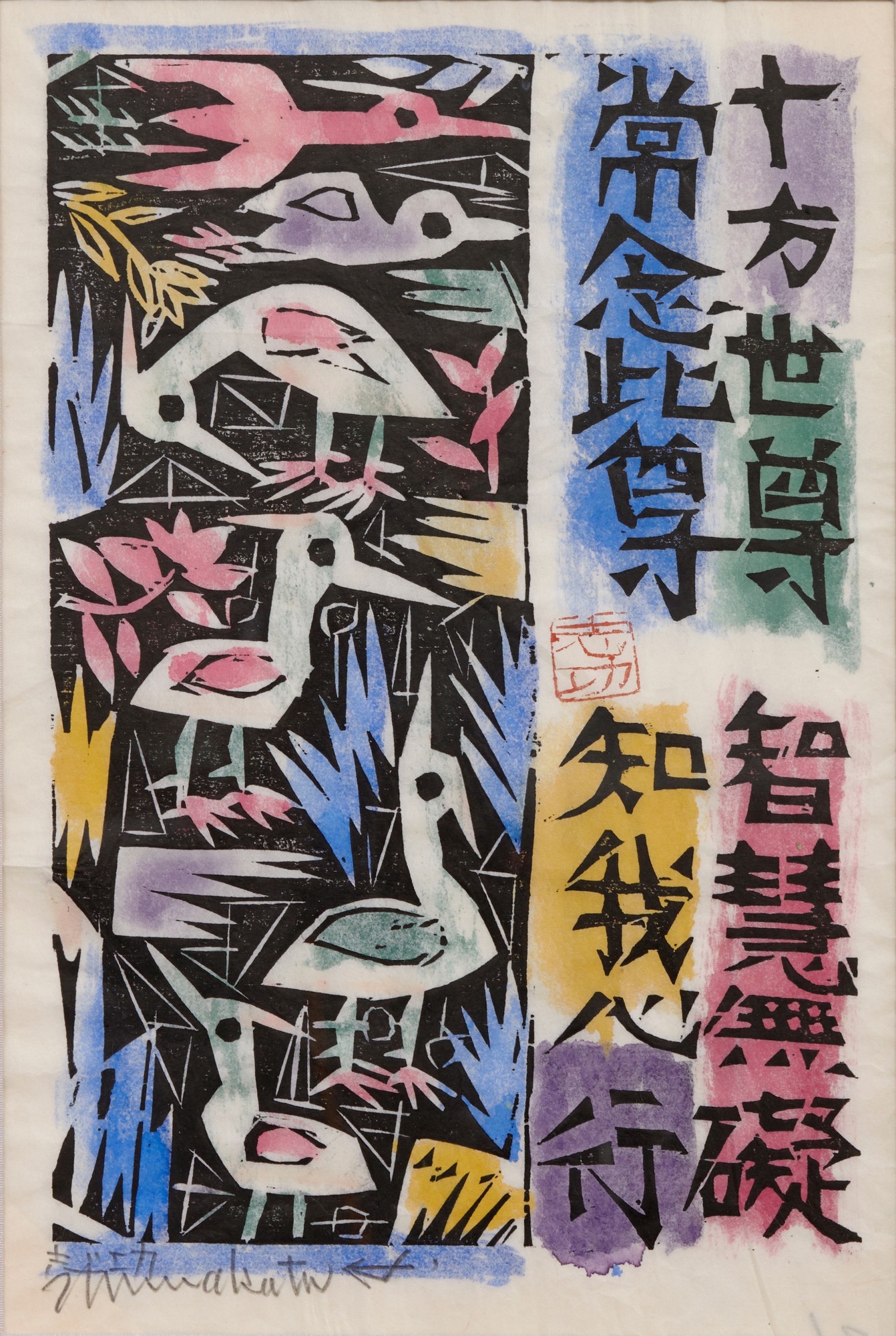
Munakata Shiko
The Ten Directions (Jippo no saku) | Showa period, 20th century
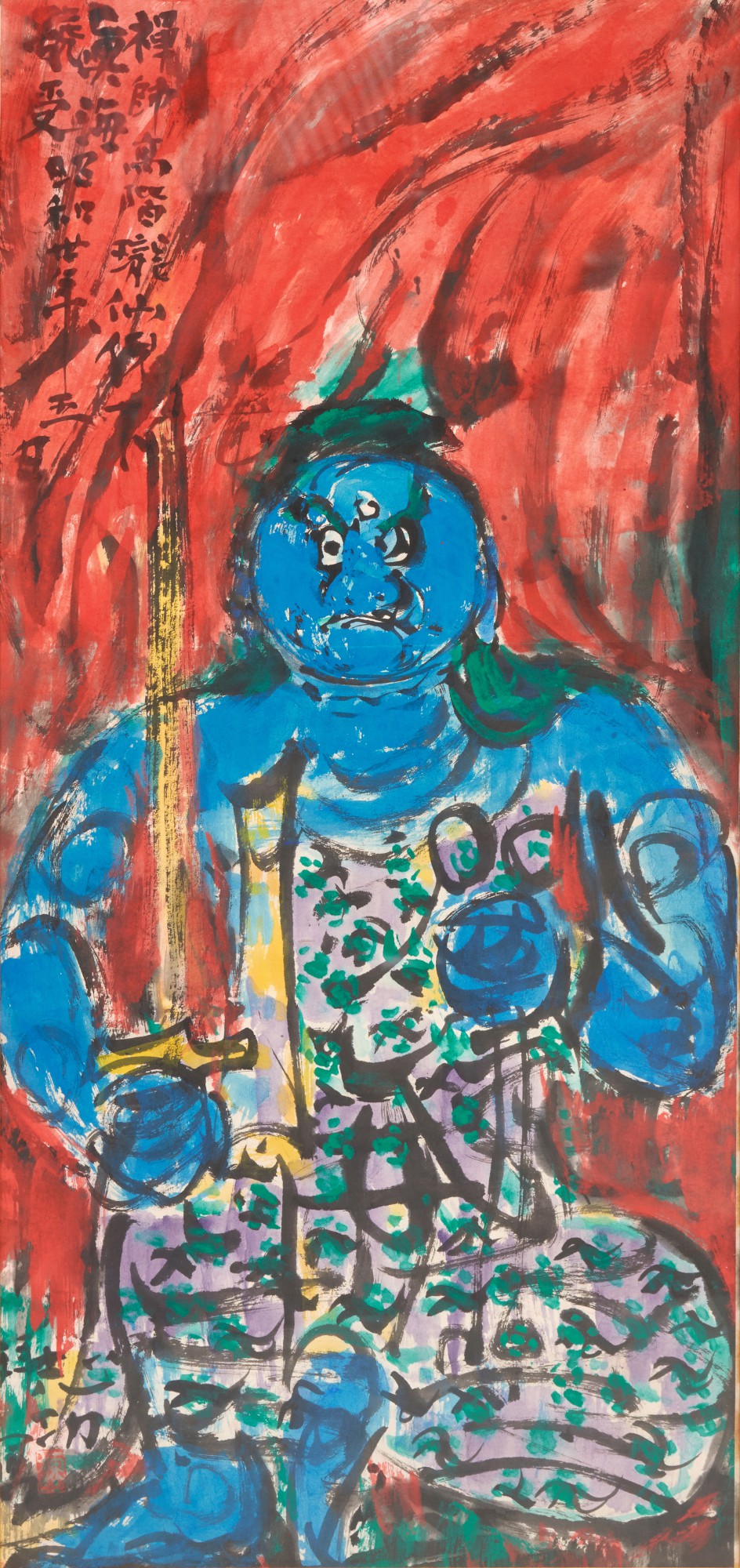
Each disciple seems to vibrate with interior life, their robes and gestures carved into the wood with strokes that feel simultaneously ancient and urgently contemporary. Works such as Fudo Myo o, depicting the fierce Buddhist deity also known as Achala vidyaraja, demonstrate how completely Munakata could channel devotional tradition into something that reads as pure expressive force. His prints of flowers, goddesses, and mythological scenes carry the same quality: an almost overwhelming sense that the image has been wrenched into existence by will alone. For collectors, Munakata's work offers a combination of qualities that is genuinely rare.
There is the historical importance of an artist who bridged Japanese tradition and Western modernism on his own terms, without compromise or dilution. There is the sheer visual power of the work, which holds its own against any print of the twentieth century regardless of nationality or school. And there is the intimacy of the medium itself: these are objects that Munakata touched, carved, and in many cases hand coloured or annotated himself. Several works in circulation bear his pencilled signatures in both Japanese and Roman script, along with personal seals and idiosyncratic marks such as pine needles or field chrysanthemums drawn in his own hand.
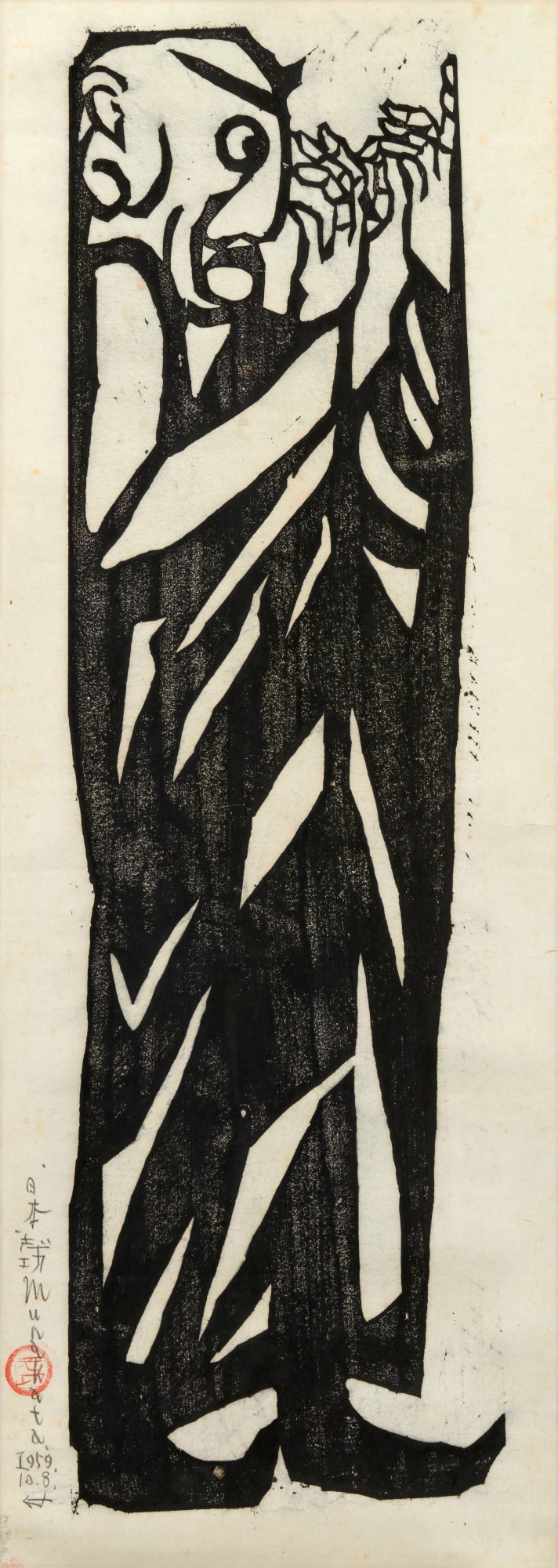
Munakata Shiko
Fudo Myo-o (Achala-vidyaraja) | Showa period, 20th century
These details transform the print from a multiple into something approaching a unique object, a direct transmission from one of the most distinctive artistic personalities of the modern era. Works from the Showa period, particularly those from the 1950s and 1960s when his mature style was fully formed, attract the strongest attention from serious collectors. To understand Munakata fully, it helps to place him within a constellation of artists who shared his conviction that printmaking could carry the full weight of artistic ambition. In Japan, he belongs to the sosaku hanga movement, the creative print tradition that insisted the artist must conceive, carve, and print every work themselves rather than collaborating with professional craftsmen.
His contemporaries in this tradition included Onchi Koshiro and Hiratsuka Unichi, both of whom pushed printmaking toward a freer, more expressive register. Internationally, his work invites comparison with German Expressionist printmakers such as Ernst Ludwig Kirchner and Emil Nolde, who similarly found in the resistance of the woodblock a vehicle for raw emotional truth. Yet Munakata's imagery is entirely his own, rooted in a Buddhist and folkloric sensibility that no European analogue can fully account for. He is, in this sense, genuinely singular.
Munakata died in Tokyo in 1975, leaving behind a body of work of remarkable range and consistency. The Munakata Shiko Memorial Museum of Art in Aomori, opened in 1975, preserves his legacy within the landscape that formed him, and his work is held in major collections worldwide including the Museum of Modern Art in New York and the British Museum in London. What continues to draw people to his prints, decades after his death, is something that resists easy description. It is the sense, unmistakable even in reproduction and overwhelming in person, that these images were made by someone in direct contact with something larger than themselves.
Whether you call that something Buddhism, folk memory, or simply the life force of the artist at full intensity, it leaves a mark. Munakata Shiko carved that mark into wood, and it has not faded.
Explore books about Munakata Shiko
Munakata Shiko: Master of the Woodblock
Keyes, Roger S.

Munakata Shiko and the Art of the Woodblock
Munakata, Shiko and Keyes, Roger S.

The Art of Munakata Shiko
Takashina, Shuji
Munakata Shiko: Works and Life
Japan Foundation
Self-Portrait by Munakata Shiko
Munakata, Shiko