Mr Doodle
Sam Cox Turns the Whole World Into Art
Artist Spotlight · The Collection Editorial
“I want to cover everything. The whole world could be covered in doodles.”
Mr Doodle, interview with The Guardian
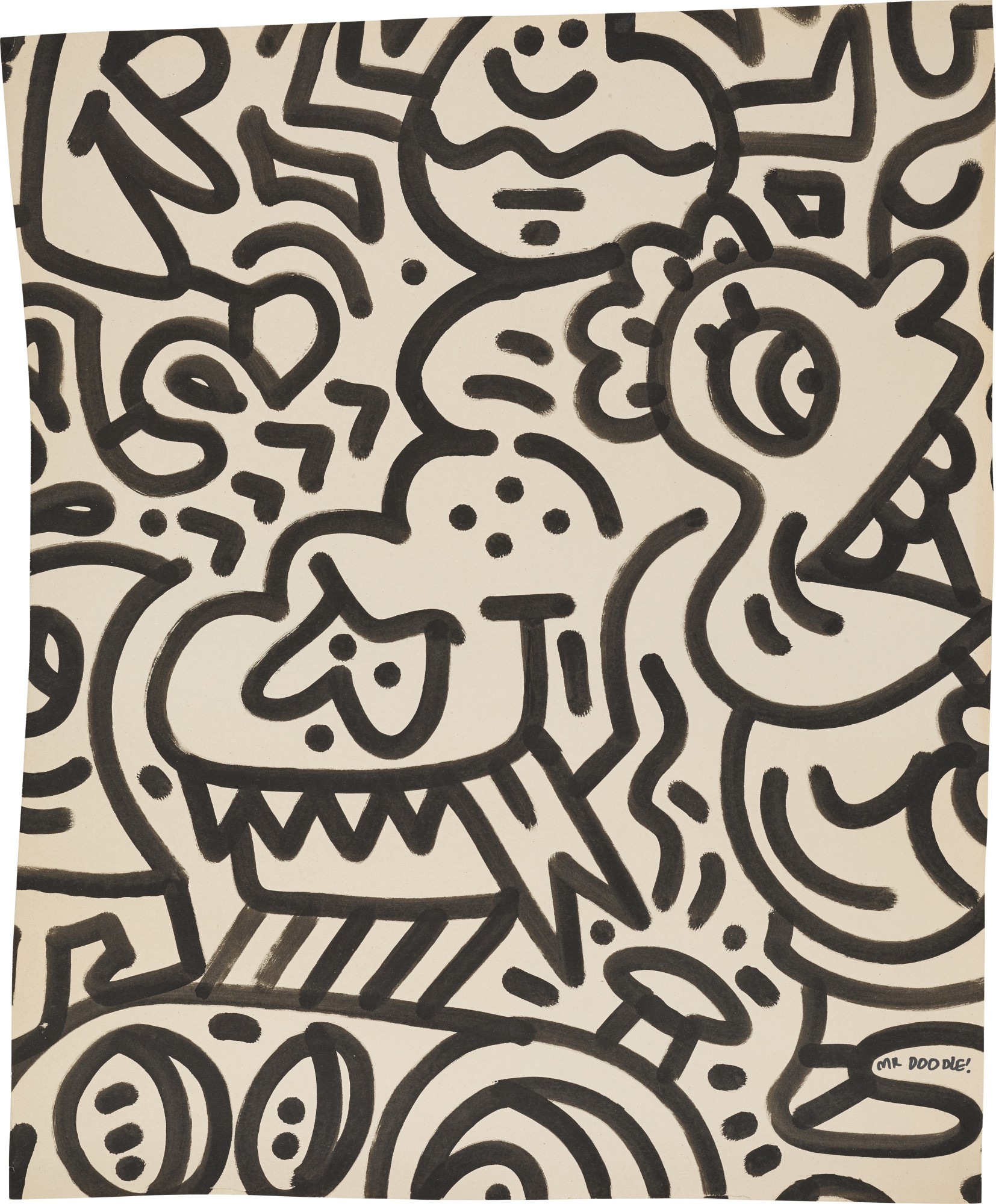
In 2020, Sam Cox, the artist known globally as Mr Doodle, completed one of the most audacious artistic undertakings of recent memory: he covered every surface of his newly built home in Kent, England, in his signature black and white linework. Every wall, every ceiling, every piece of furniture, every door handle and light switch was absorbed into the sprawling cartoon universe he calls Doodleworld. The project took two years to complete and was documented in a short film that travelled widely across social media, introducing millions of new viewers to an artist whose ambition had always exceeded the edges of a canvas. Sam Cox was born in 1994 in Tenterden, a small market town in the Weald of Kent, and by his own account he was drawing obsessively from the time he could hold a pen.
Mr Doodle
彩虹
The English countryside offered little in the way of a contemporary art scene, but Cox found his visual language elsewhere, in comic books, in the graffiti that decorated walls in nearby towns, in the dense visual storytelling of pop art. These were not passive influences. They were the foundations of an entire cosmology, one that Cox began constructing in childhood and has never stopped expanding. His formal art education at the University of the Creative Arts in Canterbury gave structure to instincts that were already fully formed.
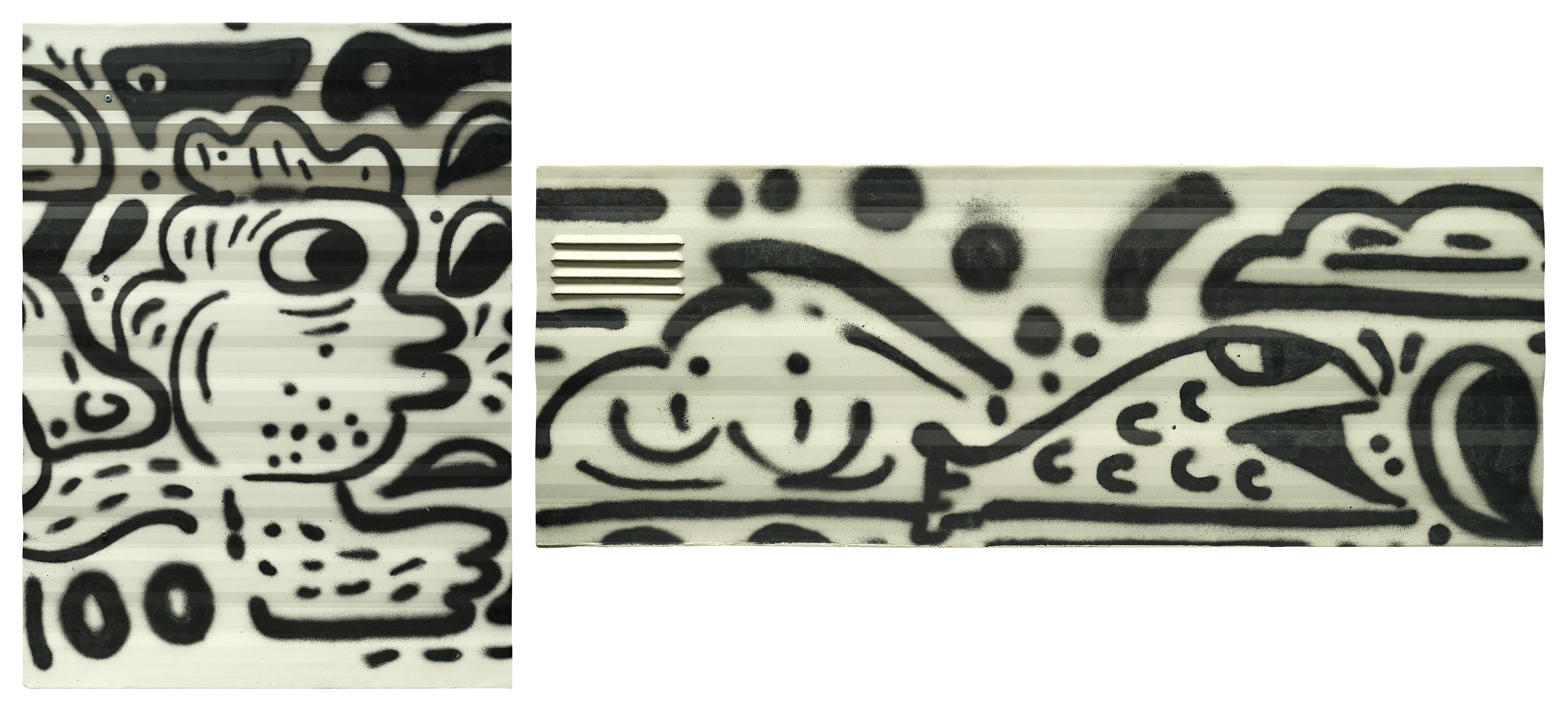
The development of Doodleworld as a coherent artistic practice accelerated during Cox's student years and immediately after graduation. His early works, including spray paint pieces on aluminium panels such as the Caravan Chaos series created around 2015, demonstrated that his vocabulary was already sophisticated and spatially ambitious. These works were not simply pattern filling. They were populated ecosystems, dense with characters that recurred and evolved, with architectural forms that suggested cities and landscapes without ever quite resolving into legible geography.
Mr Doodle
Two works: (i) Caravan Chaos: Side 4 Panel 14; (ii) Caravan Chaos: Side 4 Panel 15, 2015
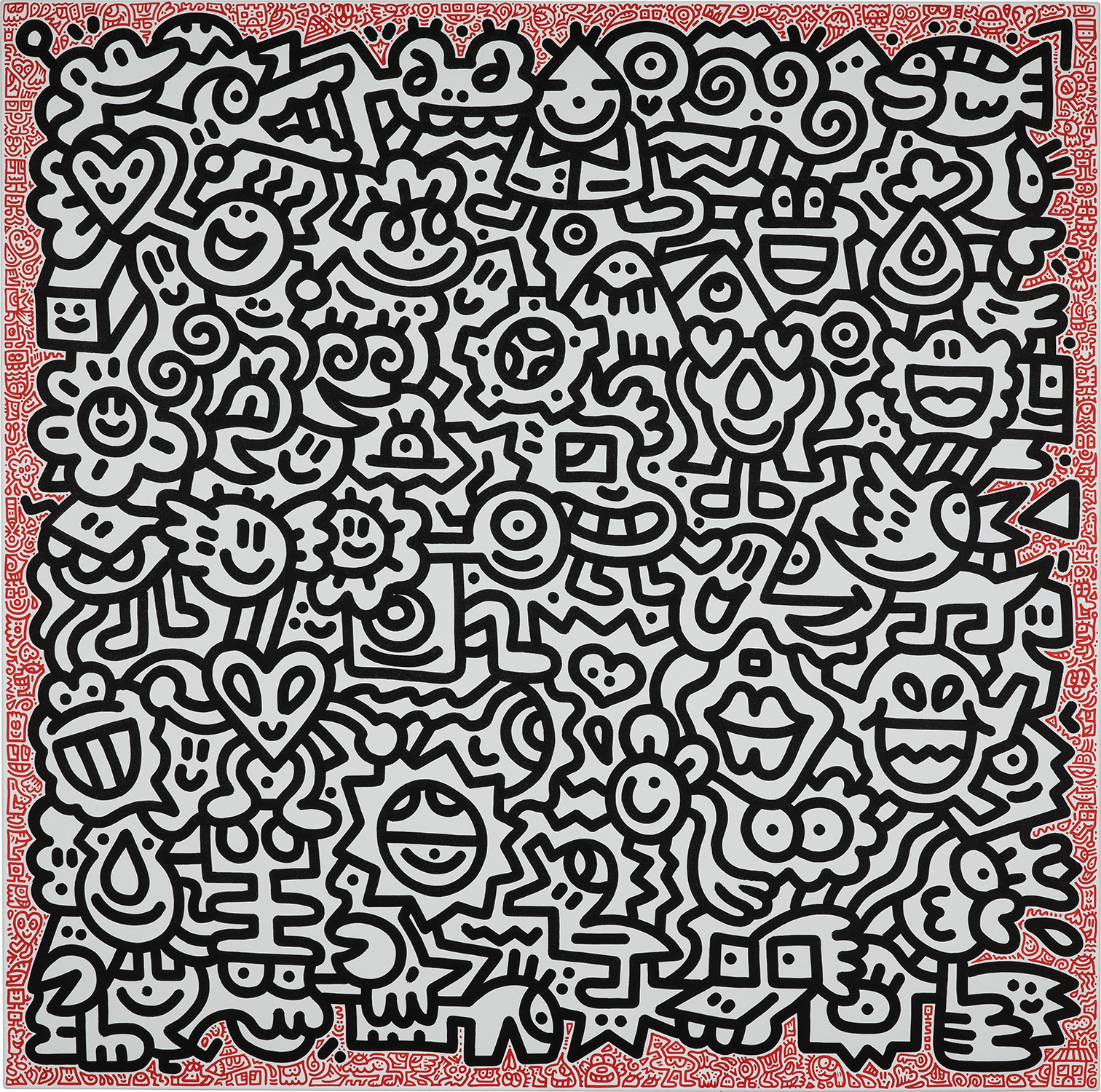
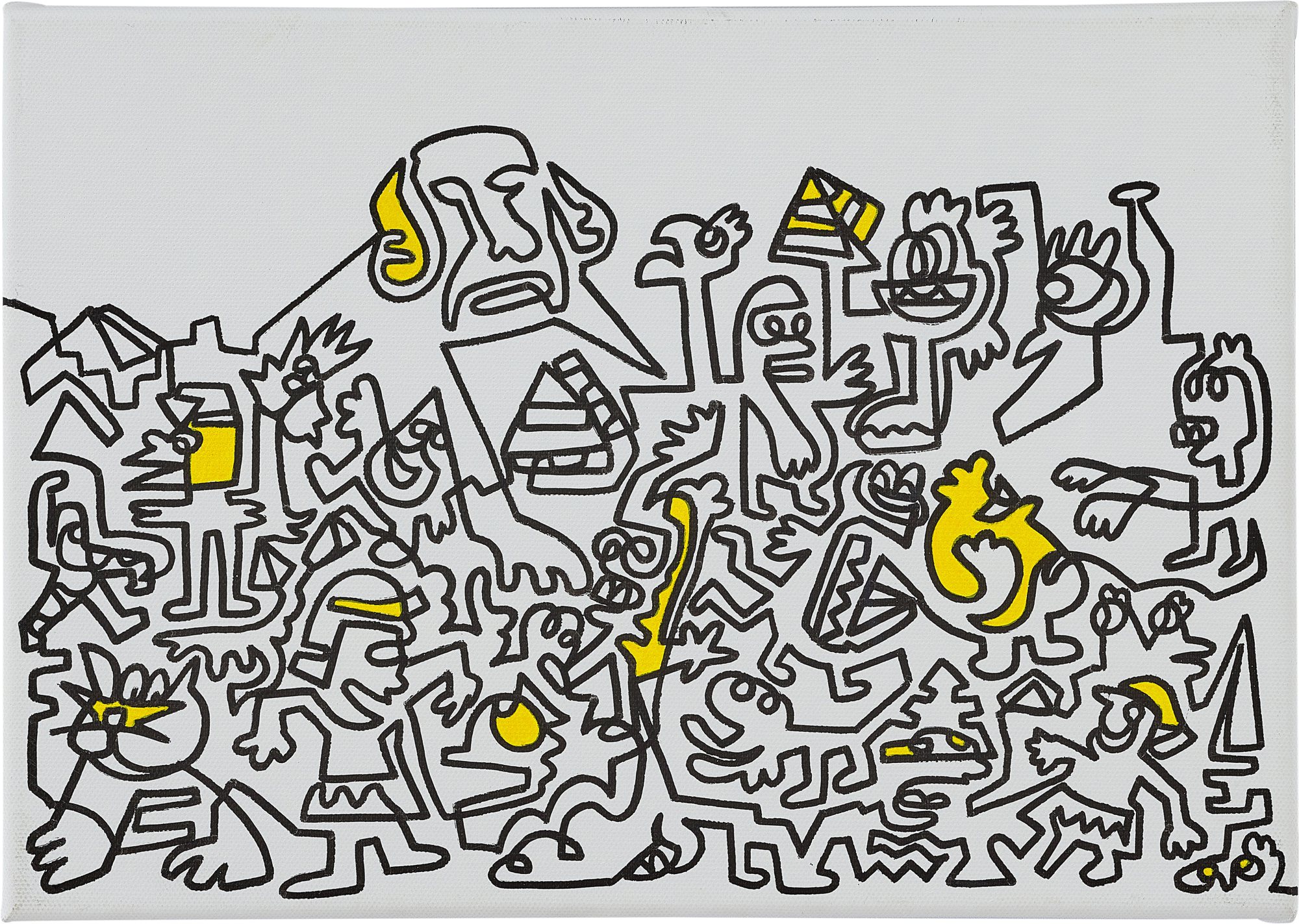
The black and white linework, often accented with bursts of bold primary colour, gave the work a graphic confidence that sat comfortably beside graffiti art and street culture while remaining entirely its own thing. As Cox's profile grew through the late 2010s, his practice expanded in ambition and scale. Works like Red Mountain from 2019 and the multi panel Doodlings series from the same year showed an artist refining his compositional instincts across formats large and small. The Eames Moulded Chair painted with acrylic doodle work demonstrated something important about his relationship to objects and to the idea of the artwork as total environment rather than framed picture.
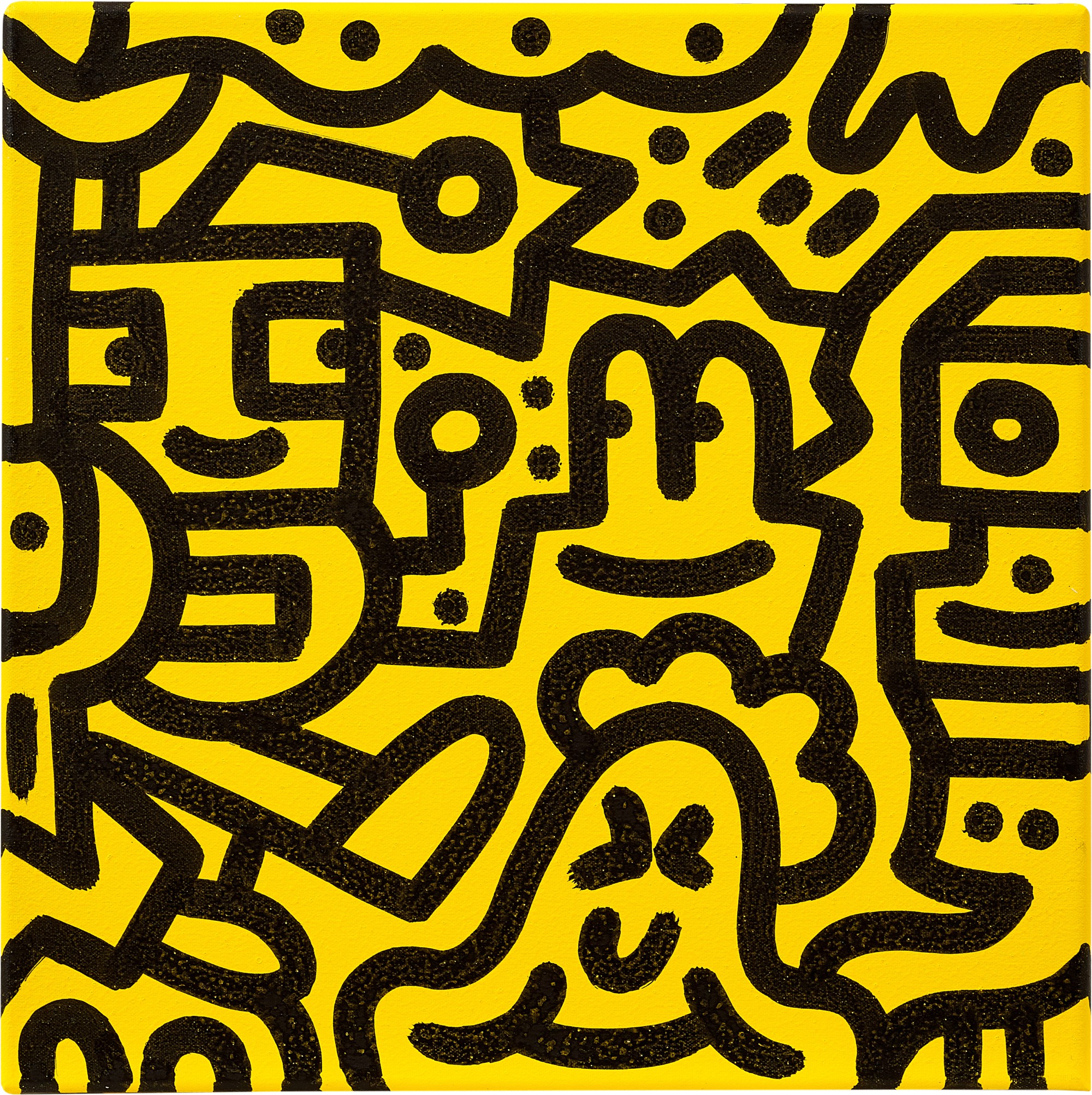
Titles drawn from Chinese characters, including works translated as Rainbow, Pyramid People, Bomb Bang, and Fear, point toward the international reach of Cox's practice and his genuine engagement with audiences across East Asia, where his work has found a particularly devoted following. The Bamboodle canvas from 2019 is a particularly elegant example of how Cox folds cultural reference into his visual language without reducing it to pastiche. For collectors, the appeal of Mr Doodle's work operates on several levels simultaneously. On the surface there is the immediate pleasure of the image, the invitation to look closely and discover new details, new characters, new spatial relationships.
Mr Doodle
Red Mountain, 2019
This is work that rewards sustained attention. Beneath that surface there is a serious conceptual proposition: that obsession, when channelled with discipline and wit, can become a form of world building. Cox is not the first artist to explore the idea of the total artwork, the Gesamtkunstwerk in the language of art history, but he is one of the few working today to pursue it with such consistency and such joy. His auction results have climbed steadily as institutional and private interest has intensified, with works appearing at major international sale rooms and achieving results that reflect genuine market depth rather than speculative heat.
The artists with whom Cox shares sensibility include Keith Haring, whose bold black outlines and cartoon figures transformed the walls of New York in the 1980s and whose work also moved fluidly between street and gallery. There are echoes too of Jean Michel Basquiat in the energy and density of the line, and of the Pattern and Decoration movement in the insistence that filling every available surface is not decoration but statement. In the context of British art, Cox occupies a space that is genuinely his own, distinct from the YBA generation that preceded him and from the conceptual cool that has dominated much of the London scene. He is more interested in abundance than in irony.
Mr Doodle
金字塔人們
What makes Mr Doodle a compelling figure for collectors and institutions alike is the coherence of his vision over time. From the early spray paint panels to the house project, from single canvases to multi part series, the internal logic of Doodleworld has remained consistent even as it has grown more complex. The characters that populate his canvases are not arbitrary. They are citizens of a place with its own geography, its own physics, its own emotional register.
Fear, referenced in the 2018 work, sits alongside joy and chaos and wonder in this universe, reminding us that even the most exuberant surfaces contain their own shadows. This is what separates Cox from artists who merely make visually busy work: there is genuine feeling at the centre of Doodleworld, and collectors who live with these works tend to find that they deepen over time rather than exhaust themselves. Sam Cox is still in his early thirties. The house project, the large scale international exhibitions, the growing body of work spanning canvas, furniture, and architectural surface: these are not the sum of an artistic life but its early chapters.
For those who collect his work now, there is the particular pleasure of knowing that the world he is building is still under construction, and that each new canvas is both a complete thing in itself and a door into something larger.