Milton Avery
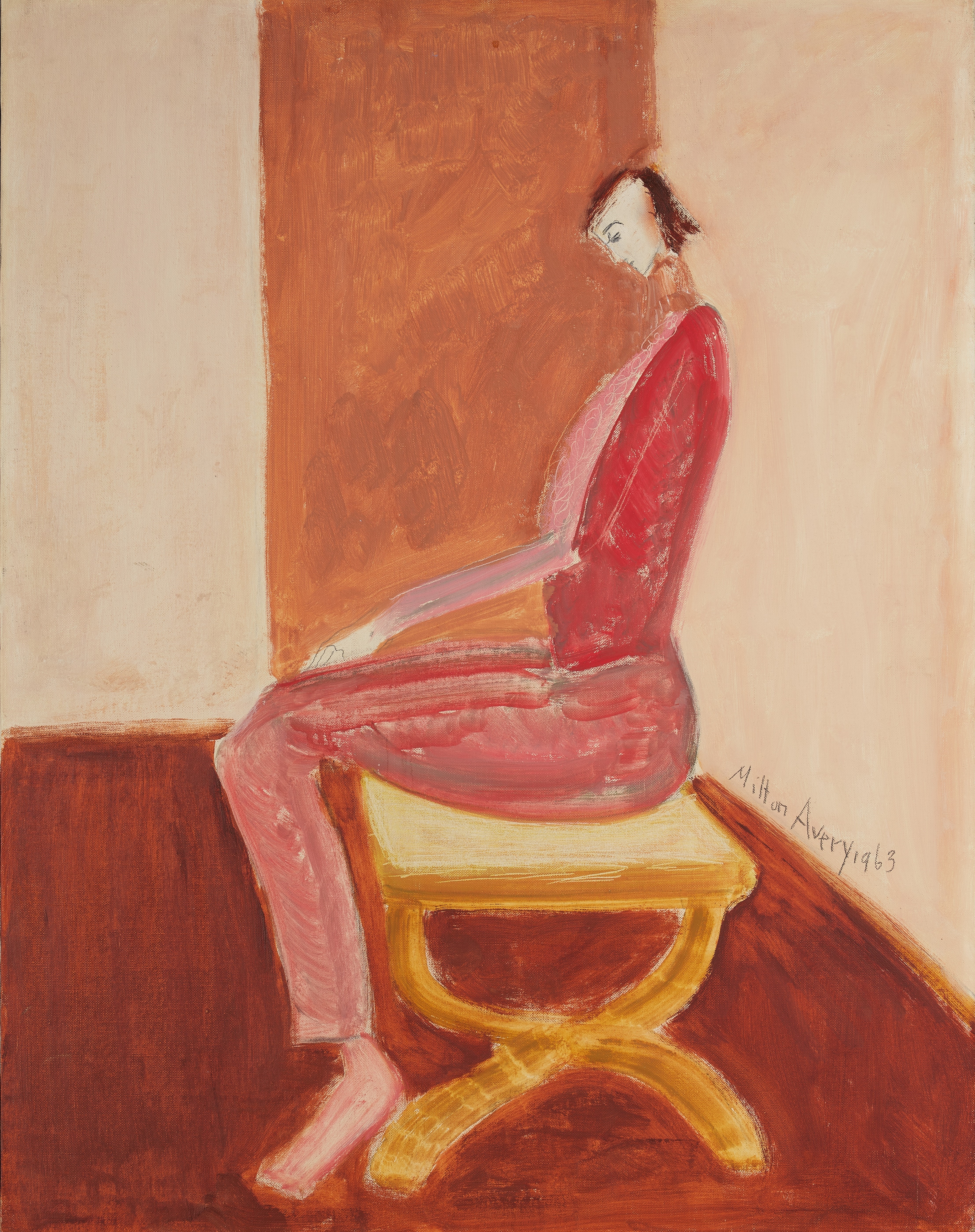
Milton Avery: America's Poet of Pure Color
Artist Spotlight · The Collection Editorial
“I try to construct a picture in which shapes, spaces, colors form a set of unique relationships, independent of any subject matter.”
Milton Avery
There is a moment, standing before a Milton Avery canvas, when the noise of the world simply falls away. The Metropolitan Museum of Art has long held his work in its permanent collection, and when the Whitney Museum of American Art mounted its landmark retrospective in 1982, critics and collectors alike were reminded of something they had perhaps been taking for granted: that Avery had spent decades quietly producing some of the most emotionally intelligent paintings of the twentieth century. His reputation, always strong among those who looked closely, has only deepened with time, and today his works command serious attention at auction houses including Christie's and Sotheby's, where his oils and watercolors regularly achieve prices that reflect the growing consensus about his place in American art history. Milton Avery was born in 1885 in Altmar, New York, a small town in Oswego County far removed from the cultural centers that would later celebrate him.
Milton Avery
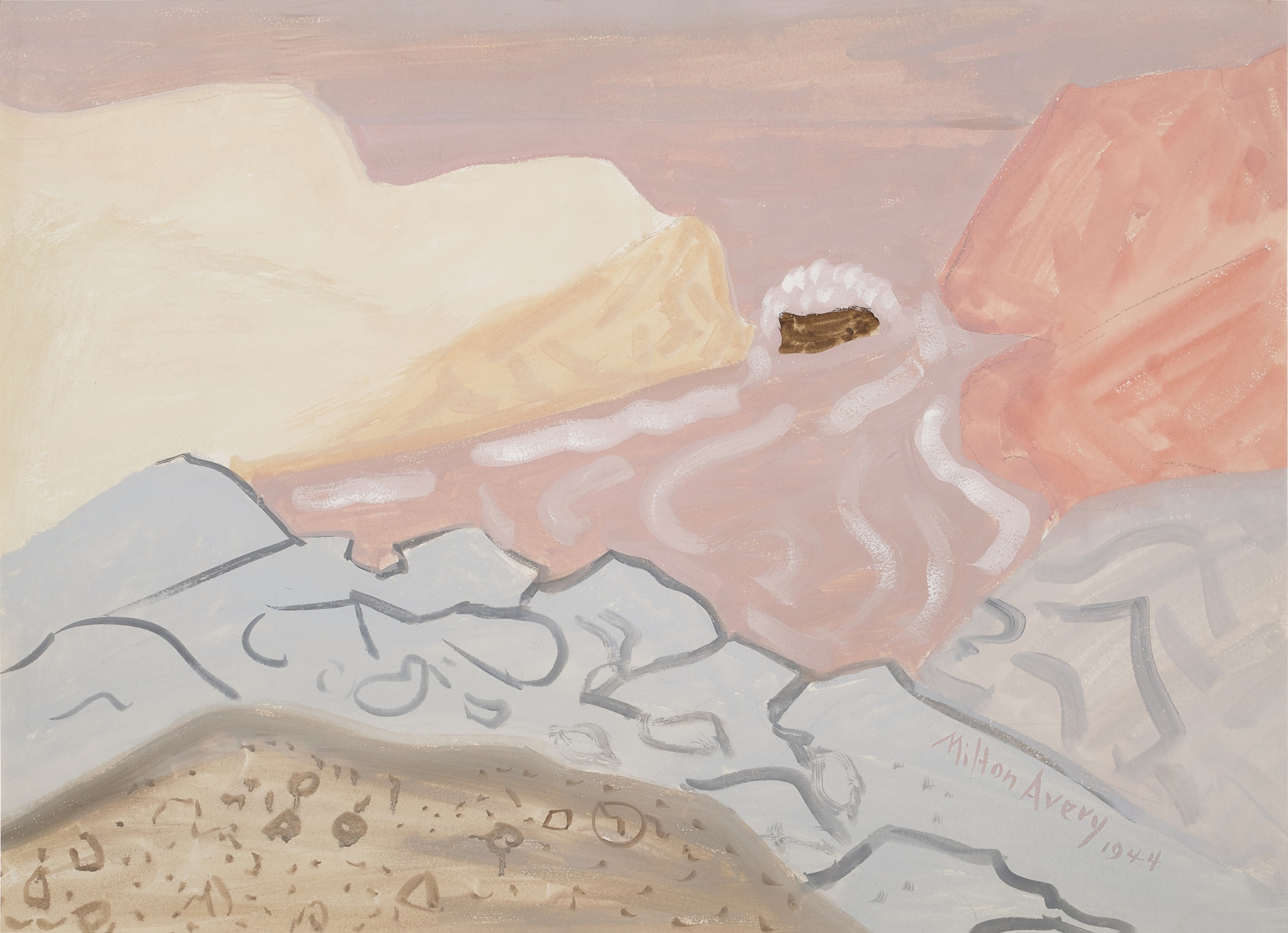
Lavender Sea, 1944
His family moved to Connecticut when he was still young, and it was there, in Wilson, that he first encountered formal instruction in drawing and painting. He attended evening classes at the Connecticut League of Art Students while working factory jobs during the day, a habit of disciplined labor and dedicated craft that would characterize his entire career. This self made quality, the sense of an artist who had earned every inch of his vision, gives his work an integrity that collectors and scholars continue to find deeply compelling. Avery moved to New York City in 1925 after meeting Sally Michel, the artist who would become his wife, his collaborator in spirit, and his steadfast financial support through the lean years.
Sally worked as a commercial illustrator so that Milton could paint, a partnership of remarkable generosity and mutual belief. New York opened him to the full sweep of modern art, and his visits to galleries and museums introduced him to the French modernists who would shape his thinking, above all Henri Matisse, whose flattened planes of color and liberated line offered Avery a language he could make entirely his own. Yet where Matisse moved with Mediterranean heat and decorative exuberance, Avery translated those lessons into something quieter, more introspective, and distinctly American. Through the 1930s and 1940s Avery refined the signature approach that would define his legacy.
Milton Avery
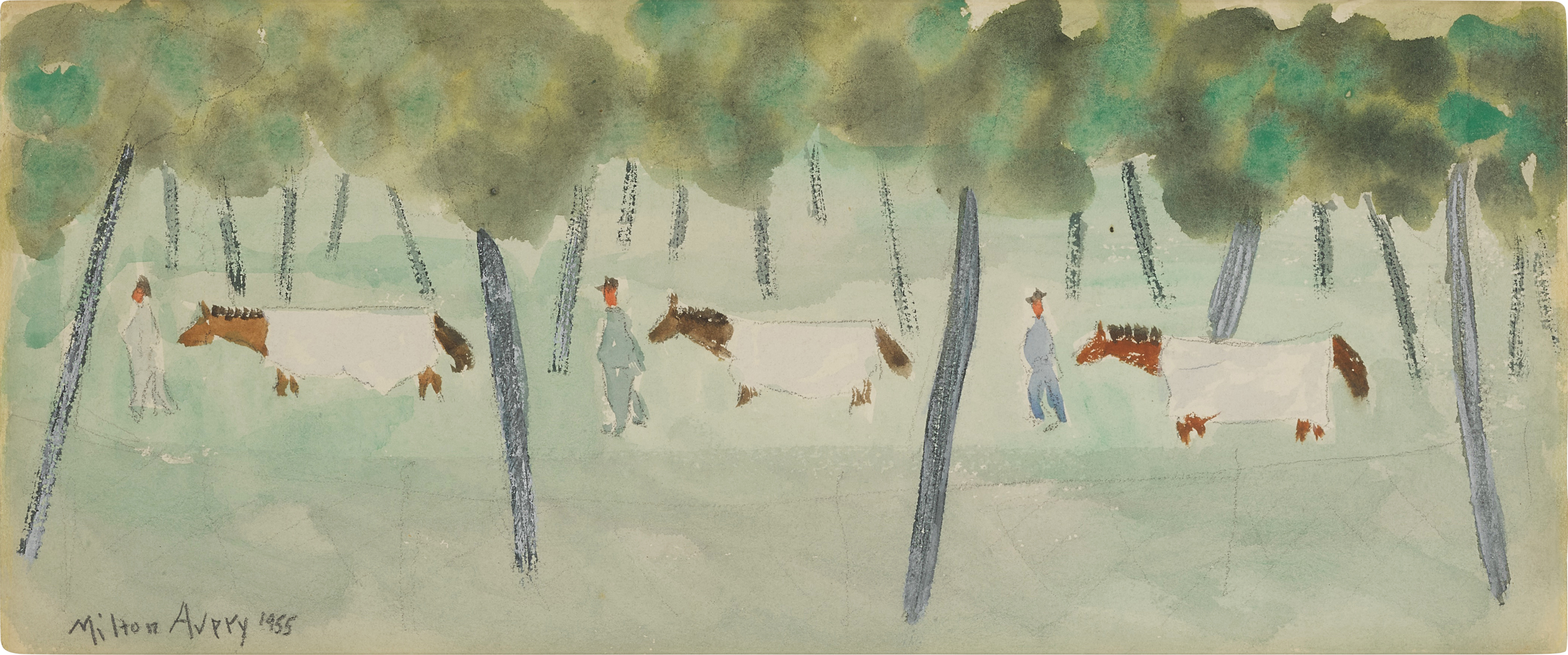
Horses with Blankets, 1955
He stripped compositions to their essential architecture, reducing figures, seascapes, and landscapes to broad, luminous fields of color held together by the most economical of drawn boundaries. There is nothing spare about these paintings in an emotional sense; they are in fact extraordinarily full, carrying tremendous feeling within their simplified forms. Works such as Lavender Sea from 1944 and Quiet Cove from the same year demonstrate this mastery with particular clarity. The sea becomes not a descriptive subject but a meditation on light and stillness, the horizon a thin thread holding two vast washes of color in delicate tension.
“Why talk when you can paint?”
Milton Avery
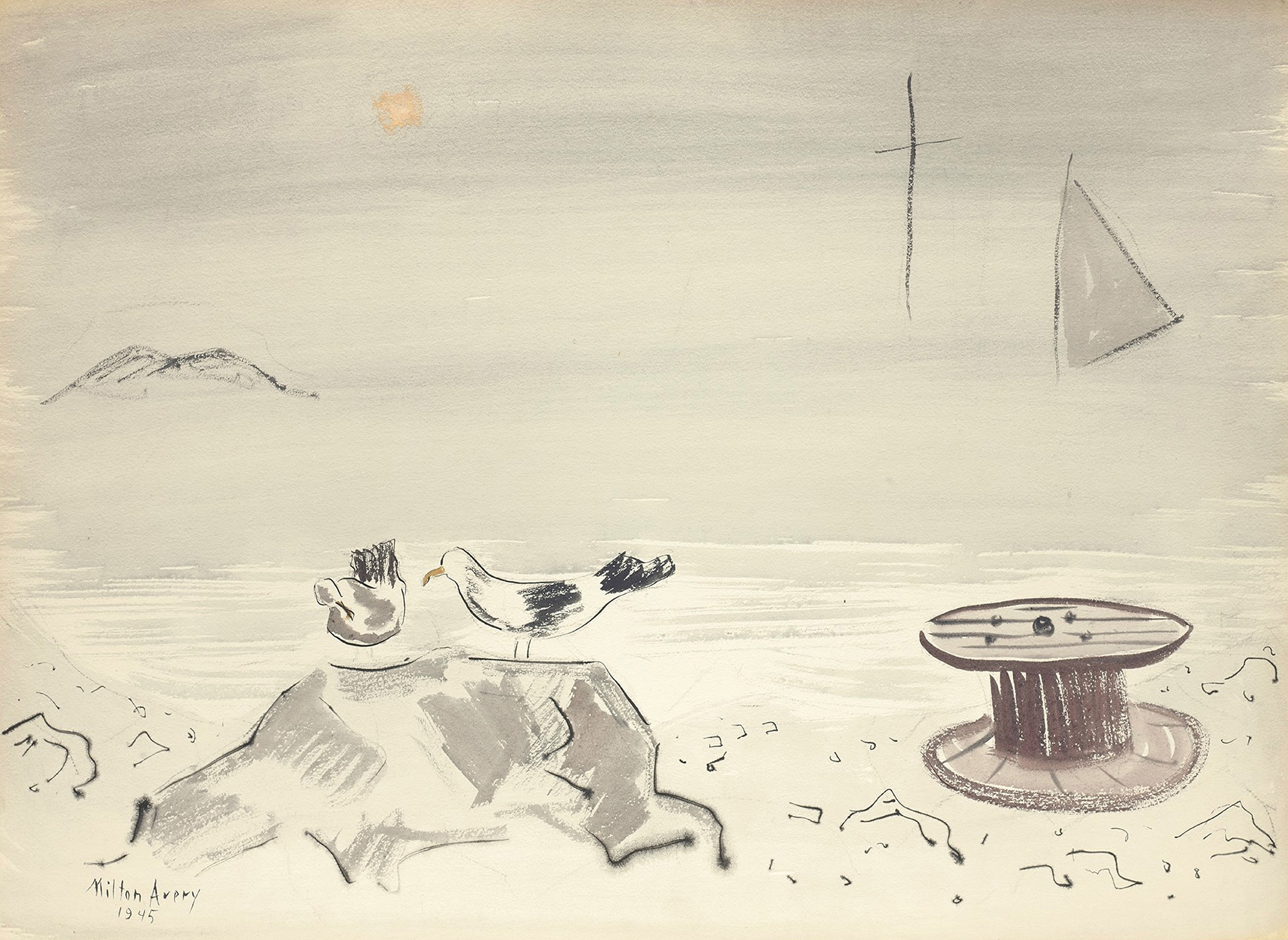
His watercolors from the same period, including Along West River from 1943 and Gulls in Fog from 1945, show the same sensibility working with extraordinary spontaneity and freshness in a more intimate scale. The friendships Avery cultivated in New York were themselves a kind of legacy. Mark Rothko and Adolph Gottlieb were among his close associates, and both acknowledged the debt they owed him. Rothko in particular spoke and wrote movingly about Avery's influence, recognizing in his color field compositions a philosophical as well as formal precedent for what would become Abstract Expressionism.
Milton Avery
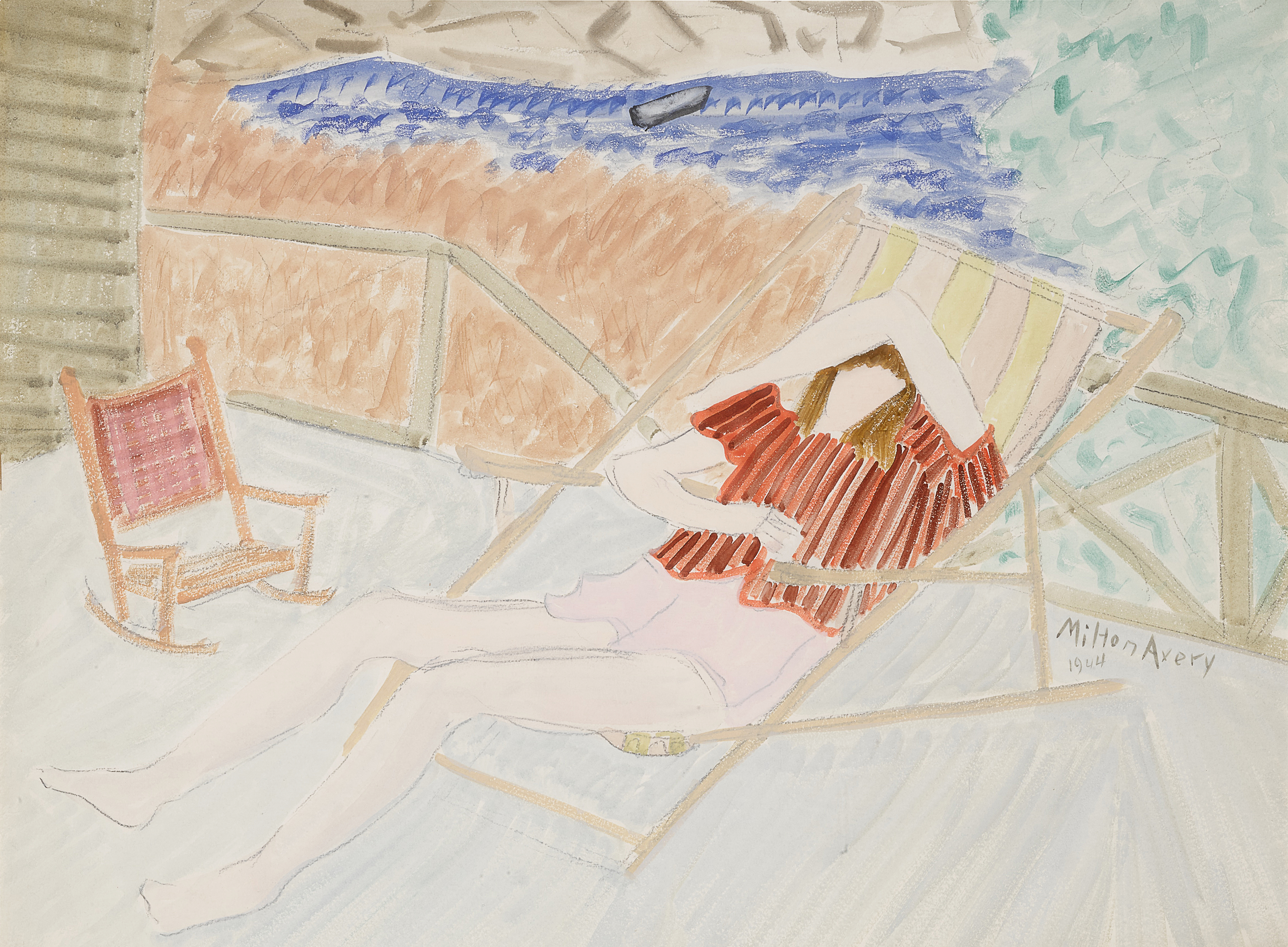
Relaxer by the Sea, 1944
Avery occupied a fascinating position: trained in realism, beloved by the abstract generation, and ultimately belonging fully to neither camp. His work from the 1950s, including Horses with Blankets from 1955 and the luminous Garden Reader from 1960, shows him pushing further toward abstraction without ever abandoning the tender human and natural subjects that grounded his art in lived experience. For collectors, the body of work Avery left behind offers remarkable range. His oils on canvas and canvasboard represent the fullest expression of his color ambitions, with works like Landscape from 1949 showing how he could charge a seemingly modest subject with a sense of the eternal.
His watercolors and works on paper, including gouache compositions such as Pond and Pines from 1938, offer an accessible entry point and demonstrate a freedom and immediacy that collectors find endlessly rewarding. The works on paper also illuminate his process, the speed and confidence of his hand, the way a few fluid marks could conjure an entire world. When acquiring Avery, condition and provenance are important considerations, as with any twentieth century American modernist, and works with clear exhibition histories carry additional resonance. His market has grown steadily, with major institutions and private collections competing for the best examples.
Milton Avery
Gulls in Fog, 1945
Avery's place in art history sits at one of its most generative crossroads. He bridges the American realism of his early training and the Color Field painting that Rothko, Barnett Newman, and Helen Frankenthaler would develop into a movement. He absorbed lessons from Matisse and the Fauves without ever becoming derivative, and he remained committed to the observable world at a moment when abstraction was becoming the dominant language of serious painting. Artists as different as Frankenthaler and Philip Guston claimed his example as formative.
To look at his work today is to understand American modernism not as a series of ruptures and revolutions but as a continuous conversation, one in which Avery's quiet, unwavering voice was always essential. Milton Avery died in New York in 1965, leaving behind a body of work of exceptional consistency and beauty. He was celebrated during his lifetime but never quite lionized in the way his Abstract Expressionist friends were, a circumstance that perhaps allowed him to work without the pressure of celebrity and to follow his vision wherever it led. Decades on, that vision looks not merely prescient but inexhaustibly rich.
His paintings teach a kind of seeing: slower, more attentive, more willing to find the extraordinary within the ordinary. For collectors who live with his work, that quality of attention becomes part of the air of a room, a daily reminder of what painting at its finest can do.
Explore books about Milton Avery