Michelle Sakhai
Michelle Sakhai Illuminates the Space Between Worlds
Artist Spotlight · The Collection Editorial
In the galleries and private collections where contemporary art finds its most devoted audience, a quiet revolution of light has been unfolding. Michelle Sakhai, the New York based artist whose luminous mixed media canvases have drawn increasing attention from collectors across the United States and beyond, represents one of the most compelling voices in a generation of artists working at the intersection of cultural memory and contemporary visual language. Her works glow with an almost sacred intensity, their surfaces built up from layers of oil paint and precious metal leaf that catch and hold the eye in ways that feel both ancient and urgently present. Sakhai was born into a world of dual inheritances, shaped by the richness of Persian culture and the restless energy of the American contemporary art scene.
Michelle Sakhai
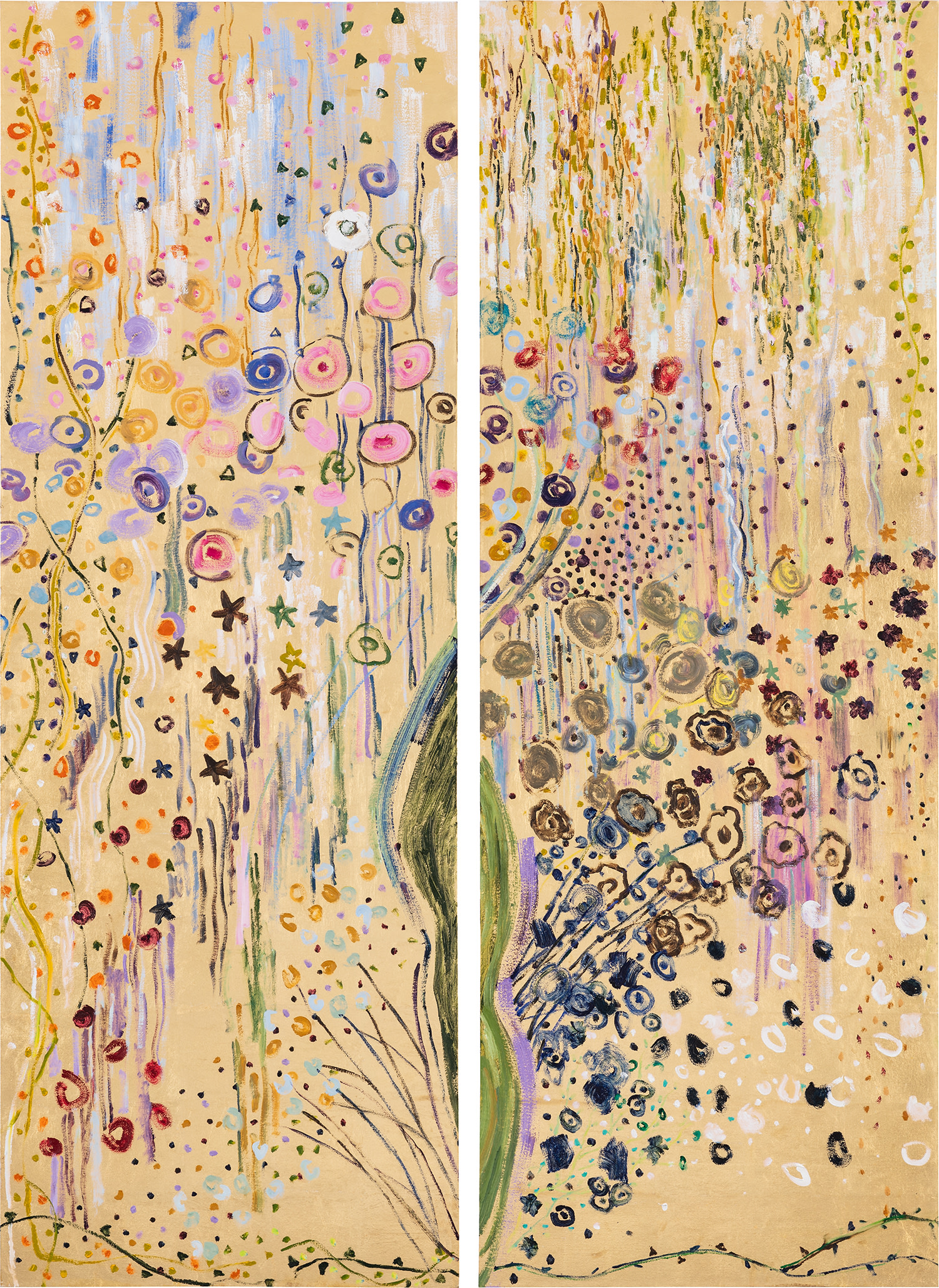
Garden of Peace, 2019
Growing up with deep roots in Iranian artistic and spiritual traditions, she came of age absorbing the visual vocabularies of two distinct civilizations, each with its own relationship to beauty, ornament, and meaning. The Persian tradition of miniature painting, with its jewel like precision and its integration of calligraphic text and allegorical imagery, left an indelible mark on her sensibility. Equally formative was her immersion in the contemporary New York art world, where she developed her studio practice and began to understand how those inherited traditions might speak to a modern audience. Her artistic development has been defined by a sustained and patient inquiry into what it means to hold multiple cultural identities at once.
Rather than choosing between East and West, Sakhai has built a practice that insists on the possibility of synthesis, on the idea that traditions need not compete but can instead inform and enrich one another. Over time, her technical vocabulary grew more ambitious. She began working extensively with gold leaf and other metal leaf materials, a choice that resonates on multiple levels simultaneously. In Persian and Byzantine art alike, gold has long signified the divine, the eternal, the transcendent.
Michelle Sakhai
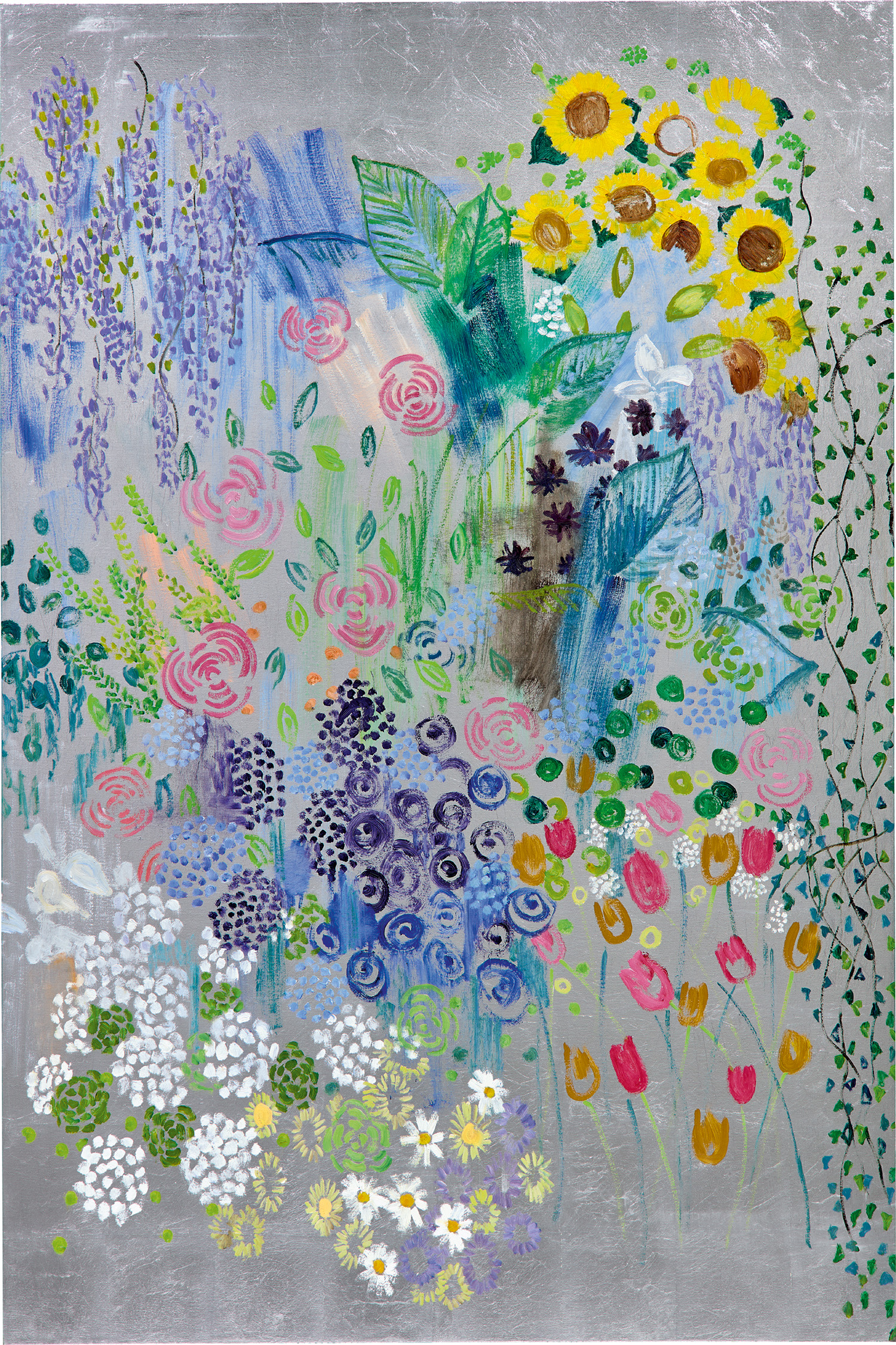
Falling Into Love, 2021
By bringing this material into her contemporary canvases, Sakhai creates a visual conversation across centuries. The works themselves are layered in the most literal sense. Sakhai builds her compositions through an accumulative process, applying and sometimes partially obscuring imagery beneath translucent veils of paint and metal. This layering is not merely technical but deeply conceptual.
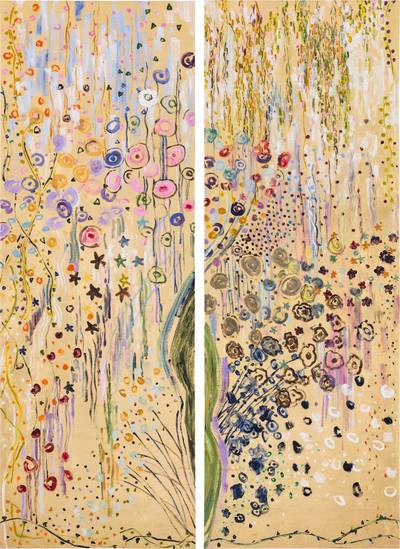
Identity, she suggests, is not a single fixed thing but a palimpsest, a surface written and rewritten over time. Her canvases invite close looking, rewarding the viewer who pauses long enough to notice the depth beneath the initial dazzle. Among her most celebrated works is the diptych titled Garden of Peace, completed in 2019, which deploys oil and metal leaf on canvas to conjure a space that is simultaneously a literal garden and a spiritual state. The composition draws on the Persian concept of the garden as paradise, as an enclosed and cultivated sanctuary of beauty and refuge, and transforms it into something that feels genuinely universal.
Michelle Sakhai
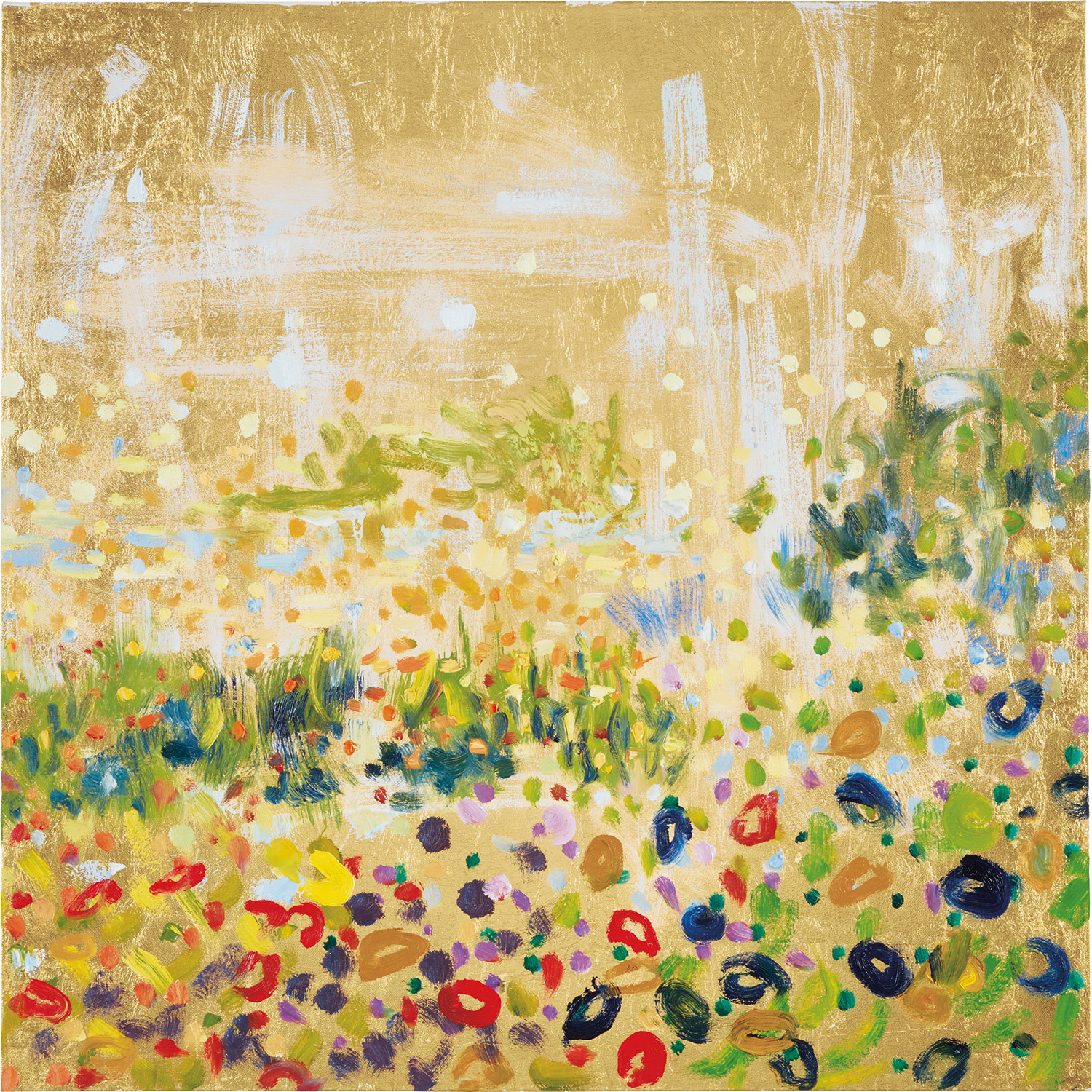
On the Path, 2017
Falling Into Love, completed in 2021, demonstrates the full range of her mature practice. The painting is at once romantic and philosophical, its surfaces shimmering with metal leaf that suggests both emotional radiance and spiritual illumination. There is a quality of surrender in the work, a willingness to be overtaken by feeling, that connects it to the great tradition of Persian lyric poetry, to the Sufi poets who understood love as a pathway toward the divine. On the Path, from 2017, belongs to an earlier phase of her development but already shows the confidence and visual intelligence that would come to define her subsequent work.
Together these paintings reveal an artist with a coherent and evolving vision, one that deepens with each new body of work. For collectors, Sakhai's work occupies a particularly compelling position in the current market. Her canvases are visually immediate, possessing that rare quality of commanding a room without overwhelming it. They function beautifully in domestic settings alongside works from very different traditions, and their material richness means they read differently under different lighting conditions, offering their owners a work that is in some sense always changing.
The use of precious metal leaf also gives the works an undeniable physicality, a presence that no reproduction can fully capture. Collectors who value work that rewards sustained engagement over time will find in Sakhai an artist whose layered surfaces continue to yield new details and new meanings. Within the broader context of contemporary art, Sakhai's practice can be understood in relation to other artists who have explored the creative possibilities of cultural hybridity and the revival of pre modern decorative and spiritual traditions. Her work shares a certain spirit with artists who have drawn on Islamic geometric patterning and illuminated manuscript traditions, as well as with those who have found in gold leaf a medium capable of bridging the sacred and the secular.
Yet her vision is distinctly her own, marked by a particular warmth and a genuine spiritual seriousness that sets her apart from more ironic or conceptually distanced approaches to similar material. What Sakhai offers, ultimately, is something the art world always needs and rarely finds in such pure form: a practice grounded in genuine belief. She works from a place of authentic connection to her materials and her themes, and that sincerity communicates itself directly through the surface of the canvas. At a moment when questions of identity, belonging, and cultural memory have never felt more pressing, her art arrives as a kind of answer, or perhaps more accurately as a kind of invitation.
To stand before one of her paintings is to be asked to consider what it might look like when two great traditions meet not in conflict but in conversation, and to discover that the result can be more beautiful than either alone.