Melvin Sokolsky
Melvin Sokolsky: The Dreamer Who Levitated Fashion
Artist Spotlight · The Collection Editorial
Imagine Paris in the early spring of 1963. Along the banks of the Seine, pedestrians glance upward, momentarily uncertain whether what they are seeing is real. A young woman in an exquisite gown floats inside a transparent sphere, suspended above the rooftops and cobblestones, serene and utterly at ease in her impossible situation. This is the world Melvin Sokolsky conjured into being, not through trickery of the darkroom alone, but through an audacious conviction that fashion photography could be something else entirely: surrealist theater, a dream made rigorous, beauty elevated to the level of myth.
Melvin Sokolsky
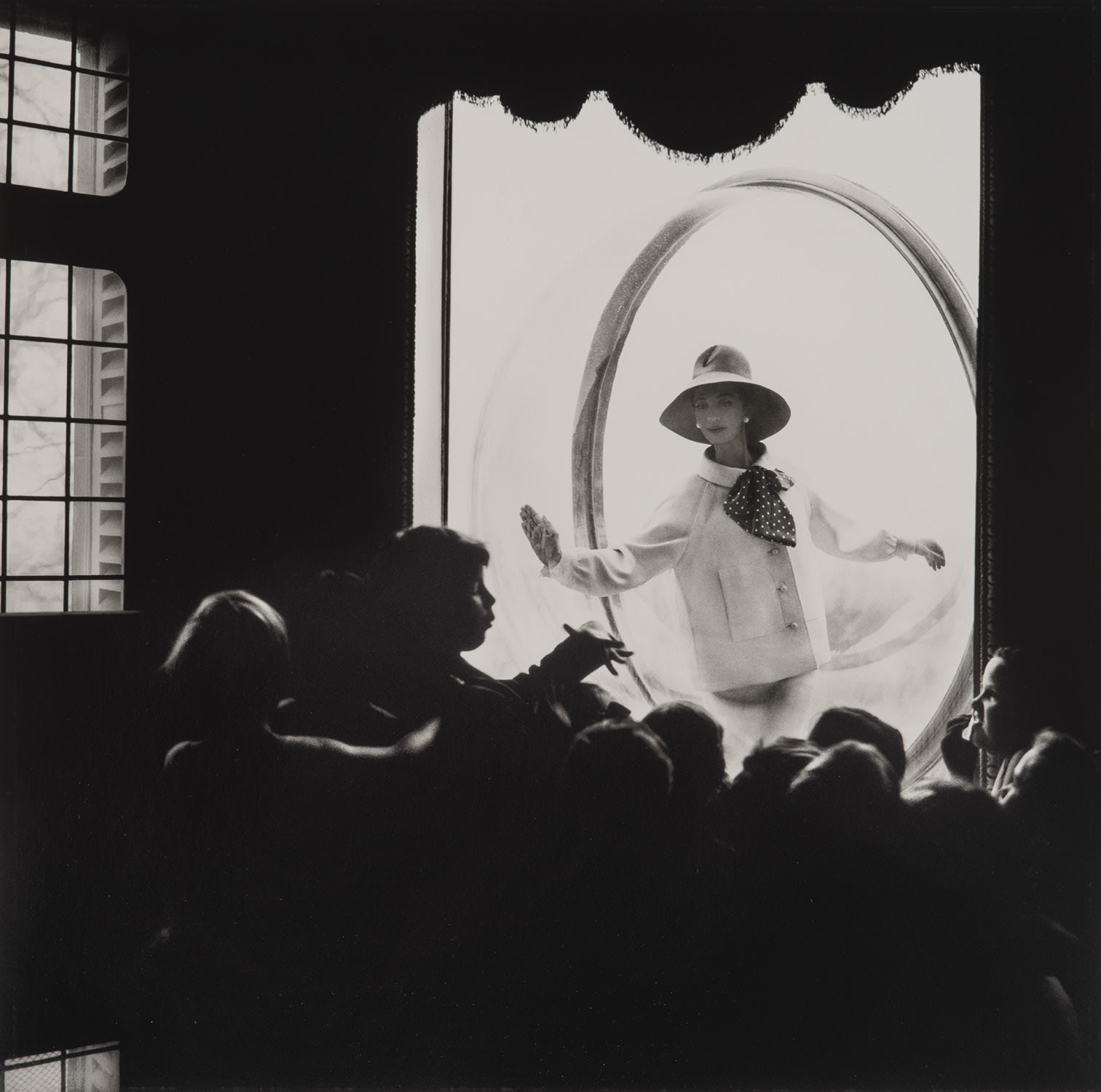
School Window, Paris
Sokolsky was born in New York City in 1933, and the city shaped him in the way only New York can, by surrounding a curious mind with relentless visual stimulus and an almost competitive pressure to be original. He came of age during the postwar flowering of American commercial culture, when advertising and editorial photography were staking their claim as legitimate artistic disciplines. He was largely self taught, which may account for the fearlessness that defines his best work. Without a formal academy telling him what photography was supposed to do, he was free to decide for himself.
His early career brought him to Harper's Bazaar at a remarkably young age, and it was there, working within one of the most prestigious editorial environments in the world, that he began to push the form toward something genuinely unprecedented. The Bazaar of the early 1960s was already a crucible of visual innovation, shaped by the legendary art direction of Alexey Brodovitch, who had earlier championed the work of Richard Avedon and Irving Penn. Sokolsky arrived into this tradition and immediately began testing its outer limits, asking not what fashion photography should look like but what it could feel like. The answer arrived with the Bubble series, produced for Harper's Bazaar in 1963.
Melvin Sokolsky
After Delvaux, Paris
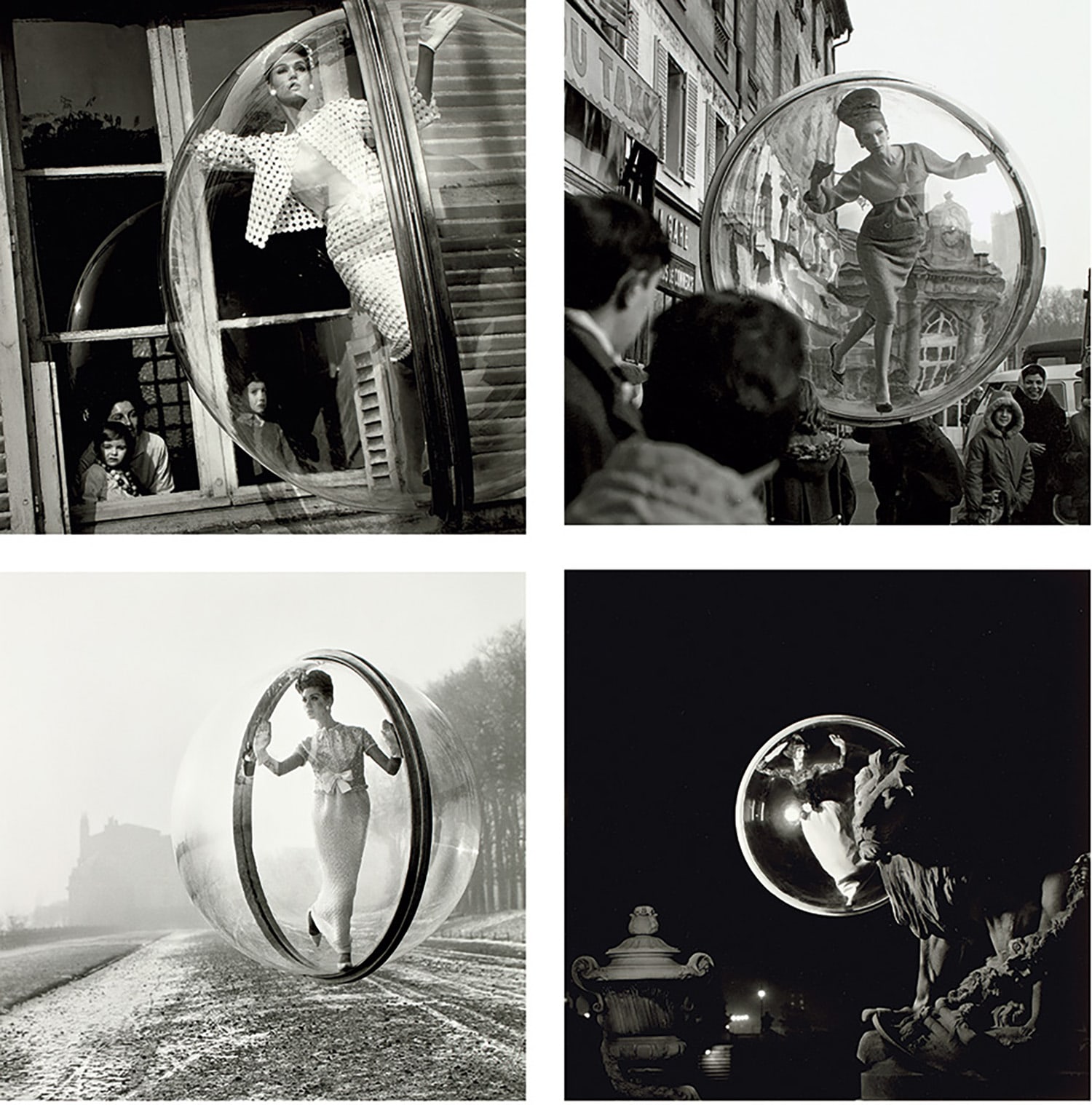
Working with an engineering team to construct a large plexiglass sphere that could be suspended and maneuvered above location settings in Paris, Sokolsky placed his models inside and photographed them floating above streets, bridges, and the river itself. Works from this series, including the now iconic Simone, Bubble, Seine, Paris and Saint Germain, Paris, possess a quality that no amount of digital manipulation could replicate today, because they carry the weight of something actually constructed, actually risked, actually done. The models were genuinely aloft. The city was genuinely below them.
The tension between the fragility of the sphere and the solidity of Paris produces an emotional register that is unique in the history of fashion imagery. What makes Sokolsky essential to any serious understanding of twentieth century photography is his insistence on the pictorial as a legitimate mode for commercial work. His photographs reference the dreamlike spatial logic of the Belgian surrealist Paul Delvaux, a debt made explicit in the work titled After Delvaux, Paris, where the staging and light carry clear echoes of that painter's haunted, depopulated streets. He was equally attuned to the cinematic, and this is no accident: Sokolsky moved fluidly between still photography and directing, building a distinguished parallel career in television commercials and receiving multiple Emmy Awards for his directorial work.
Melvin Sokolsky
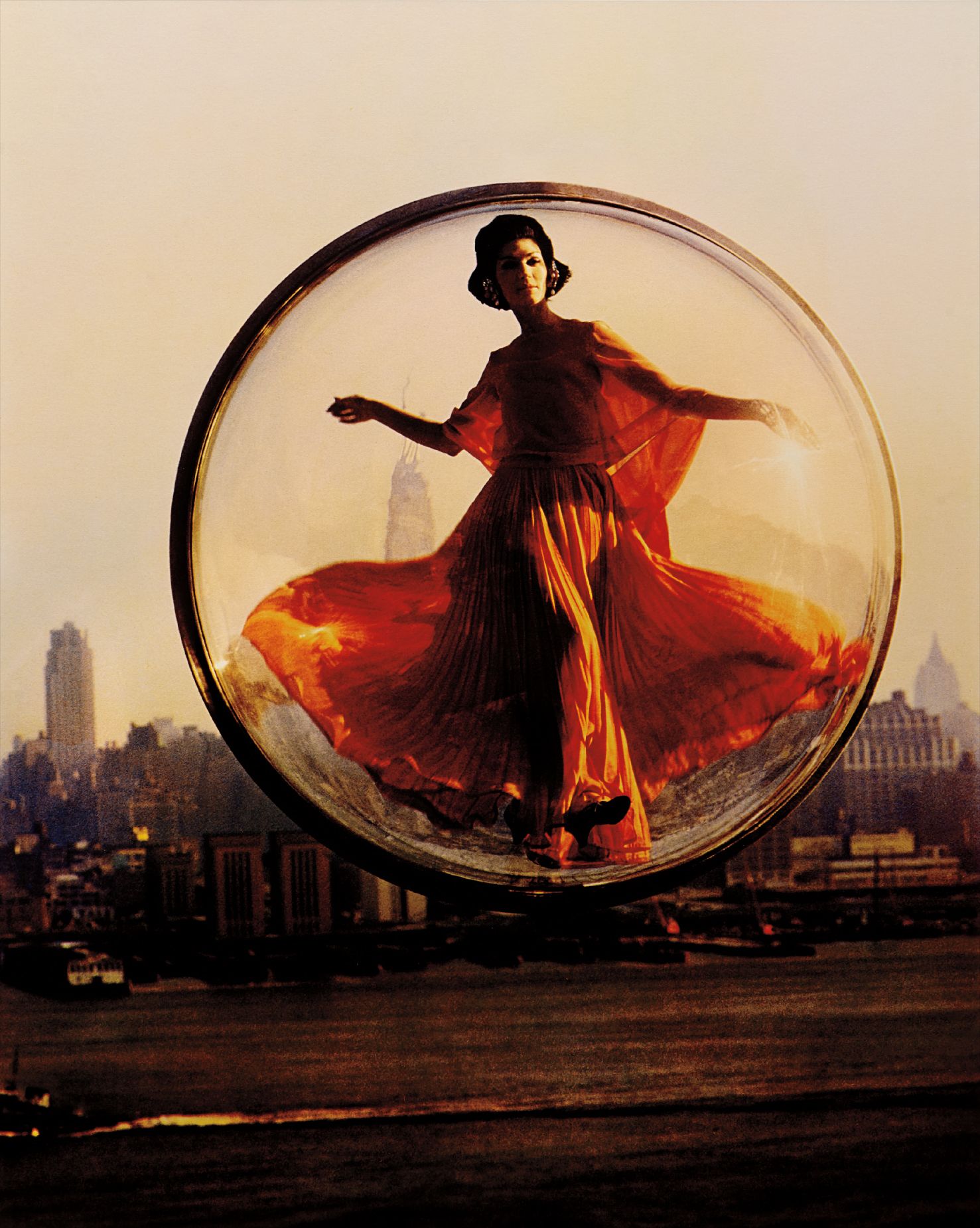
Over New York
This dual fluency gave his still images an unusually strong sense of narrative time, as though each photograph is a single frame extracted from a film that exists only in the imagination. For collectors, Sokolsky's work presents a rare combination of art historical significance and visual pleasure that is genuinely difficult to find. His gelatin silver prints, many printed later with the artist's involvement and authorization, offer a direct connection to some of the most celebrated images in the history of the medium. Works such as School Window, Paris and Sidekick, Paris demonstrate the full range of his compositional intelligence, balancing architectural precision with a floating, dreamlike atmosphere that keeps the eye moving and the mind engaged.
The Paris 1963 portfolio, issued in a limited edition of 25 copies plus artist's proofs, represents the most complete and considered presentation of the Bubble series, with Sokolsky's own introduction providing essential context and the bound folio format giving the work a monumental, bibliophilic presence. Editions at this level of scarcity and historical importance rarely remain available for long. Sokolsky's place in art history becomes clearer when set against the broader landscape of postwar fashion and surrealist photography. He shares a visionary ambition with figures like Erwin Blumenfeld, whose distorted and layered images for Vogue in the 1940s and 1950s similarly refused the boundary between art and commerce.
Melvin Sokolsky
Paris 1963
He anticipates the conceptual theatricality of Guy Bourdin, who would bring his own brand of cinematic unease to fashion photography in the decades that followed. And in his willingness to engage Paris as both setting and symbol, Sokolsky belongs to a long tradition of American artists who found in that city a visual grammar adequate to their ambitions. The work titled Over New York reminds us that this imaginative freedom was not confined to a single location: wherever Sokolsky pointed his camera, the ground became negotiable. The legacy of Melvin Sokolsky is one of those rare cases where the work has grown in stature rather than faded with time.
As digital imagery has made nearly anything visually possible, the photographs Sokolsky made through physical ingenuity and creative daring have acquired a new kind of authority. They remind us what it meant to actually build a dream, to construct wonder with steel and plexiglass and winter light above a real river in a real city. For collectors drawn to work that stands at the intersection of fashion history, surrealist art, and the purest tradition of photographic craft, Sokolsky's images are not merely desirable. They are irreplaceable.