Mel Ramos
Mel Ramos: America's Most Joyful Pop Provocateur
Artist Spotlight · The Collection Editorial
“I always wanted to paint beautiful women. That was my whole thing from the very beginning.”
Mel Ramos, interview with Peter Selz
Few painters have made desire, commerce, and humor collide with such sheer painterly confidence as Mel Ramos. In the years since his death in 2018, his reputation has only grown warmer and more assured, the kind of gradual reappraisal that happens when the culture finally catches up to an artist who was always ahead of it. Institutions across Europe and North America have continued to reassess his place in the Pop Art canon, and the market for his prints, paintings, and mixed media works has remained remarkably active, drawing collectors who recognize in his pictures something genuinely rare: a sensibility that is both critically intelligent and unabashedly pleasurable. Ramos was born in Sacramento, California, in 1935, and the specifics of that geography matter more than they might first appear.
Mel Ramos
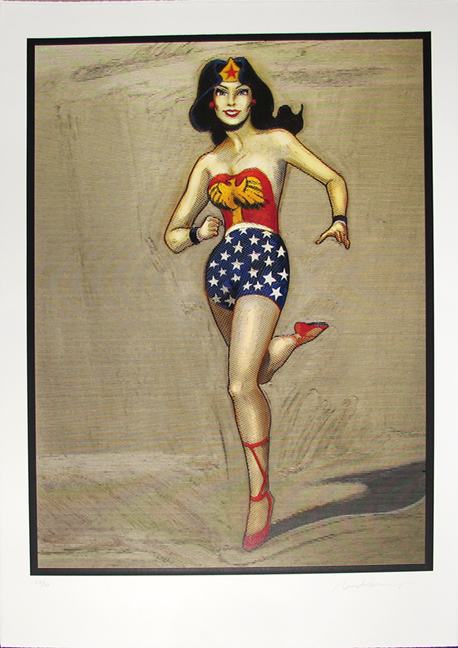
Wonder Woman, 2014
He came of age not in New York, where Pop Art mythology tends to locate itself, but in the sun drenched consumer landscape of postwar California, a world saturated with billboards, supermarket packaging, and the glossy promises of a booming economy. He studied at Sacramento Junior College and later at Sacramento State College, where he encountered the painter Wayne Thiebaud, a formative influence who shared his appetite for the visual language of everyday American abundance. That mentorship was decisive. Thiebaud gave Ramos permission to take seriously the things the fine art establishment told him to dismiss.
By the early 1960s, Ramos had arrived at what would become his signature vocabulary, one that placed idealized nude female figures directly alongside the logos, packaging, and brand identities of American consumer culture. He was painting these works at almost exactly the moment Andy Warhol was making his Campbell's Soup Cans in New York and Roy Lichtenstein was translating comic book panels into monumental canvases. Ramos knew both artists and was exhibited alongside them, but his particular angle was his own. Where Warhol found glamour in repetition and Lichtenstein found poetry in mechanical reproduction, Ramos found comedy, eroticism, and a very specific kind of American dream logic, the conflation of the desirable body and the desirable product.
Mel Ramos
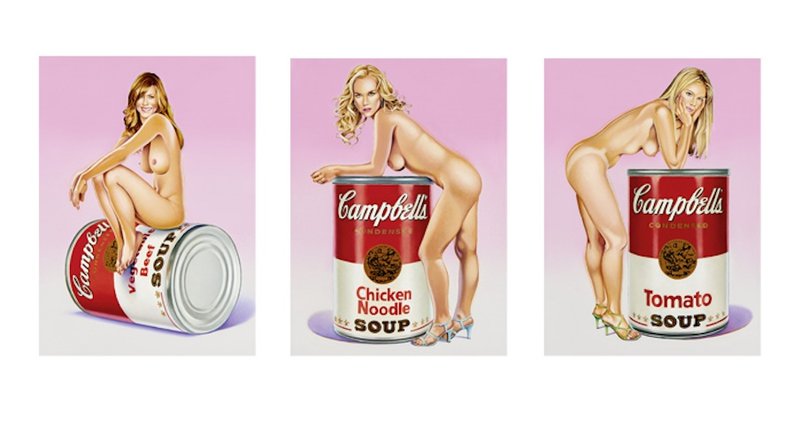
Campbell's Soup Girls (set of 3)
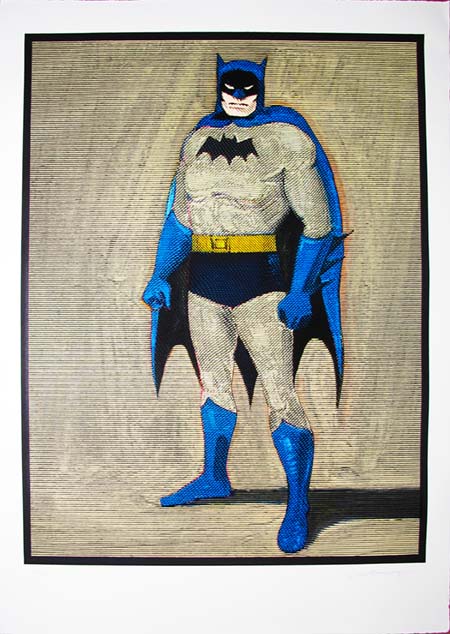
His early superhero paintings deserve special mention as a body of work that has attracted renewed collector attention in recent decades. Works like his depictions of Wonder Woman, Superman, Batman, and Hawkman, several of which he revisited in woodcut with acrylic during the 2010s, tap into a vein of popular mythology that feels entirely contemporary now. These images anticipated by decades the cultural dominance of superhero iconography, and they did so with a lightness of touch that was never merely ironic. Ramos genuinely loved these characters.
He grew up reading the comics, and his affection infuses every line. The woodcut and acrylic works from 2014 and 2015 in particular have a bold, almost heraldic quality, the grain of the wood working in productive tension against the flatness of the acrylic color. The consumer product paintings, which are arguably the works for which he is most widely known, operate on a more complex register. Pictures like his Velveeta series and works referencing Pepsi, Campbell's Soup, and the French cigarette brand Gitanes place the female nude within the logic of advertising without ever quite letting the viewer settle into a comfortable reading.
Mel Ramos
Batman, 2014
Are these paintings critiques of objectification, or celebrations of it? Are they satirizing American consumer desire, or indulging it? Ramos himself tended to resist the more earnest critical frameworks that were sometimes applied to his work, preferring to speak about beauty, craft, and the long tradition of the nude in Western painting. He was deeply conversant with that tradition, and his technical facility, the smooth, confident handling of flesh, the precise rendering of packaging and product design, is consistently underestimated.
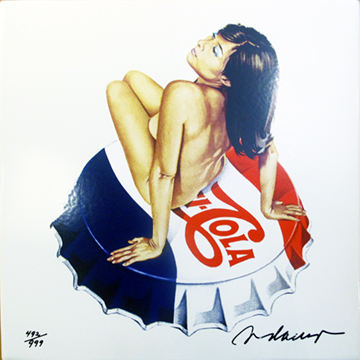
From a collecting perspective, the range of Ramos's output offers entry points at multiple levels of engagement. His prints, including lithographs such as Dionus from 2002, Gitanes from 1999, and Reese's Rose from 2008, represent some of the most accessible and visually immediate works in his catalogue. These editions have performed steadily at auction and in the secondary market, and they reward close looking in ways that reproductions simply cannot convey. The enamel print on aluminum Pepsi from 2005 is a particularly interesting object, combining the slick surface logic of advertising materials with the handmade specificity of an artist who always worked with his whole body.
Mel Ramos
Pepsi, 2005
Collectors drawn to the intersection of graphic design history and fine art practice find in these works a conversation that feels entirely alive. The context of Ramos within art history is both straightforward and pleasingly complicated. He is rightly grouped with the American Pop Art generation, alongside Warhol, Lichtenstein, James Rosenquist, and Tom Wesselmann, all of whom were grappling in their different ways with what it meant to make painting in a culture overwhelmed by images. But Ramos's California identity gave his work a specific inflection.
There is a warmth and directness to his pictures that distinguishes them from the cooler, more ironic register of much East Coast Pop. His affinities with Wayne Thiebaud and the broader tradition of West Coast figurative painting are real, and collectors who appreciate that tradition tend to find his work a natural and rewarding companion to it. The legacy of Mel Ramos is, in the end, an argument for the serious pleasures of popular culture. His work holds space in the permanent collections of the Whitney Museum of American Art, the Solomon R.
Guggenheim Museum, and major European institutions, a testament to the seriousness with which the best curators have always regarded his project. He painted for more than five decades without losing his curiosity or his generosity toward the viewer. The works available today, across paintings, prints, drawings, and mixed media, represent an artist who understood that beauty and wit are not opposites, and who spent his life making pictures that prove the point.