Mehdi Ghadyanloo
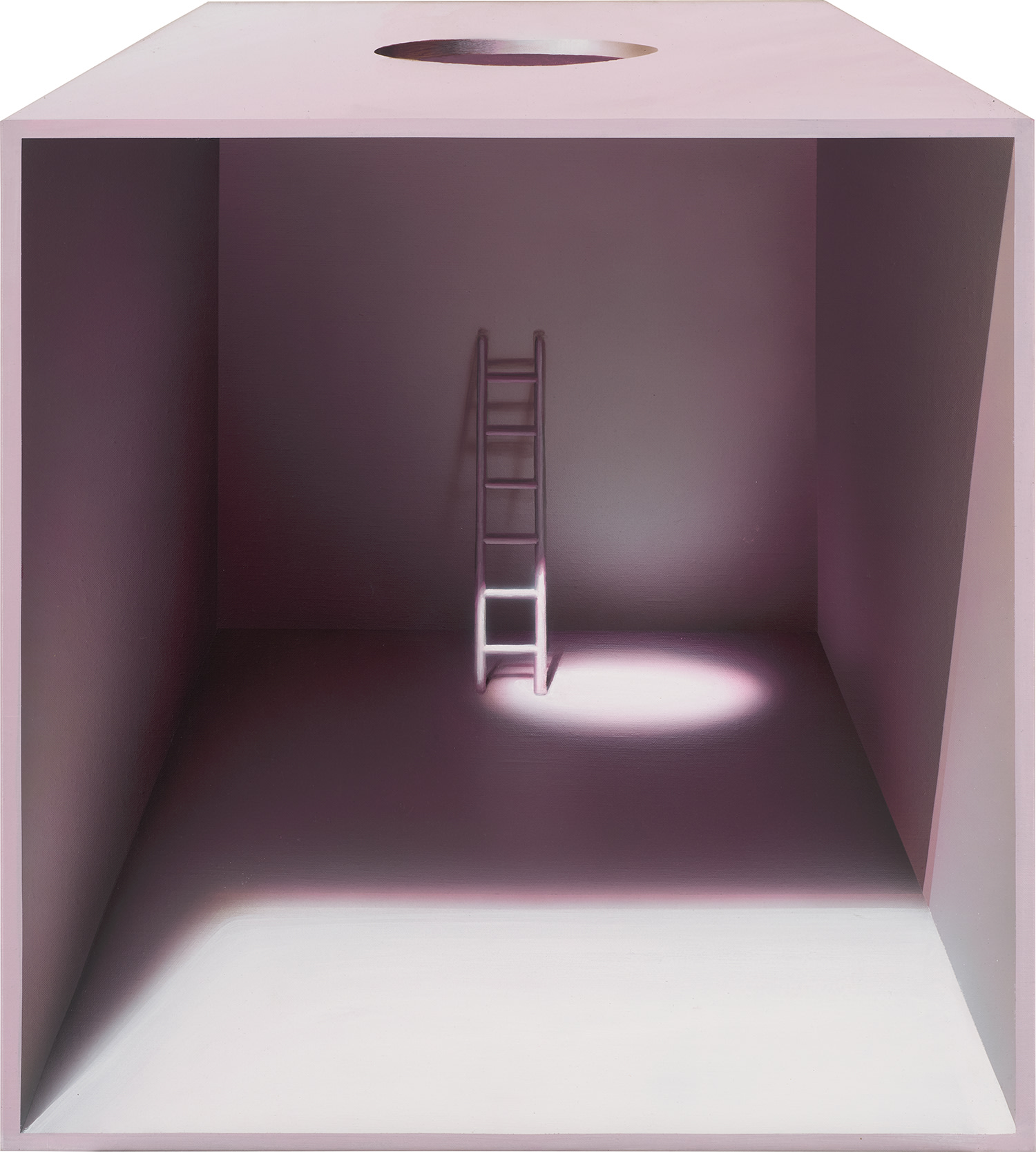
Mehdi Ghadyanloo, Dreamer of Open Skies
Artist Spotlight · The Collection Editorial
In the spring of 2015, something quietly remarkable happened on the streets of Boston. Mehdi Ghadyanloo, the Iranian artist who had already transformed hundreds of walls across Tehran with his luminous, otherworldly imagery, brought his singular vision to Nubian Square as part of the city's public art programme. The mural stopped people in their tracks. Here was a painter working at the scale of architecture yet with the intimacy of a whispered thought, conjuring pale figures suspended in cerulean space, navigating worlds that felt simultaneously impossible and deeply familiar.
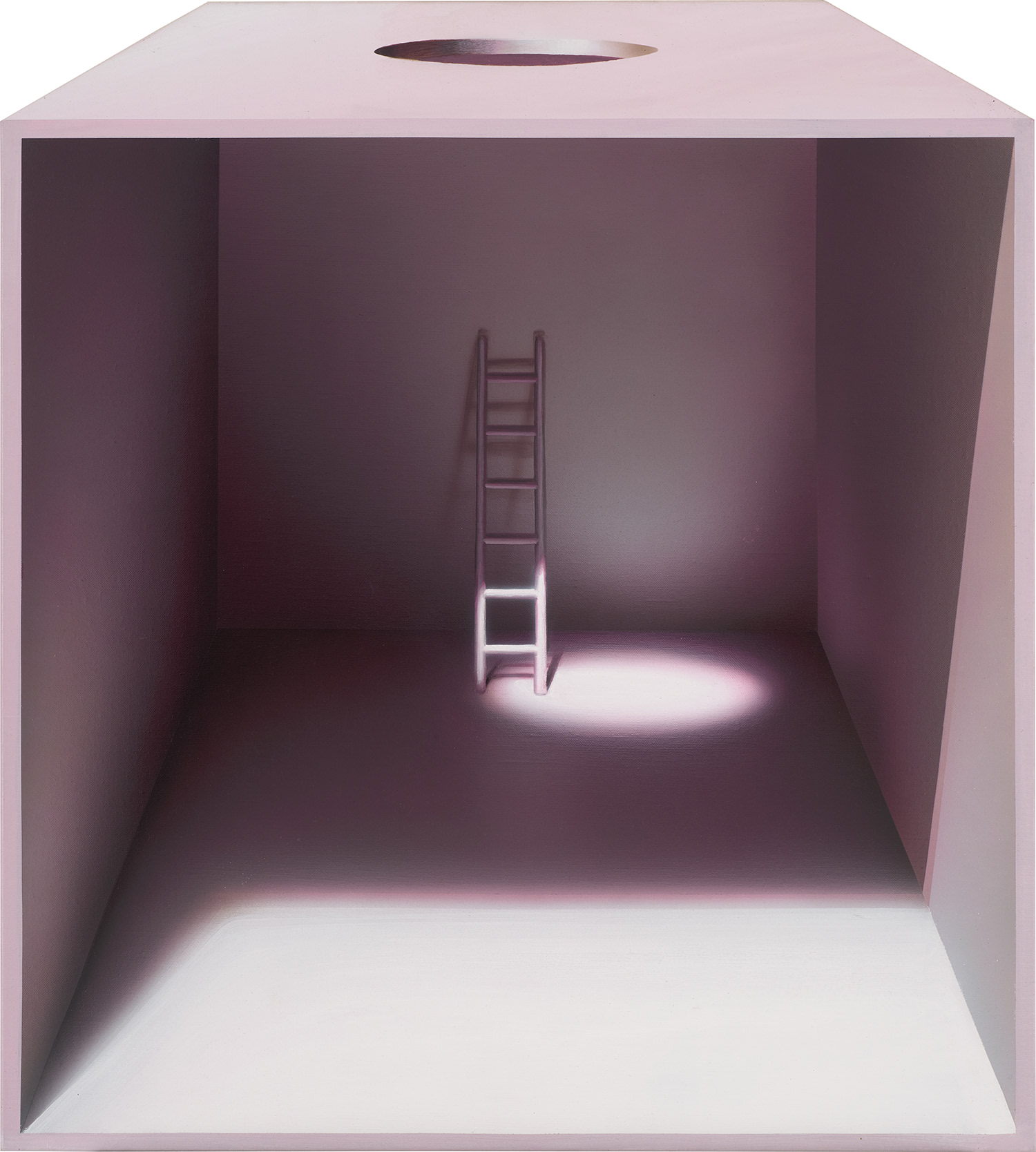
Mehdi Ghadyanloo
The Eternal Gate, 2019
It was a moment that announced to international audiences what those who had followed the Tehran art scene already understood: Ghadyanloo was one of the most genuinely original painters working anywhere in the world. Born in Tehran in 1981, Ghadyanloo came of age in a city shaped by the long aftermath of revolution and war. The Iran of his childhood and adolescence was a place of intense contradictions, where beauty and restriction coexisted in the everyday fabric of life, and where public space carried enormous symbolic weight. He studied at the University of Tehran, immersing himself in the traditions of Persian art while absorbing the surrealist and metaphysical currents flowing through Western modernism.
These twin inheritances would prove foundational. The compressed allegorical language of classical Persian miniature painting and the vast, disorienting dreamscapes of Giorgio de Chirico and René Magritte found a strange and productive harmony inside his imagination. His breakthrough came through an unlikely medium: the walls of Tehran itself. Beginning in the early 2000s, Ghadyanloo was commissioned to paint public murals across the Iranian capital, eventually working on well over a hundred walls throughout the city.
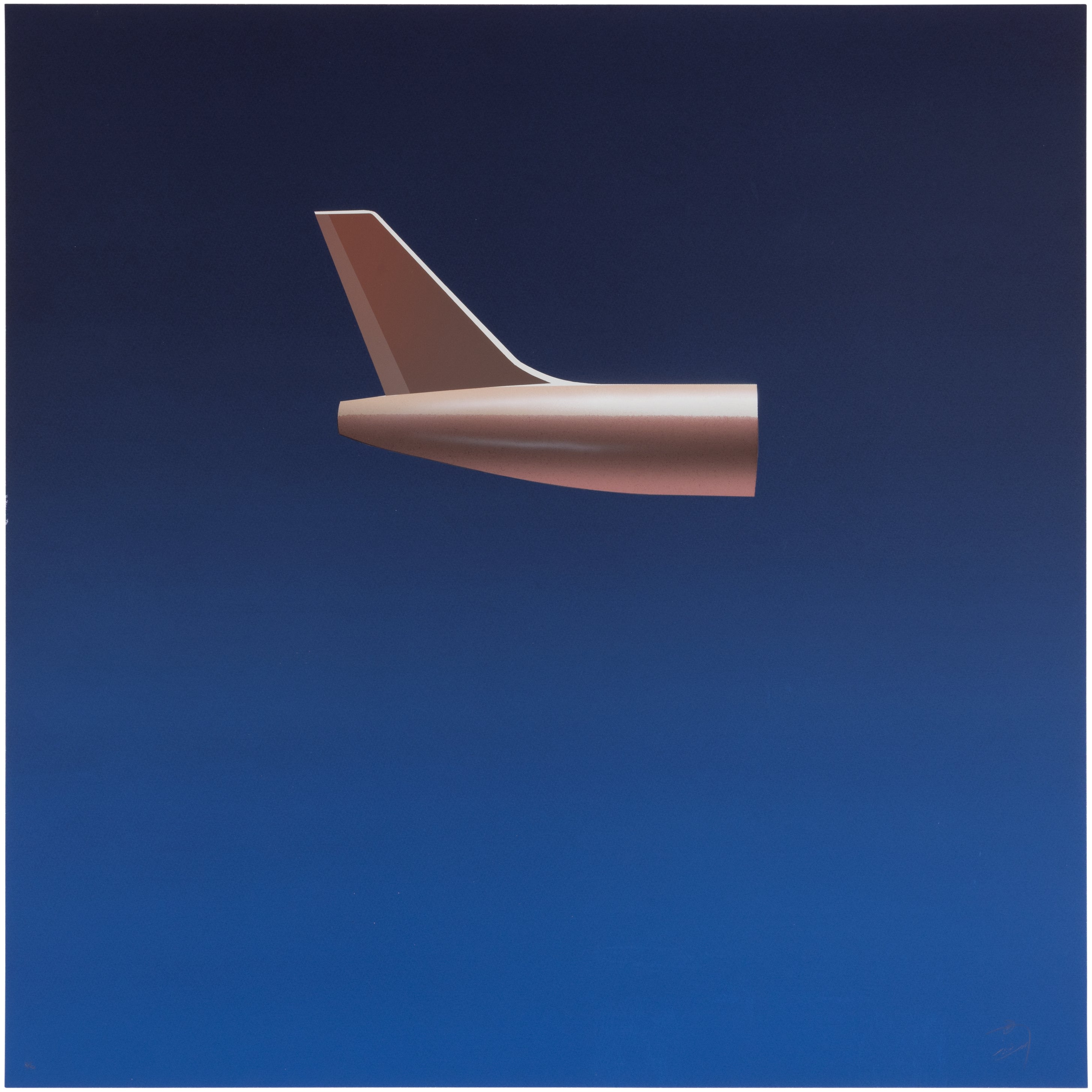
Mehdi Ghadyanloo
Gravity of Memories
Most public mural programmes in Tehran at that time served ideological functions, broadcasting political imagery or religious iconography. Ghadyanloo took a different path entirely. His murals offered something the city had rarely seen in its public spaces: pure, unencumbered wonder. He painted solitary figures perched on geometric structures floating in cloudless skies, children reaching toward light from shadowy interiors, and ladders ascending toward nothing and everything at once.
Tehranis would pause on their daily commutes to stand before these images, and something passed between the work and its audience that transcended the circumstances of its making. The formal vocabulary Ghadyanloo developed during those years of outdoor painting carries directly into his studio practice, and it is what gives his canvases, works on paper, and prints their unmistakable character. He works with a stripped down palette that somehow feels neither sparse nor cold: soft blues and greys that glow from within, architectural forms reduced to their essential geometries, and above all the figure, usually solitary, usually small against vast space, caught in a moment of suspended action. These are not figures in distress.
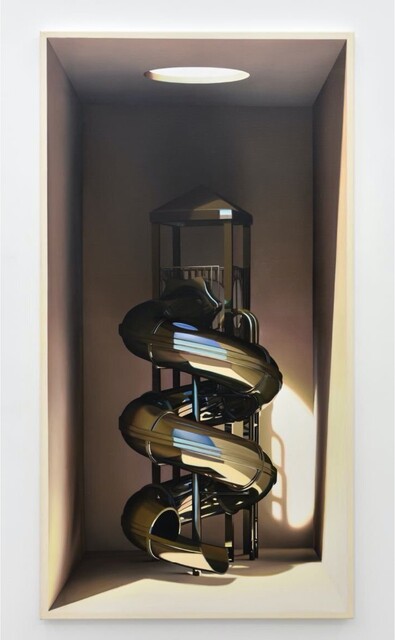
Mehdi Ghadyanloo
The Last Soldier, 2020
They are figures in a state of profound alertness, as though on the threshold of understanding something enormous. Works such as The Last Soldier from 2020 and The Stolen Dream from the same year carry this quality with particular intensity. The figures in these oil and acrylic paintings feel like emissaries from the interior life, standing in for all of us at our most contemplative and most vulnerable. His print editions have opened his practice to a wider circle of collectors and in doing so revealed another dimension of his thinking.
Works including Gravity of Memories, Enigma, Abandoned Puzzle, and Divide By Zero demonstrate how naturally his imagery translates into the screenprint medium. The precision of the process suits him: his compositions have always possessed an almost architectural clarity, each element placed with the deliberateness of a chess move. The prints, produced in editions on wove paper, retain all of the emotional weight of his paintings while offering an accessible entry point for collectors at the beginning of their engagement with his work. For those who have not yet encountered his canvases in person, the prints provide a considered and entirely satisfying introduction.
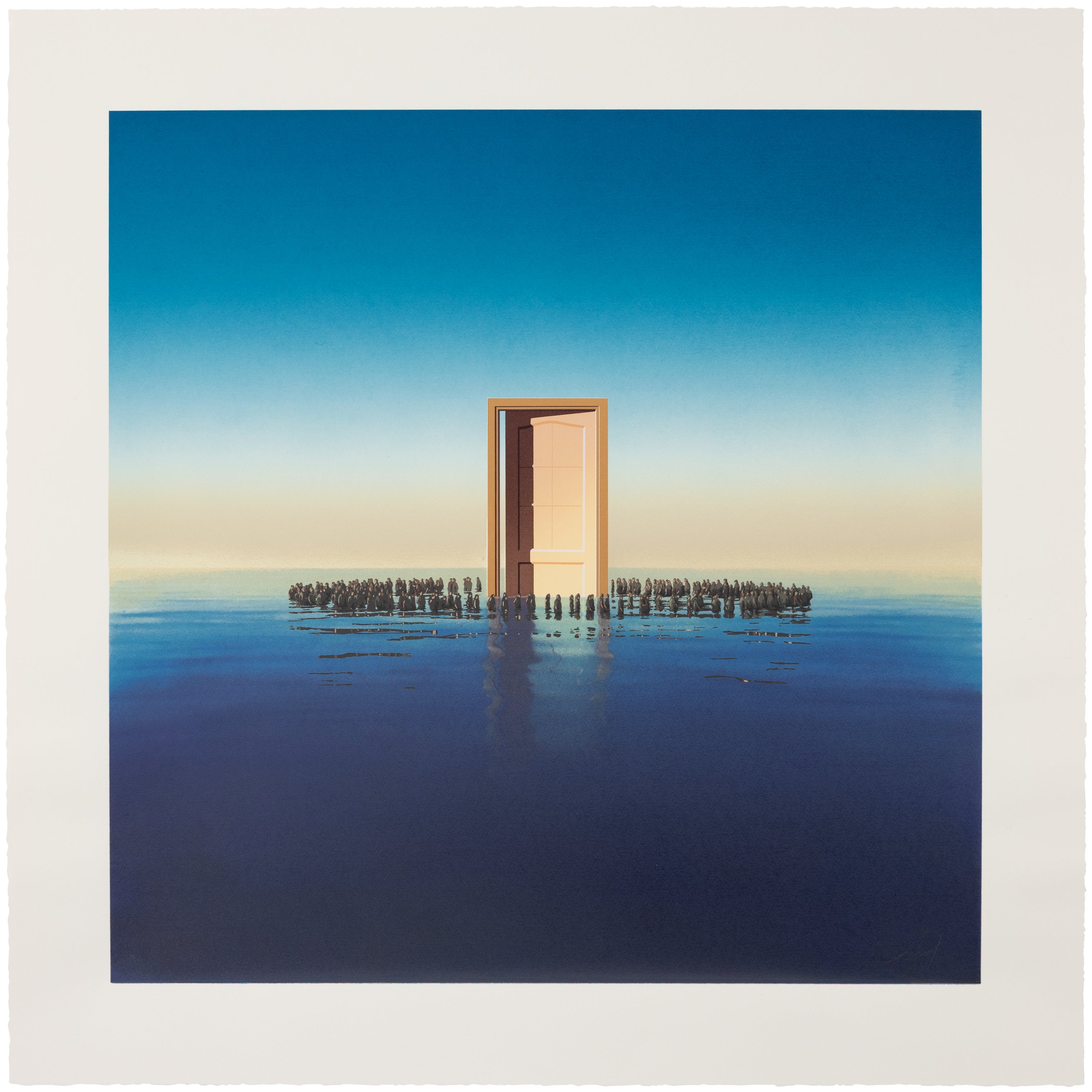
Mehdi Ghadyanloo
Enigma
Among his more recent studio works, The Eternal Gate from 2019 and The Unreachable Beauties from 2022 represent a deepening of his central concerns. In these acrylic canvases, the sense of yearning that has always animated his practice becomes more explicitly architectural, with thresholds and openings structuring the pictorial space as though painting itself were a kind of doorway. His 2023 oil on canvas, presented with its title in both English and Chinese as Untitled, points toward the genuinely international conversation his work has entered, resonating with collectors and institutions far beyond the Middle Eastern context in which he first developed his voice. The 2021 watercolour Slide, by contrast, shows his range at the intimate end of the scale, where spontaneity and control meet in the quietest and most affecting way.
From a collecting perspective, Ghadyanloo occupies a position of considerable interest and genuine opportunity. His auction presence has grown steadily as his international profile has expanded, and works across all media retain strong secondary market attention. Collectors are drawn to him for reasons that experienced advisors find both legible and durable: the work is formally coherent across decades and media, it carries emotional resonance without sentimentality, and it sits within a tradition of surrealist and metaphysical painting that connects him to canonical figures while remaining entirely his own. Those considering entry points would do well to look closely at the print editions, which are museum quality objects in their own right, and to follow the trajectory of his canvas production, where each new work adds another facet to one of the most consistent bodies of painting produced by any artist of his generation.
Collectors who are drawn to the contemplative, metaphysical strand in contemporary painting, those who love the work of Taner Ceylan, or who trace the lineage from de Chirico through to today, will find in Ghadyanloo a deeply rewarding focus. What matters most about Mehdi Ghadyanloo, in the end, is what his work does to time. Standing before one of his paintings or prints, the ordinary pressure of the present moment lifts slightly, and something older and more spacious opens up. That quality, so rare and so necessary, is what has drawn audiences from the walls of Tehran to the galleries of Europe and North America, and it is what will continue to bring new viewers into his world for decades to come.
He is an artist who reminds us that painting, at its most ambitious, is not a record of the world but a proposition about what the world might feel like if we were fully awake to it.