Maxime Lalanne
Maxime Lalanne, Poet of the Etched Line
Artist Spotlight · The Collection Editorial
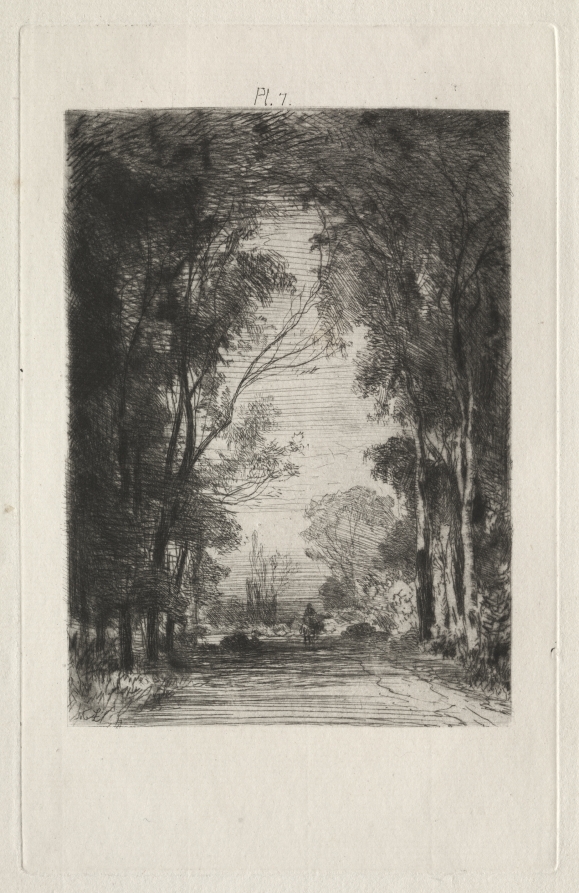
Stand before one of Maxime Lalanne's etchings and you will understand, almost immediately, why a generation of nineteenth century collectors could not get enough of them. His plates hum with atmosphere. Cobblestones glisten. Smoke rises from Bordeaux's harbor.
Maxime Lalanne
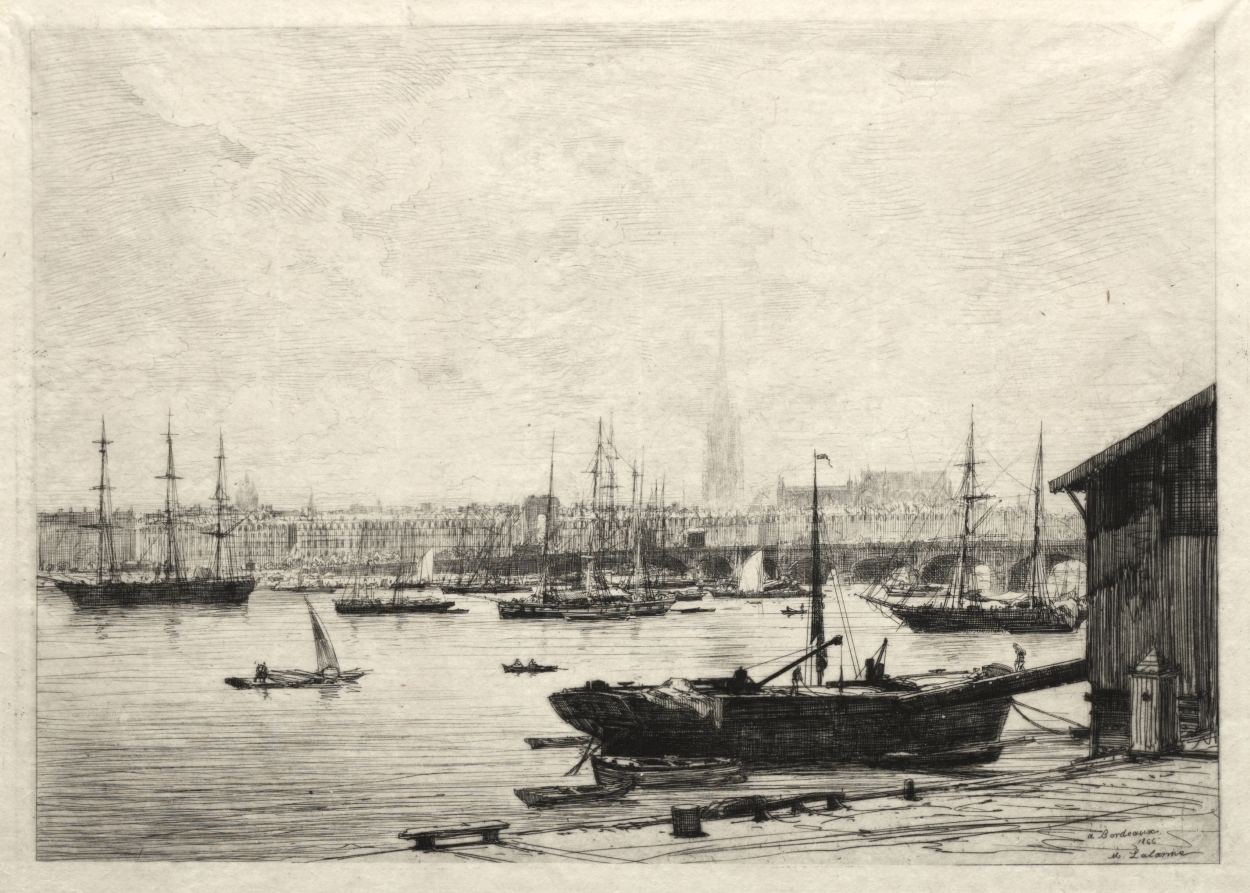
Bordeaux, 1866
The facades of old Paris lean into one another like old friends sharing secrets. Lalanne was not simply a printmaker recording his world; he was an artist who understood that the etching needle, dragged across a copper plate, could capture the very feeling of a city breathing. His rediscovery by a new generation of print enthusiasts and collectors has brought fresh attention to a body of work that rewards close looking and genuine feeling in equal measure. Lalanne was born in Bordeaux in 1827, and the city never really left him.
He grew up in a place defined by its river, its wine trade, its grand mercantile ambitions, and its deep provincial pride, all of which found their way into his sensibility as an artist. He trained as a painter and draftsman before gravitating decisively toward printmaking, a medium that suited both his temperament and his eye for the incidental detail that makes a scene feel lived in rather than merely observed. Bordeaux gave him his first great subject, and he returned to it throughout his career with the tenderness of someone paying tribute to a formative love. By the time Lalanne arrived in Paris and began exhibiting at the Salon in the 1860s, the etching revival was already gathering force in France.
Maxime Lalanne
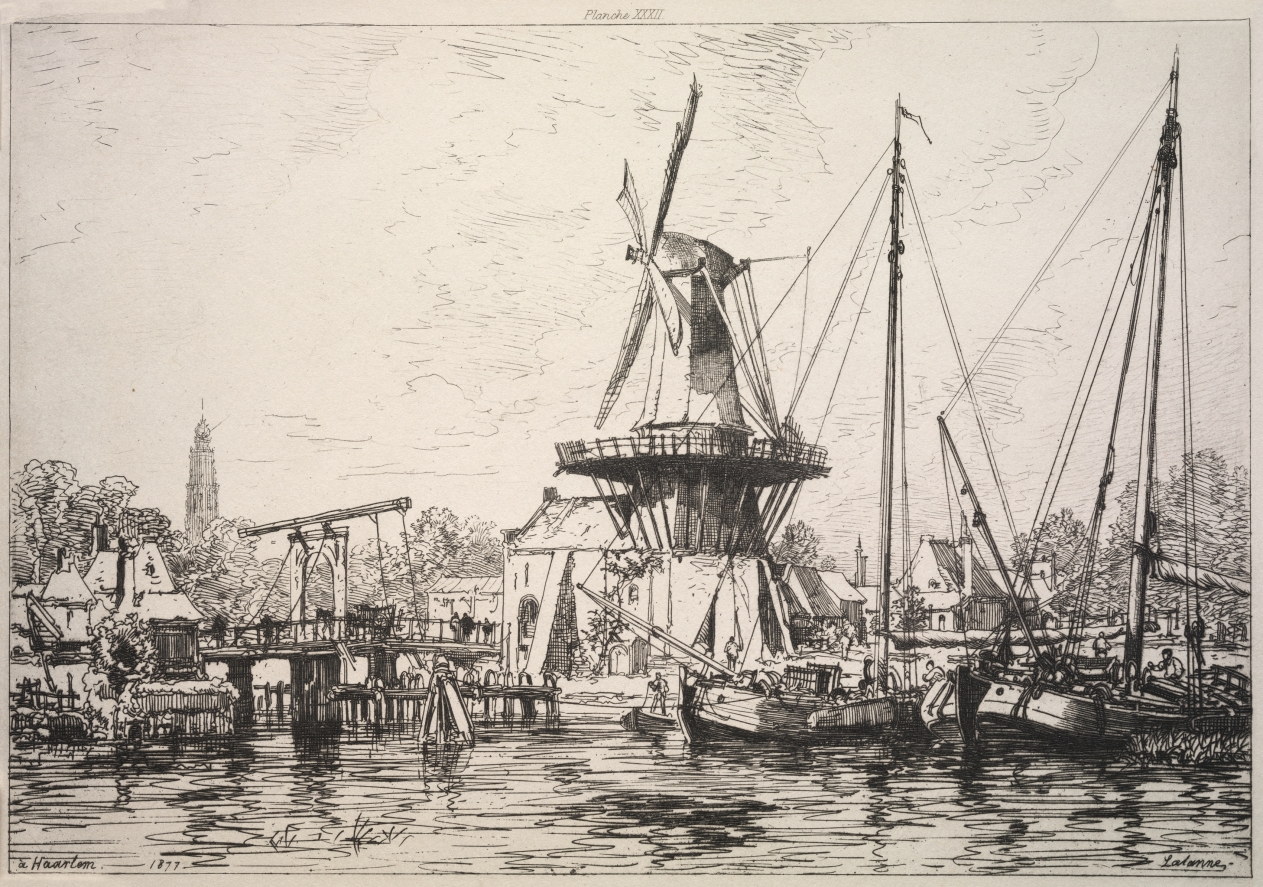
At Harlem (Holland), 1877
Charles Meryon had mapped the old city with obsessive precision. Charles François Daubigny and Jean Baptiste Camille Corot had brought the spirit of plein air painting into the print studio. Francis Seymour Haden and James McNeill Whistler were generating enormous excitement in London, and their influence rippled quickly across the Channel. Lalanne stepped into this charged moment with confidence, earning a reputation not only as a practitioner of great skill but as a teacher and theorist whose 1866 treatise on etching became one of the most widely read guides to the medium in the nineteenth century.
Published as "Traité de la gravure à l'eau forte," the book was translated into English and read avidly by aspiring printmakers on both sides of the Atlantic. His artistic development moved along two tracks simultaneously: the documenting of urban change and the celebration of picturesque permanence. The early 1860s found him working with urgent attention in the old quarters of Paris, producing plates such as "Demolition of Old Houses in Paris" (1862) and "Rue des Marmousets (Old Paris)" (1862) that stand among the most poignant visual records of Baron Haussmann's transformations of the French capital. Where some artists celebrated the grand new boulevards, Lalanne turned his gaze toward what was being lost, the medieval warrens and crooked streets that had defined Paris for centuries.
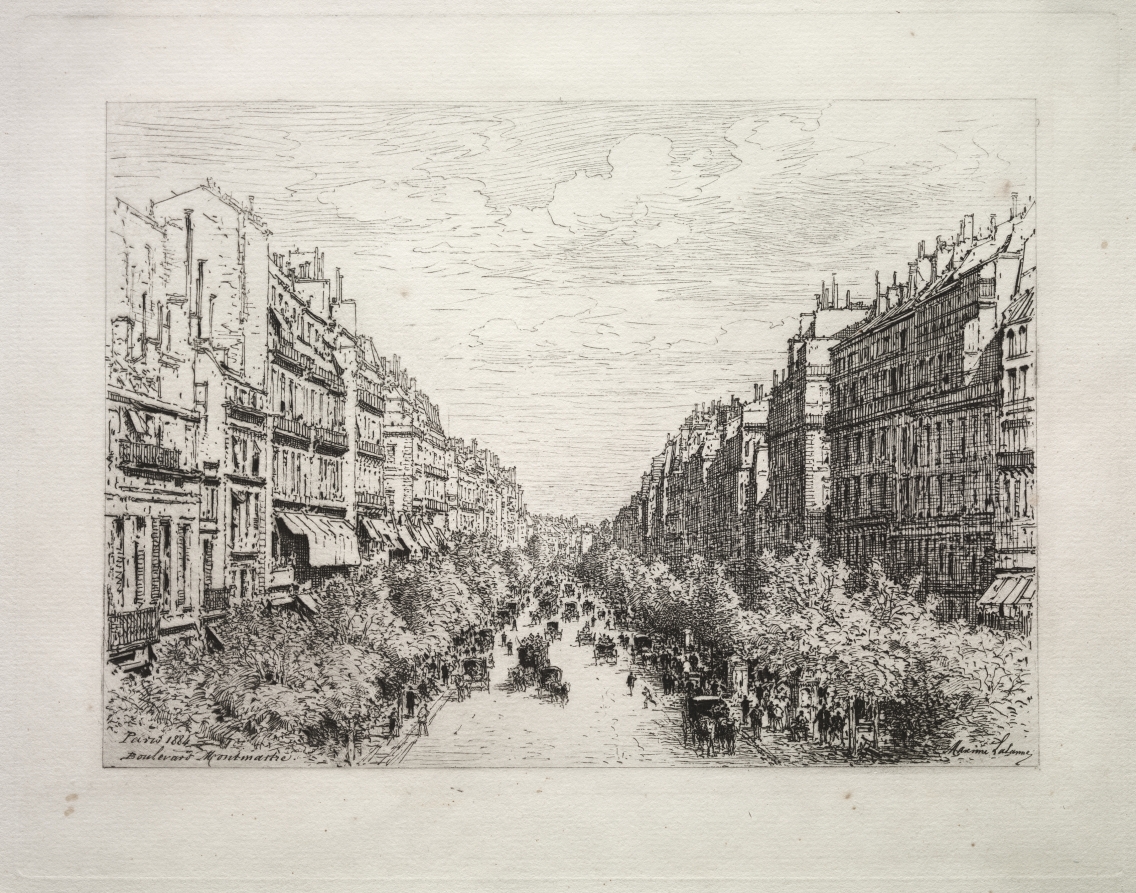
Maxime Lalanne
Boulevard Montmartre, 1884
There is no sentimentality in these works, only clarity and compassion, a commitment to preserving in ink what stone and timber could not survive. Lalanne's range was wider than his reputation as a chronicler of urban demolition might suggest. "Château de Chenonceau" (1865) demonstrates his feeling for romantic landscape and architectural grandeur, the famous chateau reflected in the Cher river with a softness that owes something to Corot and everything to Lalanne's own sensitivity to light and water. "Conflagration in the Port of Bordeaux" (1869) is an astonishing technical achievement, the chaos of fire and smoke rendered through a web of lines that somehow conveys both destruction and spectacle without melodrama.
His "Bastion 49" of 1870, made during the siege of Paris, carries a quiet weight of witness. His Dutch subject "At Harlem (Holland)" from 1877 reveals a traveler's eye delighted by new geography while remaining unmistakably his own in its tonal subtlety. And "Boulevard Montmartre" from 1884 shows his mastery undiminished in his later years, the great Parisian thoroughfare rendered with an ease that could only come from decades of practice. For collectors, Lalanne presents a genuinely compelling opportunity.
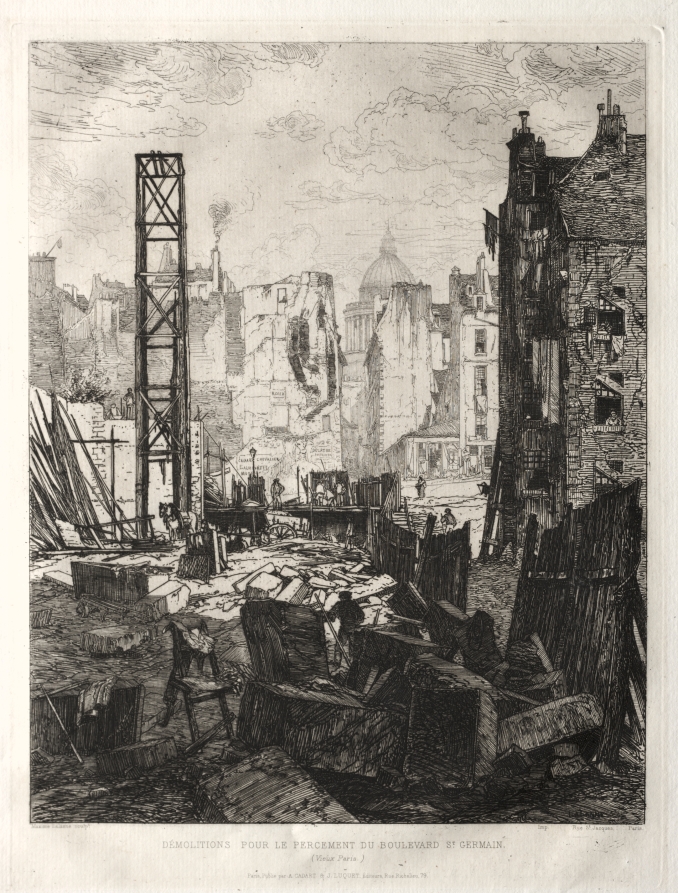
Maxime Lalanne
Demolitions pour la Perement du Boulevard St. Germain, 1874
His prints were made in relatively modest editions and were distributed through the serious print publishing networks of the day, which means that fine impressions, properly documented and in good condition, are meaningful objects rather than mere decorative items. When strong impressions appear at auction, at houses including Swann Galleries in New York and specialist print sales in Paris and London, they attract buyers who understand that quality etching from this period has historically maintained its value and its appeal across generations of taste. The key things to look for are the richness of the ink, the clarity of the biting in the plate, and the presence of good margins. Early impressions from before a plate shows signs of wear reward the attentive collector with a density and luminosity that later printings simply cannot match.
Lalanne belongs firmly in the company of the great etcher observers of nineteenth century France and Europe. His work invites comparison with Meryon for its devotion to Paris, with Daubigny for its landscape feeling, and with Whistler for its tonal sophistication. He was admired by contemporaries including Philippe Burty, the influential critic who championed the etching revival, and his treatise placed him in the tradition of artist teachers who understood that passing on technical knowledge was itself a form of contribution to the art. His Dutch subjects connect him to the broader European print tradition reaching back through Rembrandt, a tradition he absorbed and transformed rather than merely imitated.
Lalanne died in 1886, leaving behind a body of work that has never entirely disappeared from view but has sometimes been undervalued in the rush to celebrate more dramatically modern figures. What a sustained look at his prints reveals is an artist of genuine intelligence and feeling, someone who understood that the etching needle was an instrument of both documentation and poetry. In a moment when collectors are returning to the pleasures of works on paper, to the intimacy of prints that reward close attention and reward repeated looking, Lalanne's etchings feel not like relics but like discoveries. His cities are gone, but in his plates they remain entirely present, alive in the particular way that only great art can sustain.
Explore books about Maxime Lalanne