Max Pechstein
Max Pechstein: Color, Fire, and Freedom
Artist Spotlight · The Collection Editorial
“I paint what I see, what I experience, what is true for me.”
Max Pechstein
There is a moment, standing before a Max Pechstein canvas, when the room seems to breathe differently. The pigment arrives with such force, the figures press so urgently against the picture plane, that the work feels less like an object on a wall and more like an encounter with a living intelligence. It is no surprise, then, that museums across Germany and beyond have returned repeatedly to his legacy in recent decades, and that the sustained scholarly rehabilitation of his reputation, following the brutal erasure imposed by the Nazi regime, has now placed him firmly among the most essential voices of early twentieth century European modernism. For collectors approaching his work today, the conversation is not simply about art history.
Max Pechstein
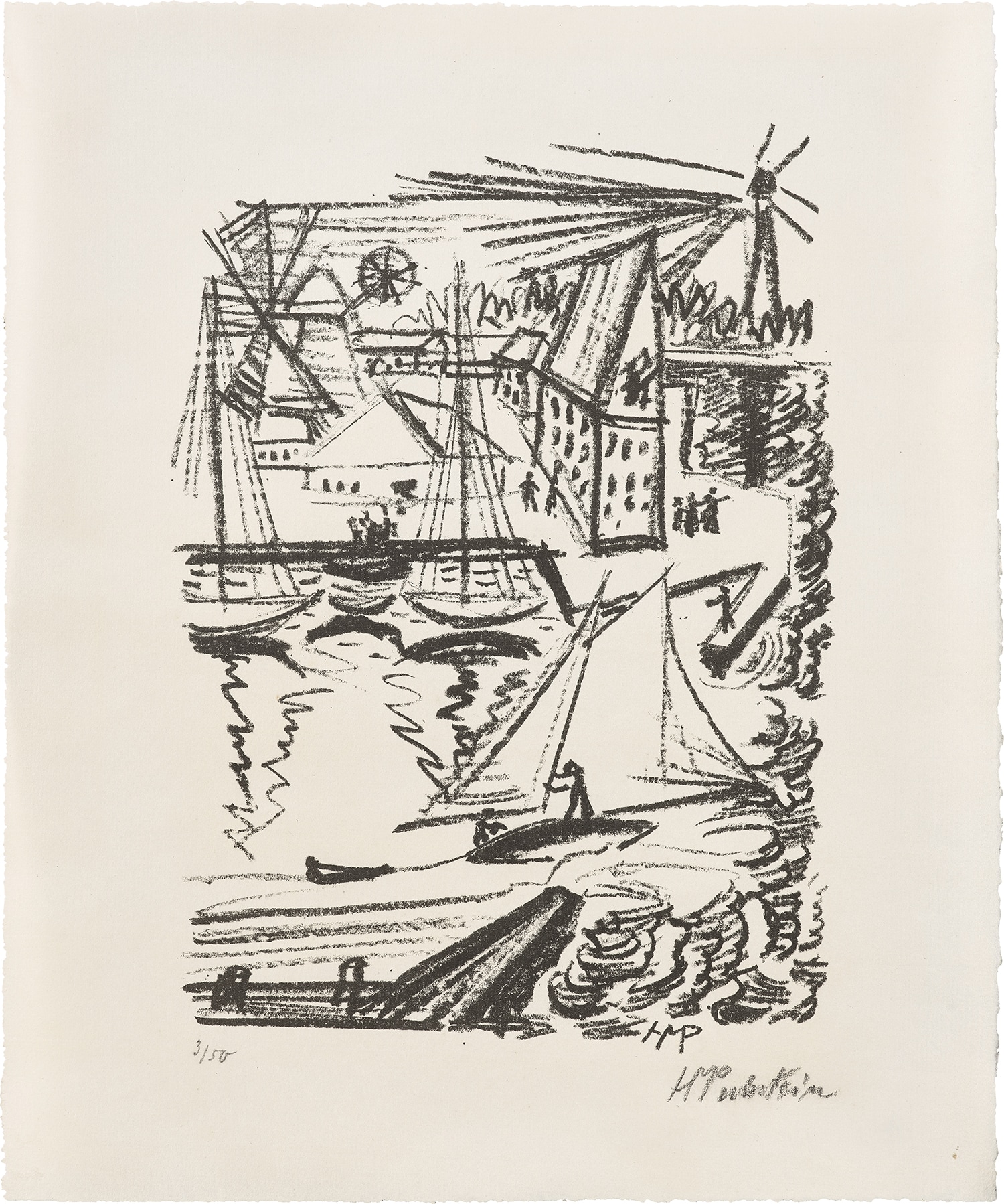
Hafen (auf Fehmarn) (Harbor (On Fehmarn)) (K. L 365)
It is about recognizing a painter of extraordinary emotional and technical gifts who has, for too long, stood slightly behind his peers in the popular imagination despite having helped invent the language they all shared. Hermann Max Pechstein was born in 1881 in Zwickau, a Saxon industrial town whose working rhythms and unpretentious atmosphere left a permanent mark on his sensibility. He trained initially as a decorative painter and craftsman before entering the Dresden School of Arts and Crafts, and later the Dresden Academy of Fine Arts, where he developed the technical discipline that would underpin even his most spontaneous looking work. He was not an aristocrat of the art world, not a product of comfortable bourgeois leisure.
He came from labor, from material making, from the tradition of the craftsman who understood that beauty was something you built with your hands. That grounding gave his painting a physical immediacy that separates it from the more cerebral strands of German modernism. In 1906, Pechstein joined Die Brücke, the incandescent Dresden collective founded by Ernst Ludwig Kirchner, Erich Heckel, and Karl Schmidt Rottluff, whose ambition was nothing less than the reconstruction of German art on entirely new terms. The group drew ferociously on medieval German woodcut traditions, on the post Impressionist liberation of color championed by Van Gogh and Gauguin, and on the structural boldness of Cézanne.
Max Pechstein
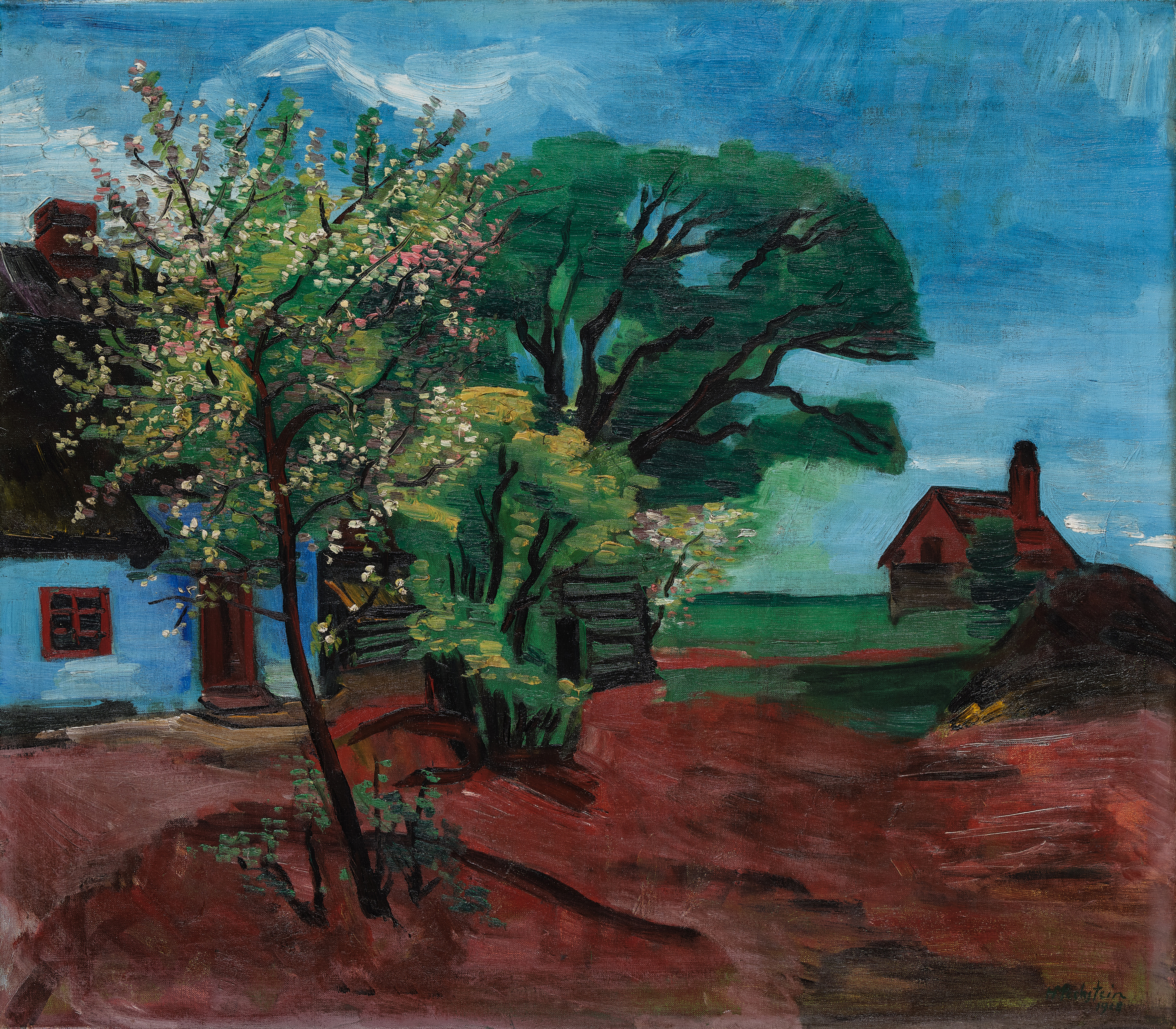
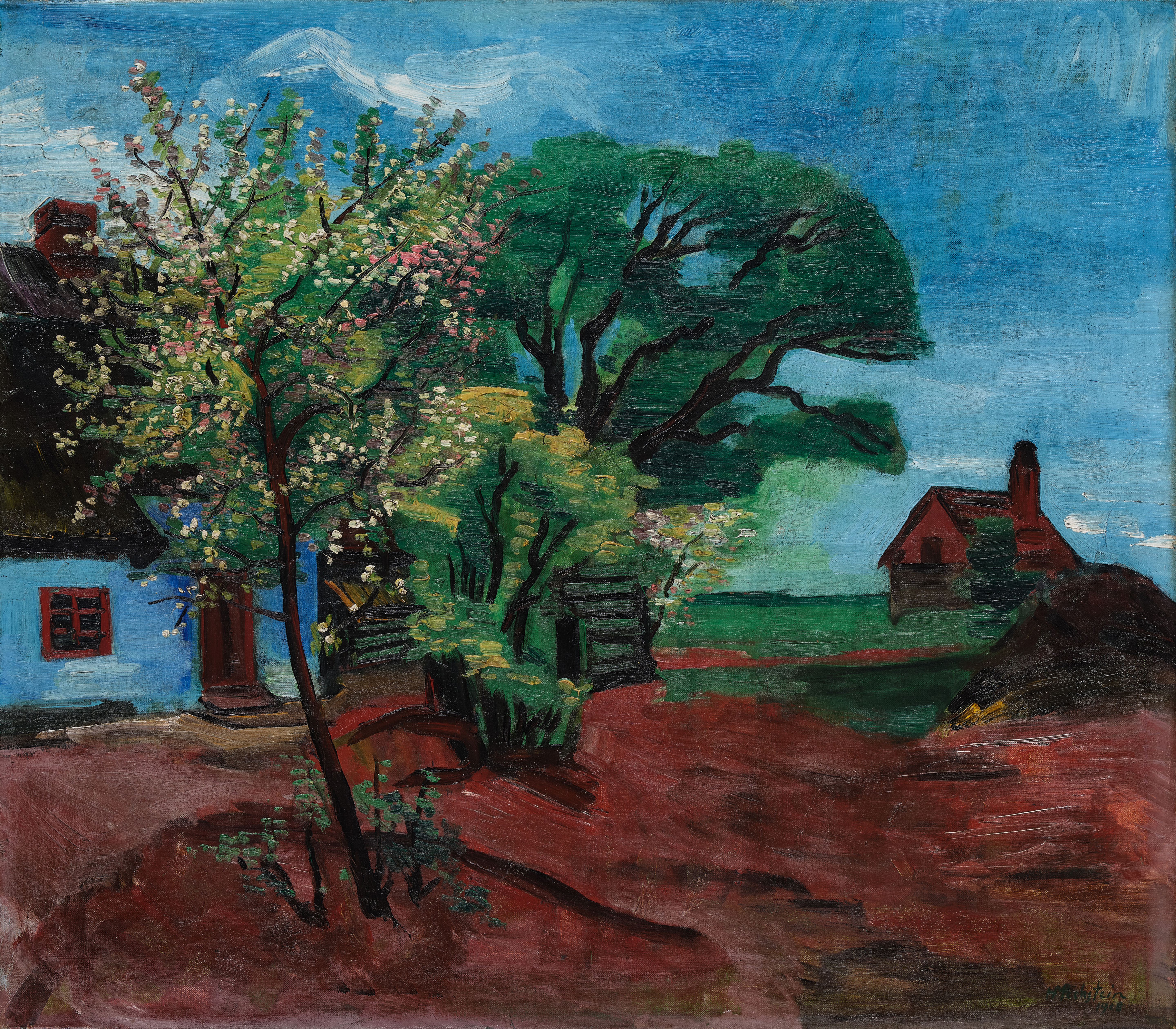
Kirschblüte (Cherry Blossom)
Pechstein absorbed all of these influences and added his own: he had encountered Fauvism firsthand during a formative visit to Paris in 1907, and the shock of Matisse and Derain loosened something in his brushwork that never fully tightened again. His palette opened wide, his figures grew more fluid, and a sense of joyful physical presence entered his compositions that would remain characteristic for the rest of his career. The journey that defined the second great chapter of his artistic life was his voyage to the Palau Islands in 1914, then a German colonial territory in the Pacific. Pechstein had long been fascinated by what he understood as the unmediated vitality of non Western visual cultures, a fascination shared by many of his Expressionist contemporaries and one that must be acknowledged today in its full colonial context, as the artists of Die Brücke were engaging with cultures they did not fully understand and could not represent without the distortions of their own historical position.
What the Palau journey gave Pechstein, whatever its complicated premises, was an encounter with light, water, and human form at an intensity he had not previously experienced. The paintings and prints that emerged from this period carry a luminosity and a looseness that feel hard won rather than casually achieved. The outbreak of the First World War cut the journey short and Pechstein was interned briefly before returning to Germany, but the images he had gathered sustained his imagination for years afterward. Among the works available through The Collection, the range of Pechstein's practice becomes richly apparent.
Max Pechstein
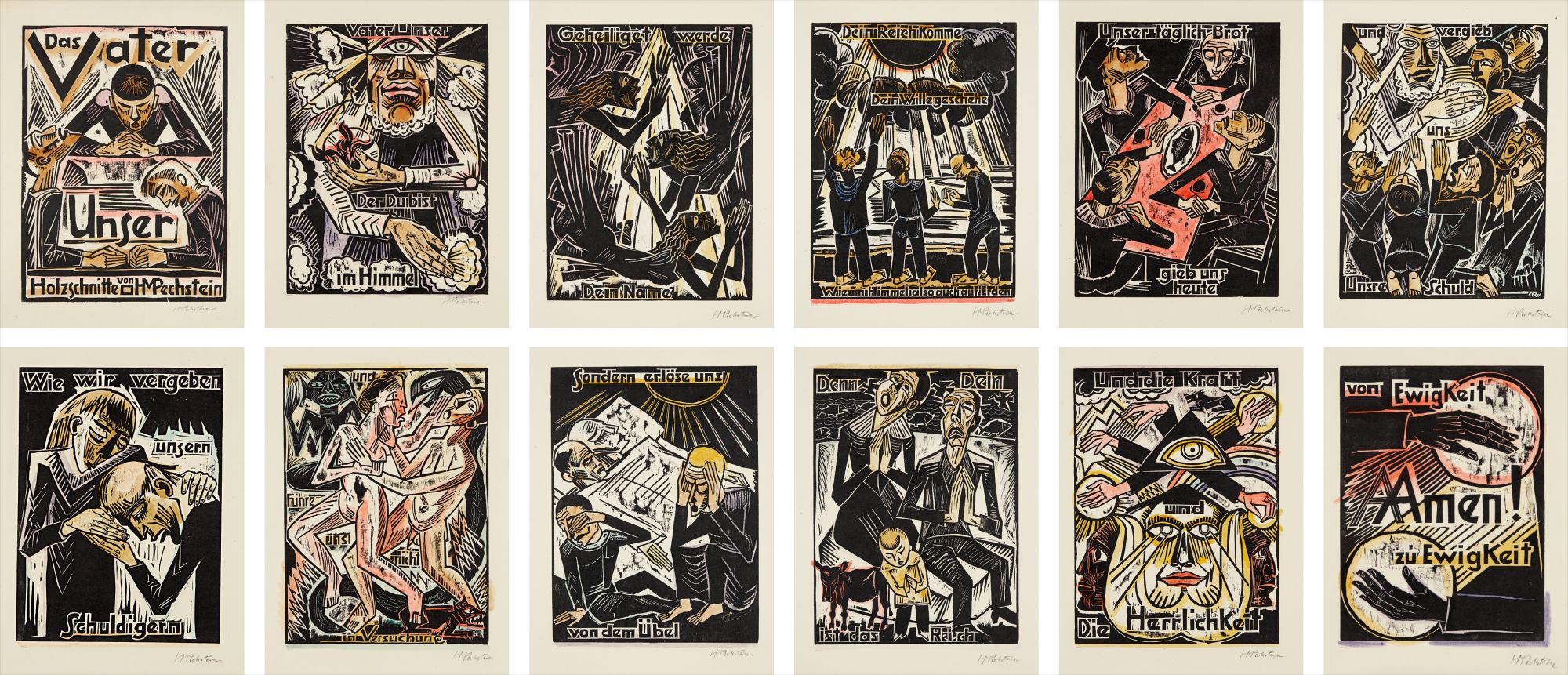
Das Vater Unser (The Lord's Prayer)
The lithograph Hafen (auf Fehmarn) demonstrates his mastery of the print medium, with the Baltic harbor rendered in bold tonal contrasts that capture both the physical weight of working boats and the particular quality of northern light on open water. Kirschblüte, painted in oil on canvas, showcases the jubilant color sense for which he is most celebrated, the blossoming tree becoming almost an abstraction of springtime feeling rather than a botanical description. Das Vater Unser, his celebrated illustrated version of the Lord's Prayer published by Propyläen Verlag in Berlin, represents one of the most ambitious intersections of his printmaking and his humanist spiritual convictions, each sheet signed by Pechstein and by the printer Fritz Voigt, with the rare hand colored edition of fifty among the most sought after of all his graphic works. And in Herbstschatten from 1921, the oil paint is applied with a confidence that has absorbed everything from Fauvism to German folk tradition and arrived at something entirely personal, the autumn shadows pooling across the canvas with an ease that speaks of total command.
From a collecting perspective, Pechstein occupies a position of genuine opportunity. His reputation among specialists has always been strong, his inclusion in major institutional collections across Germany and in museums in the United States and the United Kingdom confirms his historical standing, and yet his market has not always reflected the full measure of his achievement in the way that, say, Kirchner's or Nolde's has. Prints and works on paper offer an accessible entry point into his practice, and the graphic work is where his compositional thinking is often most clearly legible. Oils from the period between roughly 1910 and 1925 represent the peak of his powers and the heart of what collectors prize.
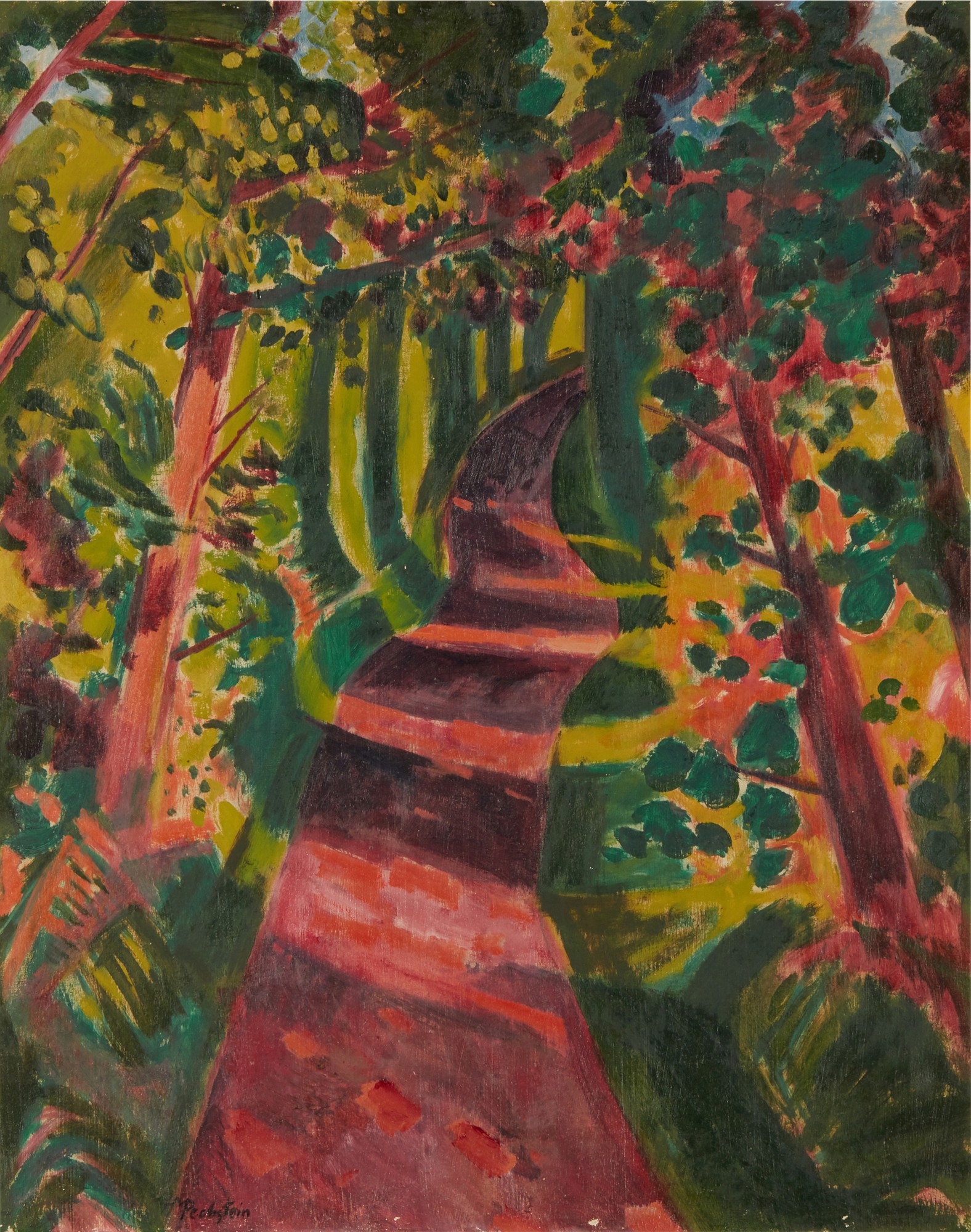
Max Pechstein
Herbstschatten (Autumn shade) , 1921
Works with clear provenance and exhibition histories are naturally preferred, given the complexity introduced by the Nazi confiscations of 1933, when hundreds of his works were seized from German public collections as part of the regime's systematic assault on modernism. That history of loss and recovery adds a dimension of cultural meaning to every authenticated work that survives. To understand Pechstein fully, it helps to hold him in relation to the artists he worked alongside and the movements he intersected with. Within Die Brücke, he was often the most accessible voice, the painter whose work carried the group's radical energy in a form that broader audiences could enter without difficulty.
Beyond the group, his affinities run to Emil Nolde's chromatic intensity, to the structural ambitions of the Fauves, and to the humanist printmaking tradition that connects him to Käthe Kollwitz, though his temperament was considerably warmer and less mournful than hers. Outside Germany, he shares something with Raoul Dufy in the way light and pattern become almost synonymous, and with André Derain in the way formal simplification serves emotional amplification rather than reducing it. The legacy of Max Pechstein is the legacy of a man who loved making things, who loved the world of fishing villages and harbor light and the human figure in motion, and who channeled that love into works of sustained beauty and formal intelligence. He was reinstated to the Berlin Academy of Arts after the Second World War and spent his final decade teaching and painting with undiminished commitment, his later oils carrying the authority of an artist who had survived catastrophe with his vision intact.
For anyone building a collection around the great arc of European modernism, his work is not a footnote or a supporting character. It is a primary voice, warm and urgent and fully alive.
Explore books about Max Pechstein
Max Pechstein: Leben und Werk
Werner Haftmann
Max Pechstein 1881-1955
Anselm Kiefer and Barbara Müller-Kempf
Max Pechstein: Katalog der Gemälde
Leopold Reidemeister
Max Pechstein und die Südsee
Jill Lloyd
Der Expressionist Max Pechstein
Peter Selz
Max Pechstein: Catalogue Raisonné of his Prints
Leopold Reidemeister
Max Pechstein: 1881-1955
Staatsgalerie Stuttgart