Max Klinger
Max Klinger: Dreams Made Gloriously, Hauntingly Real
Artist Spotlight · The Collection Editorial
There is a moment in the Städel Museum in Frankfurt, standing before a vitrine of Max Klinger's graphic cycles, when the nineteenth century suddenly feels very close. The obsessive draftsmanship, the slippery logic of dream and desire rendered in ink and acid on paper, the sense of a mind absolutely sovereign in its strangeness: Klinger does not feel like a historical artist. He feels like a discovery. Institutions across Germany and central Europe have returned to his work with renewed appetite in recent decades, and the market for his prints and sculpture has grown steadily as collectors recognize in him one of the most genuinely original imaginations European art ever produced.
Max Klinger
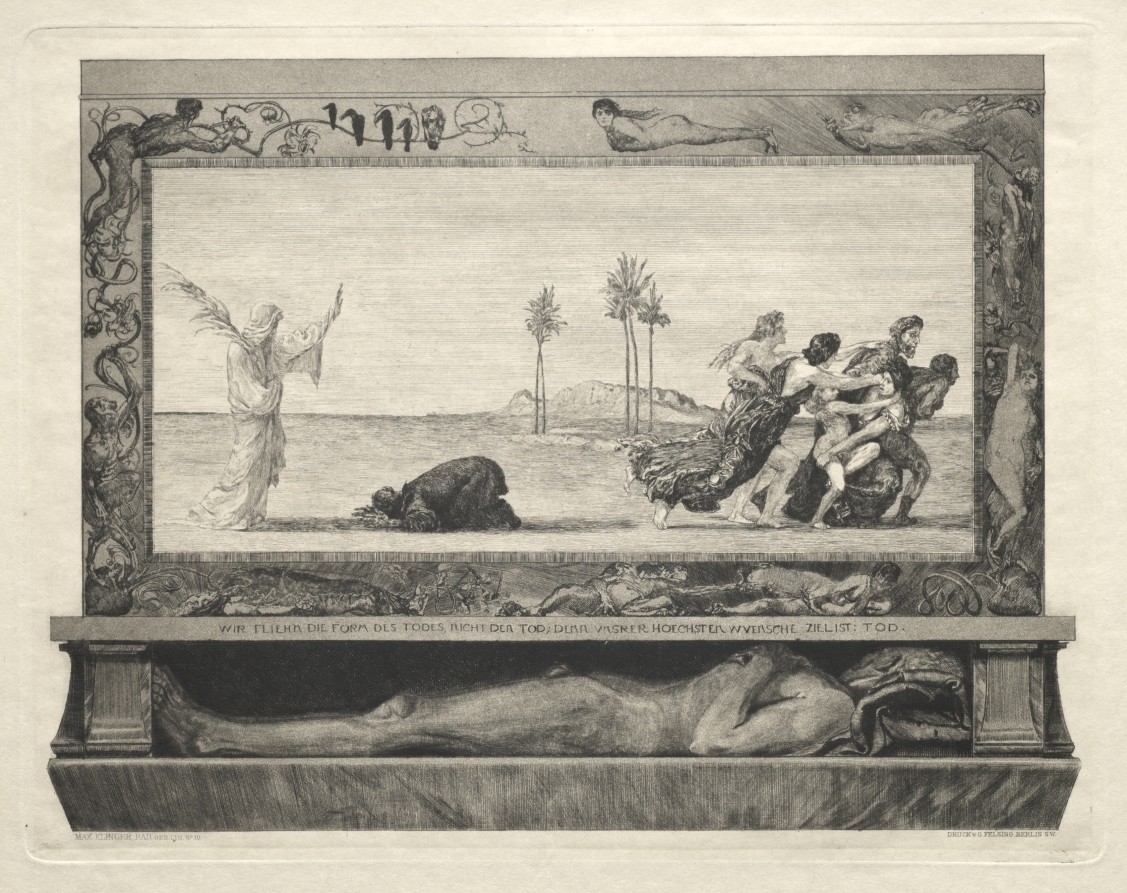
Vom Tode I, (Opus II, 1889) No. 10, 1889
Max Klinger was born in Leipzig on February 18, 1857, into a prosperous bourgeois family with the means and inclination to support his early talent. He studied at the Karlsruhe Academy under Karl Gussow before moving to Berlin, where he continued his training and first began exhibiting the graphic ambition that would define his reputation. A formative period in Brussels exposed him to the cosmopolitan currents of late nineteenth century European thought, and time spent in Paris and then Rome deepened his engagement with classical antiquity, mythology, and the philosophical questions that would animate his mature work. Klinger was not simply a draftsman who became a painter and sculptor: he was from the outset a thinker in images, a man for whom the visual was inseparable from the philosophical.
His artistic development unfolded with remarkable coherence across wildly different media. In the late 1870s and early 1880s, Klinger began producing the graphic cycles, which he called Opus numbers in deliberate homage to musical composition, that would secure his lasting fame. These sequences of etchings and aquatints were not illustrations of literary texts but self contained narrative and symbolic worlds, governed by their own interior logic. He moved from printmaking to painting on a monumental scale, producing ambitious canvases that blended allegory, naturalism, and psychological intensity in ways that anticipate Symbolism and even Surrealism.
Max Klinger
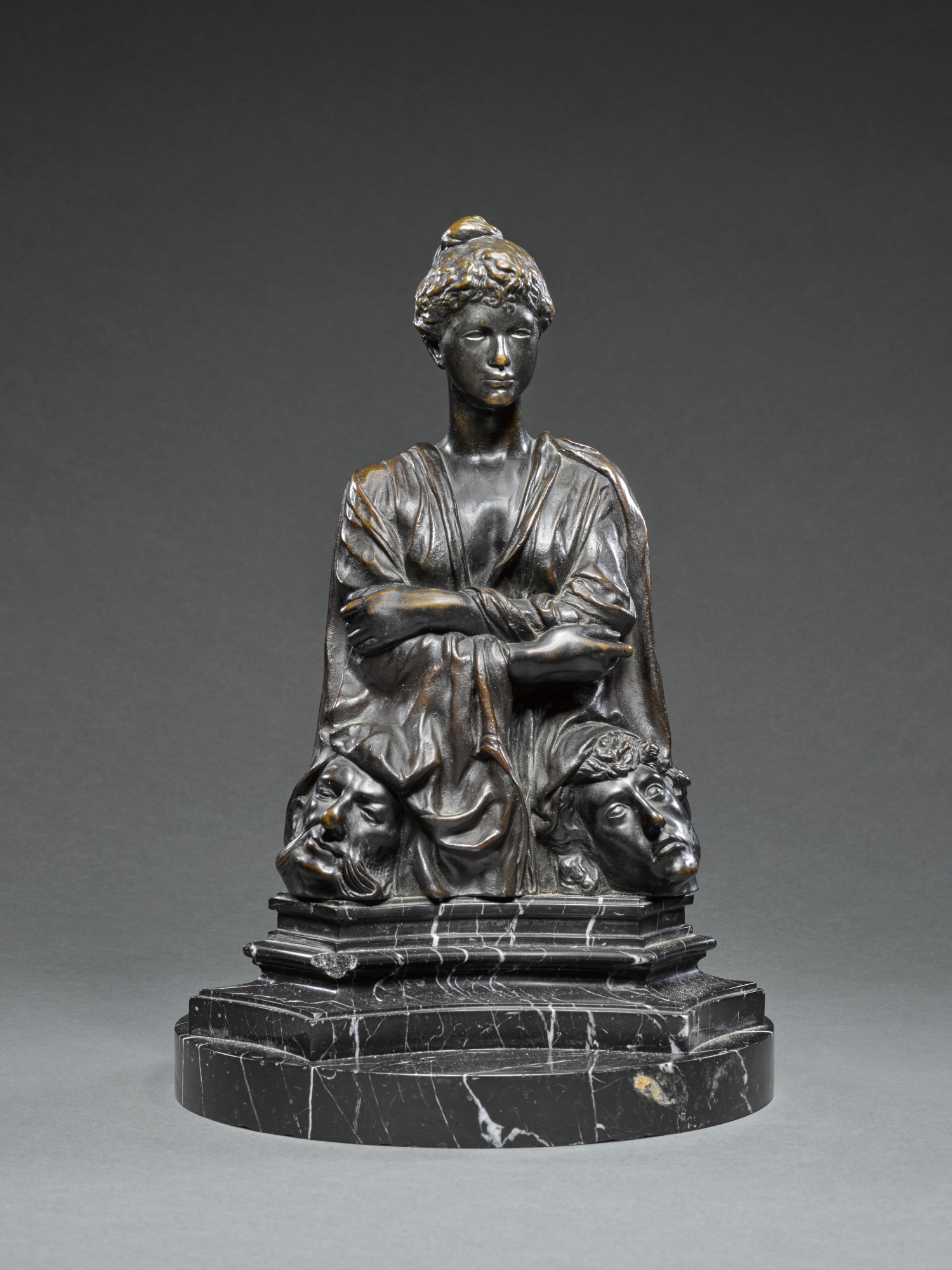
Die Neue Salome (The New Salome)
Later in his career he devoted enormous energy to polychrome sculpture, working with combinations of marble, bronze, ivory, and semiprecious stone to create works of theatrical grandeur. His marble and bronze monument to Beethoven, completed in 1902 and now held at the Museum der Bildenden Künste Leipzig, was celebrated at the Vienna Secession exhibition of that year, where Gustav Klimt and his colleagues honored Klinger as a supreme exemplar of the total artwork, the Gesamtkunstwerk that Wagner had theorized and that the Secessionists sought to realize. Among his most celebrated works are the graphic cycles A Glove, catalogued as Opus VI and created around 1880, and the series Paraphrase on the Finding of a Glove, which unfolds as a sequence of hallucinatory scenes in which a dropped glove becomes the catalyst for erotic obsession, nightmare, and fantasy. The cycle reads today as an uncanny anticipation of Freudian dream logic, and Sigmund Freud himself admired the work.
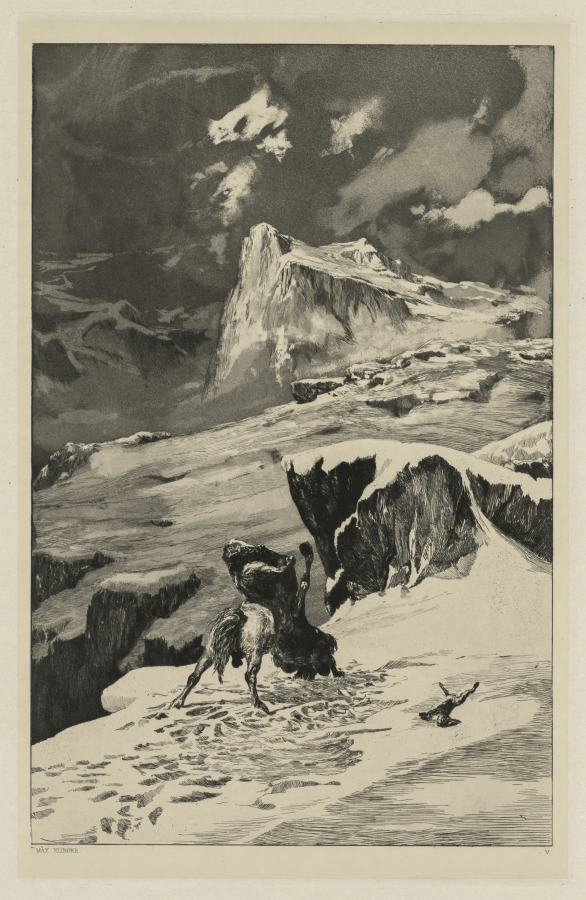
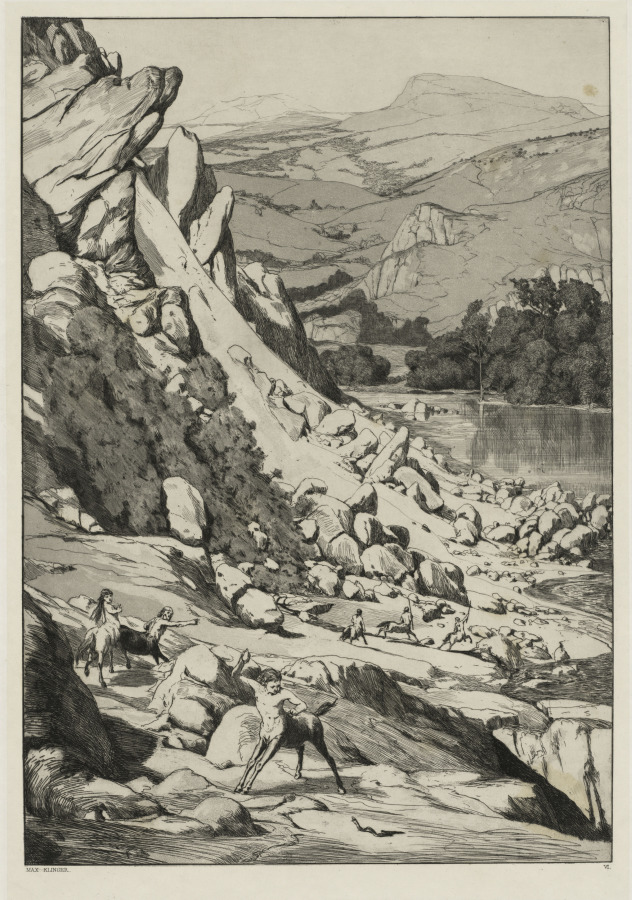
The series Vom Tode, or On Death, in its two iterations published in 1889, brings together Klinger's technical mastery with a meditative, unflinching engagement with mortality that never collapses into morbidity: these are prints of extraordinary beauty, in which the finality of death is held in tension with the luminous formal precision of the aquatint ground. The mythological series Intermezzo, Opus IV, from 1881, including the thunderous Battling Centaurs and the vertiginous Landslide, demonstrates Klinger's ability to translate classical subject matter into something raw and kinetic, full of physical force. His sculpture Die Neue Salome, cast in bronze with a dark brown patina and mounted on a veined black marble base, distills his preoccupation with femme fatale iconography into an object of arresting material elegance. For collectors, Klinger's work offers a rare combination of art historical significance and genuine aesthetic pleasure.
Max Klinger
Landslide (Opus IV, 6), 1881
His graphic cycles are among the most technically accomplished prints of the nineteenth century, and individual sheets appear regularly at auction at Lempertz, Grisebach, and Ketterer Kunst, where they attract serious competition from collectors across Europe and increasingly from North America and Asia. The complete cycles command premium attention, but individual prints from Vom Tode I, A Glove, and the Intermezzo series are each fully realized works that reward close looking. Condition is paramount, as Klinger's use of chine collé, the technique of printing onto a thin tissue paper adhered to a heavier support, makes his sheets sensitive to handling and light exposure. Collectors who acquire carefully, seeking impression quality and provenance, are acquiring works that have been valued by major public collections for over a century and that continue to attract scholarly and curatorial attention.
In art historical terms, Klinger occupies a fascinating position at the intersection of several major currents. His graphic work places him in conversation with Francisco Goya, whose Caprichos he clearly studied, and with Félicien Rops, the Belgian symbolist printmaker whose erotic and phantasmagoric imagery shares something of Klinger's sensibility. His painting connects him to Arnold Böcklin, the Swiss Symbolist whose mythological landscapes similarly blend classical reference with psychological strangeness, and to Hans von Marées, the German painter of idealized figure compositions who was another touchstone for the generation seeking an alternative to academic naturalism. The Surrealists later claimed Klinger as a precursor: André Breton and Giorgio de Chirico both wrote about his graphic work with admiration, and de Chirico's metaphysical townscapes owe something to the dreamlike spatial disjunctions Klinger achieved in ink.
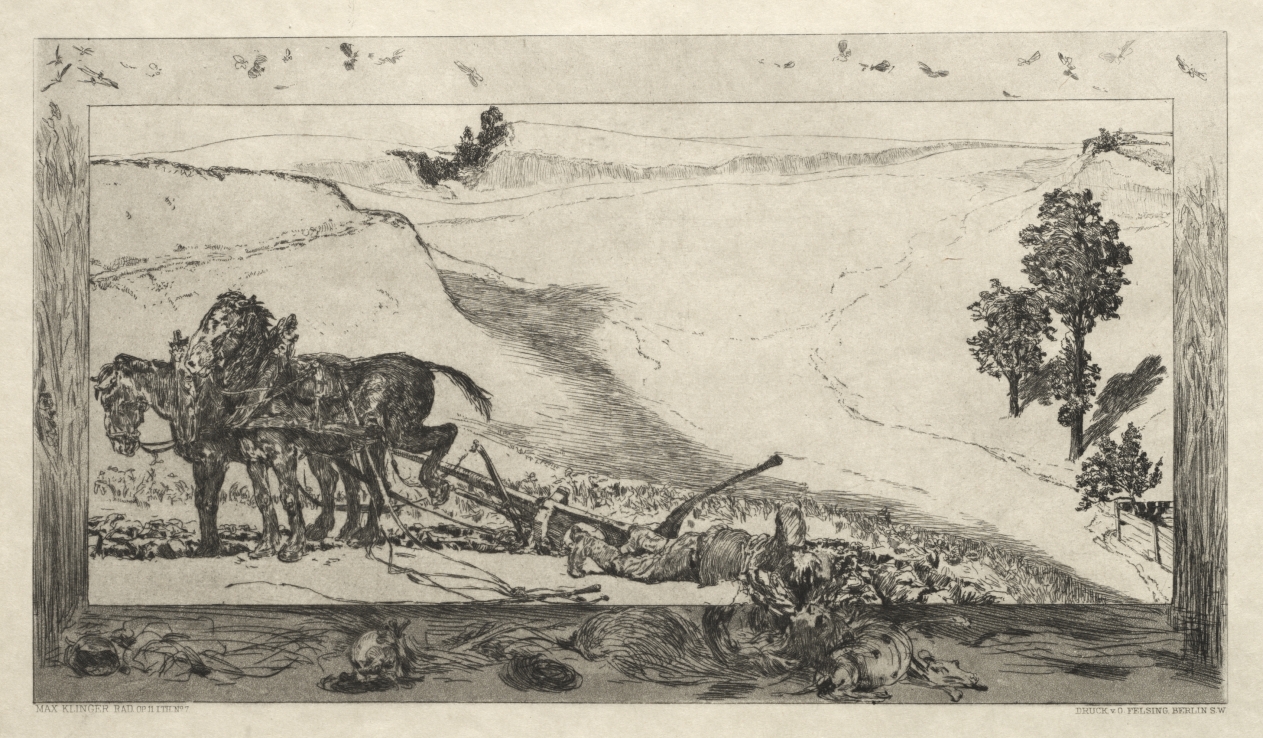
Max Klinger
Vom Tode I (Opus II, 1889) No. 7, 1889
Klinger died in Großjena on July 4, 1920, having lived long enough to see the world he had imagined in his art convulsed by the catastrophe of the First World War. His reputation fluctuated through much of the twentieth century, as Modernism's most doctrinaire voices had little patience for work that refused to choose between figuration and symbol, between craft and concept. But the broader view of history has been generous to him. The museum that bears his city's name, the Museum der Bildenden Künste Leipzig, holds the largest collection of his work in the world and serves as the anchor for continued scholarship.
For anyone who cares about the full reach of European visual culture, about the ways in which an artist can be technically rigorous and psychologically adventurous at the same time, Max Klinger is not simply worth knowing. He is essential.
Explore books about Max Klinger
Max Klinger: Das Gesamtwerk
Hans Wolfgang Singer
Max Klinger
Julius Meier-Graefe
Max Klinger: Druckgraphik
Peter Paret
Max Klinger: Leben und Werk
Dieter Gleisberg

Max Klinger
Ulrich Finke
Max Klinger and the Question of Style
Linda C. Hults
Max Klinger: Drawings and Prints
Werner Hofmann
Max Klinger: Sculpture and Painting
Christian Geelhaar