Maurice Utrillo
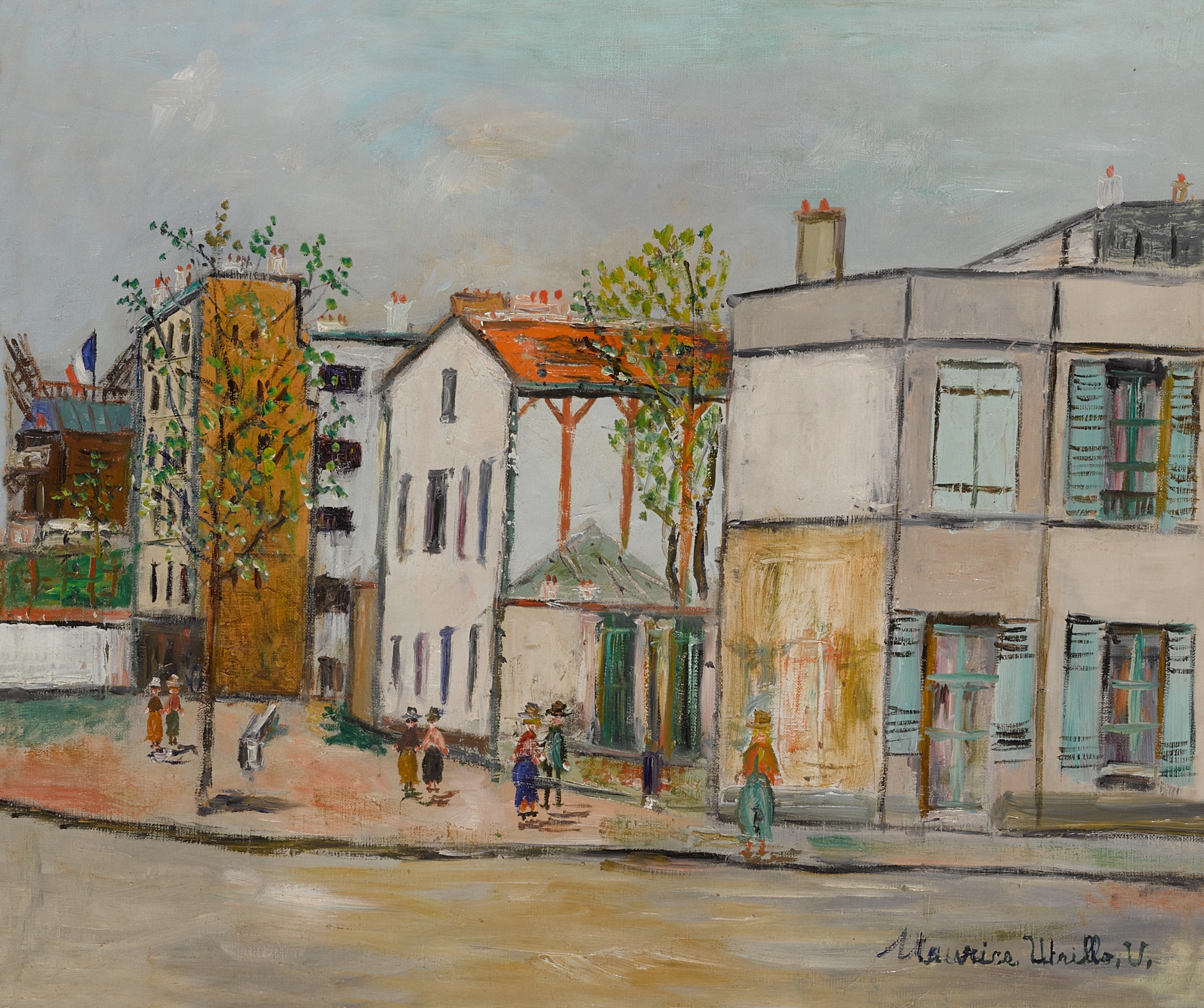
Maurice Utrillo, Poet of Parisian Streets
Artist Spotlight · The Collection Editorial
“I paint to forget the miseries of my life, and painting is the only joy I have ever known.”
Maurice Utrillo
There is a moment, standing before a Maurice Utrillo canvas, when the cobblestones seem almost audible beneath your feet. The walls lean with the particular weight of plaster and memory. The sky holds that pearl grey luminosity that belongs to Paris and nowhere else on earth. It is no coincidence that when the Musée de Montmartre, perched on the very hillside that Utrillo painted obsessively for decades, presents his work, visitors pause longer than expected, drawn into a world that feels simultaneously nostalgic and urgently alive.
Maurice Utrillo
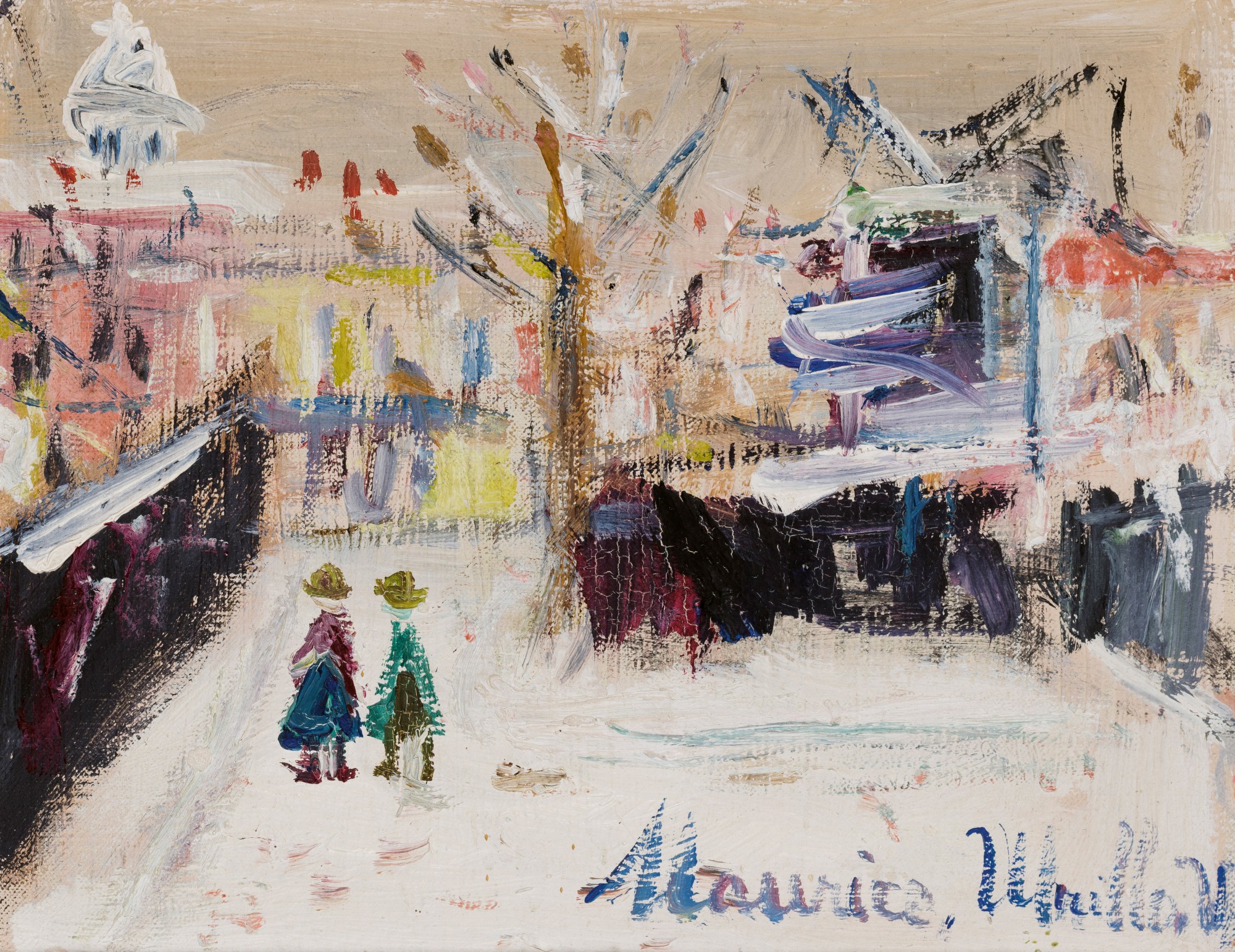
Moulin de la Galette sous la neige, 1945
Utrillo painted a city that still exists in the imagination, and his canvases remain among the most emotionally direct and technically assured records of early twentieth century Parisian life. Maurice Utrillo was born in Paris on 26 December 1883, the son of Suzanne Valadon, herself a formidable painter and former model who had posed for Renoir, Toulouse Lautrec, and Puvis de Chavannes. His father's identity remained uncertain for years, and it was the Spanish writer and critic Miguel Utrillo who eventually lent the boy his surname in a gesture of formal acknowledgment. Growing up in the shadow of Montmartre, surrounded by artists and the rhythms of bohemian life, Maurice absorbed the visual texture of Paris from his earliest years.
That immersion would later become both his subject and his salvation. Utrillo began painting seriously around 1902, encouraged by his mother as a form of therapy to address the alcoholism that had begun to consume him as a teenager. What started as a prescribed activity became a lifelong vocation of remarkable intensity. His earliest period, spanning roughly 1903 to 1909 and now referred to as his Impressionist phase, shows a painter finding his footing through careful observation and a palette still indebted to the influence of Camille Pissarro and the broader Post Impressionist tradition.
Maurice Utrillo
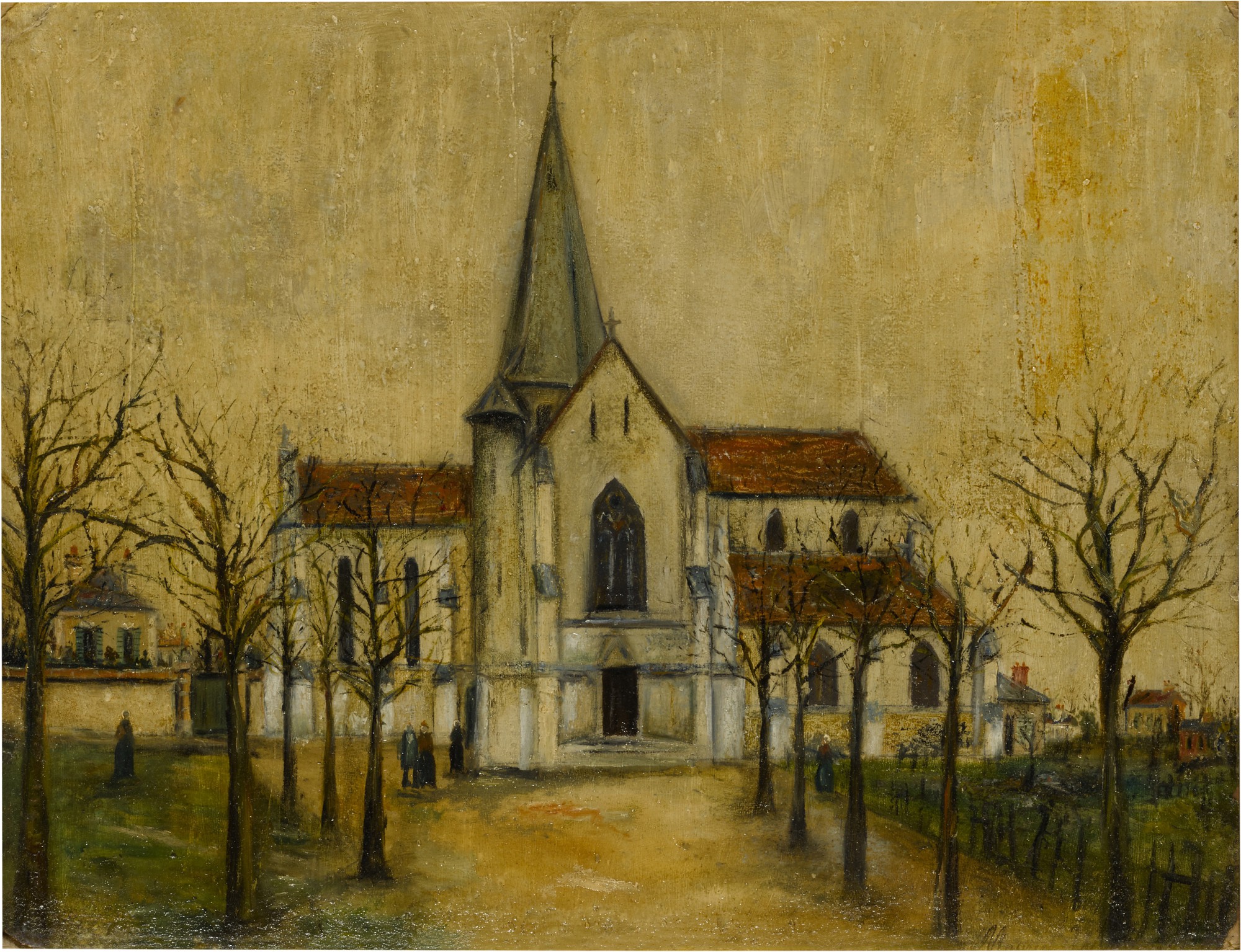
L’Église, 1914
The works from these years have a searching quality, as though the painter is learning to see the street as structure rather than merely as scenery. The period that collectors and scholars prize above all others is his White Period, lasting from approximately 1909 to 1914. During these years, Utrillo developed a distinctive technique of mixing plaster, glue, and sand directly into his paint, producing surfaces of extraordinary tactile richness. The walls of Montmartre buildings, rendered in chalky whites, warm creams, and soft greys, became almost sculptural presences on his canvases.
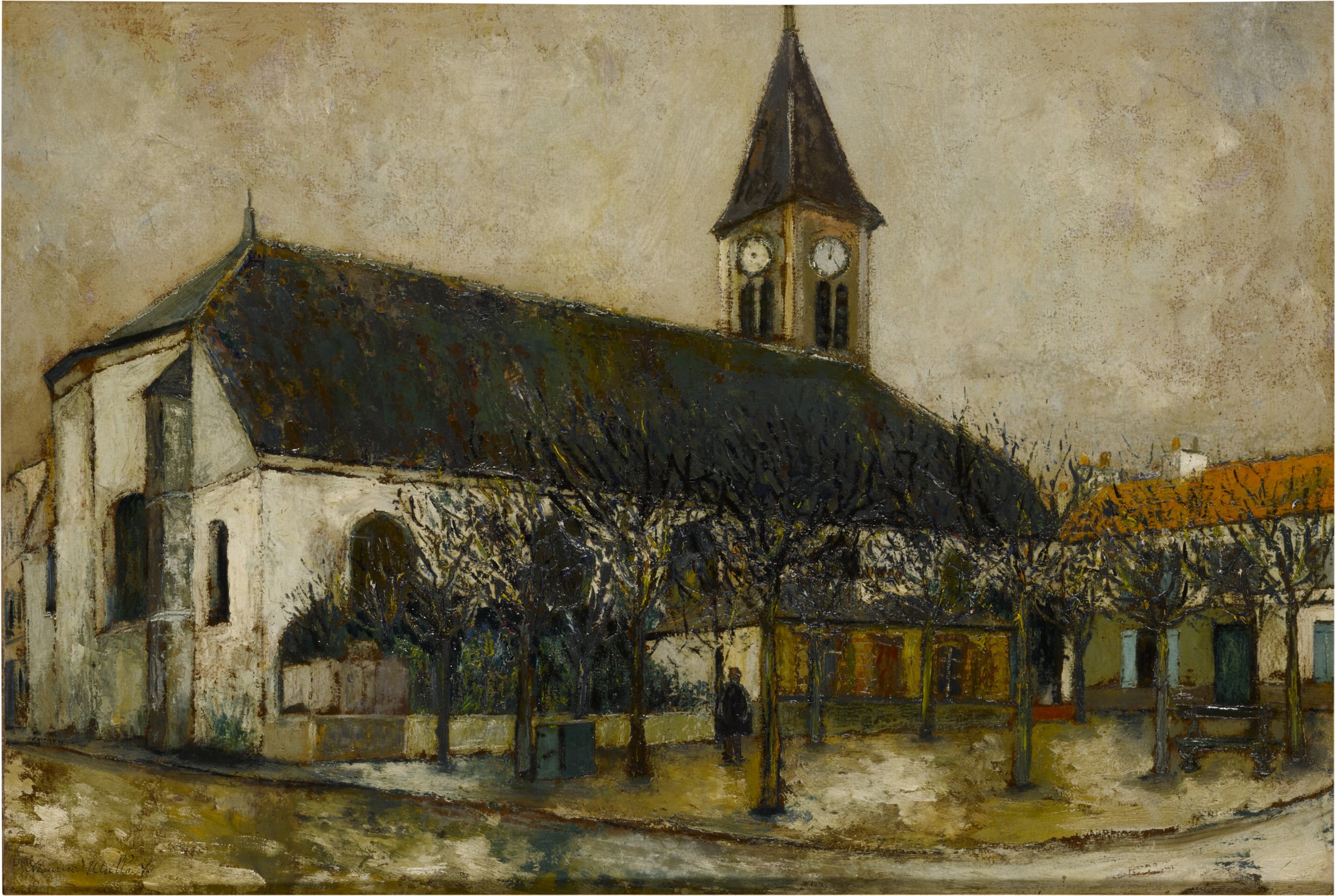
Works such as the 1914 "L'Église" and the 1908 "Église de Montmagny (Seine et Oise)" exemplify this approach with haunting precision. The churches and village streets he depicted seem to breathe with a quiet, almost melancholic dignity that no photograph of the period quite captures. It is worth noting that Utrillo frequently worked from postcards and photographs rather than painting outdoors, a practice that gave his compositions an unusual stillness and a quality of concentrated recollection. What makes Utrillo so compelling across the full arc of his career is his willingness to return again and again to the same subjects without ever quite repeating himself.
Maurice Utrillo
Église de Montmagny (Seine et Oise), 1908
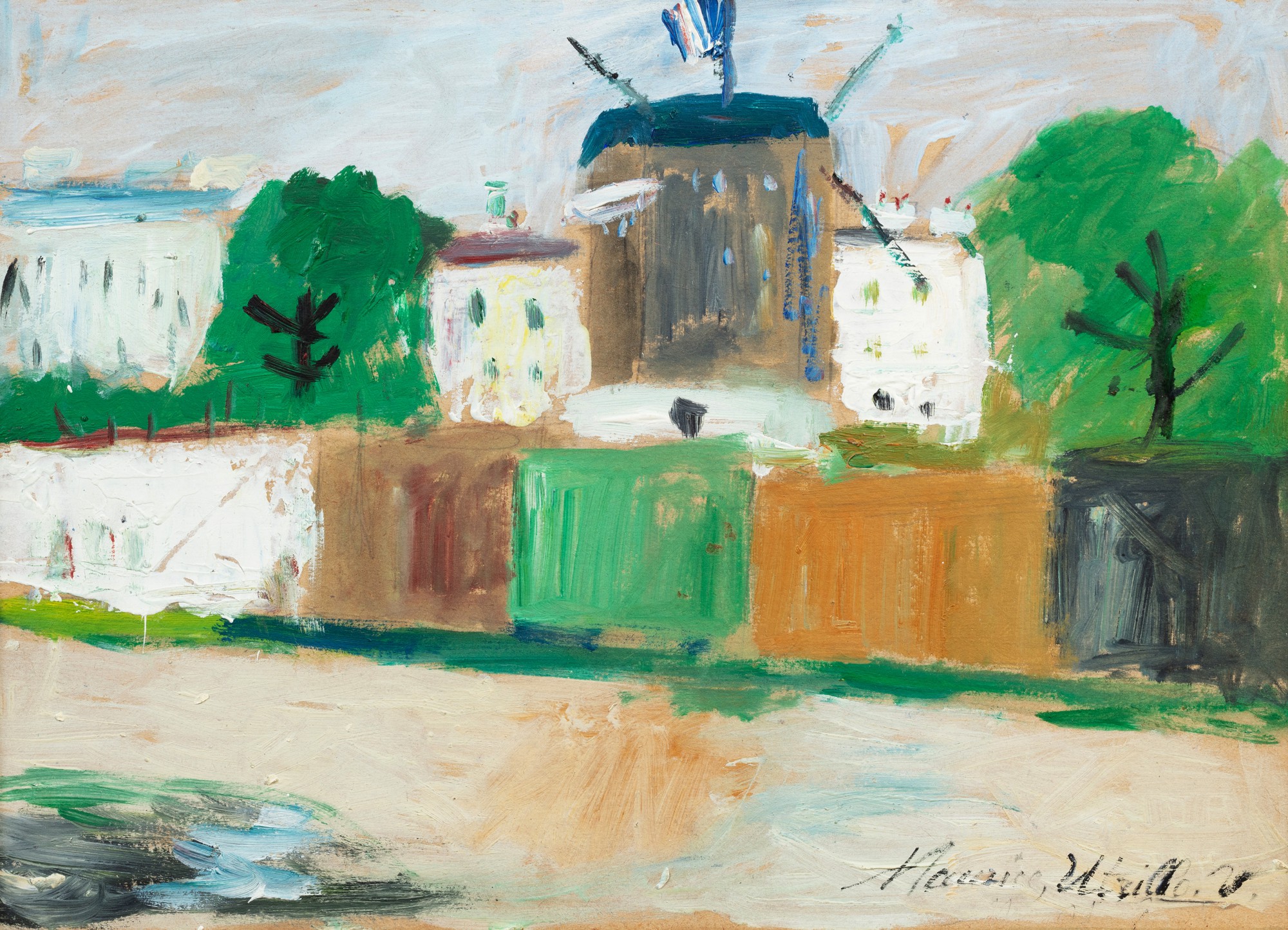
The Moulin de la Galette, that beloved windmill on the Butte Montmartre, appears in his work across multiple decades, from the glowing "Le Moulin de la Galette" of 1923 to the snow covered reverie of "Moulin de la Galette sous la neige" in 1945. Each version reveals a slightly different emotional temperature: warmer, cooler, more celebratory, more inward. The 1948 "Rue à Montmartre" shows a painter in his mature years still fully in command of his vision, the composition resolved with the ease of someone who has spent a lifetime understanding exactly how light falls on a particular stretch of wall. Similarly, works like "Rue du Mont Cenis à Montmartre" demonstrate his extraordinary sensitivity to the geometry of narrow streets and the way architecture frames the sky.
For collectors, Utrillo represents a singular proposition. He sits comfortably within the broad Post Impressionist tradition yet resists easy categorisation alongside his contemporaries. He was not an Expressionist in the manner of Soutine, nor a Cubist in the manner of his Montmartre neighbours Picasso and Braque, though he absorbed influences from all around him. His closest spiritual affiliations are perhaps with the intimisme of Vuillard and the quiet street poetry of Marquet, yet his work feels entirely its own.
Maurice Utrillo
Le Moulin de la Galette, 1923
The Ecole de Paris, that loose gathering of artists working in Paris during the first half of the twentieth century, provides the most useful frame: alongside Modigliani, Pascin, and Kisling, Utrillo helped define a Parisian sensibility that was at once cosmopolitan and deeply rooted in the particular textures of a specific neighbourhood. At auction, Utrillo's White Period works command the greatest attention and the strongest prices. Major auction houses including Christie's, Sotheby's, and Drouot have consistently seen strong results for his oils, particularly those depicting Montmartre streets and churches with that characteristic chalky surface. Works on canvas tend to attract more interest than those on board or card, though the latter can offer genuine quality at more accessible price points.
Collectors new to the artist are advised to look carefully at works from across his career rather than focusing exclusively on the famous White Period: his paintings from the 1930s and 1940s, including the evocative "Montmartre" of 1937 and "Église, Saintes Maries de la mer" of 1931, offer remarkable quality and represent a painter whose eye never faltered even as his personal circumstances remained turbulent. Utrillo spent much of his later life in relative stability, having married Lucie Pauwels in 1935 and settling eventually in Le Vésinet outside Paris. He was made a Chevalier de la Légion d'honneur in 1928, and his reputation during his lifetime was considerable, though the art world's critical apparatus was slower to fully honour him than the public. He died on 5 November 1955 in Dax, in the southwest of France.
His legacy today is that of an artist who transformed a specific corner of Paris into a universal emotional landscape, who found in the modest streets and weather beaten walls of Montmartre a subject worthy of a lifetime's devotion. To collect Utrillo is to possess not merely a painting but an entire atmosphere, a fragment of a city dreamed as much as seen, held permanently in the warmth of oil and light.
Explore books about Maurice Utrillo