Maurice Estève
Maurice Estève: A Life Lived in Color
Artist Spotlight · The Collection Editorial
In the grand galleries of the Musée des Beaux Arts de Bordeaux, where a major retrospective of Maurice Estève's work drew devoted crowds in the early 2000s, visitors encountered something that defied easy categorization. The canvases hummed with an interior warmth, as though light itself had been compressed into interlocking forms and released slowly into the room. For those already familiar with the École de Paris, the experience was one of confirmation. For newcomers, it was a revelation.
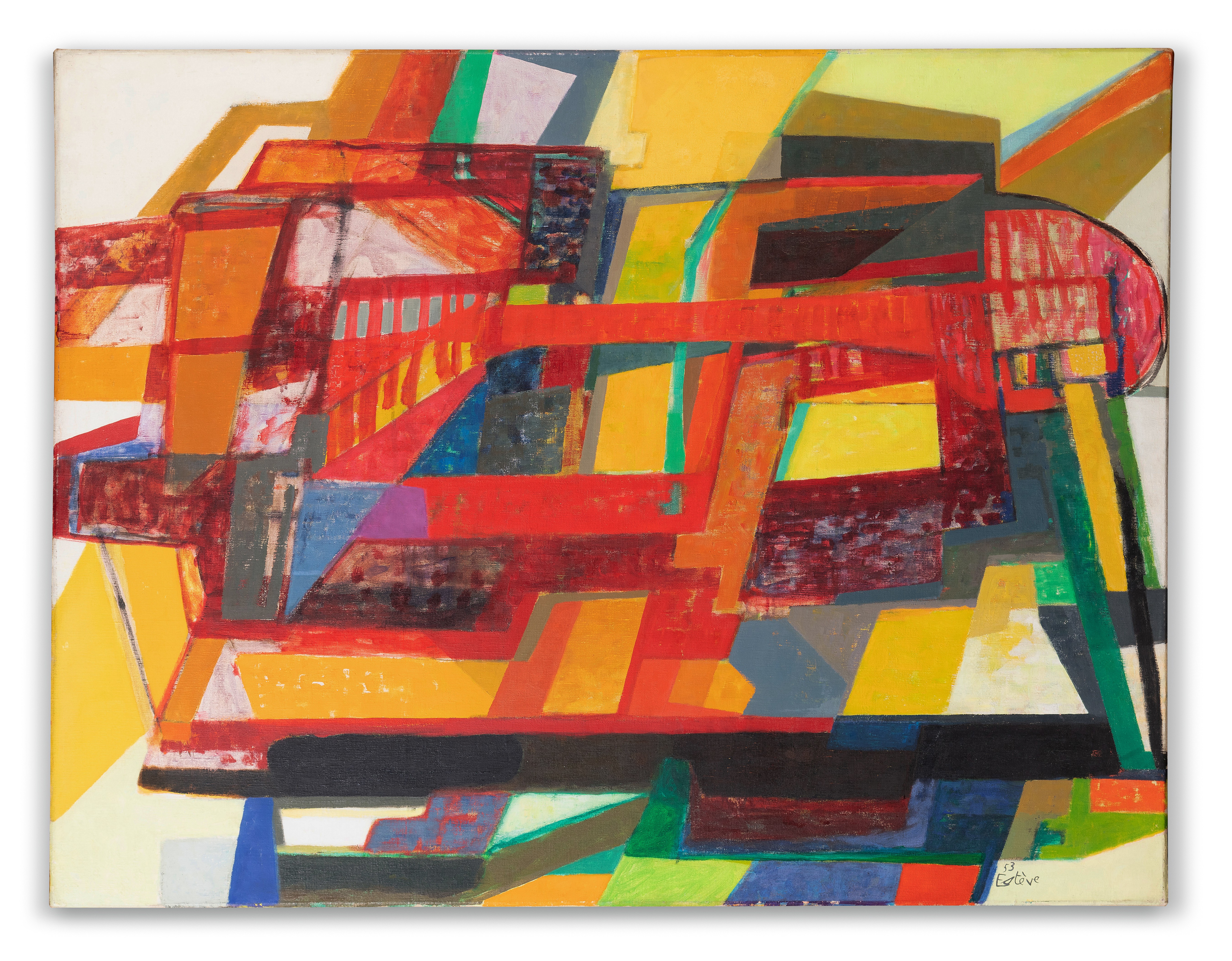
Maurice Estève
Serre chaude, 1953
Estève, who lived to the remarkable age of ninety six, left behind a body of work that continues to reward looking, and the art world's sustained affection for his painting shows no sign of cooling. Maurice Estève was born in 1904 in Culan, a small commune in the Cher department of central France, far from the artistic capitals that would eventually claim him. His origins were modest, and his formation as a painter was entirely self directed. He arrived in Paris in 1923, drawn by instinct rather than institutional ambition, and immersed himself in the collections of the Louvre and the galleries of Montparnasse with the focused hunger of someone who knows that looking is itself a form of study.
He had no formal training to speak of, and yet this absence became a kind of freedom. Without an academy to push against, Estève was free to absorb what he needed and discard what he did not. The early shaping influences on Estève were the ones that defined so much serious painting in the first half of the twentieth century. Cézanne was paramount, and one can feel the older master's structural logic running beneath even Estève's most apparently spontaneous canvases.
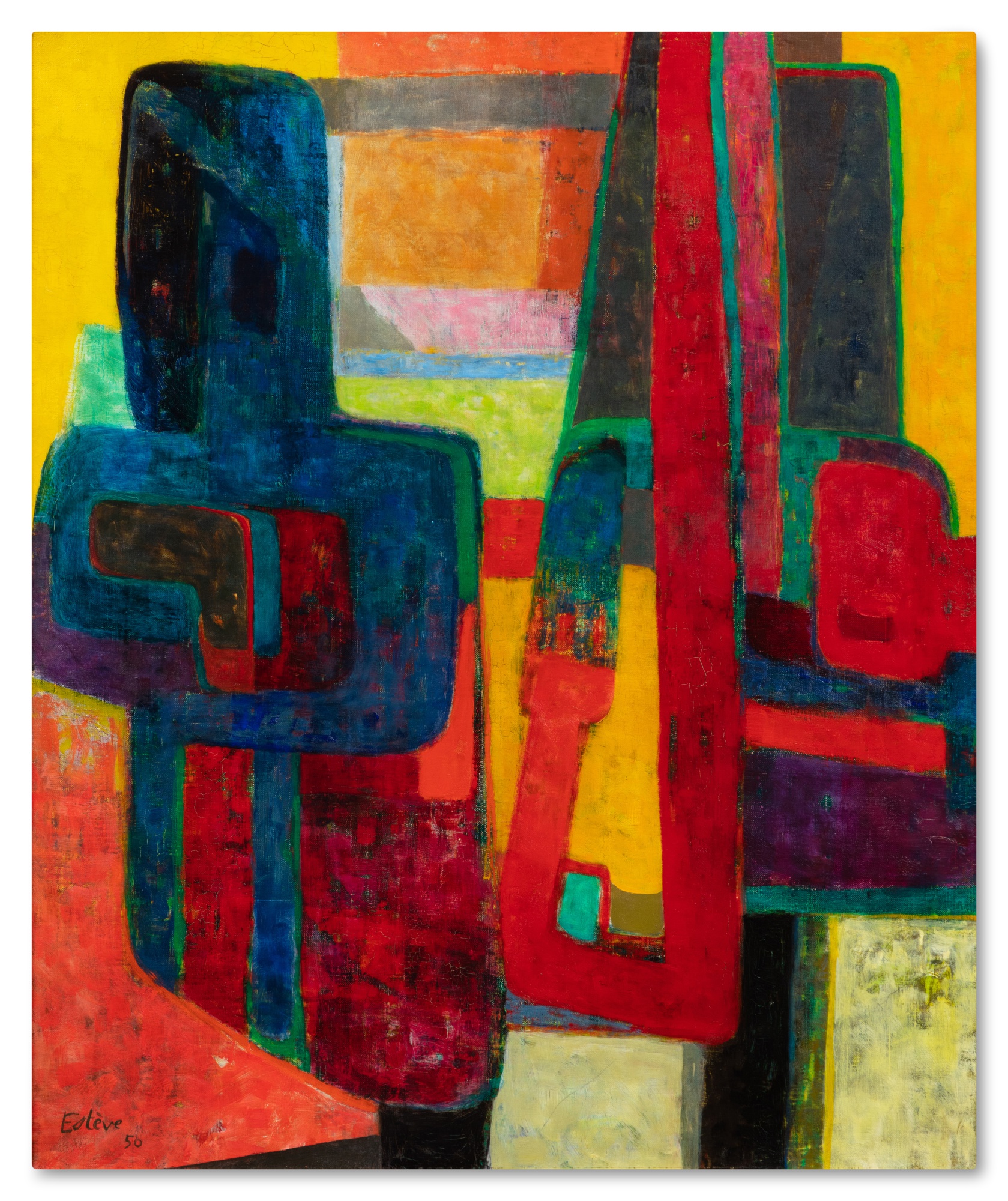
Maurice Estève
Maréchal-Ferrant, 1950
Cubism offered another set of tools, particularly its willingness to fragment and reassemble the visual field. But Estève was never a doctrinaire follower of any movement. He took what Cubism offered in terms of spatial liberation and combined it with a coloristic sensibility that was entirely his own, rooted in the deep, saturated hues of medieval stained glass and the natural world of rural France. The result was a pictorial language that felt both rigorously constructed and effortlessly alive.
His development across the 1930s and into the 1940s was marked by a productive tension between the figurative and the abstract. Works from this period, such as the magnificent "Coin de table à la serviette" of 1943, demonstrate how Estève used recognizable domestic subjects as scaffolding for explorations of color and form that were already pushing well beyond description. The still life tradition, with its centuries of accumulated meaning, gave him a stable platform from which to experiment. By the late 1940s and into the 1950s, the figurative scaffolding was coming down.
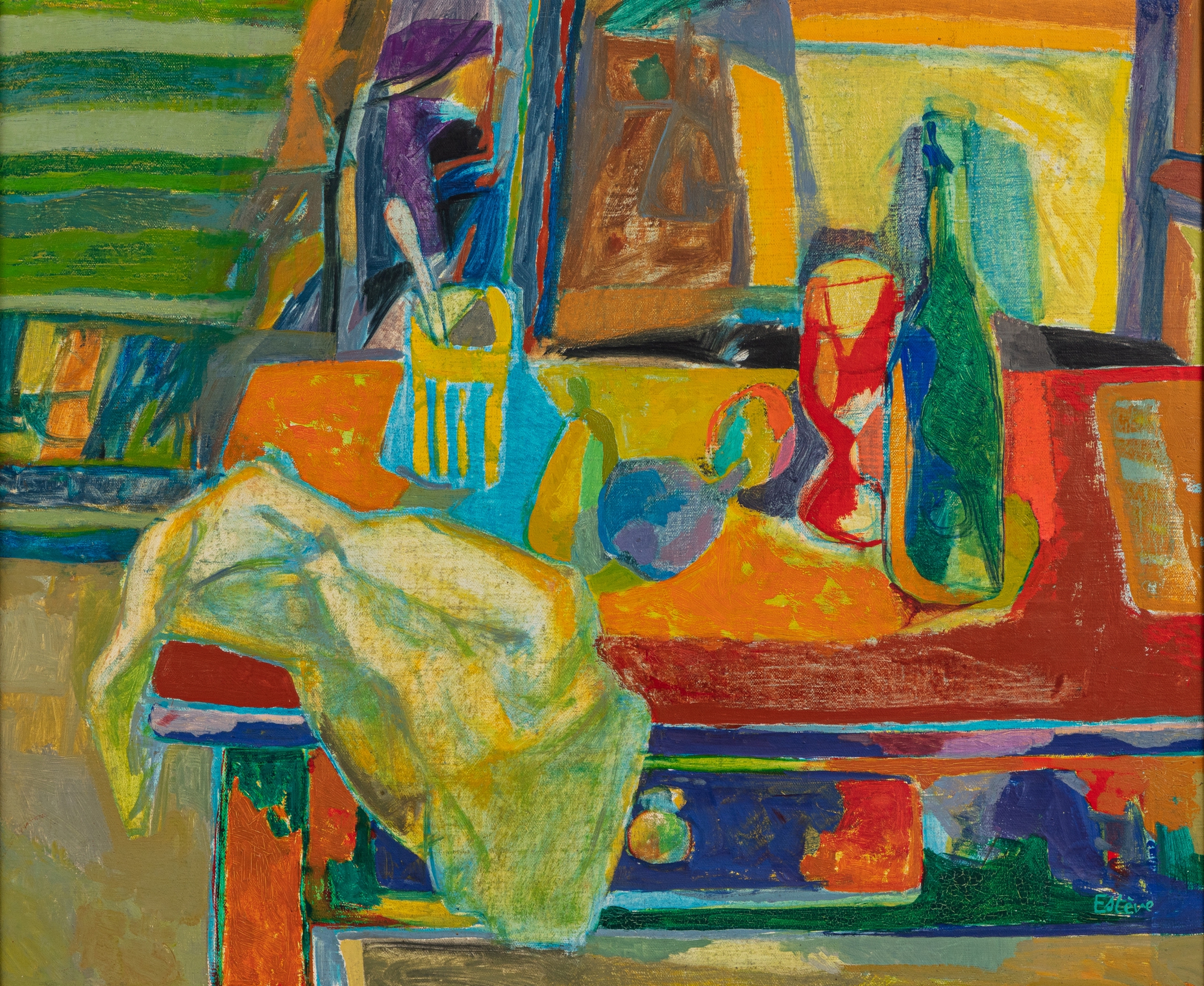
Maurice Estève
Coin de table à la serviette, 1943
"Maréchal Ferrant" from 1950 catches this transitional moment with particular vividness, the subject of a blacksmith still faintly legible within a composition that is already thinking in purely pictorial terms. "Serre chaude" from 1953 marks a kind of arrival: a fully realized abstract canvas in which form and color operate with complete mutual confidence. What distinguishes Estève's mature work is the quality of his color relationships and the particular way his forms interlock. Unlike the more gestural wing of postwar abstraction, Estève's paintings are never impulsive.
Each shape is placed with deliberate care, and the chromatic harmonies are built up through a process of patient accumulation. The surfaces reward close attention: there is always more happening than the initial impression suggests. His later works, including the luminous "Jabiru" of 1972 and the more meditative canvases of the 1960s such as "Bourdin" from 1964, show an artist who continued to develop his vocabulary without ever becoming merely decorative. His works on paper, including pastels, gouaches, and drawings in charcoal and colored pencil, reveal the same rigorous sensibility operating in a more intimate register.
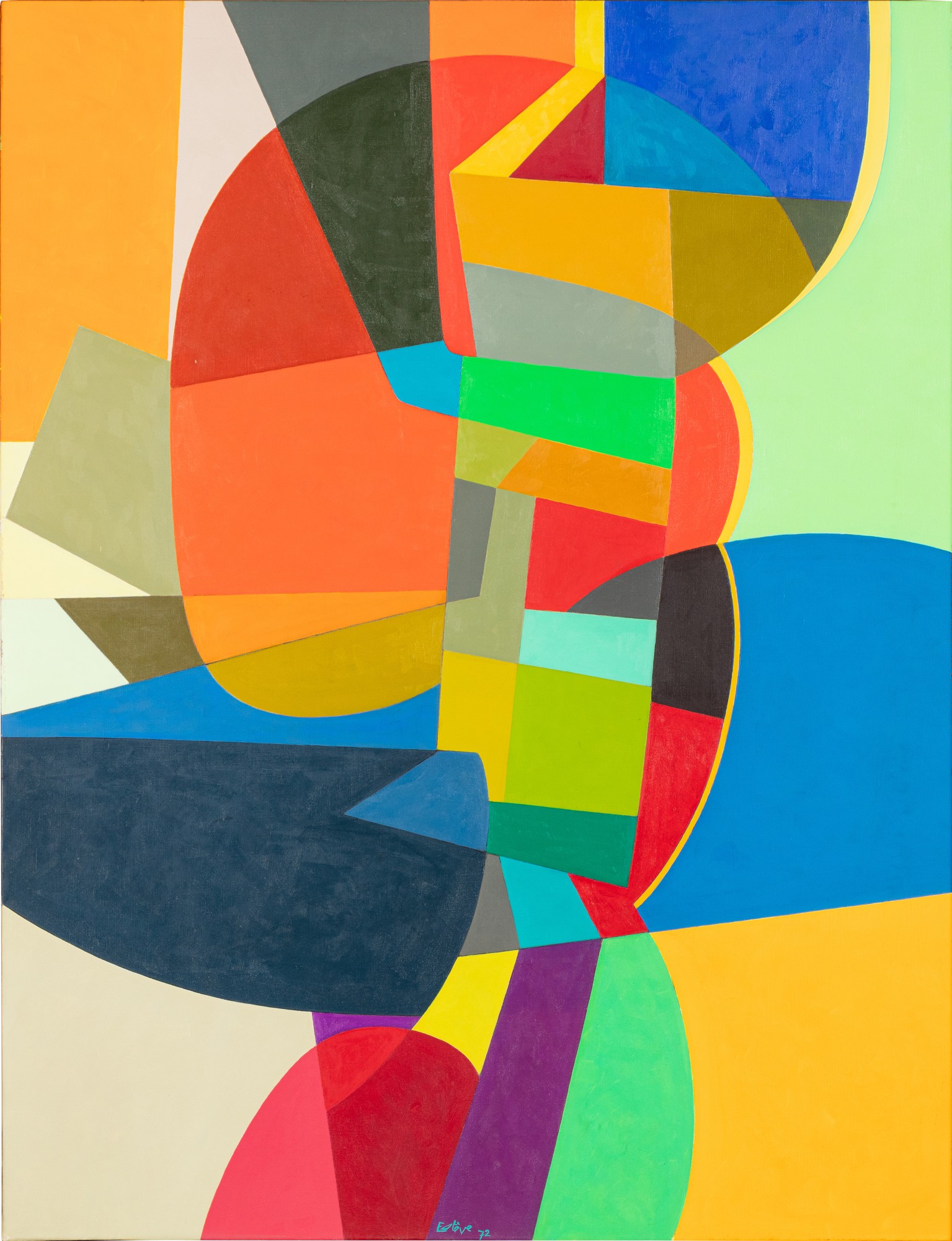
Maurice Estève
Jabiru, 1972
Works such as "Orvalin" from 1971 and the various compositions in pencil and charcoal from the mid to late 1960s demonstrate that Estève's intelligence was not confined to the large canvas format. From a collecting perspective, Estève occupies a particularly compelling position. He is an artist of genuine historical importance, associated with the École de Paris and the broader movement of lyrical abstraction that included figures such as Jean Bazaine, Alfred Manessier, and Roger Bissière. His work appears in the permanent collections of major institutions including the Centre Pompidou in Paris and the Musée de Grenoble, lending a seriousness of institutional endorsement that serious collectors rightly value.
At the same time, his paintings on canvas and his works on paper represent a range of entry points for collectors at different stages. The works on paper, in particular, offer an opportunity to engage with Estève's thinking at close range, often at more accessible price points than the major canvases, while sharing fully in the chromatic and formal intelligence that defines his practice. In the context of art history, Estève's closest companions are those painters who chose a middle path between pure geometric abstraction and the more turbulent energies of Abstract Expressionism. Bazaine and Manessier were fellow travelers within the École de Paris, and all three shared a commitment to abstraction rooted in direct experience of the world rather than purely formal or theoretical systems.
Hans Hartung and Pierre Soulages, though working in quite different ways, are part of the same generation of French painters who collectively gave postwar European abstraction its distinctive character. Placing Estève within this constellation helps to illuminate what is specific about his achievement: the sheer warmth of his pictorial world, the sense that behind every canvas lies a man who loved looking at things. Maurice Estève died in 2001, having witnessed nearly a century of art history unfold around him without ever losing his own sense of direction. His longevity was matched by a consistency of purpose that is rare in any creative life.
The sustained attention that museums, scholars, and collectors have given his work in the decades since his death reflects a growing recognition that the qualities his painting embodies, rigor, warmth, chromatic intelligence, and a deep respect for the act of looking, are not period qualities but enduring ones. To collect Estève is to invest in a vision of painting that remains stubbornly and beautifully necessary.
Explore books about Maurice Estève