Maurice Denis
Maurice Denis, Where Spirit Meets Color
Artist Spotlight · The Collection Editorial
“A picture, before being a battle horse, a nude woman, or some anecdote, is essentially a flat surface covered with colors assembled in a certain order.”
Art et Critique, 1890
There are moments in art history when a single sentence reshapes the way an entire civilization understands what a painting can be. Maurice Denis authored one of those sentences. In 1890, at the age of twenty, he wrote that a picture, before being a battle horse, a nude woman, or some anecdote, is essentially a flat surface covered with colors assembled in a certain order. That declaration, published in the journal Art et Critique, did not merely anticipate abstraction.
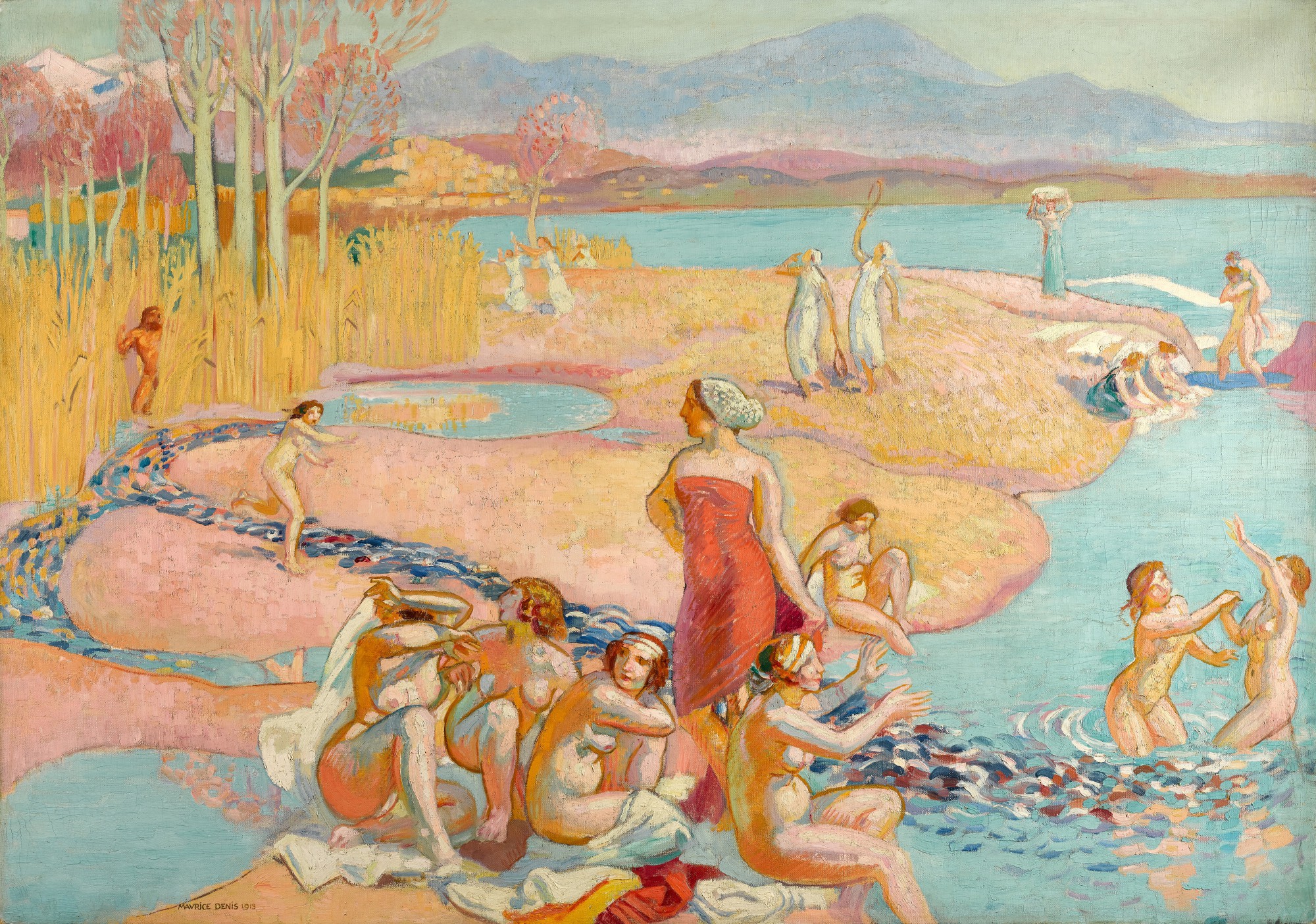
Maurice Denis
Nausicaa, 1913
It named something that artists had been reaching toward and could not yet articulate. Decades before Mondrian, before the Bauhaus, before Greenberg, Denis had already drawn the map. To encounter Denis's paintings today, whether in the permanent collection of the Musée d'Orsay in Paris, at the Prieuré museum in Saint Germain en Laye that was once his home, or through the intimate and carefully assembled group of works available on The Collection, is to feel the particular warmth of an artist who never chose between the spiritual and the sensual. He held both, with confidence and with grace.
His canvases glow. They breathe. They remain, more than a century after their making, entirely alive. Denis was born in Granville, Normandy, in 1870, and grew up in a devout Catholic household that would shape every dimension of his artistic imagination.
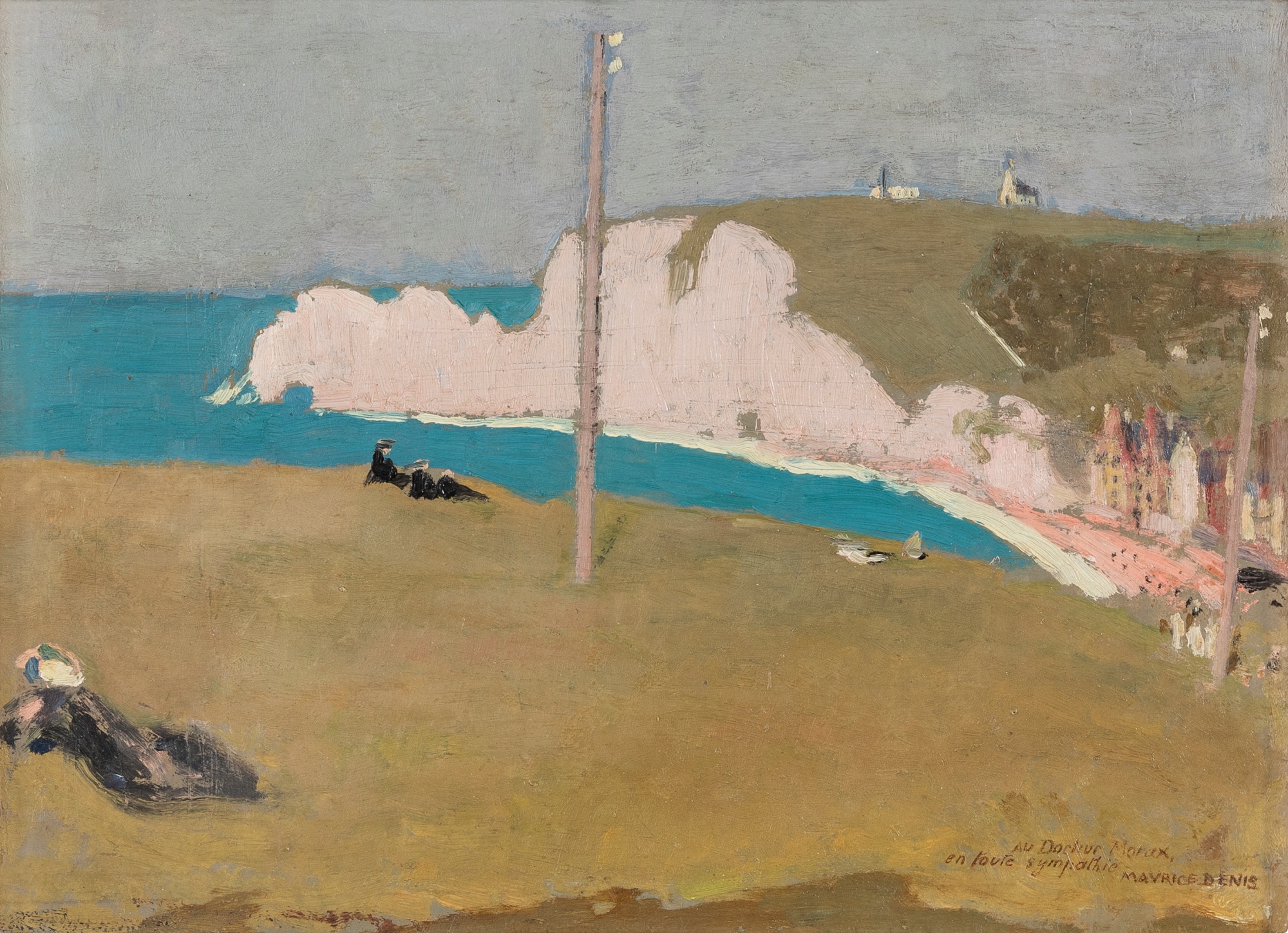
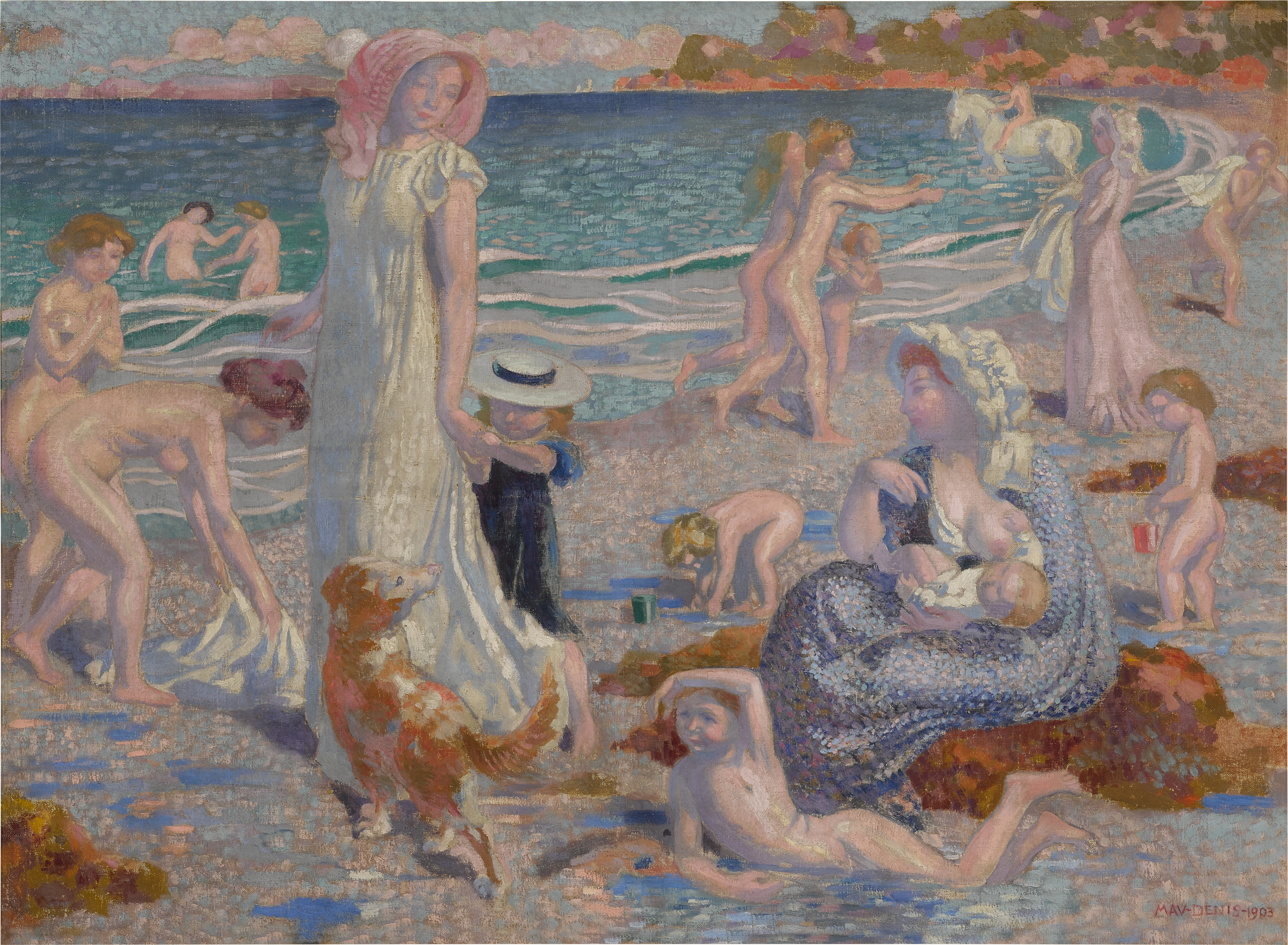
Maurice Denis
Étretat
He arrived in Paris to study at the École des Beaux Arts and, simultaneously, at the Académie Julian, where the intensity of his intellectual formation matched the rigor of his technical training. It was at the Académie Julian that he met Paul Sérusier, Édouard Vuillard, Pierre Bonnard, and Paul Ranson, the young painters who would coalesce around a shared revelation. Sérusier had traveled to Pont Aven and returned with a small painting made under the direct instruction of Paul Gauguin, a painting so radical in its use of flat, unmodulated color that it became known among the group as The Talisman. Denis and his companions recognized immediately that something fundamental had shifted.
“Art is the sanctification of nature, of that nature which is given to us to decipher and to love.”
Maurice Denis, Theories
The group called themselves the Nabis, from the Hebrew word for prophets, and Denis became their most articulate theorist and one of their most gifted practitioners. The Nabis rejected the atmospheric illusionism of Impressionism and embraced instead a pictorial language of bold outlines, compressed space, and color used for its expressive and decorative power rather than its descriptive accuracy. Denis brought to this shared program a distinctive personal vision: a fusion of Post Impressionist formal innovations with subjects drawn from Christian devotion, domestic tenderness, and the quiet rhythms of family life. His canvases from the early 1890s, including the luminous and deeply felt Drying the Linen, or Moonrise at the Priory from 1894, reveal an artist already fully in command of his intentions.
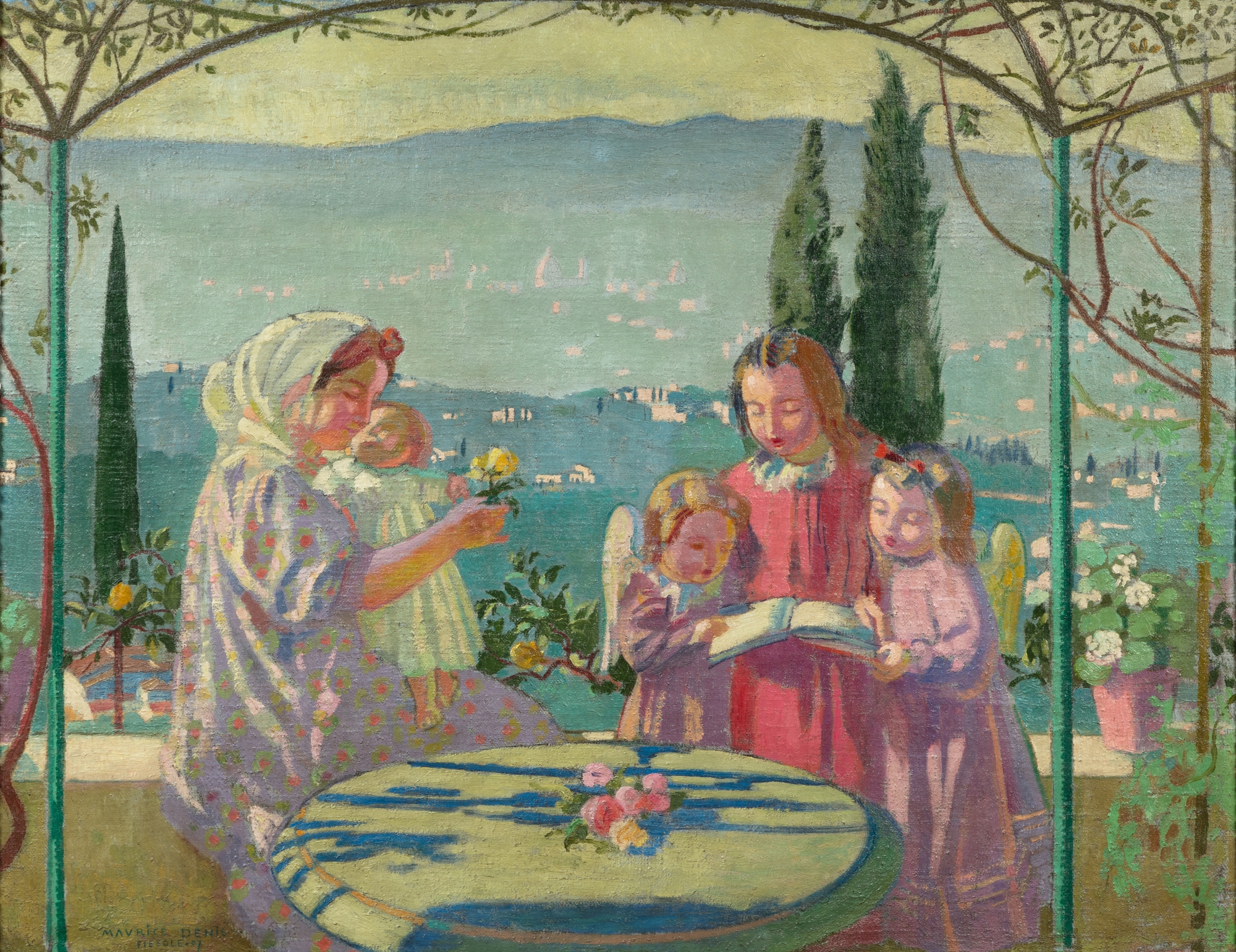
Maurice Denis
Cantique à la Madone, Fiesole, le matin, 1907
The figures are flattened, the tones are hushed and silvery, and the scene trembles with a symbolic weight that goes far beyond mere depiction. Across the following decades, Denis developed a body of work of remarkable breadth and consistency. He traveled extensively in Europe, and his journeys through Italy in particular left enduring marks on his practice. The 1907 painting Cantique à la Madone, Fiesole, le matin captures the Tuscan morning light with a reverence that is equally aesthetic and devotional, the gold and pale rose of the sky pressed flat against the picture plane in a way that recalls both Byzantine icon painting and the formal innovations of his Nabi years.
The 1908 work San Domenico de Sienne, Quartier des tanneurs, painted on board with the directness and economy of a sketch made in full conviction, shows Denis responding to architecture and urban texture with the same symbolic sensitivity he brought to religious subjects. His 1913 canvas Nausicaa, drawn from the world of Greek myth, demonstrates his sustained interest in the figure as a vehicle for timeless meaning rather than momentary observation. The prints Denis made around the turn of the century deserve particular attention from collectors and admirers of works on paper. His color lithographs of 1899, including The Knight Did Not Die in the Crusade, Morning Bouquet Tears, and Life Becomes Precious Discreet, show the full sophistication of his decorative intelligence.
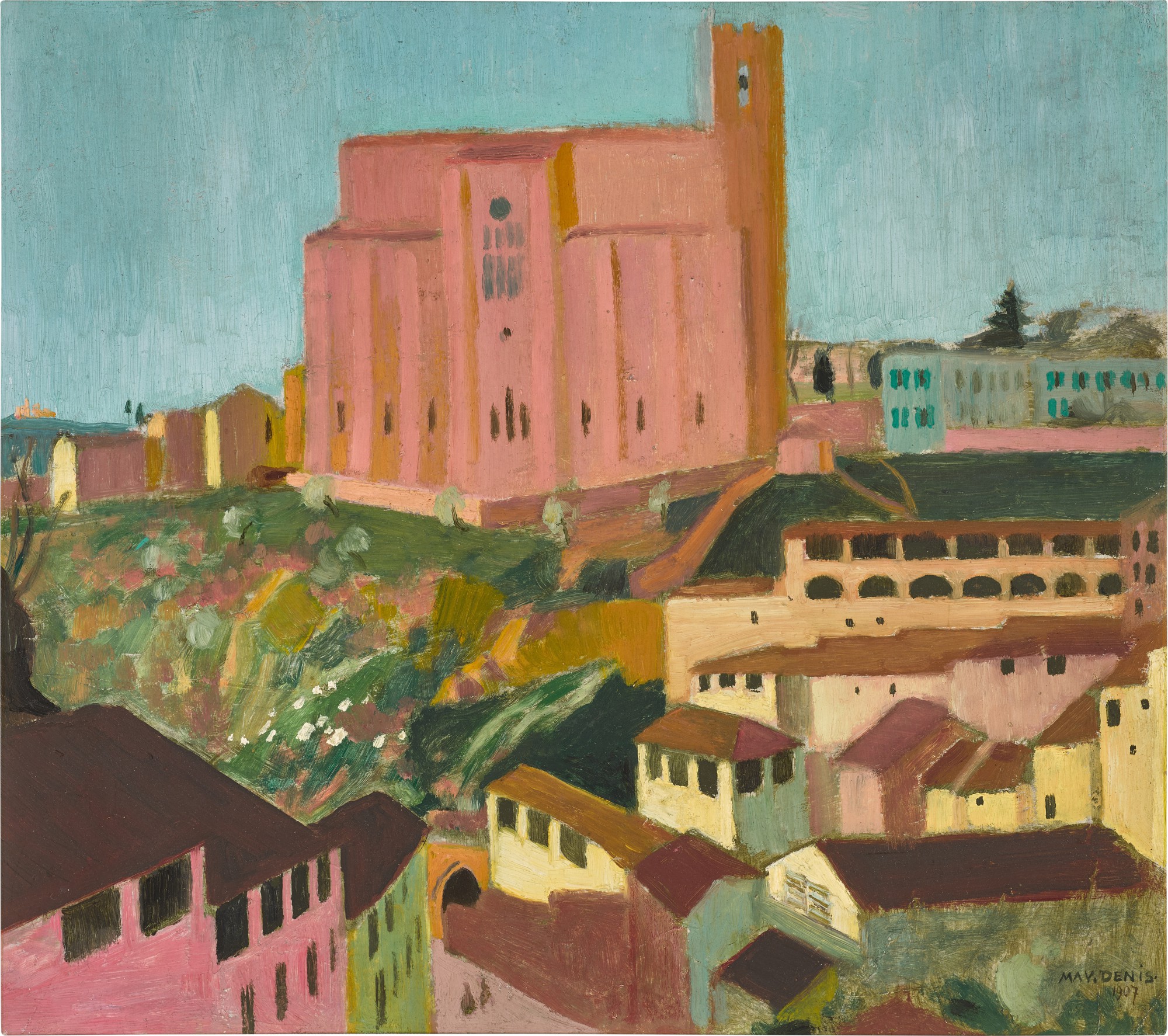
Maurice Denis
San Domenico de Sienne (Quartier des tanneurs), 1908
These works belong to a moment when the lithograph was understood as a serious artistic form, championed by the same avant garde circles that surrounded the Nabis and their allies. Denis approached the medium with the same commitment to surface, pattern, and symbolic resonance that characterized his paintings. The results are among the most refined and quietly ravishing prints of the entire Post Impressionist era. For collectors building a considered collection of works on paper, these lithographs represent an exceptional and relatively accessible entry into the work of an artist of major historical significance.
Within the broader context of art history, Denis occupies a position that is both singular and deeply connected to the network of transformation that defined European art between 1880 and 1920. He was a close friend of Odilon Redon, whose symbolist imagery shares with Denis's work a commitment to the inner life over outward appearance. He admired Cézanne, writing about him with perceptiveness and generosity. His relationship with Gauguin, mediated through Sérusier and through the formal lessons of The Talisman, was foundational.
Collectors who are drawn to Bonnard and Vuillard, Denis's great Nabi companions, will find in his work a kindred sensibility and a distinct personal voice. Where Bonnard celebrated domestic interiors with a flickering, hedonistic joy and Vuillard pressed pattern into shadow with anxious intensity, Denis suffused his domestic and devotional scenes with a calm radiance that is entirely his own. The market for Denis has grown steadily in recent decades as collectors and institutions have come to appreciate the full scope of what the Nabis achieved. Major auction houses including Christie's and Sotheby's have offered significant Denis works, with oil paintings from his mature period and his early Nabi years commanding serious attention from European and international buyers.
Works on board, such as the direct and beautiful Étretat, demonstrate the breadth of his ambition and his willingness to work across formats and supports without any loss of quality or intention. For collectors approaching Denis for the first time, his Italian landscapes and his works on paper offer some of the most compelling and accessible points of entry, combining historical importance with an immediate visual pleasure that requires no scholarly apparatus to feel. Denis died in Paris in 1943, but the conversation he started has never ended. His theoretical writings, his paintings, his prints, and his deep investment in the question of what a picture fundamentally is continue to inform how artists and critics think about the relationship between form, surface, and meaning.
He was, in the fullest sense, a prophet of modern art who never lost his faith in beauty. To live with one of his works is to share in something rare: the vision of an artist who understood that the spiritual and the formal are not opposites but reflections of the same essential longing.
Explore books about Maurice Denis