Maurice De Vlaminck
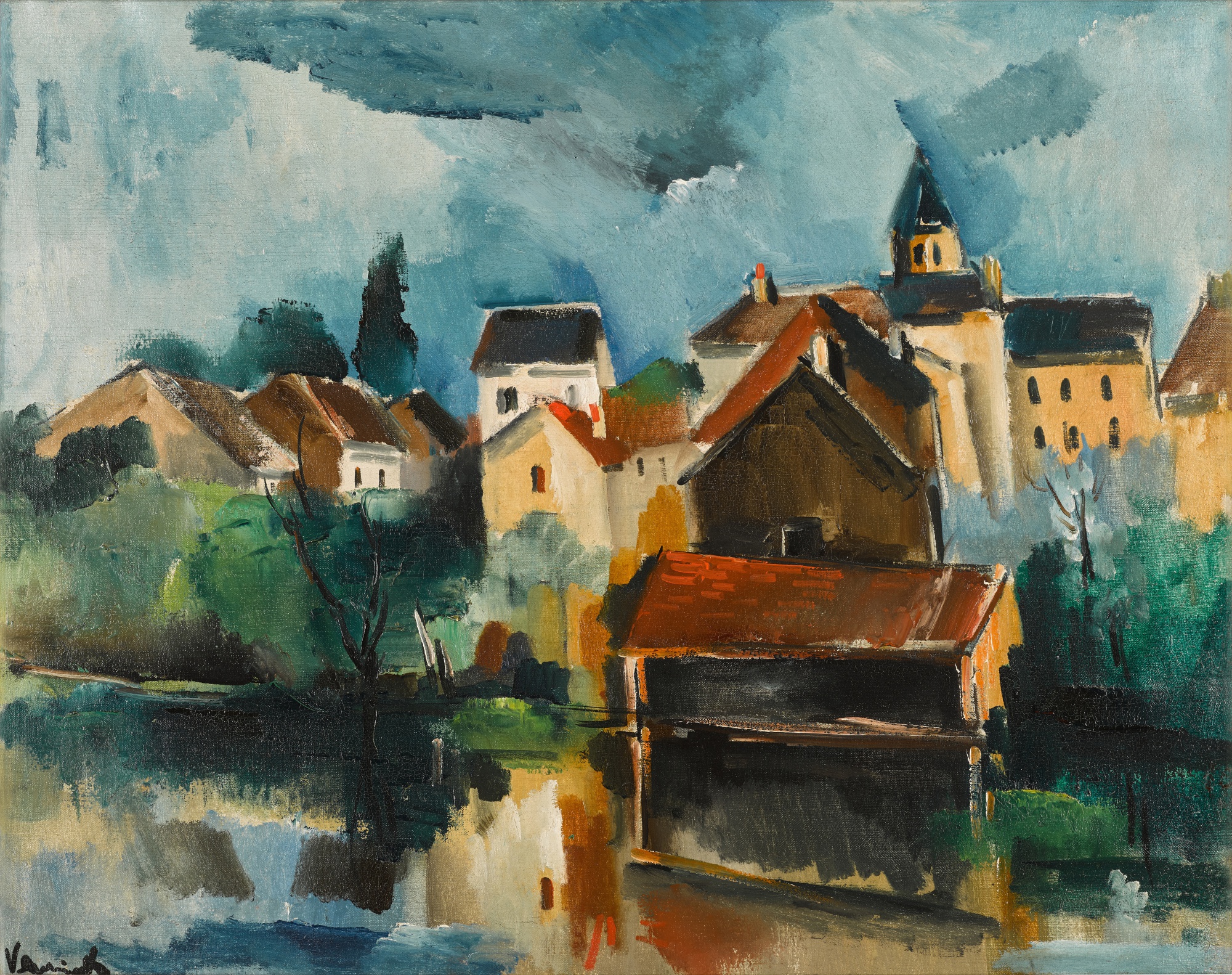
Maurice de Vlaminck, Forever Wild and Free
Artist Spotlight · The Collection Editorial
“I use color as a means of expressing my feelings and not as a thing seen in nature.”
Maurice de Vlaminck
There is a particular kind of painting that stops you mid step in a gallery, not because it whispers but because it roars. Maurice de Vlaminck painted that way his entire life, with a ferocity and physical directness that felt less like artistic composition and more like a force of nature made visible on canvas. In recent years, major institutions across Europe and North America have returned to the Fauvist generation with fresh curatorial eyes, and Vlaminck consistently emerges as one of its most electrifying presences. His work reminds contemporary audiences that color, wielded with total conviction, remains one of the most radical tools available to a painter.
Maurice De Vlaminck
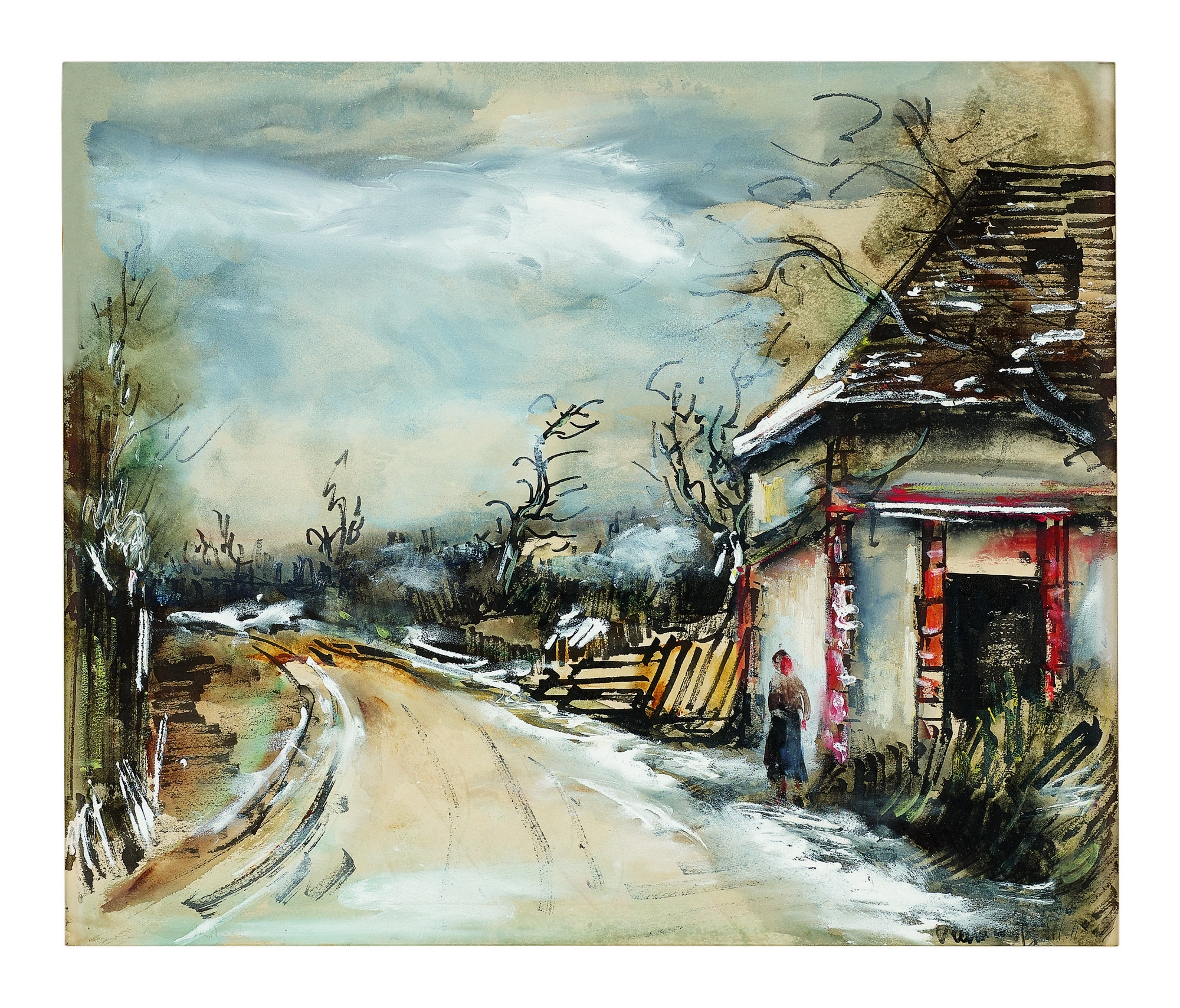
Paysage D'hiver, 1935
Maurice de Vlaminck was born in Paris on April 4, 1876, to a family of Flemish musicians. That northern European lineage matters more than it might first appear. The Flemish tradition carried with it a deep appetite for physical, tactile painting, for surfaces that breathe and textures that invite the eye to linger. His father was a violin teacher and his mother gave piano lessons, and Vlaminck himself was an accomplished violinist who played professionally in his youth to earn money.
He was largely self taught as a painter, which freed him from academic convention and gave his early canvases an unbridled, instinctive energy that trained artists sometimes spend careers trying to recover. The turning point arrived in 1900, when Vlaminck met André Derain at Chatou, a small town on the Seine just west of Paris. The two young men shared a studio in a disused restaurant and began painting together with an almost competitive intensity. Chatou became the unlikely birthplace of what critics would eventually call the Chatou School, a crucible of Fauvist ideas that predated the movement's official debut at the 1905 Salon d'Automne.
When Vlaminck encountered Vincent van Gogh's work at a major retrospective in Paris in 1901, the effect was seismic. He later described wanting to paint with pure unmixed pigment straight from the tube, to make the canvas blaze. That ambition drove him toward some of the most incandescent landscapes produced in the early twentieth century. At the 1905 Salon d'Automne, critics famously derided the room containing work by Vlaminck, Derain, Henri Matisse, and their circle as belonging to wild beasts, les fauves in French.
“I try to paint with my heart and my loins, not bothering with style.”
Maurice de Vlaminck
The name stuck, and the movement it described changed the course of Western art. Vlaminck's contribution to Fauvism was arguably its most visceral. Where Matisse sought harmony and decorative balance, Vlaminck sought confrontation. His landscapes of the Seine valley from this period, painted in reds, greens, and yellows that bear no obligation to observed reality, feel like emotional weather reports rather than topographical records.
He was among the first painters to own and openly celebrate African art as a formal and spiritual influence, acquiring works before Picasso famously encountered them, a fact that places him at the center of one of modernism's most significant cultural conversations. By the 1910s, Vlaminck began to move away from pure Fauvism. He engaged briefly and seriously with Cézannism, disciplining his color with a new attention to structure and volume. But the restraint never quite suited him, and by the 1920s and through the 1930s, he had arrived at the mature style for which he is perhaps best loved by collectors today.
His late landscapes, often depicting the villages and farmlands of the Île de France and the Beauce plain where he eventually settled, are painted in darker, more brooding tones. Prussian blues, slate greys, and heavy whites carry a sense of impending weather that feels almost theatrical. These are paintings of a man who had found his countryside and was determined to paint it on his own terms, season after season, with undiminished commitment. Among the works that collectors and curators consistently return to is a body of winter landscapes that Vlaminck produced across several decades.
His "Paysage d'Hiver" from 1935, rendered in gouache and pen and ink on paper, exemplifies the qualities that make his late work so compelling. The medium itself is telling. Gouache rewards decisiveness, its opacity demanding that the painter commit to each mark without the possibility of infinite revision. Combined with pen and ink, the work achieves a graphic crispness within its painterly atmosphere, a reminder that Vlaminck was also a gifted printmaker who brought a draftsman's instinct to everything he made.
Works on paper by major Fauvist painters carry real weight in the current market, offering collectors access to an artist's thinking in a more intimate register than a large oil. In auction terms, Vlaminck's oils have performed strongly across the major houses. His peak Fauvist canvases from the 1905 to 1910 period command the highest prices and are now largely held by institutions and long standing private collections. But the works on paper and smaller oils from his middle and late periods represent genuine collecting opportunities for those drawn to his vision.
The 1920s through 1940s output is consistently undervalued relative to its art historical significance, and specialists at leading sale rooms have noted growing interest from collectors who came to Vlaminck through the Fauvist story and found themselves captivated by the atmospheric intensity of the later work. Condition, provenance, and the directness of the painterly gesture are the qualities that matter most when evaluating any work attributed to him. To understand Vlaminck fully is to understand a network of friendships and rivalries that shaped the entire first generation of modernism. His relationship with Derain was central, collaborative and competitive in equal measure.
His admiration for Van Gogh was lifelong. His work invites comparison with that of Chaim Soutine, another painter who treated the surface of a canvas as a site of almost physical struggle, and with Raoul Dufy, who shared his love of the French landscape even as he found a lighter, more decorative register. Placed alongside any of these figures, Vlaminck holds his ground with ease. His contribution is irreducible and entirely his own.
Maurice de Vlaminck died at his farm in Rueil la Gadelière in 1958, at the age of eighty one, having spent more than five decades painting with a consistency of purpose that few artists achieve. He is buried in the countryside he loved and recorded with such ferocity. What endures is not merely a body of work but a philosophy of painting, an insistence that the emotional truth of a landscape matters more than its faithful reproduction, that color is feeling made visible, and that the painter's hand should leave a mark as clear and as personal as a signature. For collectors who believe that art should move them before it impresses them, Vlaminck remains one of the great, indispensable voices of the modern tradition.
Explore books about Maurice De Vlaminck