Matt Mullican
Matt Mullican Maps the Universe Within
Artist Spotlight · The Collection Editorial
“I'm interested in the world as it is framed by the self, and the self as it is framed by the world.”
Matt Mullican, interview
When the Centre Pompidou in Paris devoted significant gallery space to the cosmological diagrams and banner works of Matt Mullican, it confirmed what a devoted circle of collectors and curators had long understood: that this quietly radical American artist had spent five decades constructing one of the most philosophically ambitious bodies of work in contemporary art. His sprawling, symbol laden universe, built from signs, diagrams, performances, and prints, stands as a singular achievement in the history of Conceptual and Systems art. That the broader art world continues to catch up to the depth of his project feels less like a delay and more like a testament to just how much is packed inside it. Mullican was born in 1951 in Santa Monica, California, into a household shaped by art and ideas.
Matt Mullican
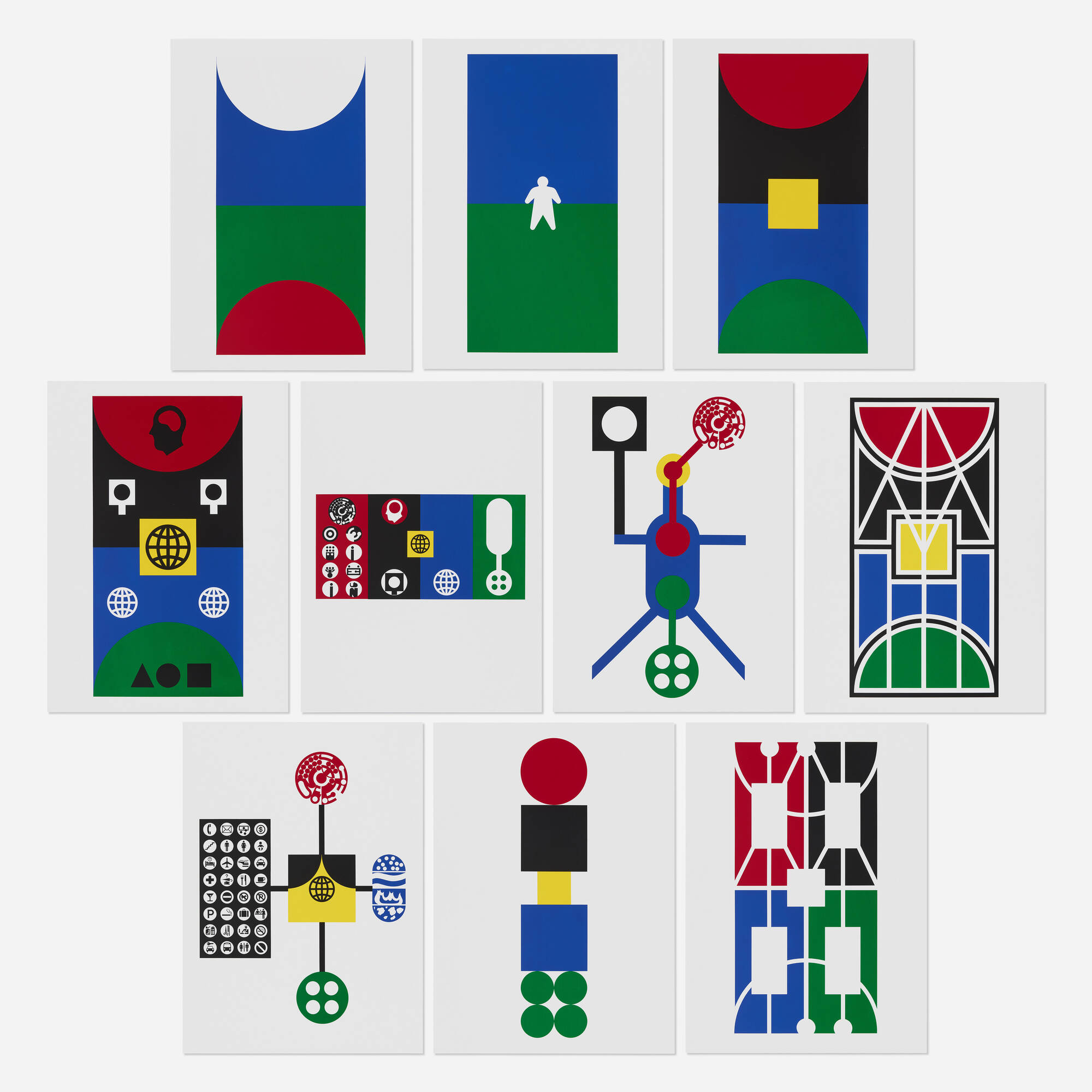
Untitled (Portfolio 1), 1992
His father, Lee Mullican, was himself a significant painter associated with the Dynaton movement, a group that explored mysticism, automatism, and non Western visual traditions alongside Gordon Onslow Ford and Jacqueline Johnson. Growing up inside that atmosphere, surrounded by the conviction that art could access dimensions of experience beyond the rational and the visible, left a permanent mark. Mullican studied at the California Institute of the Arts in Valencia, where he encountered the rigorous conceptual thinking that was reshaping American art in the early 1970s, and where his instinct to build total systems rather than individual objects first took hold. His artistic development unfolded through a sustained, lifelong inquiry into one of the oldest questions philosophy has ever posed: what is the relationship between the self and the world it perceives.
Rather than approaching this through text or argument, Mullican invented a visual language. He created a cosmological schema divided into five distinct realms, each assigned its own color and category of meaning, ranging from the world framed and the world unframed to language itself and the elemental. This framework became the scaffolding for everything: the large scale banners that hang like secular icons, the dense prints and etchings, the drawings on paper, and the performances conducted under hypnosis, in which Mullican inhabits a persona named simply MTM and allows his unconscious to draw, speak, and create without the interference of his waking mind. The hypnosis performances are not spectacle.
Matt Mullican
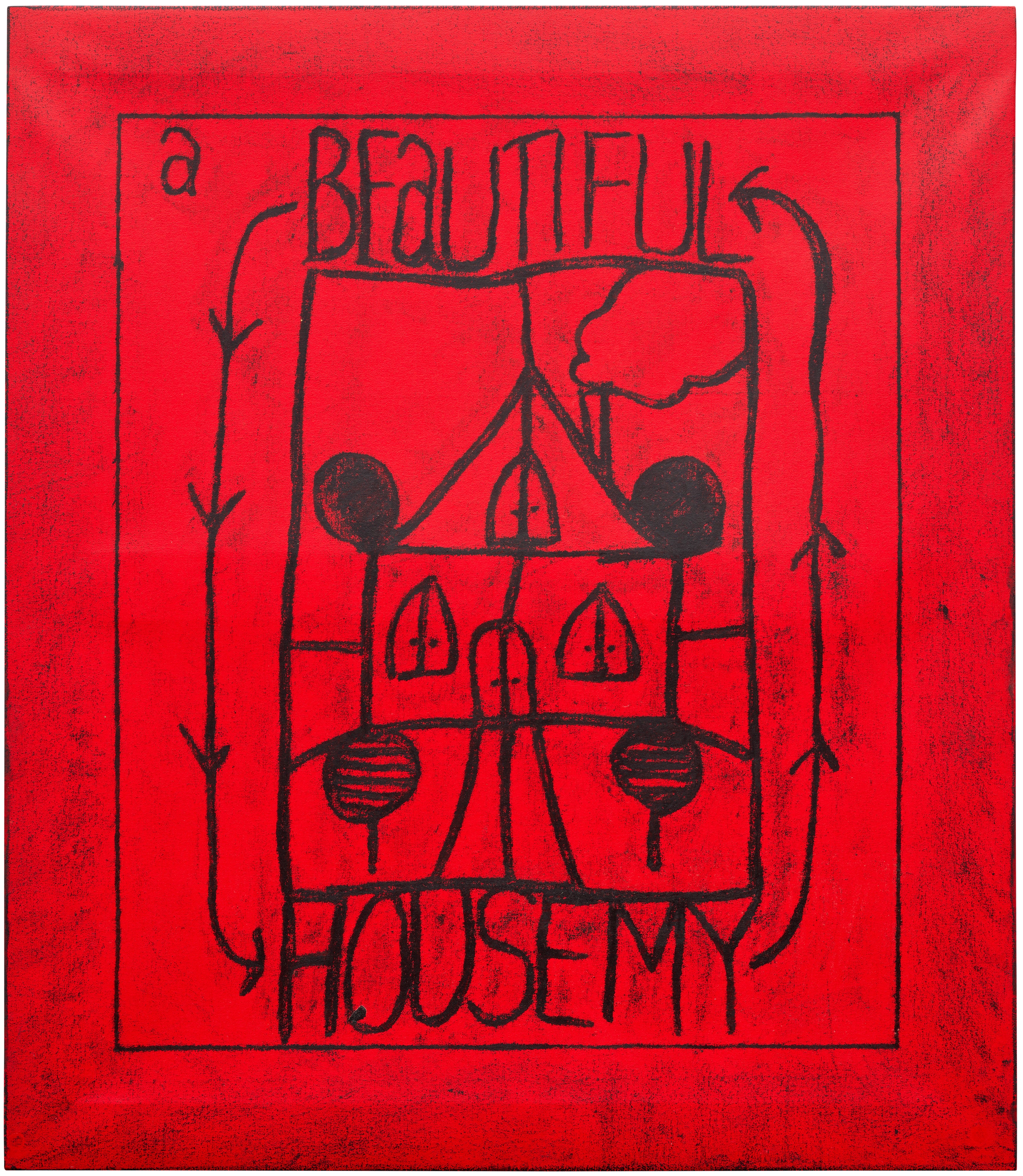
Untitled (Learning from the person's work: House, red), 2009
They are genuine experiments in the phenomenology of consciousness. The works on paper and print hold a particular place in understanding Mullican's range and discipline. His screenprints and etchings, including the important Untitled Portfolio 1 from 1992, demonstrate how fully his diagrammatic language translates into the formal demands of printmaking. These are not illustrations of ideas but the ideas themselves, rendered in color fields, symbolic figures, and schematic arrangements that reward slow, careful looking.
His painting practice, represented by works such as Untitled (Learning from the person's work: House, red) from 2009, shows a different register of the same obsession, where the sign becomes painterly and the diagram breathes. The pencil works, including pieces from the series Fictional Reality, Experiments, reveal a rawer, more searching hand, as if the artist is thinking through the cosmos in real time on the surface of the paper. For collectors, Mullican presents a rare and compelling proposition. His work operates at the intersection of Conceptual art, Performance art, Systems art, and something closer to spiritual cartography, a combination that places him in genuine dialogue with artists such as Joseph Beuys, On Kawara, and Lawrence Weiner, while remaining thoroughly, unmistakably his own.
Matt Mullican
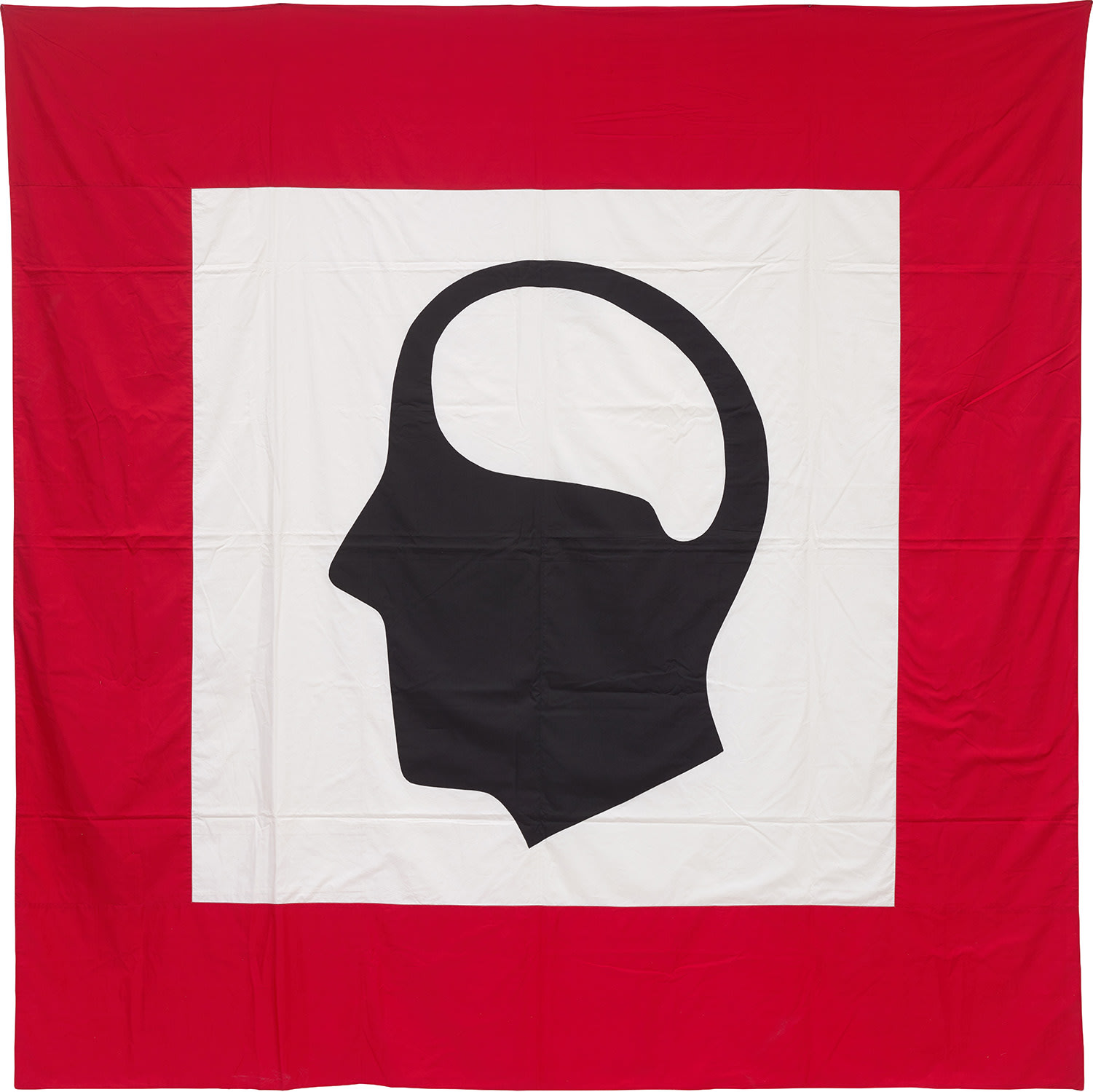
Ohne Titel, 1987
The works on paper and the prints offer meaningful points of entry into a practice that also includes monumental public installations and internationally exhibited banner works. Collectors who have followed Mullican's trajectory through institutions including the Whitney Museum of American Art and Documenta, the prestigious Kassel survey that positioned him among the most significant conceptual voices of his generation, understand that his market has remained thoughtfully priced relative to the scale of his reputation. That gap between critical standing and market recognition is precisely where the most rewarding collecting decisions are often made. Within art history, Mullican's closest companions are those artists who refused to accept the division between inner and outer worlds, between the map and the territory it describes.
His color coded cosmologies echo the systems thinking of Hanne Darboven and the diagrammatic impulse of Marcel Broodthaers, while his performances under hypnosis connect him to a lineage of artists who used the body and altered states as instruments of knowledge. There is also something in his work that resonates with the spiritual abstraction of his father's generation, filtered through the rigorous skepticism of 1970s Conceptualism. He inherited mysticism and subjected it to a kind of scientific discipline, building a world system that is simultaneously poetic and logical. What makes Mullican matter today, perhaps more urgently than ever, is his insistence that subjectivity is a legitimate and inexhaustible subject for serious art.
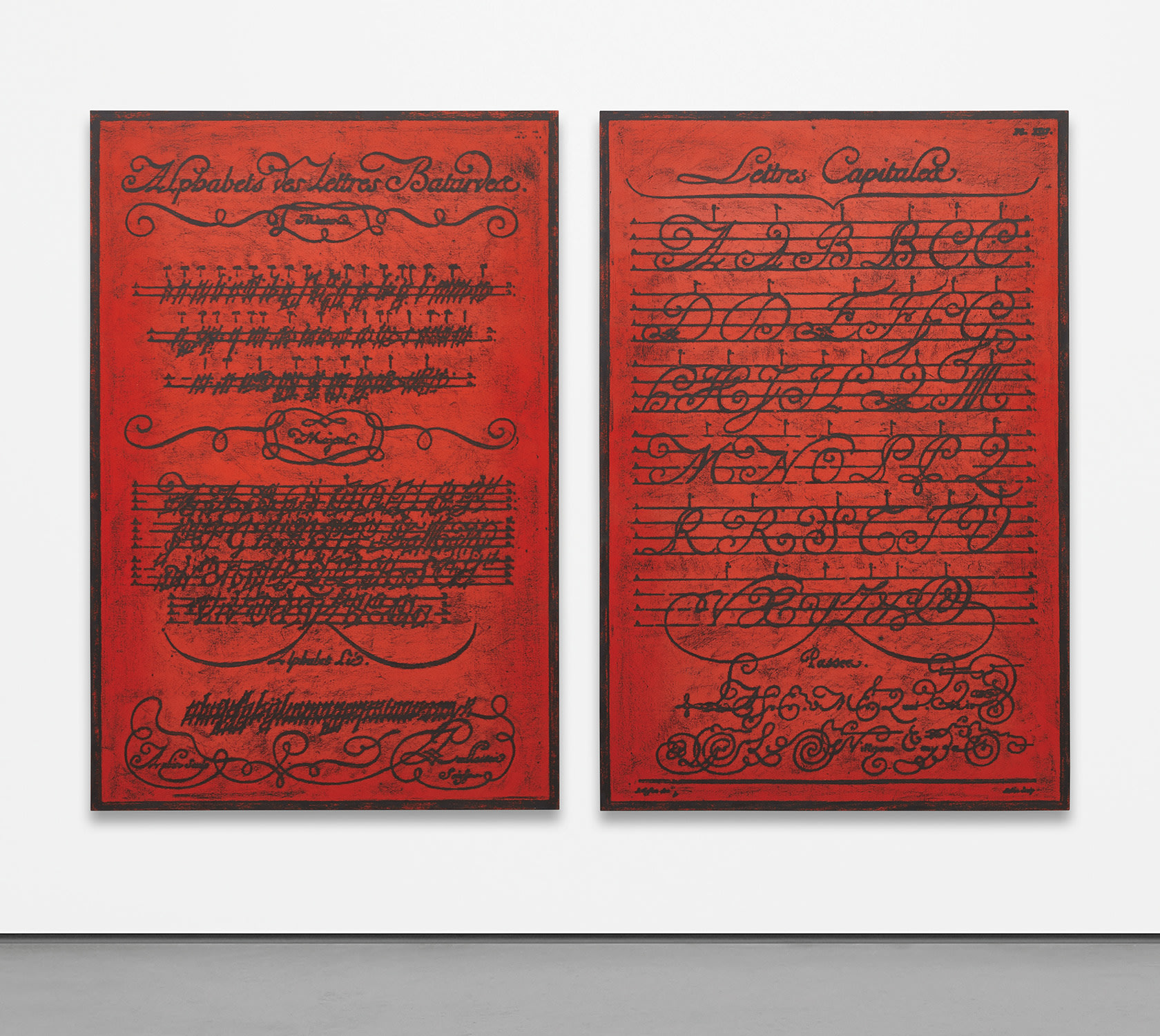
Matt Mullican
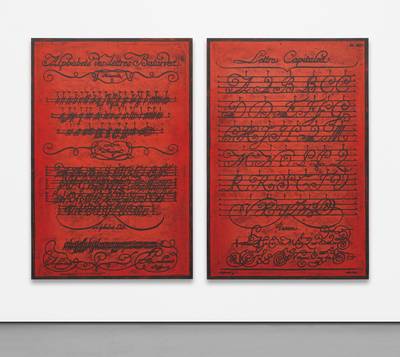
Two works: (i), 2011
At a moment when the art world is increasingly drawn to questions of identity, perception, and the nature of experience, his five decade investigation looks less like a personal obsession and more like prescient fieldwork. He has been charting the interior cosmos since before most of the current conversation existed, and his archive, dense with prints, drawings, banners, and documented performances, constitutes a body of evidence for what it feels like to be a consciousness inside a world. That is not a small achievement. It is, in fact, a vast one.
Explore books about Matt Mullican
Matt Mullican
Klaus Kertess
Matt Mullican: In the Lap of Lakshmi
Peter Halley
Matt Mullican: Content
Benjamin H. D. Buchloh
Matt Mullican: Weltanschauung
Various authors
Matt Mullican: Five into One
Robert Storr
Matt Mullican: Systems, Games, Maps, Words
Various contributors