Mary Bauermeister
Mary Bauermeister, The Visionary Who Saw Everything
Artist Spotlight · The Collection Editorial
There is a particular kind of genius that does not announce itself loudly but instead draws you close, asks you to look again, and then again, until the world you thought you understood has quietly rearranged itself. Mary Bauermeister possessed exactly that genius. As institutions across Europe and the United States have returned in recent years to the radical experiments of the 1960s Cologne avant garde, her work has emerged not as a footnote to that history but as one of its most luminous centers. Her death in 2023 at the age of eighty nine prompted a wave of reassessment, and what critics and curators found when they looked closely was an artist of staggering originality whose lens boxes and assemblages had been anticipating conversations about perception, consciousness, and materiality for more than half a century.
Mary Bauermeister
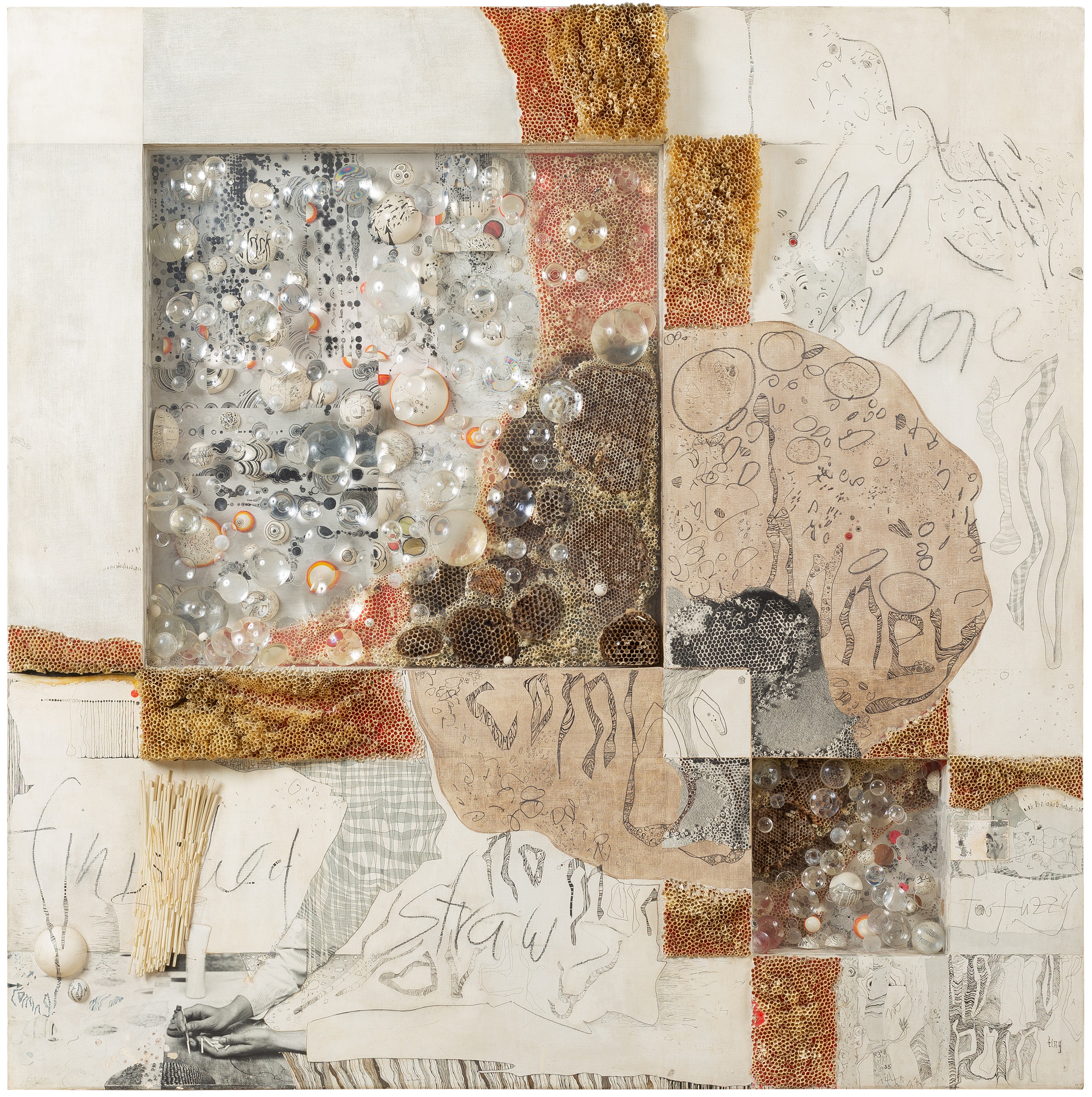
No more Pain-ting, 1965
Mary Bauermeister was born in Frankfurt in 1934 and came of age in the particular crucible of postwar Germany, a culture simultaneously devastated and electric with the need to rebuild meaning from fragments. She studied in Cologne and in the early 1950s began working in ways that resisted easy categorization, drawn equally to the visual arts, to music, and to the philosophical traditions she was absorbing with voracious curiosity. Her early panel work, represented by pieces such as "Fell Down" from 1954, already shows a sensibility alert to texture, accident, and the poetic possibilities of humble materials. This was not yet the fully realized language she would develop, but the instinct was already present: that art could be a kind of thinking, not merely a kind of making.
The decisive chapter in Bauermeister's formation came when she began hosting gatherings in her Cologne studio in the late 1950s and early 1960s. These were not casual social occasions but true intellectual salons, drawing in composers, artists, and thinkers who were collectively reimagining what art could do. John Cage attended. Karlheinz Stockhausen, whom she would later marry, was central to that circle.
Mary Bauermeister
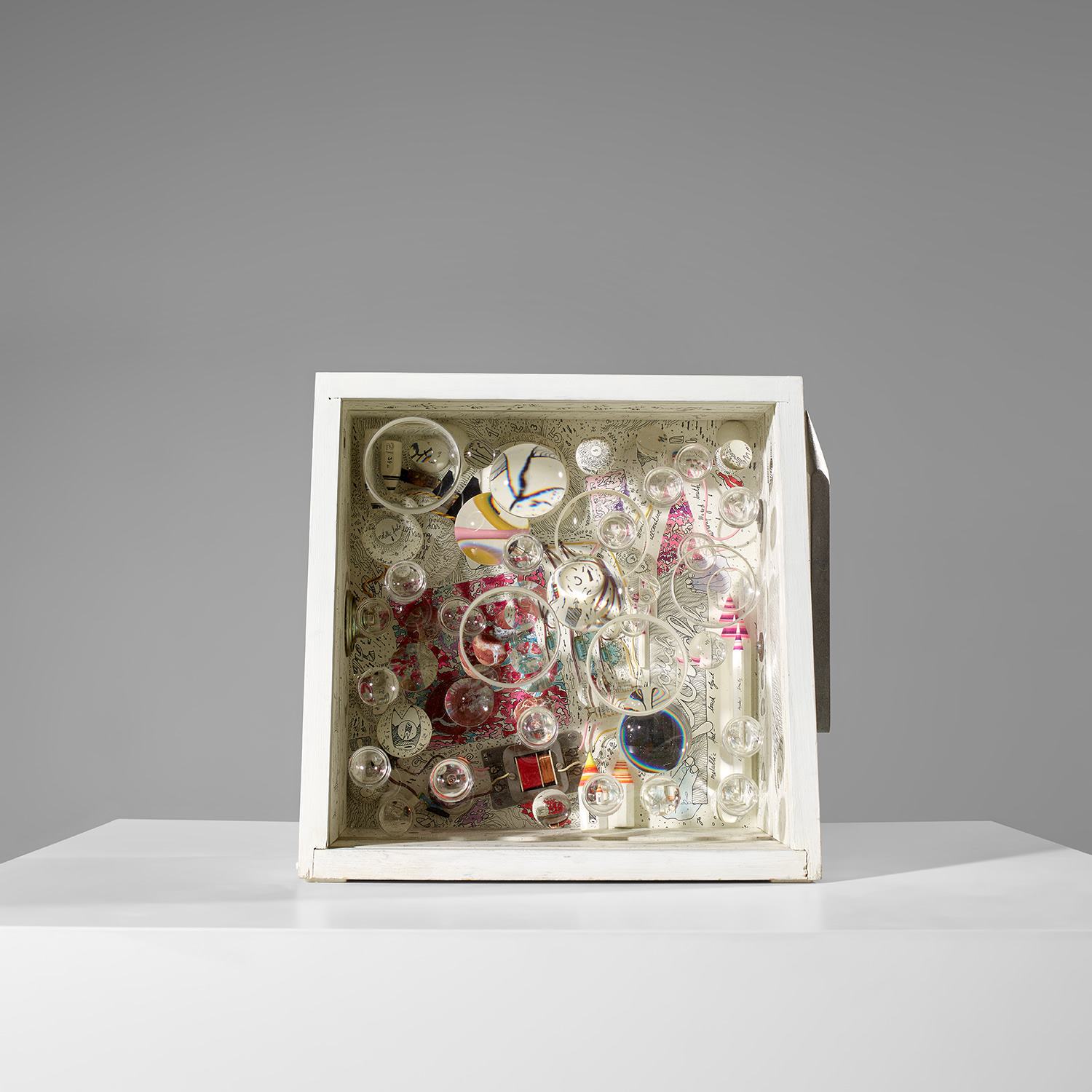
B=220 Re-voltage, 1971
Nam June Paik was there. David Tudor passed through. The atmosphere was one of radical permission: music could be visual, visual art could be sonic, and the boundaries between disciplines were understood to be constructs worth dismantling. Bauermeister absorbed all of this and turned it into something entirely her own.
Her connection to the Fluxus movement, that loose and joyful international network of artists committed to anti hierarchical experimentation, gave her work a context without ever reducing it to a style. The lens boxes that define Bauermeister's mature practice are among the most physically seductive and intellectually demanding objects in postwar art. Works like "Needless, Needles" from 1964 and "Needless Needles Commentary" from the same year establish the essential vocabulary: wooden box constructions layered with optical lenses, pebbles, sand, ink, graphite, and offset print, creating environments rather than pictures. The lenses do not merely sit on the surface; they warp, magnify, and fragment what lies beneath them, so that the act of looking becomes a subject in itself.
Mary Bauermeister
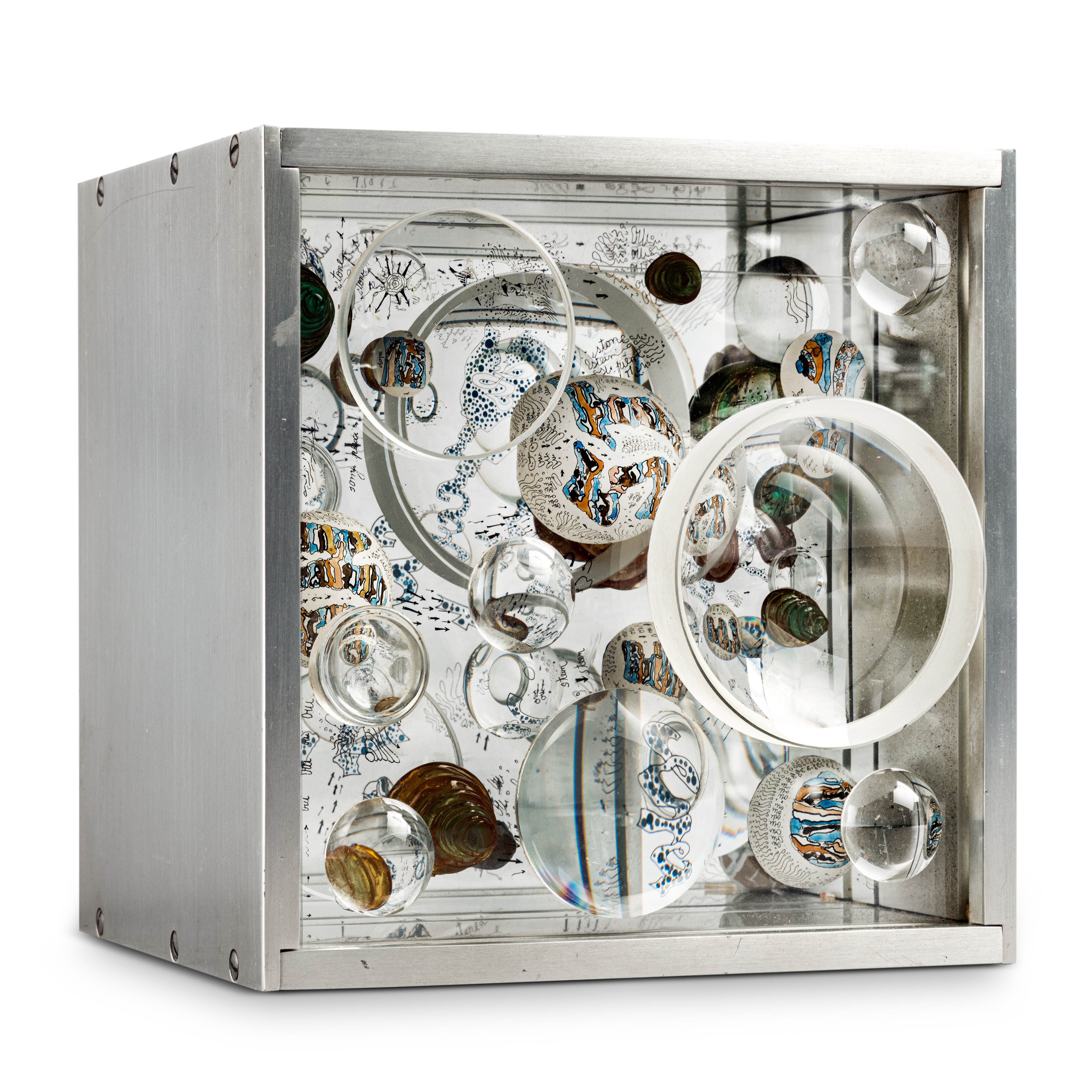
Stoned Azur, 1972
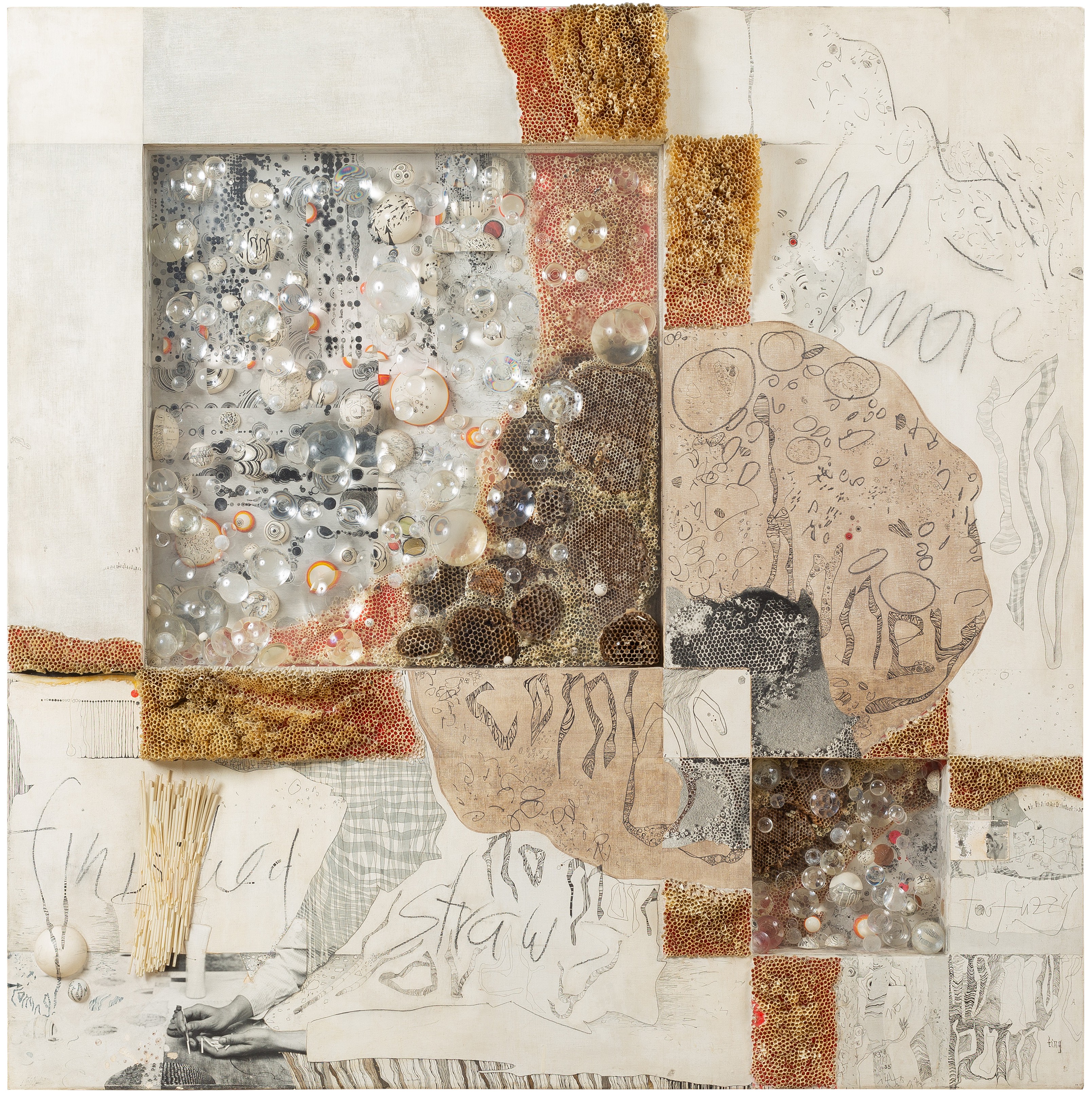
To stand before one of these works is to become aware of your own eye, your own position, the way meaning shifts depending on where you stand. "No more Pain ting" from 1965, with its ink, offset print, glass, wooden sphere, plastic straws, honeycombs, and painted wood construction, extends this thinking with characteristic wit. The title is a pun and a manifesto at once, declaring independence from the flat painted surface while constructing something that exceeds whatever painting had promised. As her practice deepened through the late 1960s and into the 1970s, Bauermeister continued to expand her materials and her conceptual reach.
"B=220 Re voltage" from 1971 incorporates electrical components alongside the familiar optical lenses, stones, pencils, and paint, introducing the language of circuitry and energy into what had previously been a quieter register. "Stoned Azur" from 1972 uses stainless steel construction with wood, glass, stone, and offset print to achieve an effect that is simultaneously industrial and meditative. The "Sketch for Tanglewood" from 1967 connects her practice to the world of music she had always inhabited, an offset lithograph with ink, graphite, stones, and glass lens on cardboard in her own hand built frame. Across all of these works there is a consistent conviction that materials carry meaning, that the weight of a stone or the refraction of a lens is not decorative but philosophical.
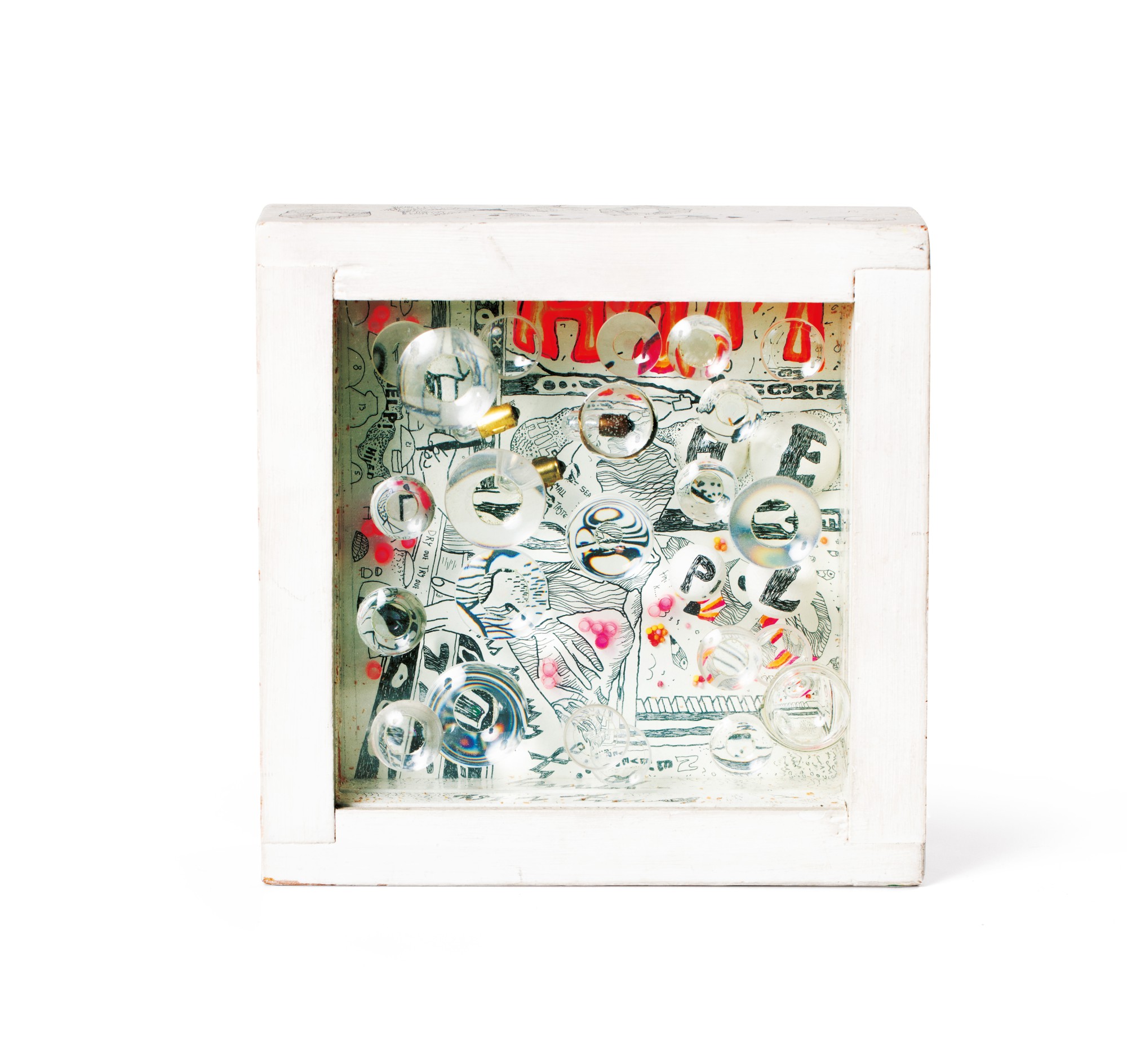
Mary Bauermeister
Jewel box, 1970
For collectors, Bauermeister's work offers something increasingly rare in the current market: an artist who was genuinely central to a pivotal historical moment and whose work has been undervalued relative to her male contemporaries. The lens boxes in particular reward sustained attention and living with in a way that many works of the period do not. They change with the light and with the viewer's movement, making them unusually dynamic presences in a domestic or institutional space. Collectors drawn to the intersection of art and music history, to German postwar culture, and to the broader Fluxus and Nouveau Réalisme networks have long recognized her importance.
Prices have risen steadily as institutional interest has grown, but the work remains accessible compared to figures like Yoko Ono or Nam June Paik, artists whose trajectories ran parallel to hers and who share something of her sensibility. To understand Bauermeister fully it helps to consider her within the constellation of artists who were rethinking the object in the early 1960s. Joseph Cornell had already established the box as a poetic form, and there is a family resemblance between his shadow boxes and Bauermeister's constructions, though her work is denser, more materially confrontational, and less nostalgic. Her German context connects her to the broader tradition of assemblage that runs from Kurt Schwitters through the Arte Povera artists she paralleled.
Among her Fluxus peers, her closest spirits are perhaps George Brecht and Alison Knowles, artists who shared her commitment to the found object and the everyday as sources of revelation. What distinguishes her is the sustained philosophical ambition behind the physical forms, the sense that each work is an argument about perception as much as a beautiful object. The reassessment of Mary Bauermeister now underway feels both overdue and perfectly timed. A generation of collectors and curators has grown deeply interested in the women of the 1960s avant garde whose contributions were acknowledged in their time but whose names were gradually eclipsed by the dominant narratives of art history.
Bauermeister was not a peripheral figure who deserves sympathy; she was a central one who deserves accurate recognition. Her salon was not a supporting act for the men who passed through it but a creative engine in its own right. Her lens boxes are not charming curiosities from an interesting moment; they are rigorous, beautiful, and still alive to new readings. To encounter her work today is to understand that the most radical art does not date.
It waits.
Explore books about Mary Bauermeister
Mary Bauermeister: Künstlerin der Stille und des Lichts
Dieter Honisch
Mary Bauermeister: Works 1952-1992
Various
Mary Bauermeister: Retrospective
Barbara Rose
Mary Bauermeister: Light, Movement, and Sound
Gabriele Knapstein